Monday, July 31, 2006

Stop the killing!


When will this hate-filled calculas cease?
Will the slaughter of innocents bring you release?
Can the blood of babies secure peace?


Names

One of my early memories is of the first dilemma I felt and grappled with, when I was about 4. Every morning, I stood in front of the bathroom sink to brush my teeth, to get ready for school. That was always an unhappy prospect, making me sad. I would pick up my father’s dhoti lying on the wash-pile and hold it to my face and breathe in a feeling of security and belonging. In this routine, one day I wondered why there was such a profusion of things and names, and why the names of things were what they were. Why was a duck called a “duck”, and so on?

I was perplexed, and I wanted to know the answer. For several days, the time in front of the sink brought to mind the same dilemma, and I would ponder over this in my mind.

Then one day the answer came to me. Yes, it was so clear, I could now understand the whole matter. I was filled with satisfaction and contentment.

Its difficult to put that intuitive understanding into words - that each creature originally lived with and was part of God's family, and bore that name; later, they all came to form individual species bearing that name.

Soils


I was born in a Tamil family. And I grew up and have lived all my life in Bengal.

10 years ago, on a holiday in the Nilgiri hills in south India, through a sequence of melodic encounters and experiences, one after another - I felt that the Tamils were essentially a race of bards, and had been so through centuries of history and circumstance, right through to the present day, expressing their unstoppable melodic urge in religion after religion. And I felt that blood running through my own veins. I could understand anew the lyrics of the beautiful song "Putham pudhu bhumi" that I'd been captivated by (from the Tamil film Thiruda Thiruda, set to melody by AR Rehman) :

"Want a fresh new land,
Want one meal every day,
Golden rain must shower,
And the cuckoo must sing Tamil."

Here's a video clip of that song.


A couple of years later, I made a chance visit to Bangladesh, spending two days in Dhaka. I spent some time at a seminar organised by the Department of Sanskrit & Pali at the university. I came upon the Charyagiti, the earliest extant Bangla poems, and the songs of Lalan Fakir. I learnt about the Tantrik, Buddhist and Islamic heritage of the folk of east Bengal. I felt the unique sensibility of that soil, that has endured through millenia, and which has moulded folk devotion. If one wants to see the highest kind of human being, the most refined sensibility, the most lofty, sweetest and child-like face of humanity - it is the golden soil of Bangla that produces this. The national anthem of Bangladesh begins:

My Bangla of gold, I love you!

If my Tamil blood makes me sing - it is of Bengal that I sing, and the humble Bengali Muslim peasant's rare sensibility that I venerate. I am supremely fortunate indeed, and doubly blessed, by these two precious soils.

Here's the Bengali folk songs group Dohar's song offering to the soil of Bengal.

Get this widget Share Track details

Special breed


Speaking of soils - my friend JP recently wrote a very interesting piece on his blog, about planting seeds and tending plants with love and care and devotion.

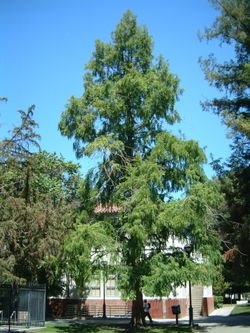
Reading this reminded me of my visit to Smith College in Northampton, Mass, in 1992. There I saw the last surviving specimen of an original “dawn redwood” tree. I was awed. I collected a couple of cones of the dawn redwood. (On that trip to the US, I also visited Walden pond, in Concorde, Mass, where Thoreau had lived; and collected some souvenirs, like leaves etc).

Over the years, when I want to give a very special gift to a very special friend - I give them a seed from the dawn redwood cone. To signify that the person is invaluable, a single survivor, of a special breed!

When I shared this with JP, he said:

"I think every one of us is a single survivor of a special breed…".

Religion


For a long time now, I have been studying and reflecting on Religion (i.e. all religions), sensing the awesome, profound truths and edifying content of the scriptures of Judaism and Buddhism, the Gospel of Christ, Islam. Not as a 'scholar' but as a seeker. My attitude was to implicitly accept what I was reading, without question or critique, and to try to understand what was written.

Also the sacred texts of the faith I was born into, 'Hindu', like The Upanishads. Thus, for instance, I felt the Srimad Bhagavat - was a scientific treatise on the origin, creation and evolution of the universe.

Advanced human life (of the mind, of spirit) is far more ancient than the western world believes, much has happened which is entirely unknown today, but with clues lying around for those who wish to know and observe.

Exchanges - commerce of soul - have taken place between peoples and cultures from ancient times, exhibiting a sweetness of intercourse incomparable to anything in contemporary life. So much of the wealth of 'secular' (i.e. non-religious) life - is the fruit of spiritual fabrication over millenia. Ordinary life is impregnated with the sacred. Everything around us - is sacred.

I don't like to use the terms 'Hindu' or 'Hinduism' - since that is etymologically and otherwise meaningless. Just like harmonising the 'scientific' and 'spiritual', there is the challenge of harmonising the spiritual and social aspects, retaining spiritual inspiration while working to analyse social mores (with their pseudo-religious trappings).

'Reading Temples', for instance, or 'Reading Ritual' - could be themes for projects, to prepare curricula and learning modules for school students.

Karl Marx wrote: "I hate the whole pack of gods in their heavens..." That was perhaps a more fundamentally spiritual articulation, than all the pious hypocrisies of the so-called religious-minded! If only Dr Marx had actually visited India and lived and travelled here - its interesting to imagine the transformations he might have undergone, from the over-conditioning of Europe. Extraordinary scrutiniser that he was - unfortunately he did not get down to scrutinising the very notion of what is human, which he simply received and swallowed lock, stock and barrel, from his culture, overemphasising the 'material', the 'rational' and the 'economic'.

Bringing up, 'educating' and sensitising future generations properly – is the simple solution to all the sufferings plaguing the world. And here, its as much a question of what not to do, as of what to do. What needs to be done – is simply to follow nature, and the human being's fundamental nature. But centuries of obfuscation have taken their toll...

I had written earlier about Sri Aurobindo's view that "all problems of existence are essentially problems of harmony". And the primary means for achieving harmony is the human personality.

Thinking about Darwin - some years ago, it struck me that while he had worked on the Evolution of the Species - what about the evolution of the human personality (in the image of the Maker)? Study of animal BEHAVIOUR and social life would give powerful leads. Lord Buddha's Jataka Tales - may be seen as a study of evolution of the human personality. In human form and guise, the world is actually full of animals of different kinds. But where is MAN?! The purpose of life on earth - is the realisation of the human personality. Love, knowledge and action (in their most profound sense) – are the three means for the perfection of personality.

In glory and grandeur, in struggle and survival

In response to my recent post on the enforcement of a "Hindu-only" zone around Tirupati in south India, Mr IK Shukla from USA has sent this response. Thank you very much Shukla-saab.

Let me hope that there emerge several blogs preaching amity, bringing people closer, enhancing our awareness, exploring our potential, and improving our prospects. We in the subcontinent have so much in common to keep us bound together in glory and grandeur, in struggle and survival, beyond the vicissitudes of history and accidents of nation-state contingencies...

Sunday, July 30, 2006

The fine art of friendship


One of my dearest friends on this planet is Lou. He is an architect-planner, from Bucharest and Jerusalem. We met at a seminar-course in Salzburg in 1992. Through the two weeks that we were together in Salzburg, we grew closer and closer. We were naturally drawn to one another, intellectually, emotionally and in terms of temperament and sensibility. Mutual empathy. Amazing intimacy.

We stayed in touch intermittently after the seminar, through letters and then e-mail. In late 1996, Lou invited me to join him in his work on neighbourhood renewal in Jerusalem. I was thrilled beyond words, and this inspired and empowered me immensely in my own difficult work in Howrah slums which I had just begun. I became immersed in my slum work and in the all-India urban poverty research study I subsequently joined. In late-1998, after I had started working full-time in the Priya Manna Basti slum, in the midst of the acute despondency I was suffering on account of all the setbacks we were facing, I wrote to Lou after a long time. He re-iterated his invitation – and so in December 1998, I went to Jerusalem.

I stayed and worked with Lou for 2 months, and then I had to return to my family in Calcutta. Lou and I were together almost all day and every day during this period. A lot of work was completed by us. And I was in that awesome, unique city of yore, going about a regular daily routine of life, as well as social, intellectual, emotional and spiritual engagements, and taking in all the resonances of that place, which my work there also required me to study and fathom in essence very quickly. As if I had always lived there, as if that was my city, and I belonged there.

It is difficult to put into words my experience in Jerusalem, each day rich and intense with seeing, feeling, thinking, learning, self-realising. Some of this I recorded in my daily diary. And all this was enabled by Lou.

How a person can give so much to another! How can two people - from completely different backgrounds and cultures - be so close to one another?! It defies imagination and belief. That is how Lou and I feel. In Jerusalem, we met a friend of Lou’s for lunch. She told me: Rama, Lou is in love. Is it you?!

In the midst of serious work, Lou would wink at me. Or out of the blue we would just face each other and smile and hug one another, kiss each other’s cheeks, and say “Oh how I love you.” As if one is an extension of the other, the two flow as one.

Since that unforgettable visit to Jerusalem, I have been there again and again! In my first visit, I met someone who then invited me to speak at a workshop on environmental awareness in Israel-Palestine in January 2000. I was there for a fortnight. During this visit I became acquainted with Jean Claude, a gifted jazz musician and bassist. JC and I, two strangers to each other - yet we became very close. JC is afflicted with multiple sclerosis. The second intifada started later that year; so far, it had been “the peace process”. In February 2003, I went to Jerusalem again, on Jean Claude’s invitation, to sing with his bass accompaniment. I was there for 10 days. We did 3 public performances in Jerusalem, and also a recording.

Each time I was in Jerusalem, I was living with Lou, and felt I was part of the city. Each visit built upon the earlier one, my circle of friends and independent engagement with the city growing, my inner self opening up and finding increasing expression - the whole Jerusalem experience becoming richer and deeper. Lou enabled all that, like a doting father, a loving brother, an inseparable friend – as if seating me on his shoulder, so I could look far. He laid out, explained and shared his adopted city Jerusalem, and country, Israel.

Through JC, I met his friend Judith. In February 2003, I was really fortunate to enjoy her hospitality. Her house, the amazing accoustics of the space (as I discovered through my singing), the awesome spiritual experience I had there, Judith's refined sensibility, her erudition, eloquence, versatility and fun-filled personality, warmth, generosity of spirit ... I gave Judith a personal name, Tara Lakshmi, to express how I saw and felt towards her.

In between, in May 2002, Lou and I met again, at a city planning congress in Salzburg. I went because Lou urged me to join him there. That was indeed fortuitous. I made some new friends in Salzburg, like Einat, also an architect, and a university lecturer, from Haifa, whom I visited in 2003. She showed and shared her beautiful city with me, making me feel every city should have someone like her who was the heart-head-conscience of the city. So the reports of rocket attacks on Haifa - make me very sad indeed.

As I was in Europe in 2002 after 10 years, I was really hit by the meaning and implications of globalisation. Having recently taken the reins of a small manufacturing enterprise started by my father – this gave me the jolt and boost that made me think about the future of this enterprise, and work on export promotion. A lot has happened in the last 4 years. A tiny unit in Calcutta is sending its critical-care precision instruments to the five continents. But its a difficult job, and a long haul.

Lou’s daughter, Avigail, is also an architect. Seeing her just cheers one’s soul, she is simply a delight. And Lou has a 7-year old son Nimrod, whom I adore. Lou named our trio in one of our child-plays (perhaps inspired by Shrek which Nimrod loved to watch): Lou – Zulu-bulu, Nimrod – Zulu-trulu, Rama – Rama-bulu. That was so symmetric!

Much has happened in the last 3 years in that part of the world. And of course right now, we are in the midst of another violent crisis in Israel-Lebanon. I also have Palestinian friends, in Jerusalem and the West Bank, and am aware of how they see things and feel. So I despair, whether I shall return to Jerusalem, and be with Lou again. But thankfully, Lou and I can meet elsewhere. I’m eagerly looking forward to that.

Lou started his blog recently and sent me the link. That pushed me to start my blog. Now we are at least in regular contact through our blogs. His blog is also a good source of information and analysis about the "Middle East".

Life is essentially about the fine art of friendship, its what makes life worth living, and its what uplifts one from all the miseries and dismal realities of life.

The cracked pot

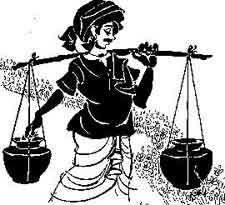
A water bearer in China had two large pots, each hung on each end of a pole which he carried across his neck.

One of the pots had a crack in it, and while the other pot was perfect and always delivered a full portion of water at the end of the long walk from the stream to the master's house, the cracked pot arrived only half full.

For a full two years this went on daily, with the bearer delivering only one and a half pots full of water in his master's house.

Of course, the perfect pot was proud of its accomplishments. But the poor cracked pot was ashamed of its own imperfections, and miserable that it was able to accomplish only half of what it had been made to do.

After two years of what it perceived to be a bitter failure, it spoke to the water bearer one day by the stream.

"I am ashamed of myself, and I want to apologize to you." "Why?" asked the bearer. "What are you ashamed of?"

"I have been able, for these past two years, to deliver only half my load because this crack in my side causes water to leak out all the way back to your master's house. Because of my flaws, you have to do all of this work and you don't get full value for your efforts," the pot said.

The water bearer felt sorry for the old cracked pot and in his compassion he said, "As we return to the master's house I want you to notice the beautiful flowers along the path."

Indeed, as they went up the hill, the old cracked pot took notice of the sun warming the beautiful wild flowers on the side of the path, and this cheered it some.

But at the end of the trail, it still felt bad because it had leaked out half its load, and so again it apologized to the bearer for its failure.

The bearer said to the pot, "Did you notice that there were flowers only on your side of the path but not on the other pot's side? That's because I have always known about your flaw, and I took advantage of it. I planted flower seeds on your side of the path, and every day while we walk back from the stream, you've watered them. For two years I have been able to pick these beautiful flowers to decorate my master's table. Without you being just the way you are, he would not have this beauty to grace his house."

Each of us has our own unique flaws. We're all cracked pots. But it's the cracks and flaws we each have that make our lives together so very interesting and rewarding. You've just got to take each person for what they are and look for the good in them. Don't be afraid of your flaws. Acknowledge them and allow them to be taken advantage of, and you too can be the cause of beauty in a pathway. Go out boldly, knowing that in our weakness we can find strength.

Author unknown

Saturday, July 29, 2006

Tirupati Hindu zone

I read with great alarm and dismay in today's The Telegraph (Calcutta) about the "Hindu-only" zone that is going to be enforced around Tirupati, the place in south India where the Venkateswara (Balaji) temple is located. Tirupati is one of the most important pilgrimage sites for Hindus.

As an Indian, and as someone born in a Hindu family, whose family deity is the one in whose name this is purportedly being done - I am shocked and shamed. This also violates everything that I have understood the sacred deity (whose name my family bears) to signify.

In the Bhagavad Gita, Lord Krishna tells Arjuna: “... whenever a decline of dharma occurs, and an uprising of adharma, I then manifest My Self. To deliver the saintly and vanquish the evil-doers, to re-establish dharma, I appear in every age.”


Tirupati Hindu zone
G.S. Radhakrishna

Hyderabad, July 28: The constitutional guarantee of free religious expression will now be suspended across a 322.68-sq-km (80,628-acre) area around Tirupati's Balaji temple.

No other religion can be preached - and no mosques or churches built - in this area spread across seven hills, the Tirumala Tirupati Dewasthanam said yesterday. The Dewasthanam till now controlled a 6,600-acre area that includes Tirumala - the small temple town housing 10,000-15,000 people, mostly temple workers - and the ban applied there. The Andhra government has now handedover to the Dewasthanam the rights to an additional 74,000 acres of surrounding hilly land, mostly a reserved forest. The move followed a report by a panel of religious heads and retired judges that Christian missionaries were distributing pamphlets and cassettes in and around Tirumala.

A.P.V.N. Sharma, temple executive officer, said the entire area will be declared a religious and autonomous township. "Non-Hindus will no longer be employed in the service of Balaji," he added. The committee reported that 42 non-Hindus, living just outside Tirumala, were now engaged in peripheral temple-related services, such as transport and accommodation.

Non-Hindu visitors will virtually be barred from the temple. "Even VIPs of other religions will have to sign a declaration that they have faith in Hinduism to gain entry," a spokesman said. The Dewasthanam took control of the earlier 6,600 acres six years ago by getting the state to forcibly resettle Tirumala town's 2,000 hereditary residents. Their properties have been converted into lease land for the temple.

Appeal to the President of India

I sent an appeal to the President of India, through his website. His e-mail id is: presidentofindia@rb.nic.in


Respected Shri Kalam-ji

I read with great alarm in today's The Telegraph (Kolkata) about the Hindu-only zone that is going to be enforced in Tirupati.

As a citizen of India, I am shocked and shamed that this can happen in a secular democratic country. This is definitely utterly unconstitutional, violating Indians' right to life (livelihood), equality, residence and freedom of worship.

It is an insult to non-Hindu Indians. And it is a sullying of the sacred names of Tirupati and Lord Balaji, by using them as the reason for this trampling on Indians' constitutional rights.

As you are the custodian of our precious constitution, I have no recourse but to write to you to ensure that our invaluable secular heritage is protected.

Yours respectfully

World Map of Happiness


A world map of happiness prepared by Adrian White, analytic social psychologist at the University of Leicester (U.K.), ranks Denmark as the happiest country and Burundi as the most unhappy of 178 countries.

Switzerland is 2nd, Austria 3rd, Iceland 4th and Bahamas 5th.

Canada is 10th, Ireland 11th, USA 23rd, Germany 35th, UK 41st, Spain 46th, Italy 50th, France 62nd, China 82nd, Japan 90th and India 125th.

According to the study, happiness is found to be closely associated with health, followed by wealth and education

Health is more important than wealth or education. Further analysis was performed to examine the links between satisfaction with life and measures of life expectancy (health), wealth (GDP per capita) and education (access to secondary level education). It was found that satisfaction with life correlated most closely with health, followed by wealth and then education.

Adrian White said “The concept of happiness, or satisfaction with life, is currently a major area of research in economics and psychology, most closely associated with new developments in positive psychology. There is increasing political interest in using measures of happiness as a national indicator in conjunction with measures of wealth."

"The three predictor variables of health, wealth and education were also very closely associated with each other, illustrating the interdependence of these factors."

“There is a belief that capitalism leads to unhappy people. However, when people are asked if they are happy with their lives, people in countries with good healthcare, a higher GDP per capita, and access to education were much more likely to report being happy.”

“The frustrations of modern life, and the anxieties of the age, seem to be much less significant compared to the health, financial and educational needs in other parts of the World."

"Uplift them before they rise in revolt"


The Statesman (Calcutta) today carries an interview with the Vice President of India, Mr Bhairon Singh Shekhawat.

Mr Shekhawat makes some strong comments. That he says this after long years of holding high public office - should make one think.

"A vast segment of our population, more than 26o million, are living below the poverty line. They constitute the fifth pillar of our democracy ~ rather the most important pillar of democracy. The other four pillars ~ legislature, executive, judiciary and media ~ cannot harm each other, but if the fifth pillar gets organised and rises in revolt due to protracted poverty and distress, then not only the four pillars but also the very foundations of our democratic system can be jeopardised."

"The stark reality is that about 26o million people are living below the poverty line, about 25 % men and 47 % women are still illiterate. Our country, which was self-reliant in the production of food grain till some time ago, is compelled to import food grain, pulses and oil seeds. Farmers commit suicide because of indebtedness. We have acknowledged primary education as a fundamental right, but about 30 % children are deprived of basic education even today. The drop-out rate before reaching 8th standard is 53 % and by 10th it is about 63 %. Can we deny the fact that despite having more than 300 universities and about 12,000 colleges, only about 8 % are able to get higher education? In many developing countries this figure is as high as 25 %. It is my firm opinion that we may secure high levels of GDP to whatever extent we want, we may add to our foreign exchange reserve as many millions of dollars we want, we may attain dominance in the fields of technical knowledge, industry and trade, but unless we improve the living standards of the fifth pillar of our society or provide them the right to live with dignity we cannot have all-inclusive development."

"Despite having higher education, children belonging to poor families attain a low level of employment with marginal salaries whereas children belonging to affluent families with similar educational attainment get lucrative employment opportunities with handsome salaries. Here comes the role of the state. We need to establish a system in which poverty should not be a hindrance to one’s development and everyone gets equal opportunities to ensure there’s no sense of dissatisfaction among poor children."

"While the edifice of democracy rests on its four estates, the key pillar of strength of democracy is people’s welfare. In my view, this pillar ~ the fifth pillar ~ needs to be nurtured and strengthened by everyone because the actual strength of democracy lies in it. Uplift them before they rise in revolt."

Read the full interview here.

Friday, July 28, 2006

28 July


Today’s date, 28 July, and this combination of numbers, 28 & 7, are mnemonics of conscience for me.

They connote loss, as opposed to possession, and sacrifice, as opposed to indulgence.

This day, several years ago, was a very sad one for me, full of grief, pain and darkness. And I had brought all this on myself, with my desire, craving and grasping, despite knowing everything.

Ravaged and devastated with intimations of loss as I woke up that day, I willed everything I cherished to be taken away from me, and accepted living with that loss.

But I could not bear the pain. I wrestled with it, and sobbed and wept – and before the day ended, I found solace and I saw light. It was not rage or vanity but trust, compassion and love that brought light.

Through my folly, I had been haunted by some lines from Kahlil Gibran’s The Prophet. After I emerged from my ordeal of 28 July, I still did not learn. And hence the teaching of this date, on transcending craving and embracing sacrifice, had to be grievously re-learnt anew. Now I can understand and accept Gibran, when he tells us:

Give your hearts, but not into each other's keeping.
For only the hand of Life can contain your hearts.
And stand together, yet not too near together:
For the pillars of the temple stand apart,
And the oak tree and the cypress grow not in each other's shadow.


Our moments of extreme helplessness are the very moments we are actually lifted to the bosom of Life, and our experience of pain is actually the searing heat of that protective embrace. Dispossession and loss also bring safe deliverance.

Picture: Untitled Grief, by Shane Moore

Thursday, July 27, 2006

One month of this blog

I started this blog one month ago. I installed a sitemeter a week later. I had e-mailed and sms-ed my friends to take a look. I also started learning about blog-sphere by going through various kinds of blogs, making searches by some key terms related to my interests. I left comments on others’ blogs.
Over 1,000 visitors have come so far. On average, over 40 people visit each day, spending about 6 minutes here. The lowest no. of visitors on a day was 24, and the highest 149. The visitors so far have been from 39 countries, from the 5 continents.

A few people leave their comments. A few people are regular visitors. A few people have carried some of my posts on their blogs. A few people have put me on their blog-roll.

But most importantly, through my engagement with blog-sphere and through my blog – I have re-connected with an old college friend (after 26 years), as well as with another college friend I had lost touch with, and also found some new friends with whom I feel a close commonality of sensibility, through reading their blogs and then exchanging e-mails with.

Who is visiting? Who is reading? Why? How do they feel about what they read? How does it affect them? And is all this at all significant in any sense?

For at least 15 years now, I have wanted to be a (full-time) writer, of fiction and non-fiction, publishing book after book. Though that hasn’t happened, and nothing has been published, I have written a lot, especially over the last 9 years.

Self-publishing, through a blog – can be a writer’s ultimate dream, and shorn of all the attendant things which have nothing to do with writing per se. You write, you want people to read this and respond, people from all over the world read what you write, immediately as well as later, they respond, you share a relationship with your readers, all your writing is available for anyone to read, anywhere, at any time, for ever – what more can one ask for?!

In one of my first posts (on 27 June 2006), I wrote about the name of my blog, inspired by the book The Prince who became a Cuckoo, by Lo-Dro, one of Tibet’s most cherished tales, illustrative of Buddhist teachings. That was a split second choice, at the moment of filling up the blogger registration template. I felt as if that tale - and its elaboration of journey, enlightenment and song - was all that mattered.

A new journey has begun through this blog, something new has started in my life, and even in just one month it has been personally enriching. I hope readers have got something out of it as well. The future is pregnant with possibility.

The cuckoo looks forward to every new day, of journey, enlightenment and song!

Cyclone strikes


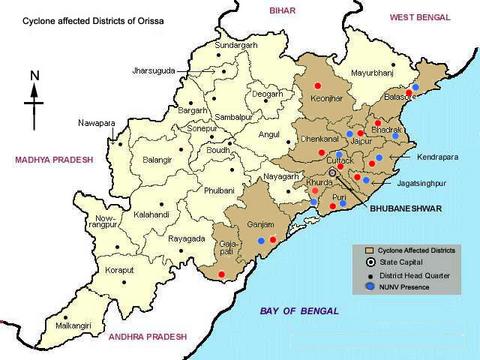
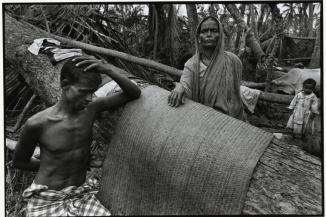
Orissa, a state along India’s eastern seaboard, adjoining the Bay of Bengal, was hit by an extreme cyclonic storm, in late-October 1999. Coastal Orissa was devastated by the combined action of storm surge, high speed cyclonic winds and local flooding.

An estimated 15 million people were directly affected. About 15,000 people perished. Over 10 million people were rendered homeless, over half a million cattle were lost, and most of the standing crops were destroyed.

Orissa is one of India’s poorest states. The levels of living and power of vulnerable populations in coastal Orissa are low, even though this is a relatively prosperous area of the state.

3 weeks after the super-cyclone, I visited the affected area as a member of the
TARU team undertaking a rapid assessment of damage to housing and lifeline infrastructure. I reproduce below my field notes from our visit to Sahadabedi village, in Erasama Block of Jagatsinghpur District, Orissa.


One of the first things that strikes the visitor to this village - which is at least 10 kms inland - is the many shaven heads of small boys and young men. Many in this village, which lies within the worst affected belt, had perished.

The hamlet of Sahadabedi (under Jirailo village panchayat) had a pre-cyclone population of about 350, or 46 households. The adjacent Bengali Para hamlet consisted on 24 households. All the familes lived in mud (cob) houses with thatch roofs. The Bengali households (from Mednipur district in West Bengal) do not own any agricultural land, and they derived their livelihood from agricultural labour. Relations between the people of Sahadabedi and Bengali Para are said to be harmonious, with inter-community marriages also taking place.

78 people from this village were killed in the cyclone, 42 adult males, 22 children, and 14 women. 24 families in all lost their members. One entire family was killed, save a young son who was away attending a tailoring course. In another family, all were killed except an old woman and two young children.

This is a single paddy crop village, with a subsequent minor mung dal (lentil) crop. Because of inflow of sea-water into the Tibriya river adjacent to the village, farmers are unable to plant another crop. The village is flanked on the other side by the Hansua river. About 150 acres of agricultural land in all is owned by the villagers.

The villagers had been fore-warned about the cyclone, as early as on Tuesday 26 October 1999. But people thought there would only be strong winds and heavy rain, and that they would have to remain indoors. Rain and wind started on Thursday 28 October 1999. On Friday morning, at 4 am, very strong winds, from the N-NE direction started blowing. At 11 am, the surge of sea-water from the east hit the village: a huge wave of water, advancing with a roaring sound and topped by a smoke-like cloud of spray. Those who saw this were left speechless and paralysed in terror. The roofs collapsed over the houses and the water broke down the earth walls and destroyed the houses. People clutched at the roof and tree-tops in a bid to survive. Many were washed away. Tree braches broke in the fierce wind and those clutching these were carried away. Livestock were swept away.

People stayed in their perches on roof-tops, in the rain and wind, for 5 days, without any food or water. On the sixth day the government relief team arrived and provided relief supplies and materials. Many people sought shelter in a brick-RCC building in the adjacent hamlet of Ekghoria. They remained clutching one another in waist-deep water for 3 days, without any food or water, praying for succour.

Those with large houses, with a large, high roof, were able to save themselves by holding on to the roof. The only public building in the village, the Harwali Thakurani temple, also a mud-thatch structure, was also washed away. Only the image of the goddess remained.

About 450 heads of livestock were lost in Sahadabedi. Only 11 animals are left. All household assets, belongings, foodgrain and seed stocks, agricultural implements etc were lost. Because of inundation by sea water, the standing paddy crop has been entirely destroyed. Land productivity is expected to be significantly affected. People hope the next June crop will be realised, but expect a much lower yield. Restoring agricultural operations without livestock or implements or seeds has cast a pall of anxiety over the minds of farmers.

Riverbank embankments have been partially breached. Village paths have been buried under earth, debris and felled trees. A hand-pump served as the source of drinking water in Sahadabedi. This is being used again now.

The main road approach to the hamlet had been damaged and the approach paths to the hamlet were under water for several days after the cyclone.

Villagers together with outside rescue and relief workers and volunteers cleared and cremated the dead bodies. The villagers are in a kind of daze, numbed and in a state of shock, yet to fully digest that they have survived when so many, including close kin of many, had perished. They are just living on the little relief they have obtained and are beginning to realise the gravity of their plight and all that confronts them. “Our brain is not functioning”, they say. Their situation is dire, and they are unable to think out what they should do. Their immediate priority is to rebuild their house somehow. Restoring agriculture and ensuring next year’s crop is their next concern.

The revenue inspector was here 8-10 days ago to enquire about deaths and to list the damage to houses and loss of livestock. No intimation has been given yet on any financial assistance.

Making some arrangement to prevent the saline water inflow into the adjacent river Tigiriya is an issue the farmers are very concerned about. However, there has been no formal initiative on this from the government or panchayat side. Some 15-20 villages could benefit from such a scheme, through improved agriculture.

Having learnt from this cyclone, the next time there is a cyclone warning, people will take the matter more seriously. If arrangements are made to evacuate them, the villagers will readily leave. They realise the importance of building a cyclone shelter and say they are willing to contribute their voluntary labour to build a shelter at a suitable site that could cater to a number of villages and hamlets. This place can also serve as a school or a community hall, or a kirtan-bhajan (devotional singing) hall at other times.

There are no social or voluntary organisations working in this village. The people hope some food-for-work programme will be started. Because of loss of livestock, they are now thinking of using power-tillers and want assistance in this regard. They also want assistance for seeds and fertilisers.

Having seen and interacted with villagers across virtually the entire region affected by the cyclone, surge and related flood, there is clearly a tangible, qualitative difference, in the attitude and thinking of people in the isolated small villages in the worst-hit areas, who have personally experienced the death of many and been lucky to survive – in comparison to people in villages less affected. Though wanting assistance to rebuild their lives, they have a largely self-reliant demeanour. The people of Sahadabedi possess this spirit.

Disasters – natural & man-made

Natural disasters may strike a people, but its impact depends upon the existing situation within society. In that sense, the fundamental causes of the resultant devastation have to be found within the functioning of society, government and institutions, and in social relations.

Rehabilitation is therefore essentially a process of awakening to the critical necessities for building a humane, just, and sustainable society. A natural disaster could serve to initiate a process to address long-neglected matters. Rehabilitation could act as a means for renewal of a moribund society.

Read the full essay here.

Photo: © Raghu Rai / Magnum Photos

Wednesday, July 26, 2006

A poem to commemorate new beginning

In 2002, I wrote to my friend James: “It looks like a long, difficult, sad period of depression has lifted and a new, energetic beginning is being made, in a new direction.”
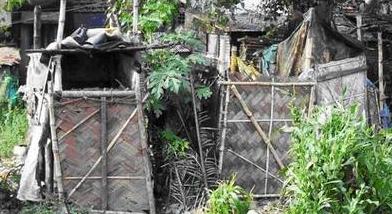
James replied with a poem “to commemorate new beginning”.


The Lifting of the Dread (for Rama)

James Christopher Aboud

Here's to the lifting of the dread, to the ball of hair
choking us without strangulation
that is spat out suddenly without explanation;

Here's to the unnoticeable things that once noticed
unlock the doors that lead us back

that remind us that everything is temporary
including this day, this beautiful day,
this moment of lightness seeping through the heavy sky

O let us memorize this moment as a prayer is memorized.

Painting: New Beginning, by David Miller.

The algebra of infinite expansion


"The very crudities of the first attack on a significant problem... are more illuminating than all the pretty elegance of the standard texts which has been won at the cost of perhaps centuries of finicky polishing."

Eric Temple Bell, about Mathematics

Thank you Peter!

Tuesday, July 25, 2006

Earth-shattering


In August 1997, on the occasion of the 50th anniversary of India’s independence, I felt that the best way to commemorate this, to pay homage to the memory of Mahatma Gandhi, the father of the nation, was to work to eliminate service latrines from the slums of Howrah.

A ‘service latrine’ is a toilet that has to be manually cleaned out, by lowly sweepers. This is an arrangement that was widespread in old towns and cities across India. The image of a person carrying a basket of excreta on his / her head – had been the subject of a call to conscience by Mahatma Gandhi. But it was only in 1986 that the govt. of India finally enacted a law banning such ‘manual scavenging’. Local bodies had to ensure the implementation of this and a programme was subsequently initiated to provide a subsidy for the conversion of service latrines into sanitary toilets.

We had found and demonstrated through a pilot project the solution to this apparently insoluble problem, which affected thousands of people, and was responsible for severe environmental health risks. The lives of hundreds of people had been positively transformed. And very foul spots, in the midst of the metropolis, were rehabilitated.

And now, we had researched and developed a community-based programme for the complete elimination of service latrines from Howrah’s slums. We had surveyed slum households and learnt about their situation and the willingness to pay for the toilets. We had engaged with a leading housing finance company and got them to give loans for building toilets. We had got the approval of the metropolitan development authority, who also agreed to advance the govt subsidy component up-front, for 10 toilet units at a time.

I felt like a scientist who has made an earth-shattering new discovery, expanding the frontiers of knowledge and transforming human life. (As a 11-year old, I had read with rapt awe Eve Curie's biography of Madame Curie which my mother had presented on new year's day in 1972, with the inscribed exhortation: "Go through this book like a book worm & may it inspire you to great deeds.")

Read the full essay here.

Mirror of awareness

When we see through our eyes – what we see is only a resultant of our own mental projections. Rather like Heisenberg’s principle of uncertainty …
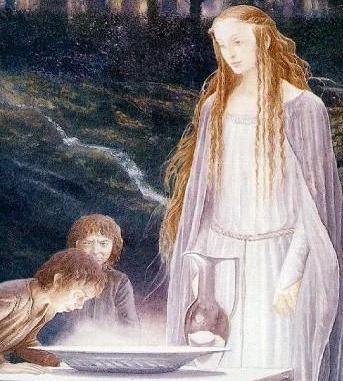
So everything we see – can be taken as a mirror, to know more about oneself.

Especially people, and our thoughts and feelings in response to them. An unpleasant situation with two colleagues at work helped me to see this.

In late 1996, I wrote a poem about this, called “Awareness”.


Through your appearance friend, I learnt to recognise myself,
Your inward is in my outward, I am the inward in your outward.
If I am ever right, that is only because of you
And mine the evil that poisons you.
You are only a figment of my imagination,
While I know myself only through your blessing.
My place is at your feet, by your side, and in your embrace
May you be the body through which I realise myself.
Through failure and betrayal, I struggle to uphold your love and compassion,
Disconsolate shame my constant reward.
The world is my mirror, I look and see myself;
May I be able to be yours, and help you to see yourself.
In gratitude for your kindness, through which I am,
May I be able to help you know who you are.

Image: from the website The Mirror of Galadriel.

Monday, July 24, 2006

Morning with the boys

I spent today morning with my sons Rituraj & Rishiraj.
But they are far away, in their school in Rishi Valley in south India, while I'm in Calcutta!

For a long time, I'd been deferring the termite elimination at my family house. A few days ago, I saw that there had been a new termite invasion in one of the rooms. So I immediately called the pest control company and gave the go-ahead for the elaborate treatment. The work began today, and so I stayed at home to attend to that.

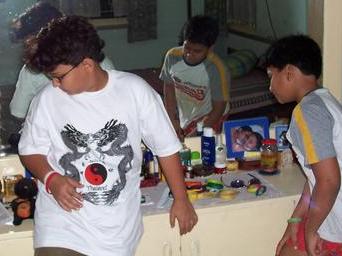
I had to move all the things in all the rooms, away from the walls. In my sons' bedroom, moving their desk, I came upon their footprints on the wall.

And in my bedroom, behind the large mirror-dressing table unit - hanging from a cross-piece, like a victory flag, was a T-shirt of Rishiraj's. I visualised a no-holds-barred brawl between the boys, with someone having hurled the T-shirt at the other, with decimatory intent. I know the path of a projectile in a vacuum is parabolic. So allowing for the change in parameters, the T-shirt-missile had taken some kind of path and slipped through the crack of space behind the un-moveable mirror unit - and stayed there, who knows for how long.

Also behind the mirror unit - the mystery of the once missing chocolates was partially solved. Strewn there, away from anyone's sight, were the chocolate wrappers, conveniently chucked behind the mirror to ensure certain non-discovery.

"Don't dirty the wall!"

"Stop this fighting this instant!"

"Who's gobbled the chocolates?"

But when I came upon the footprints, and the suspended T-shirt and the hidden chocolate wrappers - my boys kept me company as I plodded on dejectedly with the arduous business of moving things.

Did I miss them!

So I sat down and wrote a letter to Rituraj and Rishiraj - telling them how they had given me company through a morning's hapless work, with the telltale signs of everything they should'nt have done. And that I was glad for that.

Saturday, July 22, 2006

Grandma’s eyes

One afternoon in December 1991, I got a phone call at work from my father-in-law, to tell me that my wife’s grandmother – his mother-in-law – had passed away. He asked me to come down to her house when I could. Grandma was over 80, she’d had a long, eventful life, with many years of hardship and struggle as a young widow with 8 children, as well as several more nieces and nephews she brought up. But she had lived to see all her offspring, and several of her many grandchildren, all do very well in life in every way. My wife was close to her and so I too became acquainted with her through accompanying my wife on visits to her house and to family functions and get-togethers. Grandma had been ailing, and had been in hospital for a few days.

I wound up my work at office and went to her house. My office, Grandma’s house, my in-laws house, as well as the rented apartment I lived in until recently, were all very close to one another, around Gariahat in south Calcutta. When I reached the house in Dover Lane, my wife’s uncles were there. Her body arrived from the hospital. Then eldest uncle told me that Grandma had donated her eyes and instructed her family to see to this. She had passed away around noon. The corneas had to be removed within a few hours. It was already late afternoon. Could I do what was necessary?

I accepted the task and immediately set off, taking a taxi. A friend of mine had been involved in mounting a campaign for body and organ donation, and had managed to get the govt’s support through an order that all the 4 medical college hospitals in Calcutta would receive bodies and collect organs for transplant. I had assisted and participated in his work off and on. So it was just a question of going to the nearest medical college and arranging the collection of the corneas.

I headed towards the National Medical College, near Park Circus. In the usual slow moving traffic, it took a while to get there. I kept the taxi waiting and went into the hospital complex. I had never been here before Any public hospital in Calcutta – a scene of chaos and crowds. Its difficult to make any sense of what is where. No one to ask for help. One is always directed somewhere else. I finally reached the ophthalmology department and found someone to enquire from, only to learn that there was no arrangement for receiving corneas here.

Time was ticking away. The corneas had to be removed quickly otherwise it would be futile. Back to my taxi. I headed towards the Nilratan Sarkar Medical College. I had been there once, for an investitgation by the head of ENT, thanks to my landlady's grandson who was a medical student there. It was not so far off, in Entally. But the traffic was bad now, as it was the beginning of the evening office rush. I reached the hospital complex and kept the taxi waiting. Another scene of even more chaos and crowds. These were supposed to be hospitals, but it was anything but a sterile, hygienic, organised, quiet atmosphere. Again multiple enquiries, again the same frustration, and finally again to a doctor in the ophthalmology department, again only to learn that this hospital too did not receive corneas. I vented my frustration, asserting the govt’s announcement that all the medical college hospitals would receive this. I was told that the reality was that there were no arrangements for this, and that I should go to the Calcutta Medical College, which was the only place with the set-up.

Back again to my taxi. The Calcutta Medical College was a huge complex, it was going to be even more chaotic there. I remembered visiting my university professor many years ago, when he was there for surgery. I had gone to the hospital unit close to the Central Avenue entrance. That had been somewhat more sane and organised. So I headed towards that place.

The Calcutta Medical College was spoken about in reverential terms in my home as I was growing up, with my two aunts and an uncle having studied there before going to England where they settled down and practiced. On one of his visits to Calcutta during my university days, my uncle had taken me on a tour of the college where he had studied and shown me around. I felt the awesome grandeur and gravity of the institution that I had grown up hearing so much about.

It was the peak of the office rush, and I was now in the heart of the city. The traffic was terrible, the vehicles barely moving, just crawling along between long periods of waiting at traffic signals and unending hold-ups. Time was ticking away. I was on the edge, in a rage. That was it. Grandma’s eyes were going to be lost. And I was not going to be able to do anything about it. I went into a panic. I was trembling. Terror seized my heart. My breath broke into sobs and gasps, my voice a distraught bleat, my eyes brimming over and my face melting in grief. No! No! This cannot happen. I have to do it. I just had to flinch and wince and grimace and grit and go on and do it. I accepted the worst. But I was going to see this thing through.

The taxi eventually reached the Central Avenue entrance of Calcutta Medical College. I rushed and ran into the hospital, running from one place and person to another. Things seemed a bit better here. I was directed to an RMO, he was in his room. I ran there, he was not there, I found someone. Shouting and speaking at machine-gun speed I communicated the urgency of the matter. Hearing the shouting, the RMO appeared from somewhere. I said someone’s eyes had to be removed, very quickly, it was almost too late, I had gone from place to place and only been turned away. I shouted out all my anger and frustration. The RMO immediately took control of the situation. He asked me to calm down and said he would do what was necessary. He said there was still time to collect the corneas. He asked me for the address and said the people who would collect Grandma’s eyes would go there at once. He said I could leave and I should not worry.

I was immediately calmed and reassured. I went back to my waiting taxi and the driver who had accompanied me through the whole ordeal. After all the rushing and running and rage and edginess and panic and terror – I felt drained, giddy and exhausted. I collapsed into the seat. It took a while for gladness and satisfaction to sink in. I was pleased. I felt a deep sense of contentment. I returned to Grandma’s house in Dover Lane.

I reported to the people there that it had been more difficult than I had anticipated and that it had looked like I was going to fail, but I was eventually able to do what was necessary. The eyes would be collected soon. And sure enough, soon thereafter, a team arrived in an ambulance, with the special container for the eyes. We were impressed by their serious, brisk and efficient manner. They asked us to vacate the room where Grandma lay. They emerged after a few minutes, with their precious booty. And Grandma’s eyes were covered over with cotton wool.

If I’m not wrong, I think I did later learn that Grandma’s corneas had been put to use for two people.

Several years later, I was narrating this incident to my friend Achinto, acting out the whole thing, re-living that experience. And I concluded by saying: I did it! Because of me, two blind people got sight. Who can give sight to the blind? Only God. So I was God! But what exactly happened? It was Grandma’s pledging of her eyes. It was her family’s desire to fulfil her wish. It was their entrusting me with the responsibility. It was my fierce determination to do this, come what may. It was my persistence, despite all the hindrances and frustrations. It was my having stared at the face of failure and swallowed the terror and pressed on. And it was because of one person, who finally owned up to the responsibility and arranged for the eyes to be taken. All this together - that is God. That is what is immensely powerful, capable of working miracles.

When my life is over, I can go with the small satisfaction that whatever else I might have done or not done in life - I did try my very best to fulfil Grandma’s wish to give sight to others, and I was fortunate to succeed. And so my life would not have been entirely worthless.

Grandma was always knitting something for somebody. She had made me a soft, thin flesh-coloured sweater. And I had always worn that at home in winter, and also as an inner vest whenever I visited any cold place. I’ve worn it for almost 20 years now. Some years ago, it was washed improperly and became stretched, mis-shapen, faded and somewhat coarse. But I still wore it. I was recently searching for it and couldn’t find it. Becoming absent-minded with age, I wasn’t certain whether I hadn’t given this away – maybe to the gardener or someone like that. Then I found it, hidden from sight among a pile of things in a cupboard. Was I was relieved and glad! It would be a terrible thing if I lost it. For me that sweater made by Grandma is like chain mail, something to protect me.

Friday, July 21, 2006

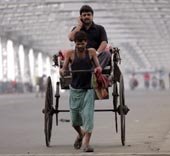
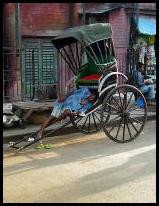
Rickshaws: brief lease of life


The vain, callous and inhumane move to ban hand-pulled rickshaws in Calcutta, initiated by West Bengal chief minister Buddhadev Bhattacharjee, has been put on hold.

The Telegraph, Calcutta, reports:

Moments after the Calcutta Hackney-Carriage (Amendment) Bill, 2006, which seeks to enforce the ban, was tabled in the state legislative assembly yesterday, it was referred to a select committee for further discussion. There is little chance of the bill — contested by sections within the ruling Left Front as well as the Opposition — being passed in this session of the Assembly.

The chief minister later told reporters that he would ensure that the House approves the piece of legislation in the next session. “The plying of hand-pulled rickshaws has to be stopped. Since the Opposition wanted more time for discussion, I have relented for now. But it will be passed in the next session,” he asserted.

Speaker H.A. Halim said the bill has been referred to the select committee in an attempt to reach a consensus on the issue. “The Geneva convention speaks against man-drawn rickshaws. But many are opposed to the ban, as it will affect the livelihood of the rickshaw-pullers, mostly poor migrants from UP and Bihar.”

The bill stresses the need “to eradicate the inhuman practice of plying man-drawn rickshaws” and to “ease... traffic congestion caused by such slow-moving vehicles”.

Perhaps the wise and dynamic CM will now also similarly "ban" poverty, disease, slums, illiteracy, child labour, unemployment etc etc? Now that he has suddenly woken up to the Geneva convention, perhaps he he will invoke all the other international conventions, covenants and declarations and seek to follow those as well, to make his state a haven of humanity?

I hope the assembly members who opposed the bill will ensure that a proper rehabilitation package is prepared, so that the rickshaw-pullers' loss of legal livelihood is taken care of. But I am not optimistic. It is the rickshaw owners who are somewhat organised, and they may be able to extract something for themselves from the govt. Many of the rickshaws are also actually owned by police personnel. But will the pullers be simply left to fend for themselves?

There has been mention of replacing the rickshaws with auto-rickshaws. I cannot see the rickshaw pullers getting the auto permits, or driving them; if anything the owners may get this.

But auto-rickshaws are entirely unwholesome and undesirable. A prime instrument of air and noise pollution. They are a menace to traffic. Unsafe, severely harmful in every way. Part of a noxious lumpen under-life of the city. Most autos are illegal. Permits are given to party cadres. No civilised city should have auto-rickshaws - of the kind now used in Calcutta. I read a news report some days ago about tuk-tuks being introduced in the UK (I think it was in Brighton). But the report also mentioned the stringent pollution and safety norms that the vehicle would have to satisfy.

Rickshaw pulling does not really disrupt traffic. It is a meaningful mode of transport in particular localities, for particular functions, for both passengers and freight. The ergonomics of the hand rickshaw are superior to that of the cycle rickshaw (the model used in Calcutta). The health profile of the typical cycle-puller is far worse than that of the hand-puller.

Perhaps the matter can be taken to court through a public interest litigation, under Art. 226 of the Constitution. Through a change in a law, a livelihood that is legal is made illegal. The right to life is vitally tied to the right to livelihood. When a farmer's land is acquired by the state, he is compensated. Similarly, when a person's profession is taken away, he is entitled to compensation. Given the numbers of pullers involved, and given their poor socio-economic condition, it must be ensured that this move - on the ostensible pretext of humanity - does not drive the pullers to destitution.

The pretext of freeing roads for cars - traffic flow is also severely impeded by hawking, markets and shops on pavements and roadsides, which are organised and profited from by political cadres. Public transport is in a shambles. There has to be a long-term plan, of expanding roads as well as promoting good quality public transport and pedestrian-only spaces. This also raises the question of how long the unchecked growth of private cars will continue. Car drivers race through lanes at full speed blaring their horns at the highest volume. It is becoming impossible to keep one's sanity in the city streets. Private vehicular transport must be checked.

But who am I talking to, in this heap of skulls that is Calcutta?

Thursday, July 20, 2006

Its raining, its pouring


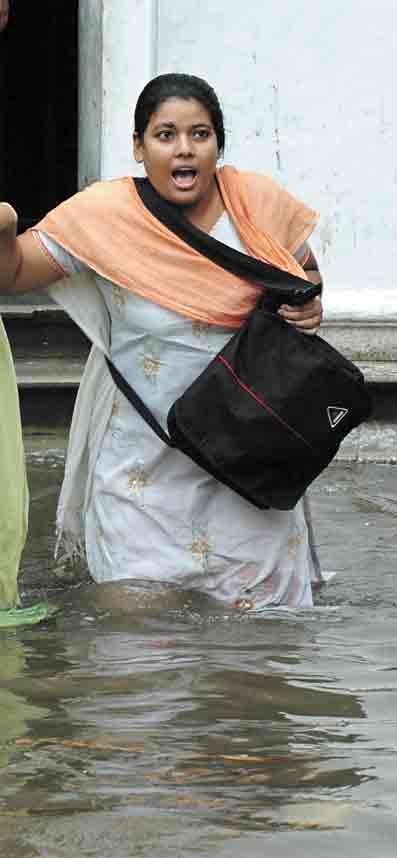
Calcutta, on Wednesday.

Photo: Bijoy Sengupta, The Statesman.

A dark day for Calcutta

Today, the West Bengal government will table the Calcutta Hackney-Carriage Amendment Bill, 2006 in the state legislative assembly. Given the size of the Opposition, this bill is likely to be passed.
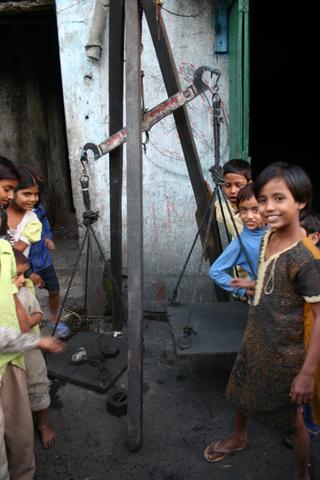
The amendment to the original Calcutta Hackney-Carriage Act of 1919, calls for a complete ban on man-drawn rickshaws. The Chief Minister, Mr Buddhadev Bhattacharjee had made clear his intention to ban rickshaws on 15 August last year. "This is so inhuman. How can we tolerate such modes of transportation in the 21st Century?" asked Mr Bhattacharjee.

Ironically, the yeoman services of the rickshaw to city-dwellers was once again in full view on Calcutta's flooded streets yesterday, as they ferried stranded women, children and the elderly.

The CM wants to get rid of the image - of man's inhumanity to man - rather than the reality, of an inhumane society, with inhuman living conditions for the labouring poor. There is actually no humanity in the CM or his party or his govt, for that would have meant working out a proper rehabilitation programme for the rickshaw pullers. Only inhumanity, and vanity. Banning rickshaws without successfully arranging alternatives for the pullers means actually inflicting cruelty on the pullers.

The govt is also displaying its parochialism - the pullers are predominantly Bihari. They are insecure, unorganised. Hence they are an easy target to pick on.

Shame on you CM!

Money money money


This morning I went to our slum project in Howrah. I had taken along money for:

3 ceiling fans for our community centre /school;
7 umbrellas for our volunteer community oganisers & teachers; and
printing cost for 500 pass-books for the women's thrift cooperative

Where will the money come from? - I wondered. I had simply drawn the money from my bank account.

Early last year, I had been in despair over how we would find the money to pay the hefty additional deposit for our new premises. Then I simply wrote an appeal and e-mailed it to all my friends and relatives. It was the first time I had done that. Very soon, we had the money we needed for the deposit, as well as something over and above that. I was overwhelmed!

We moved into our new premises in November. The number of children studying in our Talimi Haq School increased, from about 60 to over 125.

For the last year or so we have been running on the surplus. Now that is running out. Where will the money come from? One can't go on asking one's friends and relatives.

Surely something will materialise ... Until then I will just have to go on making withdrawals from my account. Thankfully, somehow there's always sufficient cover.

Wednesday, July 19, 2006

Confessions of an Economic Hit Man

I enrolled as a student of economics 30 years ago. I studied economics for 5 years, and later also taught economics for 6 years. Consequently, I found this mail I received this morning very interesting. I recall talking about blue-eyed young Indian MBAs doing stupendous jobs based in commodity trading houses in New York, earning astronomical sums, and through their meritorious work driving to destruction poor farmers in Africa. Or right now, in cities and towns in India, young graduates who are unable to get any other jobs work as salesmen for agencies contracted to credit card companies, pushing easy loans to whoever is in "need". There is also a whole sector specialised in loan recovery, using strong-arm techniques.


John Perkins is a former respected member of the international banking community. He describes himself as a former economic hit man. In his book Confessions of an Economic Hit Man, he describes how as a highly paid professional, he helped the U.S. cheat poor countries around the globe out of trillions of dollars by lending them more money than they could possibly repay and then take over their economies.

From 1971 to 1981 Perkins worked for the international consulting firm of Chas T. Main. 20 years ago Perkins began writing a book with the working title, "Conscience of an Economic Hit Man."

Perkins writes, "The book was to be dedicated to the presidents of two countries, men who had been my clients, whom I respected and thought of as kindred spirits - Jaime Roldós, president of Ecuador, and Omar Torrijos, president of Panama. Both had just died in fiery crashes. Their deaths were not accidental. They were assassinated because they opposed that fraternity of corporate, government, and banking heads whose goal is global empire. We Economic Hit Men failed to bring Roldós and Torrijos around, and the other type of hit men, the CIA-sanctioned jackals who were always right behind us, stepped in."

John Perkins goes on to write: "I was persuaded to stop writing that book. I started it four more times during the next twenty years. On each occasion, my decision to begin again was influenced by current world events: the U.S. invasion of Panama in 1980, the first Gulf War, Somalia, and the rise of Osama bin Laden. However, threats or bribes always convinced me to stop."

But now Perkins has finally published his story.

Shame


Our consciousness is agitated by all the troubles and problems surrounding us. We may even feel that perhaps never before was India laid so low as she is today. The corruption, dishonesty, strife, disparity, ignorance, poverty, exploitation, degradation of the soil, water and air, unemployment, frustration, crime, violence … The list could be endless.

Thinking about others, where this at all happens, has itself become something parochial, defined in oppositional terms to others, camouflaging the deep fissures within. We think from our petty rather than our enlightened self. It has become something provoking cynicism among most people, thanks to the poor example set by the so-called leaders in all sectors of society. For many, being concerned about others is something irrelevant, unnecessary, unjustified. The predominant urge is to look out for oneself, to try one’s best to fulfill one’s own aspirations, often without worrying too much about the means adopted. Then there are those whose professed concern for others only reflects their own vanity, arrogance, quest for power and domination over others.

Amidst all the competition, the sky-rocketing cost of living, the media images projecting superior life-styles, rising aspirations - little else concerns us other than ourselves and our own well-being. And so we blind ourselves to what is happening around us. When we are troubled or disturbed by something that we see or hear which we find offensive, or unjust, or shameful, we suffer doubly for our sense of impotence and ineffectuality against forces that appear too large, too abstract, too powerful for us to be able to do anything. This gives rise to a destructive rage within us, that is ultimately only self-destructive. Or we swallow this unease, maybe even vengefully seeking to become one with what offends us.

Meanwhile, much as we are full of ourselves within the country, the fact is that in the international arena, India is still a marginal entity. It would be difficult for any Indian to walk with his head erect in front of the world community. Things happen here that do not, would not, happen anywhere else. But they can happen here, with no difficulty.

Nowhere else is such illiteracy, disparity, injustice, apathy, impoverishment, suffering, wanton destruction of human potential and false arrogance to be found.

Not that this really matters to most people. We are all so full of ourselves, our own goals and targets, our thoughts and rationalisations, justifications and explanations. But for any outsider, we are irrevocably Indian. And for them, India is ultimately a land of poverty, destitution, ignorance, superstition, over-population, disease; a nation teetering on the edge of catastrophe.

Such views offend us. We want to have a positive feeling about ourselves – but without doing anything to really deserve that. We are satisfied with a false sense of achievement, superiority, pride. In fact, today it is truly difficult for any person of integrity to speak of our civilisational values, our ancient wisdom – our reality is too shameful to permit us to wax eloquent on this.

The sense of shame is also something basic to our make-up. Our need to feel upright, to be free from shame, in others’ and one’s own eyes, is perhaps our most fundamental urge as humans, as social beings, as thinking and feeling beings.

Manifesto for Youth


I came upon an article “Youth power in India's resurgence”. That prompted me to post something I wrote long ago.


Only the youth of today can do something. Because only they have the innocence, the ideals, the indignation, the integrity and the energy that is needed to re-weave our tattered moral, ethical, spiritual fabric. Upon them does the future depend. No heroes of the past have been as heroic as what is now called for.

Youth need a positive message. Begin some good work. This should be with a vision, a vigour, a purpose and a commitment – above all, for oneself. Life is too valuable, too full of promise, too rich, to be frittered away. Nothing short of the full attainment of human potential should be the goal for the youth of India. And in this shall be India’s liberation.

We have much to be thankful for today, which we simply take for granted while lamenting this or that unpleasant fact. We are truly in a fortunate situation today compared to other periods in our long history as a civilisation, as a society, a people, a culture. But that is not what we are aware of.

Satyameva jayate

Satyameva jayate: India’s national motto, emblazoned on our national standard, the Asokan lions over the Dharma chakra. Truth alone triumphs. Truth shall prevail. Truth is ever victorious.
After almost 60 years years of Independence, that motto seems like a bizarre joke. But it wasn’t like that for those who suffered and sacrificed for India’s freedom. For they had only the power of Right in their arsenal, and for them this was something unvanquishable. India was for them a slumbering civilisation, that was now awakening to its destiny. The attainment of political independence was part of this awakening, a corroboration of the credo, Truth shall prevail.

There is so much hypocrisy, deceit, pretension, arrogance and smugness, that any truthful person would rather seek silence and solitude than join the cacophony of untruth. When someone knows what is really happening, and why, and really wants positive change, there is very little to be said. Because something has to be done, rather than said. He would rather shun company and recognition, and do his utmost, alone if necessary.

There needs to be a calm, level-headed introspection on the situation. Most importantly, such an assessment cannot be divorced from an assessment of oneself. If we are honest enough to recognise within ourselves the things that offend us when we encounter them in others – then we must admit that this is both the effect and the cause of the larger problem. What one can do is decide to take control of oneself, to make oneself in an image that is sound.

In short, the solution to all our immense problems is straightforward: there has to be such an inner transformation, in all people. This is no more or less difficult than the transformation in a single person. This one event has to be experienced by all, individually.

We need such an inner transformation. We all carry a deep-rooted sense of right and wrong, regardless of our social background or circumstances. Everyone has a fundamental urge for integrity, cleanliness, goodness, no matter how compromised they might be. Everyone has a conscience. Who does not want to be happy, successful, fulfilled, recognised and respected by others? Who does not want to be justifiably proud of himself? But this seems to elude us. All our attainments – for those who are still able to attain something – seem incomplete, flawed, insignificant, distorted, in the face of the larger problems. So there is an inherent tendency to cut oneself off from the society around us. Thus the problems only get worse.

See also: Source of Satyameva Jayate

Where do I begin?


When we try to think about the difficulties surrounding us, we are overwhelmed. Where do we begin? And when so many experts and specialists are unable to do anything, to what avail one’s own efforts?

But are the problems really so complex as to elude personal comprehension? Perhaps we have continued to repose faith in others, the authorities, the leaders. The government, the experts, the knowledgeable people … And when we are confronted with all the immense problems, we automatically tend to think of these as inevitable, or insoluble, and something within us closes, or even dies.

Therefore we should seek to look, think and understand for ourselves, using our own intelligence, good sense and life experience to guide us. Things would then appear much simpler.

The analysis would be quite simple, almost too simple to be true. But that is what leads to the discernment of the true complexity we are locked within, which the explanations of specialists only serve to obscure and obfuscate. Certain things should happen, but are just not happening. Certain things should not happen, but they just go on happening. And at an immense scale. People are responsible. Ordinary people. The same people who at other times would complain about this or that. We lack any accountability. Anything can pass here – something that is inconceivable in most households and families. Its as if there is a great scandal happening, only no one is concerned, everybody goes about acting out their own role in this gigantic scandal.

In such a context, self-integrity and self-accountability have to be sown in the soil of people’s sensibility.

Things cannot just continue as they are. This can only lead to the most devastating, catastrophic outcomes. And there are signs that this devastation has already begun. So there is an urgent need for all those who cherish a humane future, for themselves, to act now to enable that possibility to remain alive.

The children of this ancient, exhausted, grieving land - their elders have failed them. So they have to awaken, separate themselves in spirit from the degradation and corruption all around them, ascend to conscience – even as they continue to live and function amidst their squalid surroundings – and assemble, join together and work together to save their land for its future generations. They must be fired by high ideals and infinite compassion. And it will be a long haul, so they have to be outstandingly strong, tenacious and resilient.

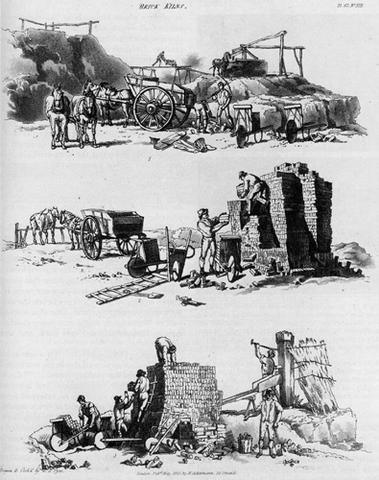
Image: Brick Clamp, courtesy Cultural Resource Analysts, Inc.

Love is ...

Love is an act of endless forgiveness, a tender look which becomes a habit.

Peter Ustinov

Monday, July 17, 2006

Two Indias

With the initiation of market-based economic reforms a decade and a half ago, India, a country hitherto perceived as “poor”, is emerging as a significant player in trade globalisation and is seen as a future economic powerhouse and global economic leader.

In spite of this performance, India is home to very large numbers of poor and deprived people. Ancient inequities and conflict continue to overshadow the modern nation. Economic reforms and impressive economic and export growth have been accompanied by widening disparities, and continuing marginalisation of the poor and vulnerable.

The state, from its commanding and almost-singular role in fostering social equity and eliminating poverty, has in practice retreated from such a concern and responsibility. Instead, there has been a growth in NGOs, working for the poor and vulnerable in rural and urban areas. But in terms of their numbers and spread over the vast country, and their impact on poverty as well as public policy and action, NGOs are as yet a largely insignificant force in society.

(From a collaborative research proposal on upgrading slum-based manufacturing in Calcutta.)

Photo: courtesy Janmeja Johl

Poverty in India

Today I can see that India is firmly bound and held back in every way by poverty. Those who are free of such bonds try to advance by pushing down and pushing away the poor. They feel threatened and demeaned by any exposure to or contact with poverty. They assume and wish the state will take care of all that. They also feel the state must assist in continuously enhancing their own quality of life. The state, however, has only proven its incapability in making a dent on the poverty and acute inequity.

But most importantly, poverty is also something sustained and perpetuated by the thoughts, attitudes and conduct of the affluent sections. They have been born into and socialised in this. A complete transformation in society and culture is therefore needed if every Indian is to live a life of dignity. This is not something any affluent person wants. Civil society’s selfless and enlightened initiative and leadership in poverty eradication – is still largely absent from the horizon.

In its obsession with economic growth and foreign investment, the state has retreated from poverty eradication. But dehumanising poverty, shocking disparities and institutional and public apathy continue to exist. In the poverty-ridden environments, the horizon is bereft of any hope.

Crisis of civil society


Globalisation and economic growth has actually contributed to new attitudes of disregard for the poor. India faces a vacuum in civil society ownership of concerns such as poverty, social inclusion, social justice, peace & tolerance, and good governance.

The current situation in the country is quite telling. Thus, for example, there was a crisis regarding a major dam project, because those who have been ousted from their traditional lands have not yet been adequately compensated and rehabilitated. Demanding urgent attention to their resettlement is seen as heretical and destructive. Elite schools in the metropolitan centres rejected proposals for including measures to open their doors to the urban poor. The mass media and the middle class reacted strongly against a proposal for increasing reservation of seats for historically underprivileged and disempowered groups in elite technical education institutes. The private corporate sector strongly negated proposals for job reservations, while never seriously considering the issue of affirmative action in favour of historically disenfranchised communities, for advancing what are simply national goals of distributive justice.

And yet this crisis was occurring even as stock markets sizzle and indices boom to ever higher levels. The fact is that India, as a society defined and socialised by historically entrenched social inequities, is yet to assert itself as a democracy of free and equal co-citizens. Or assume the responsibilities for advancing that goal. On the contrary, disparities and perceived injustices continue to breed violent conflict and polarisation. Against this backdrop of the social exclusion accompanying economic growth, there has been a spurt of extremist violence against the state in some of the most backward areas of the country. The Prime Minister has also described the Naxalite (i.e. Maoist extremist) threat as the most serious threat ever to India’s national security.

But there are some signs of hope. Business groups and leaders have begun to speak of the responsibility to the population that is not industrialised and is living in rural areas. They say in a country like India with a large disadvantaged population, one cannot create great wealth without making an effort to spread the wealth. The Prime Minister of India, who is also a senior public economist and had been the architect of India’s economic reforms, has urged civil servants to ensure that growth is equitable, inclusive and not unduly harsh. It may be recalled that through the 2004 national election verdict, people had angrily rejected the previous govt’s “India Shining” publicity campaign, which touted the new prosperous India, when things like farmer suicides were afflicting the countryside.

(From a collaborative research proposal on upgrading slum-based manufacturing in Calcutta.)

Painting: Harmony in Blue and Silver, by James McNeil Whistler

Renewing public action

If Indians are concerned about poverty and indignity in the country, they must question the planning and development process which excludes and marginalises the poor and vulnerable, which creates acute disparities. They must envision and advocate alternatives. They must fight for transparent and good governance. They must be the living means of civic participation and action.
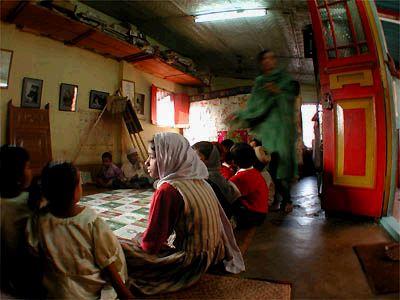
Activists must think about systemic factors, see through to the “political” at the heart of everything, and thus develop appropriate strategies of action.

Activists must work in the “public domain”. They must reach out to people, and try to be part of a public process. They must build public organisations, processes and movements.

Activists’ relations with the poor must be a means for empowering the poor to seek and sustain improvements in their stakes.

Finally, there must be thinking about the future. Voluntarism must be nurtured. And sustained. We have to think about how this can be meaningfully institutionalised, without killing the voluntary spirit. Voluntarism also has to be transferred to subsequent generations. Civic activity and capabilities must enter into the formal education of children and youth.

Seriously reflecting on such questions and addressing them through one’s work - could help to bring a much-needed spark of life to the currently blighted domain of public action in India.

Image: courtesy Navgati

Talimi Haq School

Talimi Haq - means right to education in Urdu. But it also means learning is Truth, as being. Al-Haq is one of the names of Allah.
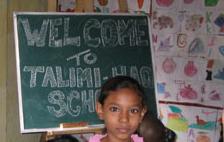
Started by Howrah Pilot Project on 1 June 1998, this is a non-formal learning centre for poor and working children in Priya Manna Basti, a 100 year old jute workers’ settlement on the Grand Trunk Road, in the Shibpur locality of Howrah.

Posted below is a letter I wrote to a friend in March 2005 about the school reunion.

Photo: Jean Cassagne

Reunion

Yesterday afternoon we had an old students' reunion at the Talimi Haq School in Howrah. I had thought about this for a long time, and also spoken to Amina and Binod who run the school. I had visited Howrah a few days ago after almost 4 months. The school reunion was planned, and it took place on Sunday, 20 March 2005.

It is difficult to express all the feelings from looking, as an observer, at all that had happened since I started working in Howrah in 1996-97. I had been at the Howrah office-centre virtually everyday, 6 days a week, from 1998 to 2000. In mid-2000, after I joined the CALMANAC website assignment, my visits became infrequent. After this assignment was over, for a month or so I again went there everyday. But then I began getting more and more into my new duty / responsibility, the family business. Through 2001 and 2002, I went about once a week. In 2003 and 2004, this became even less frequent. I went only for specific purposes. But I had remained in close and regular contact, with Prodyut, Amina and Binod, and earlier Ranjit and Anguri. And of course I worried about the funds to keep the school running.

To my surprise I learnt that since its inception in June 1998, over 400 children had studied here for some length of time. I was particularly keen that a group of boys who had studied in the very first year attend. I had taught them myself - arithmetic, singing - and developed a close rapport with them.

Some 30-40 ex-students came for the reunion, and together with a good number of the small children currently studying - there was quite a crowd in our school room. It was hot and sweaty inside the room, but that did not affect anybody's enthusiasm. Some boys who had been studying here until quite recently, were now strapping lads. Some girls from a few years ago were now very pretty adolescents. Among them a girl living across the lane who had joined after I had asked her father to send her to our school.

Photographs taken over the years were displayed on a wall - a school function on Independence Day, a picnic to the Botanical Gardens, a visit to the Science Museum, visitors from Britain. Looking at some of the pictures, I felt a lump in my throat and my eyes clouded over. Some of the tiny kids in the pictures were big boys and girls now.

The programme began with a short welcome address by me. I said like every school and college, Talimi Haq School too should have a reunion of the ex-students. They should feel happy and proud to have belonged to a special school, which set them off on their journey in education and life. Where they learnt something, and can remember a time of happiness, fun and frolic. For the current students, it will give them a feeling that they are studying in a special school, which is looked up to and with which ex-students feel an attachment. This a special school as its name proclaims. Education is a right of all, so this is a school for that. So many children have come here and then gone on to other schools, where they are now studying, or have even graduated from. And thus is the stream of education in this locality advancing. The students learn Urdu, English, Arithmetic, cleanliness, good behaviour, correct values. But at root, the teachers here give love and affection to the children. Boys and girls who were unable to continue with their schooling - learnt at least something here. All ex-students should know that this is their place, like their home. And we at the school consider you all as our own. You have a right to this place, it is yours. You can come whenever you want, when you are happy come and share your happiness with us. When you are feeling sad and burdened, come here and find a shoulder to rest on. And you will always be in our thoughts, and we hope you will drop in every now and then. We remember all those who are unable to come today. We remember in particular all the teachers who have taught here over the years and we miss their presence very much. I hope there will be a lot of happiness today, a lot of fun, jokes and anecdotes, remembering of joy and mischief, songs, recollection of old times.

There was a juice break. Several of the small children were given their juice and coaxed to go home to make space for the ex-students. Some of the boys and girls came to chat with me and I enquired about their studies.

A number of skits and songs were then presented by ex-students, which had the audience in splits. A group of boys sang a song I had composed, "PM Basti ke ham sab sachhey Mussalmaan hain" (“we are all true Muslims, from PM Basti”). A video recording of a women and children's rally on International Literacy Day in 1998 was played.

Amina and another new teacher asked me to sing. I sang three songs, including my composition "Hari aur Ali galey miley jab" ("When Hari and Ali embrace"). Finally there was an hour-long antakshari session, between boys and girls, with a male teacher, Binod, and a lady teacher, Rehana as the referees. The competition was fierce, and the enthusiasm quite explosive. The boys exulted in singing out love songs teasingly, but the girls were not going to be outdone in knowledge of songs and singing.

Packets of savouries and sweets had been prepared, to give to everyone - but because many more than estimated had turned up, everyone had to share. Two boys asked me to share their sweets.

The CPI(M) was organising an Anti-Imperialism Human Chain in the evening. I had invited the local councillor to attend a meeting with a group of visiting architecture students and faculty from Sweden next week. She had requested that the school teachers and older children join the human chain. So we all proceeded to the Grand Trunk Road, and stood in the chain for 10 minutes. Returning to the office, I bid them goodbye and said I really enjoyed myself.

The programme was shadowed for me by sadness and uncertainty, as I got the news that the building was going to be pulled down after 10 days and a new construction put up. This had been in the offing but nothing concrete had materialised. But yesterday morning my colleague Prodyut had been called by the landlord for a meeting. I remembered when we moved to this office, in early 1998, exactly 7 years ago. Every tiny detail in the office had been visualised and rendered with so much thought and feeling. And the school had been started shortly after that. So much had happened here, so much of me had been formed in this space. The bitter irony of the reunion happening right now was difficult to swallow. Where would we go? Would the school have to close down? Where will we keep all the things in the room? Maybe something will work out, everything will turn out alright - but something was over, a chapter had come to an end. I shouldn’t feel burdened by sadness over the past that's coming to a close, one should look forward practically to the new.

At home later in the evening, I spoke to Prodyut over the phone and he assured me that there was no cause for concern. After all we had a proper deed of occupation and payment of deposit. A new agreement deed for premises in the new construction would have to be prepared. The landlord was also going to find us an alternative temporary accommodation. And until all this was sorted out there was no question of vacating our centre.

At night, Rajashi, my wife, who had also attended the school reunion, told me that from being at the reunion I should be proud and happy about the school. She referred to something I had told her once, that everyone should have the right to failure. She said a lot of successful people would not have done something like this.