
Showing posts with label religion. Show all posts
Showing posts with label religion. Show all posts
Friday, December 24, 2010
Christmas greetings
Here is Mr Pascal, by the British animation film artist Alison de Vere. This shall remain an immortal classic, and there's no better time to watch it than Christmas!
Christmas greetings to everyone, and may the occasion spur us to seek and find the child within us.


Tuesday, March 17, 2009
Ashis Nandy lectures

Dr Ashis Nandy is a political psychologist and social theorist whose path-breaking work has revitalized scholarship on political psychology, the Indian encounter with colonialism, mass violence, nationalism and culture. In 2008, he was listed as one of the top 100 public intellectuals of the world by the journal Foreign Policy, published by the Carnegie Endowment for International Peace. One of his most celebrated books, The Intimate Enemy: Loss and Recovery of Self Under Colonialism (1983), is currently being honored as it comes out in its 30th edition.
Dr Nandy is with the Centre for the Study of Developing Societies, Delhi.
The Center for South Asia together with the Stanford Humanities Center organised a lecture by Ashis Nandy on 6 March 2009. The title of the lecture was:"The Demonic and the Seductive in Religious Nationalism: Vinayak Damodar Savarkar and the Rites of Exorcism in Secularizing South Asia".
Ajit Sanzgiri, who attended the lecture, wrote:
A Post-Secular Intellectual
I attended the talk. It was more a look at the life of Vinayak Savarkar - arguably the father of Hindu nationalism in India. Much of it was uncontroversial (at least to people who don't hold Savarkar in high regard) and unsurprising. So let me just quote the bits that seemed 'interesting'.
Right in the beginning, Dr. Nandy said the practice of biography is somewhat different in South Asia than in the rest of the world - by which I presume he meant Western scholarship. Biographies in S. Asia either tend to be pamphleteer rants - in which he included A G Noorani's biography of Savarkar - or unquestioningly adulatory [of which I presume there are many for Savarkar].
He pointed out that Savarkar was not a 'believing Hindu'. He ate meat and fish despite being a Chitpavan Brahmin and advocated eating beef. He was an avowed atheist and dismissive of the plethora of Hindu divinities. Interestingly, Jinnah, who Nandy mentioned as the representative of Muslim nationalism in South Asia, wasn't a practicing Muslim either and quoted an interview of M.C.Chhagla (Jinnah's nephew) in which he said one of his duties as Jinnah's secretary was to make sure he did not have to receive religiously minded visitors who might disturb him while enjoying his whiskey or a ham sandwich.
Among the various nineteenth century religious reform movements in South Asia all the Hindu and Buddhist ones and some (though not all) Islamic ones were (in Nandy's opinion) a reaction to the challenge posed by evangelising Christianity and represented a desire to "become in some ways like the enemy they wished to resist, the better to resist it".
That this was also the inspiration behind both Hindu and Muslim religious nationalisms. Speaking specifically of Savarkar, Dr. Nandy said, having studied European history and political theory he had come to the conclusion that a modern nation state had to be based on a dominant 'national identity' (respectively Hindu or Muslim) and minorities "tamed". This, Nandy said, is only emulating the examples set by England where Catholics were systematically marginalised and France where protestants were targeted. [These are Dr. Nandy's views.] Nandy pointed out that Savarkar had always had the most cordial relations with Jinnah and (apparently) completely sympathised with the demand for partition.
He had a fascinating riff on modern day fundamentalisms being attempted solutions to the problem faced by greater mobility.
Why is this a problem ? Well, before the nineteenth century - being a devout Hindu (or to some extent Muslim) meant following practices that were necessarily local, in a language that was local, worshipping aspects of divinity (whether deities, saints or whatever) which were also local. These things didn't travel well in case the devotee had to move long distances. As mobility increased - a need arose in the minds of some - to make faith portable like a laptop. The tensions that we see today are in some ways the results of this.
Savarkar was tortured at Andaman and this probably explains his offer to cooperate with the British authorities and the reduction of his prison sentence (initially condemned to two life sentences).
In an aside he said that in democratic India it is far easier for a Dalit (or some other minority) to be the head of the state government in 'communal' Maharashtra than in 'Communist' West Bengal. He said this in response to a question about why Gandhi's most bitter internal enemies were Chitpavan Brahmins from Maharashtra, the bhadralok babus of Bengal and - to a lesser extent - Tamil Brahmins.
In his introduction he was described (using text he had prepared) as a 'post-secular' intellectual. I meant to ask him to explain this but it slipped my mind, there were so many interesting threads to pick.
The defense attorney to Nathuram Godse (Gandhi's assassin) has recorded Godse's disappointment that Savarkar not only did not own up to his role in the assassination plot but deliberately distanced himself from the plotters and did not show any support or sympathy for them. [Savarkar narrowly avoided conviction in the case. Subsequent enquiry brought damning evidence to light.]
While I have always admired Nandy's writings, I came away with a very positive impression of his attention to detail and genuine dedication to scholarship.
Nandy's lecture is accessible here.
Here is a report on another talk by Ashis Nandy, carried in India West:
Hate Not Last Word in Partition: Nandy
by Ashfaque Swapan
It was not hatred, but a strong undercurrent of humanity, that was the surprising finding of research on the traumatic bloodbath of the Partition, iconoclastic Indian researcher Ashis Nandy told an audience March 3 at the University of California.
Nandy made some unconventional points: Even in the terrible bloodbath that claimed the lives of millions, as many as one in four people among survivors said they were saved by the other community, and their fondest memories were still of the days when they lived with the ostensibly enemy community. He added that while those who engaged in the killings virtually got off scot-free, they paid a price in terms of mental and physical health and some even accepted culpability in their later age.
Nandy was the featured speaker at the Sarah Kailath lecture here.
UC Berkeley sociology Prof Raka Ray, chair of the Center for South Asia Studies, introduced him as an “intellectual extraordinaire” who was India’s first post colonial theorist, calling him a “prototypical public intellectual” and India’s most famous dissenter.
“I am a little perturbed by my steady decline into respectability, and I do not know what to do about it,” quipped Nandy, who brought an avuncular bonhomie to his
lecture.
Nandy highlighted his presentation with gripping stories of individuals caught in the maelstrom of murder, hatred and exile in 1946-48.
According to conservative estimates, roughly one million people died, but Nandy puts the figure to over two million.
Nandy and associates carried out a study that included about 1,300 interviews with survivors of the Partition violence of 1946-48, including 100 in-depth interviews.
“When we started the study, we depended heavily on available data on other genocides, and I must say some of the things did not fit,” Nandy said.
“The first finding that surprised us that nearly one-fourth of all survivors said that they owed their survival to somebody from the opposition,” he said. “This figure was astonishing because nowhere we have come anywhere near it — in any other genocide.”
Another surprising finding was the lack of rancor among direct victims, he said.
“The second finding is … that those who actually faced the violence, those who are direct victims, the first generation of victims, those who have been subject to the violence, those who have seen it first-hand, mostly were those who had lesser prejudice and lesser bitterness about their experience than their own children and their grandchildren because they had lived in communities where the other side was the majority,” Nandy said. “They have lived with them and they had very warm memories of that experience. Many of them have said that those were the best days of their lives, whereas the children have a packaged view mostly of those violent days and how the family survived . . . So they carry more bitterness, more hostility.”
Nandy focused on an individual to underscore some of his points. During the research on the Partition, an associate had interviewed Madan Lal Pahwa, who was raised in what is now Pakistan.
Raised in a “kattar” (orthodox) Hindu family, Pahwa grew up to become a Hindu militant. He participated in vigilante groups that killed Muslims, said Nandy, and even threw a bomb at a prayer meeting of Mahatma Gandhi five days before Gandhi’s assassination.
Many years later, during an interview for the research, Pahwa appeared to have mellowed considerably.
What was Pahwa’s most treasured memory? “It is Pak Pattan (his ancestral village in Pakistan),” Nandy said. “And what he remembers in Pak Pattan the most, not only what he called the pure air and the pure milk and the green vegetables . . . above all (Muslim Sufi spiritual leader) Baba Farid’s mazar (tomb). He used to sneak out at night from his home . . . and with his friends go to the mazar (saint's tomb-shrine).
That Sufi music and the singing he remembers as the most valuable moments of his life. The memory of the shared shrine, the Sufi music, the ambiance of the mazar had left a deep impression on him.”
Pahwa also subsequently revised his earlier blanket condemnation of Muslims. “Muslims were otherwise friendly people,” Pahwa reportedly said. “A small minority of Muslims were bad, the politicians.”
“In South Asia, living with multiple selves is not an exception, we don’t diagnose it as schizophrenia,” Nandy quipped.
“I don’t think you should be surprised that even Madan Lal Pahwa showed at least some awareness somewhere that he was culpable,” he said.
“Fanaticism drives a person but insaniyat — humanity — is also there,” Nandy said. Nandy also mentioned a “third striking feature of this genocide.”
“I have yet to meet, or any of our team has yet to meet, a killer who is happy in his old age,” he said. “I am yet to meet a happy killer.
Even the ones that claim to be at perfect peace with themselves either
have psychosomatic ailments or other instances of mental ill health directly traceable to the experience during the violence of '46-48. So escaping prosecution is not the last word in this matter.”
India’s pre-partition history of various communities living together was the result of a pre-Western tradition of tolerance, Nandy said.
This became clear after he researched the 600-year history of communal peace in the Kerala port city of Kochi.
The initial response of people, when asked about their history of peace, was predictable.
“They gave all the responses people like us would love,” Nandy said. People said that the absence of violence was because people were secular, progressive and educated.
However, said Nandy, deeper examination revealed something else.
“Nobody liked anybody else. Tolerance, alas, was based on mutual dislike,” he said. “Every community thought they were the best. Yet in Cochin there was no instance of serious violence in 600 years of recorded history.
“And then gradually I deciphered that in a community-based society, a society where individuation has not gone beyond a point, there is bound to be this dislike and this sense of superiority. . .
“But whereas you think your community is the best you also learn the (other) community’s right to believe they are the best. That mutuality is there. Secondly, the other is not only the other, but they are a part of you, you internalize. . . . The other is crucial to your self-definition. . . There are no annihilatory fantasies. . .
“This is not the enlightenment vision of cosmopolitanism, it is the alternative form of cosmopolitanism, and I am now convinced that this is the cosmopolitanism with which societies based on communities survive.”
He said that the most bitter opponents of Gandhi, including his killers, didn’t dislike him mainly because of his perceived appeasement of Muslims. Gandhi’s critics in India hated him because they thought he was too mired in tradition to allow India to develop as a modern state, Nandy said.
However, that may have been Gandhi’s strong suit, Nandy suggested.
“Somewhere Gandhi’s strength lay not in conforming to the ideas of proper politics of modern India and middle classes, that in any case found him a liability and a problem, people like you and me, perhaps his strength lay partly in the folk traditions of India, in the realities of India that is outside the reach of modern India,” Nandy said.
The Return of the Sacred
These recent lecture by Ashis Nandy brought to mind a lecture by Nandy I attended, at Calcutta University's Centre for South and South-East Asian Studies, in January 2008.
Visiting the Centre again last week, I found they had published the lecture.
It was titled "The Return of the Sacred: The Language of Religion and the Fear of Democracy in a Post-Secular World".
It was presented earlier, in 2006, in Sydney, and an MP3 audio file of that lecture is accessible here.
On the subject of the partition of India, a must-read article is by Ayesha Jalal: "Exploding Communalism: The Politics of Muslim Identity in South Asia". This is accessible here.
Tuesday, May 20, 2008
Visvarupa

Over the last 10 years or so, I have been drawn to particular sacred verses, in specific sacred texts. And I have set these to melody, as devotional songs or chants, in Sanskrit, Pali, Arabic, Hebrew etc.
Recently, I happened to pick up the Sanskrit verses from the Bhagavad Gita describing the cosmic vision of Krishna revealed to Arjuna just before the Mahabharata war. These are verses 10-12 in Chapter 11, the chapter on vision of the cosmic form, or Visvarupa. I hope to set these to melody and add it to my small repertoire of songs.
As Robert V Moody writes:
"The verses represent one of the great moments in the Bhagavad Gita. Arjuna, the great warrior, stands on his chariot between the two contending armies of what is about to be an epic internecine battle. With him is his chariot driver who is no less than Krishna, one of the manifestations of Vishnu. Arjuna, mighty warrior though he is, seeing the carnage about to ensue, with his family and friends pitted against each other, loses heart and feels his spirit fading. He wants no part of this battle. Turning to Krishna, he begins to question him. The text, which is something akin to the sermon on the mount for millions of Hindus, is a theological and philosophical discussion of the nature of reality and divinity, and as well as a practical spiritual manual for daily living. Arjuna knows that Krishna is not only a personal friend but also nonetheless a manifestation of the supreme godhead itself. Still,when he asks Krishna to show his real form he is completely unprepared for what he sees. This is the source of the often quoted "...now I am become Death, the destroyer of worlds…" which Robert Oppenheimer used to describe the testing of the first atomic bomb."
I am reproducing the verses below, together with Edwin Arnold's poetic transcreation of the Sanskrit original.

anekavaktranayanamanekaad.hbhutadarshanam.h
anekadivyaabharaNaM divyaanekodyataayudham.h
divyamaalyaambaradharaM divyagandhaanulepanam.h
sarvaashcharyamayaM devamanantaM vishvatomukham.h
Hear these verses in Sanskrit here.
Out of countless eyes beholding,
Out of countless mouths commanding,
Countless mystic forms enfolding
In one Form: supremely standing
Countless radiant glories wearing,
Countless heavenly weapons bearing.
Crowned with garlands of star clusters,
Robed in garb of woven lustres,
Breathing from His perfect Presence
Breaths of every subtle essence
Of all heavenly odours; shedding
Blinding brilliance; overspreading
Boundless, beautiful - all spaces
With His all regarding faces.

divi suuryasahasrasya bhavedyugapadutthitaa
yadi bhaaH sadRishii saa syaadbhaasastasya mahaatmanaH
Hear this verse in Sanskrit here.
So He showed! If there should rise
Suddenly within the skies
Sunburst of a thousand suns
Flooding earth with beams undeemed of,
Then might be that Holy One's
Majesty and radiance dreamed of!
Wednesday, February 13, 2008
Taslima Nasrin and Free Speech

Mahashweta Devi, Arundhati Roy, Ashish Nandy and Girish Karnad have issued this statement on Taslima Nasrin and Free Speech.
Public Statement by Forum For The Protection of Free Speech and Expression
At a time when India is projecting itself on the
world's stage as a modern democracy, while it hosts
international literary festivals and book fairs, the
Government of India, most mainstream political parties
and their armed squads are mounting a concerted
assault on peoples' right to Free Speech.
It is a matter of abiding shame that even as some of
the world's best-known writers were attending the
Jaipur literary festival and prestigious publishers
were doing business at the World Book fair in Delhi,
the exiled Bengali writer Taslima Nasrin was (and is)
being held in custody by the Government of India in an
undisclosed location somewhere in or around Delhi in
conditions that amount to house arrest. Contrary to
misleading press reports stating that her visa has
been extended, her visa expires on the 18th of
February, after which she is liable to be deported or
remain confined as an illegal alien.
Taslima Nasrin is only one in a long list of
journalists, writers, scholars and artists who have
been persecuted, banned, imprisoned, forced into exile
or had their work desecrated in this country. At
different points of time, different governments have
either directly or indirectly resorted to these
measures in order to fan the flames of religious,
regional and ethnic obscurantism to gain popularity
and expand their 'vote-banks'. Every day the threat to
Free Speech and Expression increases.
In the case of Taslima Nasrin it was the CPI (M) and
not any religious or sectarian group who first tried
to ban her book Dwikhondito some years ago. The ban
was lifted by the Calcutta High Court and the book was
in the market and on bestseller lists in West Bengal
for several years. During those years Taslima Nasrin
lived and worked as a free person in Calcutta without
any threat to her person, without being the cause of
public disorder, protests or demonstrations.
Ironically, Taslima Nasrin's troubles in India began
immediately after the Nandigram uprising when the
people of Nandigram, mostly Dalits and Muslims, rose
to resist the West Bengal Government's attempt to
takeover their land, and tens of thousands of people
marched in Calcutta to protest the government's
actions. Within days a little known group claiming to
speak for the Muslim community asked for a ban on
Dwikhondito and demanded that Taslima Nasrin be
deported. The CPI(M)-led government of West Bengal
immediately caved in to the demand, informed her that
it could not offer her security, and lost no time in
deporting her from West Bengal against her will. The
Congress-led UPA Government has condoned this act by
holding her in custody in Delhi and refusing, thus
far, to extend her visa and relieve her of her public
humiliation. They have once again played the suicidal
card of pitting minority communalism against majority
communalism, a game that can only end in disaster.
Inevitably, hoping to make political capital out of
the situation, the BJP is publicly shedding crocodile
tears over Taslima Nasrin, going to the extent of
offering her asylum in Gujarat. It seems to expect
people to forget that the BJP, VHP and RSS cadres have
been at the forefront of harassing, persecuting,
threatening and vandalizing newspaper offices,
television studios, galleries, cinema halls,
filmmakers, artists and writers. Or that they have
forced M.F. Husain, one of India's best-known
painters, into exile.
Meanwhile, in states like Chattisgarh, Andhra Pradesh
and Karnataka, away from the public glare of press
conferences and television cameras, journalists are
being threatened and even imprisoned. Prashant Rahi
from Uttarakhand, Praful Jha from Chattisgarh,
Srisailum from Andhra Pradesh, P. Govind Kutty from
Kerala are a few examples. As we speak Govind Kutty,
who is on a hunger strike in prison is being
force-fed, bound hand and foot. Scores of ordinary
people, including people like Binayak Sen have been
arrested and held illegally under false charges.
We the undersigned do not necessarily agree with,
endorse or admire the views or the work of those whose
rights we seek to defend. Many of us have serious
differences with them. We agree that many of them do
offend our (or someone else's) religious, political
and ideological sensibilities. However, we believe
that instead of making them simultaneously into both
victims and heroes, their work should be viewed, read,
criticized and vigorously debated. We believe that the
Freedom of Speech and Expression is an Absolute and
Inalienable Right, and is the keystone of a modern
democracy.
If the Indian Government deports Taslima Nasrin, or
holds her as an illegal alien, it will shame and
diminish all of us. We demand that she be given a
Resident's Permit or, if she has applied for it,
Indian citizenship, and that she be allowed to live
and work freely in India. We demand that the spurious
cases filed against M.F. Husain be dropped and that he
be allowed to return to a normal life in India. We
demand that the journalists who are being illegally
detained in prison against all principles of natural
justice be released immediately.
Read Dr Mrinal Bose's appeal on Taslima here.
Read the letter on Taslima Nasrin by Mahmood Farooqui, Delhi-based columnist, writer and actor here.
Read writer Ruchir Joshi's article on the 21 November 2007 anti-Taslima riot in Calcutta here.
Thursday, November 08, 2007
Clash of Civilisations

A friend sent me a link to a video clip, saying “watch this clip from Al Jazeera before its taken off the web”.
I clicked the link – and heard the discussion in Arabic, with English sub-titles. Its also available on YouTube.
This is an interview with Arab-American psychologist, Wafa Sultan, shown on Al Jazeera TV (Qatar) on 21 February 2006.
I am reproducing the transcript of the interview here.
Wafa Sultan:
The clash we are witnessing around the world, is not a clash of religions, or a clash of civilisations. It is a clash between two opposites, between two eras. It is a clash between a mentality that belongs to the Middle Ages and another mentality that belongs to the 21st century. It is a clash between civilisation and backwardness, between the civilised and the primitive, between barbarity and rationality. It is a clash between freedom and oppression, between democracy and dictatorship. It is a clash between human rights, on the one hand, and the violation of these rights, on the other hand. It is a clash between those who treat women as beasts, and those who treat them like human beings.
What we see today is not a clash of civilisations. Civilisations do not clash, but compete.
Interviewer:
I understand from your words that what is happening today is a clash between the culture of the West, and the backwardness and ignorance of the Muslims?
Wafa Sultan:
Yes, that is what I mean.
Interviewer:
Who came up with the concept of a clash of civilisations? Was it not Samuel Huntington? It was not Bin Laden. I would like to discuss this issue, if you don’t mind…
Wafa Sultan:
The Muslims are the ones who began using this expression. The Muslims are the ones who began the clash of civilisations. The Prophet of Islam said: “I was ordered to fight the people until they believe in Allah and His Messenger.” When the Muslims divided the people into Muslims and non-Muslims, and called to fight the others until they believe in what they themselves believe, they started this clash and began this war. In order to stop this war, they must re-examine their Islamic books and curricula, which are full of calls for takfir and fighting the infidels.
My colleague has said that he never offends other people’s beliefs. What civilisation on the face of this earth allows him to call other people by names they did not choose for themselves? Once he calls them Ahl Al-Dhimma, another time he calls them the “People of the Book”, and yet another time he compares them to apes and pigs, or he calls the Christians “those who incur Allah’s wrath.” Who told you they are “People of the Book”? They are the People of the Book, they are people of many books. All the useful scientific books that you have today are theirs, the fruit of their free and creative thinking. What gives you the right to call them “those who incur Allah’s Wrath”, or “those who have gone astray”, and then come here and say that your religion commands you to refrain from offending the beliefs of others?
I am not a Christian, a Muslim, or a Jew. I am a secular human being. I do not believe in the supernatural, but I respect others’ right to believe in it.
Other Participant:
Are you a heretic?
Wafa Sultan:
You can say whatever you like. I am a secular human being who does not believe in the supernatural …
Other Participant:
If you are a heretic, there is no point in rebuking you, since you have blasphemed against Islam, the Prophet, and the Koran …
Wafa Sultan:
These are personal matters that do not concern you. Brother, you can believe in stones as long as you don’t throw them at me. You are free to worship whoever you want, but other people’s beliefs are not your concern, whether they believe that the Messiah is God, son of Mary, or that Satan is God, son of Mary. Let people have their beliefs.
The Jews have come from the tragedy (of the Holocaust), and forced the world to respect them, with their knowledge, not with their terror, with their work, not their crying and yelling. Humanity owes most of the discoveries and science of the 19th and 20th centuries to Jewish scientists. 15 million people, scattered throughout the world, united and won their rights through work and knowledge. We have not seen a single Jew blow himself up in a German restaurant. We have not seen a single Jew destroy a church. We have not seen a single Jew protest by killing people. The Muslims have turned three Buddha statues into rubble. We have not seen a single Buddhist burn down a Mosque, kill a Muslim or burn down an embassy. Only the Muslims defend their beliefs by burning down churches, killing people and destroying embassies. This path will not yield any results. The Muslims must ask themselves what they can do for humankind, before they demand that humankind respect them.
...........
Ms Sultan is an impressive woman, I like her, and her spiritedness. We need lots of women like her, all over the world. I can understand her ire against regimes like the one in Saudi Arabia.
But she is grossly unfair to Muslims, by condemning them all for the actions of some who act in the name of the faith. She could also place matters in true perspective, taking religion, theology, history, politics – and geopolitics - into account. I have no doubt whatsoever that Ms Sultan is a genuine humanist. But in her interview she does not at all touch upon things like the crusades, colonial occupation, missionaries, racism, the role of the USA, the role of the state of Israel etc etc. Hence, sadly, taken out of context, she would only strengthen Islamophobic currents.
Thankfully, YouTube also carries a response to Wafa Sultan by her interview colleague.
As an Indian too, I felt she was unfair to the Indian Muslim experience. Muslims in India occupy a very special place by virtue of their large number, and co-existence with people of diverse faiths, languages and cultures. Indian Muslims themselves are made up of so many ethnicities, languages and cultures. Talking of free and creative thinking, the first half of the 20th century saw the blooming of Muslim poets, writers, artists and activists in south Asia, who were rooted in the community at large – for instance in anti-colonial struggles or revolutionary activism. Islam, leftist politics and the arts – had a very rich fusion in south Asia, of which all, Muslims and everybody else, could be justifiably proud.
Today, in India, despite the overall marginalisation of and discrimination against Muslims, there are celebrated thinkers, entrepreneurs, painters, artists, film-makers, actors, singers, musicians dancers, sportspersons, poets, writers, scientists, social scientists, activists - who are Muslims, men and women, who, while being rooted in the community at large, also usually bring to the fore something distinctive through their Muslim identity. They are all positive ambassadors of Muslims, who help non-Muslims enlarge their vision and shed their habitually embraced prejudices. I have written earlier, referring to historian and writer Mukul Kesavan's insights on pluralism in India.
And there are also Muslims who are ordinary human beings, sons, daughters, brothers and sisters, husbands and wives, mothers and fathers, grandfathers and grandmothers, girls and boys, who are all part and parcel of the plurality that is India.
Islam, like all the other great religions of the world, is part of the heritage of humanity, and Muslims are the ambassadors of this heritage, for the enlightenment and elevation of humanity at large. Muslims too are human beings, like everybody else. They also have blood running through their veins, love and sorrow in their hearts, laughter and tears in their eyes, songs, of joy and pain on their lips. So why this distinction between Muslims and the rest of the world? And why not instead a zest to know more from, to share with, and to join Muslims, in building a better future for the whole world’s children?
Tuesday, April 24, 2007
God's architect

by Graham Keeley
Antoni Gaudí (1852-1926), the deeply pious architect whose unfinished cathedral in Barcelona, the Sagrada Familia, has inspired Catholics for generations, is being considered for sainthood - but his masterpiece may be under threat.
Cardinal José Saraiva Martins, the Portuguese prelate who heads the Vatican's Congregation for the Causes of Saints and decides who should be recommended for sainthood, has been mulling a delicate issue for some time; should he give the nod to Pope Benedict XVI to make Antoni Gaudí a saint? The Pontiff gets the final say.
A pile of documents gathered by the then Archbishop of Barcelona, Cardinal Ricard Maria Carles, was sent to the Vatican as proof of Gaudí's ability to intercede with God on behalf of those who pray to him. "God's architect", as the monk-like Gaudí is famously known, left this world with his life's work, the Sagrada Familia cathedral, less than half completed. But campaigners for the beatification of Gaudí are quietly confident that the Vatican has been convinced of their argument and their hero will soon be on the fast track to receive the Lord's greatest honour.
They rest their case on the argument that Gaudí's Sagrada Familia was not simply the work of a visionary architect. The Association for the Beatification of Gaudí, which has been gathering up to 80,000 supporters from around the world for the past 25 years, believes it also inspires unbelievers. Archbishop Carles has said: "Can anyone acquainted with Gaudí's work believe that all which one contemplates could possibly have been produced only by cold thought?"

Antoni Gaudí was born in Catalonia into a poorly paid family of metal workers. Too weak to play with friends because of chronic rheumatism, the young Gaudí spent much of his childhood observing nature, an influence that featured heavily in his work. As an architecture student at the Escola Tècnica Superior d'Arquitectura in Barcelona from 1873 to 1877, his grades were mediocre. His racy architectural designs, which married gothic and traditional Spanish architectural modes with influences drawn from nature, were a radical departure from the architecture of the time. At his graduation in 1878, his patron, Elies Rogent, declared: "I have either found a lunatic or a genius."
In 1883, Gaudí took over the Sagrada Familia project after a dispute between the church's original architect and its founder. Then aged 31, he was already considered a brilliant artist who drew his inspiration from nature and, soon after, from God.
"He found everything in nature," said his biographer Joan Bassegoda. "He would look at an insect or a duck and find interesting forms that he would transfer into architecture. After Gaudí, there were no Gaudí schools. Because Gaudí always said, 'Don't copy me, copy nature'."
Campaigners for Gaudí's beatification also believe his legendary piety is reason enough to lift him up among St Peter and St Paul. Gaudi was obsessively pious, especially in his old age. He used to shuffle around the streets of his native Barcelona nibbling on crusts of bread and seeking alms for the building of the Sagrada Familia.
When he was hit by a tram in Barcelona's Gran Via in 1926, he was so dishevelled taxi drivers refused to take him to hospital, believing he was a tramp. He died days later in a paupers' hospital, after his friends had at first failed to recognise him.
Meanwhile, another more earthly problem may bedevil those who are behind Gaudí's bid for sainthood. The Sagrada Familia, on which campaigners have based their campaign for his beatification, faces a new threat from plans for a railway tunnel just a few feet from its foundations. Architects, geologists and the authorities that run the Sagrada Familia oppose the route of the high-speed AVE train from Madrid, which is due to start operating later this year.
The cathedral's crypt and Nativity façade are Unesco World Heritage Sites and campaigners want to mobilise international pressure to force the authorities behind the plan to change the route of the AVE train.
Read the full article in The Independent.
Monday, April 09, 2007
India Untouched

INDIA UNTOUCHED: Stories of a People Apart is perhaps the most comprehensive look at untouchability ever undertaken on film. Director Stalin K. spent four years traveling the length and breadth of the country to expose the continued oppression of Dalits, the 'broken people' who suffer under a 4,000 year-old religious system.
The 110 minutes long film (in Hindi, Bhojpuri, Gujarati, Punjabi, Tamil, Telugu and Malayalam, with English sub-titles) introduces leading Benares scholars who interpret Hindu scriptures to mean that Dalits 'have no right' to education, and Rajput farmers who proudly proclaim that no Dalit may sit in their presence, and that the police must seek their permission before pursuing cases of atrocities.
The film captures many 'firsts-on-film', such as Dalits being forced to dismount from their cycles and remove their shoes when in the upper caste part of the village. It exposes the continuation of caste practices and Untouchability in Sikhism, Christianity and Islam, and even amongst the communists in Kerala. Dalits themselves are not let off the hook: within Dalits, sub-castes practice untouchability on the 'lower' sub-castes, and a Harijan boy refuses to drink water from a Valmiki boy. The viewer hears that untouchability is an urban phenomenon as well, inflicted upon a leading medical surgeon, and in such hallowed institutions as the Jawaharlal Nehru University in New Delhi, where a Brahmin boy builds a partition so as not to look upon his Dalit roommate in the early morning.
A section on how newspaper matrimonial columns are divided according to caste presents urban Indians with an uncomfortable truth: marriage is the leading perpetuator of caste in India.
But the film highlights signs of hope too: the powerful tradition of Dalit drumming is used to call people to the struggle, and a young Dalit girl holds her head high after pulling water from her village well for the first time in her life.
Spanning eight states and four religions, this film will make it impossible for anyone to deny that untouchability continues to be practiced in India.
Director Stalin K. is a human rights activist and award-winning documentary filmmaker. In recent years, he has become known for his pioneering 'participatory media' work with urban and rural communities, in which local people produce their own videos and radio programs as an empowerment tool.
INDIA UNTOUCHED is Stalin's second film on the issue of caste - his earlier film Lesser Humans, on manual scavenging, helped to bring international attention to the issue of caste.
DVDs of this film are available from: Drishti, 103, Anand Hari Tower, Sandesh Press Road, Bodakdev, Ahmedabad 380054, India. +91-79-2685 1235 and 6661 4235. drishtiad1@gmail.com
Public Screenings of INDIA UNTOUCHED
14th April, 2007, 8:15pm, at Natarani, Usmanpura, Ahmedabad. Call Gaurang @ 98799 19549 for free passes.
19th April, 2007, 5:00 pm, at School of Arts & Aesthetics (Auditorium), Jawaharlal Nehru University, New Mehrauli Road, New Delhi. RSVP to Anisha Chug at 011-4164 0929.
See also the Human Rights Watch reports:
Hidden Apartheid: Caste Discrimination against India's "Untouchables" (2007); and
Broken People: Caste Violence Against India’s “Untouchables” (1999)
Read Sandip Bandopadhyay's article on caste in West Bengal here.
Image: Buddha accepting a request for ordination from the untouchable, Sunita. From Buddhism in Pictures, The Buddhist Information Center, Sri Lanka.
Monday, December 25, 2006
Indian Politics
I reproduce below a very interesting news report from the state of Gujarat in western India. Some explanations: the Bajrang Dal is a Hindu hooligan squad. The Vishwa Hindu Parishad (VHP, World Hindu Council) is a fascist body funded by rootless non-resident Indians to spread religious hatred and bigotry and annihilate minorities. These bodies, together with the Hindu brown-shirt brigade known as the RSS and the BJP political party, are collectively known as the Sangh Parivar, i.e. organisation family.
At 19, Nilesh Lohar was a rising saffron star, leading Bajrang Dal assaults on churches and missionary schools in Gujarat’s Dangs district.
It’s partly because of his Muslim neighbours that eight years later, he is full of remorse.
“I wish I hadn’t done what I did. It was a criminal act. I did not realise it then. I was misled,” says the 27-year-old burly six-footer from Vyara, a town near Surat.
Lohar, who had become chief of the Bajrang Dal’s Vyara unit at 16, was the outfit’s Surat president when he was assigned the “mission” to attack Christian institutions in neighbouring Dangs in 1998.
Leading a core group of heavily indoctrinated youths, he put Dangs in international headlines, winning applause from Sangh parivar bigwigs like his mentor Praveen Togadia.
“I used to imitate Togadia (a Vishwa Hindu Parishad leader) so much that I came to be known as ‘Chhote (junior) Togadia’ in south Gujarat,” recalls Lohar, who underwent VHP training in firearms, martial arts and the use of the stone as a weapon.
It all changed with one incident about two years ago, when the Vyara municipality served notice saying Lohar Falia, the slum where Nilesh was born and brought up, was to be demolished to make room for a dental college.
As Lohar was a sangh parivar star, neighbours expected him to use his clout to save their homes. But his meetings with chief minister Narendra Modi and Togadia didn’t follow script.
“I was told they would not like to intervene as a sizeable population in Lohar Falia is Muslim. I was shocked,” Lohar recalls.
He approached rights activists Girish Patel and Mukul Sinha who petitioned the high court and got the demolition stayed.
Lohar resigned from the Bajrang Dal. His defection badly hurt the BJP in the municipal elections last year, annoying the sangh leadership.
“Some of them have threatened me, saying they would implicate me in false cases. Others have been decent and have tried to cajole me. But I told them I do not care any more. I’m my own man now.”
Lohar regrets his role in setting off communal clashes in neighbouring Bardoli town after a Muslim youth married a Hindu girl.
“I had been at the forefront, engineering trouble in the town. But today I feel I was just a pawn in the game.”
Lohar recently joined the Youth Congress as its Surat district vice-president and is tipped to become a state-level office-bearer. He says he feels at home in his new organisation. “The Congress, unlike the sangh parivar, does not discriminate.”
At 19, Nilesh Lohar was a rising saffron star, leading Bajrang Dal assaults on churches and missionary schools in Gujarat’s Dangs district.
It’s partly because of his Muslim neighbours that eight years later, he is full of remorse.
“I wish I hadn’t done what I did. It was a criminal act. I did not realise it then. I was misled,” says the 27-year-old burly six-footer from Vyara, a town near Surat.
Lohar, who had become chief of the Bajrang Dal’s Vyara unit at 16, was the outfit’s Surat president when he was assigned the “mission” to attack Christian institutions in neighbouring Dangs in 1998.
Leading a core group of heavily indoctrinated youths, he put Dangs in international headlines, winning applause from Sangh parivar bigwigs like his mentor Praveen Togadia.
“I used to imitate Togadia (a Vishwa Hindu Parishad leader) so much that I came to be known as ‘Chhote (junior) Togadia’ in south Gujarat,” recalls Lohar, who underwent VHP training in firearms, martial arts and the use of the stone as a weapon.
It all changed with one incident about two years ago, when the Vyara municipality served notice saying Lohar Falia, the slum where Nilesh was born and brought up, was to be demolished to make room for a dental college.
As Lohar was a sangh parivar star, neighbours expected him to use his clout to save their homes. But his meetings with chief minister Narendra Modi and Togadia didn’t follow script.
“I was told they would not like to intervene as a sizeable population in Lohar Falia is Muslim. I was shocked,” Lohar recalls.
He approached rights activists Girish Patel and Mukul Sinha who petitioned the high court and got the demolition stayed.
Lohar resigned from the Bajrang Dal. His defection badly hurt the BJP in the municipal elections last year, annoying the sangh leadership.
“Some of them have threatened me, saying they would implicate me in false cases. Others have been decent and have tried to cajole me. But I told them I do not care any more. I’m my own man now.”
Lohar regrets his role in setting off communal clashes in neighbouring Bardoli town after a Muslim youth married a Hindu girl.
“I had been at the forefront, engineering trouble in the town. But today I feel I was just a pawn in the game.”
Lohar recently joined the Youth Congress as its Surat district vice-president and is tipped to become a state-level office-bearer. He says he feels at home in his new organisation. “The Congress, unlike the sangh parivar, does not discriminate.”
Saturday, September 30, 2006
Devi Saraswati
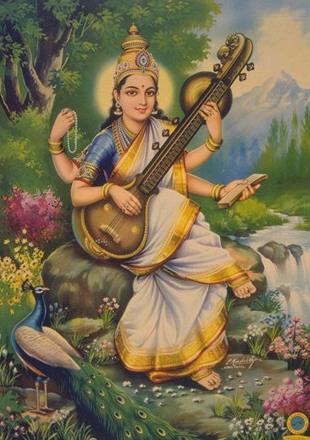
Tomorrow is Saraswati Puja, for (Hindu) south Indians.
Saraswati literally means “one who gives the essence (sara) of our own Self (swa).” She sits on a swan, and carries a veena (a string instrument).
Puja, as I have explained earlier, means worship, with flower offerings.
Devi Saraswati is the Mother of Learning.
Music is the highest art, the distilled essence of all knowledge, which is self-knowledge. Self-effacing devotion, expressed in heart's melody, in a prayer to Devi Saraswati, is accompanied by Divine vision.
In Carnatic music (i.e. the south Indian classical tradition), one of the first songs learnt is “Varaveena”, a prayer, in Sanskrit, a song of adoration, to Saraswati, composed by Appaya Dikshitar (1554-1626), a scholar, sage and saint.
Varaveena mrudu paani
Vanaruha lochana raani
Suruchira bambhara veni
Suranutha kalyaani
Nirupama shubha guna lola
Nirathi jaya prada sheela
Varadaapriya ranganaayaki
Vaanchita phala daayaki
Saraseejaasana janani
Jaya jaya jaya
You hold the divine veena in your soft hands.
You are the queen of the omniscient. Your eyes are like the lotus petals.
Your curly tresses resemble the bees.
Devas worship your auspicious form.
You have unequalled virtuous qualities.
You give endless victory.
You are the munificent consort of the Beautiful Lord.
You grant boons to the deprived.
O Mother of lotus-seated Creator!
Victory to you!
This song is set in Mohanam raga, which is Bhopali raga in the Hindusthani or north Indian classical system.
Shivkumar Kalyanaraman is a professor of computer science in the USA. His website is also a treasure trove of resources on Carnatic music. He has provided the musical notations for this song, as well as an MP3 recording of a teaching of this song.
Thank you Shivkumar, and may Mother Saraswati’s blessings be always with you.
Another rich site is karnATik.
My mother is away in Bombay, otherwise she would have organised the Puja at home, with an offering of sweet and savoury rice, and the placing of books (of students in the house) before the image of Saraswati.
My younger son Rishiraj (aka Chotu), 11, was the last to religiously place all his school books in front of the image at home. This is a day on which there must be no studying! Great for kids at home during vacations! Chotu's in boarding school now, with his brother Rituraj, 15.
My mother will be doing the Puja at her sister’s, in Bombay.
Hence it will only be an 'inner' observation for me. I observed Saraswati Puja by:
conveying my heartfelt good wishes to -
JP, a college-mate and fellow Tamil-ian & Calcuttan (in which fact I take particular pride right now, as JP has recently become the CIO, Global Services, of British Telecom);
Achinto, photographer, with whom I had been out of touch for a long time; and
Dipali, painter, designer, art teacher and friend, and Saraswati incarnate.
Tuesday, September 26, 2006
Ramadan greetings!
Today, Tuesday, is the second day of Ramadan, or Ramzaan as its known here in India.
On Saturday evening, out of the blue, I got a telephone call from a man in Syria. He was travelling to Calcutta, and wanted to know the local fasting time. I was very surprised. I asked him how he had got my number, and he said he had got this through the internet. I was most puzzled! I told him I would get the details and so he could call me later. I called my colleague Amina and asked her, and later conveyed this to the person.
But I’m not a practising Muslim, nor was I born in a Muslim household. Nor am I observing the Ramadan fast, or have I ever done so. But I was glad to be of some assistance to a traveller.
Fasting between sunrise and sunset through this month – not even drinking water, or swallowing one’s spit. This is one of the five cardinal pillars of Islam, together with faith, prayer, charity and pilgrimage. Fasting, or roza as its known here, is at the very heart of a Muslim's faith, and identity. This is an awesome vision and conception, a grand teacher, a ritual par excellence, for the ascent of humanity, to all that is good and high. Bearing discomfort and hardship; self-discipline; humility; virtue; conscience; reflection; appreciation; gratitude; goodwill … these are among the qualities seared into the flesh and fibre of Muslims by the great fasting; as much as they are also filled into the belly by the great feasting, of Ramadan. It is a most auspicious month.
Ramadan is as much about feasting as its about fasting! It is the time when the thoughts of Muslims are entirely on food! It is the time when food is like ambrosia lovingly fed by compassionate Allah’s own hands to the meek, starving follower! The spirit feasts, in gratitude, on the Almighty's kind compassion.
It is a time when Muslims cannot help awakening to “good”, to listening to the voice of conscience, and to practicing piety and virtue.
In India - where the second largest number of Muslims live (after Indonesia), as a large minority among peoples of other faiths, principally Hindu, but also Sikh and Christian - the fasting month of Ramzaan is a time when non-Muslims are naturally aroused to feeling, solidarity, support, compassion, admiration and one-ness towards Muslims; as they are drawn by the feasts. So the evening iftaar, the grand meal, is the means for warmth, friendship, camaraderie, between Muslims and people of other faiths. Several non-Muslim friends of Muslims join their brethren in fasting, to express their one-ness with them.
Ramzaan is a special time for me. It is the time when I call on my Muslim friends and colleagues, when I eat delectable goodies, the time when I love to walk through the crowded, adorned lanes of Muslim neighbourhoods. Everything is a feast; for the eyes, the colourful shops full of wares to tempt families to purchase for the approaching festival of Eid: of fragrances; of smells of food that make the taste buds and the stomach do acrobatics in unbearable anticipation; of innocent, eager, cheerful faces, bright eyes …
Last year, I had posted a piece called "Ramzaan Buffet" on an internet readers’ list. This was about the magnificent culinary spread laid out in the city of Calcutta during Ramzaan, and inviting readers to contact me for a guided gourmand’s tour. I shall make such a post again now. I've acquired a digital camera since then, so I can now garnish my narrative with captivating (and fragrance-exuding) pictures.
My love and good wishes to all my Muslim brothers and sisters! May your valour and prayers in this auspicious month help to bring peace and brotherhood in the world.
On Saturday evening, out of the blue, I got a telephone call from a man in Syria. He was travelling to Calcutta, and wanted to know the local fasting time. I was very surprised. I asked him how he had got my number, and he said he had got this through the internet. I was most puzzled! I told him I would get the details and so he could call me later. I called my colleague Amina and asked her, and later conveyed this to the person.
But I’m not a practising Muslim, nor was I born in a Muslim household. Nor am I observing the Ramadan fast, or have I ever done so. But I was glad to be of some assistance to a traveller.
Fasting between sunrise and sunset through this month – not even drinking water, or swallowing one’s spit. This is one of the five cardinal pillars of Islam, together with faith, prayer, charity and pilgrimage. Fasting, or roza as its known here, is at the very heart of a Muslim's faith, and identity. This is an awesome vision and conception, a grand teacher, a ritual par excellence, for the ascent of humanity, to all that is good and high. Bearing discomfort and hardship; self-discipline; humility; virtue; conscience; reflection; appreciation; gratitude; goodwill … these are among the qualities seared into the flesh and fibre of Muslims by the great fasting; as much as they are also filled into the belly by the great feasting, of Ramadan. It is a most auspicious month.
Ramadan is as much about feasting as its about fasting! It is the time when the thoughts of Muslims are entirely on food! It is the time when food is like ambrosia lovingly fed by compassionate Allah’s own hands to the meek, starving follower! The spirit feasts, in gratitude, on the Almighty's kind compassion.
It is a time when Muslims cannot help awakening to “good”, to listening to the voice of conscience, and to practicing piety and virtue.
In India - where the second largest number of Muslims live (after Indonesia), as a large minority among peoples of other faiths, principally Hindu, but also Sikh and Christian - the fasting month of Ramzaan is a time when non-Muslims are naturally aroused to feeling, solidarity, support, compassion, admiration and one-ness towards Muslims; as they are drawn by the feasts. So the evening iftaar, the grand meal, is the means for warmth, friendship, camaraderie, between Muslims and people of other faiths. Several non-Muslim friends of Muslims join their brethren in fasting, to express their one-ness with them.
Ramzaan is a special time for me. It is the time when I call on my Muslim friends and colleagues, when I eat delectable goodies, the time when I love to walk through the crowded, adorned lanes of Muslim neighbourhoods. Everything is a feast; for the eyes, the colourful shops full of wares to tempt families to purchase for the approaching festival of Eid: of fragrances; of smells of food that make the taste buds and the stomach do acrobatics in unbearable anticipation; of innocent, eager, cheerful faces, bright eyes …
Last year, I had posted a piece called "Ramzaan Buffet" on an internet readers’ list. This was about the magnificent culinary spread laid out in the city of Calcutta during Ramzaan, and inviting readers to contact me for a guided gourmand’s tour. I shall make such a post again now. I've acquired a digital camera since then, so I can now garnish my narrative with captivating (and fragrance-exuding) pictures.
My love and good wishes to all my Muslim brothers and sisters! May your valour and prayers in this auspicious month help to bring peace and brotherhood in the world.
Tuesday, September 05, 2006
Father and son
It was the night of 16 November 1992. We had celebrated my son Rituraj’s first birthday three days ago. That had been a grand affair, a very happy occasion of thanksgiving and sharing one's joy with relatives and friends, for being blessed with an angelic child.
I was in bed, Rituraj was sleeping beside me. My wife had left that evening on an out-station trip in connection with her work.
I was awakened in the dead of night by the sound of something like coughing. It was Rituraj. I jumped out of bed and turned the light on. There was something the matter with him. A strange sound emanated from his throat, a terrifying hoarse croaking-choking-coughing-gasping kind of sound. I could see he was having difficulty breathing. And when he got some breath he was crying or trying to cry, but only that frightful sound came out. I tried to give him a drink of water from his bottle, but he was unable to swallow.
Terror seized my heart. Oh my God! He is dying! I imagined he had someting like tetanus and was going to die in front of my eyes. What am I going to tell Rajashi when she returns?
I had no clue whatsoever about what might be the problem. I tried to calm him, by talking to him, saying soothing things, stroking his head. But seeing his condition I only sank deeper into panic.
I opened the doors. Rituraj’s nanny Pratima had heard the sounds and woken up. I went down to the ground floor, where my father lived and woke him up. His maidservant Archana also woke up. I told my father Rituraj seemed to have taken ill. I brought the baby downstairs and laid him on my father’s bed. But he too was clueless, and his helplessness was evident. So I realised it was up to me now to do something.
It was early winter in Calcutta. I wrapped Rituraj in his blanket and asked Pratima to carry him, and we set out for the emergency doctor’s clinic a few minutes walk away. On the way, in the desolate lane was a cow. As we passed it, Rituraj saw the cow from his place on Pratima’s shoulder and, as he was wont to do, said “Hamba”. That was his baby-word for “cow” (from it’s mooing). This only made it all the more poignant for me, but it also heartened me somewhat, that he must be alright.
We reached the emergency clinic – to discover that it was closed down. Back home again. It was close to 3 am. I dug out his paediatrician Dr Radha Narayan’s telephone number and called. After a while, she picked up the phone. I introduced myself, apologised for calling her at this unearthly hour, and explained Rituraj’s condition. She said it sounded like a case of chest congestion and gave me the names of certain medicines, including a broncho-dilator. I noted this down. I left Rituraj in the care of my father and Pratima and Archana, grabbed my wallet and set out, on my bicycle, to the 24-hours medicine shop, about 2 kms away.
Cycling at breakneck speed in the silent, still, desolate, cold night, I reached the shop. It was closed. I decided to try at another place I recalled, half a km away. I found that too closed. My panic and despair grew. I decided to go to another shop, quite a distance away, which I knew would definitely be open. In my state, I became disoriented and lost my sense of direction. I stopped an empty taxi passing by and asked the driver the way.
I was sobbing as I peddled. I knew that I was merely going through an act, of appearing to be doing something, when in reality I was simply avoiding and escaping witnessing my son's death. As far as I could see, when I returned I was going to find Rituraj gone. Oh the horror and despair of that! I wailed plaintively in my grief. How cruelly fate was mocking me with such a blow. I remembered all the unconscionable things I did habitually. No! No! Anything but that! Anything to avert that! And nothing was too high a price for that.
And then for the first time in my life, I turned to prayer. I sobbed out the mantra my father had once shared with me. Make my son well, oh Lord, I prayed, and extract any price from me. Take my life oh Lord, but spare him. I tried to shut out all other thoughts and simply utter the prayer. When I observed myself like this – it only heightened my despair. But in that desolate dead of night, there was no one to see me, I was all alone, and I kept uttering the prayer and peddled on, as if by this very act of will I could reverse fate.
I finally reached the medicine shop, found it open, got the prescribed medicines and headed back homewards. I kept uttering the prayer audibly, and tried to shut out any other thoughts, shut out the remembrance of the terror.
I reached home. Everyone was waiting or me. Pratima and Archana had somehow managed to put Rituraj to sleep on my bed. I woke him up and gave him the medicines, and patted him to sleep again. And I lay down beside him, watching over him until I too dozed off. My sleep was disturbed. In my dreams the horrid sound from Rituraj’s throat kept coming. I dreamt he was well again.
I woke up at dawn and after giving Rituraj another dose of the medicines, rang up my father-in-law and told him what had happened. I said I was bringing Rituraj over right away. I took him there in a taxi. My in-laws had called Tutul, a medical student who lived nearby, who was a close friend of the family. We went right away to a friend of his, Atom, a paediatric intern, who lived nearby.
Atom examined Rituraj. He told us that he had a bad chest congestion. The phlegm had congealed in his chest. And as a result there was also an infection. He said it was fortunate that he had been diagnosed right now. It might otherwise have been too late and quickly led to pneumonia. He prescribed a more precise set of medicines. Rituraj was unwell, but he was going to be alright after a few days.
After the night’s experience – I felt drained. But the whole day I was giddy with relief and gladness. A week later Rituraj was fully recovered. And after my wife returned, I told her what had happened.
When I am in any kind of personal difficulty or unhappiness – I sometimes remember Rituraj’s survival that night. And I remember that I will gladly pay any price, bear any kind of personal pain for the rest of my life, for that gift of his life.
…………….
As a ten year old, I had learnt in school that the Mughal emperor Babur, had prayed for his son Humayun’s life when he was very ill, and exchanged his life for his son’s. Something like that happened with me as well. About a year after Rituraj's respiratory condition, I was very ill, having come down with reactive arthritis consequent to gastroenteritis. My father had suffered a mild cerebral stroke earlier, and in the altered mental state induced by that condition he thought I was dying. He prayed for exchanging his life for mine. I recovered. Shortly after that my father passed away, suddenly, in his sleep.
…………….
When Rituraj was about seven, on the way back after a short holiday in the Lakshwadip islands (off the south-western coast of India), he and I made a quick trip to my grandmother’s village, in Thodupuzha, in the state of Kerala. This was now a bustling municipal town. We went to the house of my grandmother’s cousin, and after a few seconds of introduction-explanation, we were welcomed. That evening we went to the ancient Krishna temple in Thodupuzha. The deity there had been my grandmother’s companion and solace all her life.
The new place, the new topography, the new culture, the new people around, the new traditional village house – perhaps because of all this, a transformation had taken place in Rituraj. I was struck by how angelic he had become. And when Rituraj wore a dhoti (a wrap-around lower garment) to go to the temple – all the people in the house felt Krishna himself had visited their home!
I went to the temple again that night, as the closing rituals were being performed. I took a walk around the temple. This was where my grandmother had been born and grew up, the place where my father had been born. This place represented the cultural roots of my family. I had come here 23 years earlier, to attend a marriage. Now it seemed to me to be the culmination of all my journeys and all my learning. It was the centre of the world. The temple, its layout, the layout of the town around the temple, all seemed to suggest a deep symmetry and pattern.
On this visit to Thodupuzha, I learnt that this temple was famed for healing sick children. The deity in the temple represented the infant Krishna, who had just fought off the attack by the monstrous bird Bakasura. I was told that besides bringing the sick children to the temple, even praying to the deity from faraway saved the children.
…………….
A couple of years ago, Mike Davis, a friend in Melbourne, had come on holiday to Calcutta with his wife and two daughters. He was staying with Mahadev, a common friend. I went to meet them. Mike’s younger daughter, who was about six years old, was quite unwell. They had all returned from a trip where she had caught some kind of infection, and had a high fever. They had seen a doctor then, and medication was being taken. But the symptoms persisted. And they had to catch their return flight later that night. The parents were very anxious and distraught.
I could not bear to see the parents’ agony. So I immediately phoned my boys’ paediatrician and told her I was coming with a little girl who was unwell. And I set off with Mike and his wife and daughter. The doctor examined the girl, prescribed some medicines, and assured the parents that she could travel and that they should not worry.
After many hours of the anxiety gnawing away at them – that cloud over the terrified parents was lifted. I was happy I had been able to help. On the way back to Mahadev’s apartment, I shared with them the stories of Rituraj’s illness when he was one, of Babur and Humayun, of my father and me, and of the temple in our village which was famed for healing sick children.
Doing all one can to help sick children, whether one’s own or anyone else’s, whatever the cost – I think that is one of the most important things in life. This is what led me, in 1996, to start working in the slums of Howrah, where the infant mortality rates are disproportionately high. But sadly, owing to utter collapse of governance at the grassroots, this is not something where one's personal efforts bring any kind of positive result.
I was in bed, Rituraj was sleeping beside me. My wife had left that evening on an out-station trip in connection with her work.
I was awakened in the dead of night by the sound of something like coughing. It was Rituraj. I jumped out of bed and turned the light on. There was something the matter with him. A strange sound emanated from his throat, a terrifying hoarse croaking-choking-coughing-gasping kind of sound. I could see he was having difficulty breathing. And when he got some breath he was crying or trying to cry, but only that frightful sound came out. I tried to give him a drink of water from his bottle, but he was unable to swallow.
Terror seized my heart. Oh my God! He is dying! I imagined he had someting like tetanus and was going to die in front of my eyes. What am I going to tell Rajashi when she returns?
I had no clue whatsoever about what might be the problem. I tried to calm him, by talking to him, saying soothing things, stroking his head. But seeing his condition I only sank deeper into panic.
I opened the doors. Rituraj’s nanny Pratima had heard the sounds and woken up. I went down to the ground floor, where my father lived and woke him up. His maidservant Archana also woke up. I told my father Rituraj seemed to have taken ill. I brought the baby downstairs and laid him on my father’s bed. But he too was clueless, and his helplessness was evident. So I realised it was up to me now to do something.
It was early winter in Calcutta. I wrapped Rituraj in his blanket and asked Pratima to carry him, and we set out for the emergency doctor’s clinic a few minutes walk away. On the way, in the desolate lane was a cow. As we passed it, Rituraj saw the cow from his place on Pratima’s shoulder and, as he was wont to do, said “Hamba”. That was his baby-word for “cow” (from it’s mooing). This only made it all the more poignant for me, but it also heartened me somewhat, that he must be alright.
We reached the emergency clinic – to discover that it was closed down. Back home again. It was close to 3 am. I dug out his paediatrician Dr Radha Narayan’s telephone number and called. After a while, she picked up the phone. I introduced myself, apologised for calling her at this unearthly hour, and explained Rituraj’s condition. She said it sounded like a case of chest congestion and gave me the names of certain medicines, including a broncho-dilator. I noted this down. I left Rituraj in the care of my father and Pratima and Archana, grabbed my wallet and set out, on my bicycle, to the 24-hours medicine shop, about 2 kms away.
Cycling at breakneck speed in the silent, still, desolate, cold night, I reached the shop. It was closed. I decided to try at another place I recalled, half a km away. I found that too closed. My panic and despair grew. I decided to go to another shop, quite a distance away, which I knew would definitely be open. In my state, I became disoriented and lost my sense of direction. I stopped an empty taxi passing by and asked the driver the way.
I was sobbing as I peddled. I knew that I was merely going through an act, of appearing to be doing something, when in reality I was simply avoiding and escaping witnessing my son's death. As far as I could see, when I returned I was going to find Rituraj gone. Oh the horror and despair of that! I wailed plaintively in my grief. How cruelly fate was mocking me with such a blow. I remembered all the unconscionable things I did habitually. No! No! Anything but that! Anything to avert that! And nothing was too high a price for that.
And then for the first time in my life, I turned to prayer. I sobbed out the mantra my father had once shared with me. Make my son well, oh Lord, I prayed, and extract any price from me. Take my life oh Lord, but spare him. I tried to shut out all other thoughts and simply utter the prayer. When I observed myself like this – it only heightened my despair. But in that desolate dead of night, there was no one to see me, I was all alone, and I kept uttering the prayer and peddled on, as if by this very act of will I could reverse fate.
I finally reached the medicine shop, found it open, got the prescribed medicines and headed back homewards. I kept uttering the prayer audibly, and tried to shut out any other thoughts, shut out the remembrance of the terror.
I reached home. Everyone was waiting or me. Pratima and Archana had somehow managed to put Rituraj to sleep on my bed. I woke him up and gave him the medicines, and patted him to sleep again. And I lay down beside him, watching over him until I too dozed off. My sleep was disturbed. In my dreams the horrid sound from Rituraj’s throat kept coming. I dreamt he was well again.
I woke up at dawn and after giving Rituraj another dose of the medicines, rang up my father-in-law and told him what had happened. I said I was bringing Rituraj over right away. I took him there in a taxi. My in-laws had called Tutul, a medical student who lived nearby, who was a close friend of the family. We went right away to a friend of his, Atom, a paediatric intern, who lived nearby.
Atom examined Rituraj. He told us that he had a bad chest congestion. The phlegm had congealed in his chest. And as a result there was also an infection. He said it was fortunate that he had been diagnosed right now. It might otherwise have been too late and quickly led to pneumonia. He prescribed a more precise set of medicines. Rituraj was unwell, but he was going to be alright after a few days.
After the night’s experience – I felt drained. But the whole day I was giddy with relief and gladness. A week later Rituraj was fully recovered. And after my wife returned, I told her what had happened.
When I am in any kind of personal difficulty or unhappiness – I sometimes remember Rituraj’s survival that night. And I remember that I will gladly pay any price, bear any kind of personal pain for the rest of my life, for that gift of his life.
…………….
As a ten year old, I had learnt in school that the Mughal emperor Babur, had prayed for his son Humayun’s life when he was very ill, and exchanged his life for his son’s. Something like that happened with me as well. About a year after Rituraj's respiratory condition, I was very ill, having come down with reactive arthritis consequent to gastroenteritis. My father had suffered a mild cerebral stroke earlier, and in the altered mental state induced by that condition he thought I was dying. He prayed for exchanging his life for mine. I recovered. Shortly after that my father passed away, suddenly, in his sleep.
…………….
When Rituraj was about seven, on the way back after a short holiday in the Lakshwadip islands (off the south-western coast of India), he and I made a quick trip to my grandmother’s village, in Thodupuzha, in the state of Kerala. This was now a bustling municipal town. We went to the house of my grandmother’s cousin, and after a few seconds of introduction-explanation, we were welcomed. That evening we went to the ancient Krishna temple in Thodupuzha. The deity there had been my grandmother’s companion and solace all her life.
The new place, the new topography, the new culture, the new people around, the new traditional village house – perhaps because of all this, a transformation had taken place in Rituraj. I was struck by how angelic he had become. And when Rituraj wore a dhoti (a wrap-around lower garment) to go to the temple – all the people in the house felt Krishna himself had visited their home!
I went to the temple again that night, as the closing rituals were being performed. I took a walk around the temple. This was where my grandmother had been born and grew up, the place where my father had been born. This place represented the cultural roots of my family. I had come here 23 years earlier, to attend a marriage. Now it seemed to me to be the culmination of all my journeys and all my learning. It was the centre of the world. The temple, its layout, the layout of the town around the temple, all seemed to suggest a deep symmetry and pattern.
On this visit to Thodupuzha, I learnt that this temple was famed for healing sick children. The deity in the temple represented the infant Krishna, who had just fought off the attack by the monstrous bird Bakasura. I was told that besides bringing the sick children to the temple, even praying to the deity from faraway saved the children.
…………….
A couple of years ago, Mike Davis, a friend in Melbourne, had come on holiday to Calcutta with his wife and two daughters. He was staying with Mahadev, a common friend. I went to meet them. Mike’s younger daughter, who was about six years old, was quite unwell. They had all returned from a trip where she had caught some kind of infection, and had a high fever. They had seen a doctor then, and medication was being taken. But the symptoms persisted. And they had to catch their return flight later that night. The parents were very anxious and distraught.
I could not bear to see the parents’ agony. So I immediately phoned my boys’ paediatrician and told her I was coming with a little girl who was unwell. And I set off with Mike and his wife and daughter. The doctor examined the girl, prescribed some medicines, and assured the parents that she could travel and that they should not worry.
After many hours of the anxiety gnawing away at them – that cloud over the terrified parents was lifted. I was happy I had been able to help. On the way back to Mahadev’s apartment, I shared with them the stories of Rituraj’s illness when he was one, of Babur and Humayun, of my father and me, and of the temple in our village which was famed for healing sick children.
Doing all one can to help sick children, whether one’s own or anyone else’s, whatever the cost – I think that is one of the most important things in life. This is what led me, in 1996, to start working in the slums of Howrah, where the infant mortality rates are disproportionately high. But sadly, owing to utter collapse of governance at the grassroots, this is not something where one's personal efforts bring any kind of positive result.
Monday, August 14, 2006
Threads
After my posts yesterday on Religion, I was chatting with my friend Dr Mrinal Bose. He is a practising physician, a man of science and rationality, a secular man, and a humanist. And an aesthete, at least in regard to literature.
As a medical man, he is aware of human psychology, and in his training had spent some time in clinical psychiatry and been quite drawn to this work. He knows his physiology and biochemistry! Yet we can talk about matters like “spirituality” or “Religion”. He knows I am sharing my personal experience when I say something, and accepts and respects this. But he has his views.
He said: “If man had not created religion, the world would have been a better place.”
My response was: If man had not created religion, there would still be natural law, and Religion (with a capital R) is nothing but that. There is also self-knowledge, of body-mind, states, and self-realisation, which man has attained for thousands of years. The marriage of Religion to worldly concerns, of power and wealth, is another matter, and also inevitable. But that need not stop someone from looking at Religion differently, even specific religions and their associated beliefs, practices and rituals, and seeing all of this as something magnificent, which raises humanity to living light. For instance, how can someone know what a pilgrimage is for the inner-world of the devout?
Dr Bose also referred to something a renowned Bangladeshi writer had said in an interview, to the effect that only people who had the time engaged with religion. Peasants and workers did not have time for religion.
I agreed with him. I remembered the Buddhist teaching about a human life with the opportunity to learn - being as rare an occurrence as if a deep sea turtle which surfaces once in millenia came up precisely inside a tube that happened to be floating by at exactly the same time and place! And hence the necessary injunction, to utilise this life to the fullest, to strive to come to awareness, and to help bring other living beings to light.
I also mentioned that it was humble labouring folk, peasants, craftsmen and workers, who exhibited faith and devotion, and the "spiritual" impulse (in the innate sense, rather than any particular sect) was also found among the labouring folk. Hence a person like Kabir, the 15th century weaver, poet and mystic of India. He was heard and revered by the common folk, in whose language and idiom he gave voice to his deep spiritual feelings and insights. Not surprisingly, he attracted people of diverse faiths, and particularly Hindus and Muslims; his own faith was always ambiguous; he quoted Hindu and Islamic precepts, and also forswore external rituals and formal piety and places of worship. His songs and poems still resound in vast parts of India.
When I relate to Dr Bose, I see him as a friend, someone I like and respect and think well off. Because that is what my relation to him has occasioned. Yes, there are some things people could say, which are likely to shock and hurt me, and make me distance myself from them. But equally, there are matters on which I don’t let people’s words or views interfere with my relationship with them, and interfere with the fine commonality shared in other matters. That view is only one small part of them. We can still be one in essence.
I feel a commitment to try to think deeply about what someone I like says, which seems to run counter to my own thoughts and feelings, to see whether that statement can very exactly represent some aspect of my own view on that subject. And very often one finds that there need not really be any disagreement. Besides, merely hearing something one does not like to hear, which offends, or irritates – one need not then let this harden into a feeling of resentment or ill-will against the person.
Dr Bose is very blunt. And disarmingly so! I once sent him a set of synopses of stories (for films) that I had worked on over the years. He said: “Be original dammit, these are formulaic shit” (or something to that effect). I did get a bit of a start! But now, I am supremely grateful for that honest feedback. That helped to open up for me a new dimension of being. And so I always like to get some sharp critical outburst from him!
Dr Bose had also introduced me to the name and work of the Bengali writer Subimal Misra. That led to my taking up translation of his short stories. He also pointed out the parallels between the work of Misra and that of Elfriede Jelinek, the Austrian writer. Through Dr Bose’s feedback about originality, and my exposure to the writings of (and about) Misra and Jelinek – though I’ve been a serious reader for more than half my life, and nursed a wish to write (literary fiction, non-fiction) for years, for the first time in my life I awakened to some fundamental questions, some new considerations and discernments, some new realisations, decisions and choices.
Why write? Write what? Why? For whom? Why? How?
As a medical man, he is aware of human psychology, and in his training had spent some time in clinical psychiatry and been quite drawn to this work. He knows his physiology and biochemistry! Yet we can talk about matters like “spirituality” or “Religion”. He knows I am sharing my personal experience when I say something, and accepts and respects this. But he has his views.
He said: “If man had not created religion, the world would have been a better place.”
My response was: If man had not created religion, there would still be natural law, and Religion (with a capital R) is nothing but that. There is also self-knowledge, of body-mind, states, and self-realisation, which man has attained for thousands of years. The marriage of Religion to worldly concerns, of power and wealth, is another matter, and also inevitable. But that need not stop someone from looking at Religion differently, even specific religions and their associated beliefs, practices and rituals, and seeing all of this as something magnificent, which raises humanity to living light. For instance, how can someone know what a pilgrimage is for the inner-world of the devout?
Dr Bose also referred to something a renowned Bangladeshi writer had said in an interview, to the effect that only people who had the time engaged with religion. Peasants and workers did not have time for religion.
I agreed with him. I remembered the Buddhist teaching about a human life with the opportunity to learn - being as rare an occurrence as if a deep sea turtle which surfaces once in millenia came up precisely inside a tube that happened to be floating by at exactly the same time and place! And hence the necessary injunction, to utilise this life to the fullest, to strive to come to awareness, and to help bring other living beings to light.
I also mentioned that it was humble labouring folk, peasants, craftsmen and workers, who exhibited faith and devotion, and the "spiritual" impulse (in the innate sense, rather than any particular sect) was also found among the labouring folk. Hence a person like Kabir, the 15th century weaver, poet and mystic of India. He was heard and revered by the common folk, in whose language and idiom he gave voice to his deep spiritual feelings and insights. Not surprisingly, he attracted people of diverse faiths, and particularly Hindus and Muslims; his own faith was always ambiguous; he quoted Hindu and Islamic precepts, and also forswore external rituals and formal piety and places of worship. His songs and poems still resound in vast parts of India.
When I relate to Dr Bose, I see him as a friend, someone I like and respect and think well off. Because that is what my relation to him has occasioned. Yes, there are some things people could say, which are likely to shock and hurt me, and make me distance myself from them. But equally, there are matters on which I don’t let people’s words or views interfere with my relationship with them, and interfere with the fine commonality shared in other matters. That view is only one small part of them. We can still be one in essence.
I feel a commitment to try to think deeply about what someone I like says, which seems to run counter to my own thoughts and feelings, to see whether that statement can very exactly represent some aspect of my own view on that subject. And very often one finds that there need not really be any disagreement. Besides, merely hearing something one does not like to hear, which offends, or irritates – one need not then let this harden into a feeling of resentment or ill-will against the person.
Dr Bose is very blunt. And disarmingly so! I once sent him a set of synopses of stories (for films) that I had worked on over the years. He said: “Be original dammit, these are formulaic shit” (or something to that effect). I did get a bit of a start! But now, I am supremely grateful for that honest feedback. That helped to open up for me a new dimension of being. And so I always like to get some sharp critical outburst from him!
Dr Bose had also introduced me to the name and work of the Bengali writer Subimal Misra. That led to my taking up translation of his short stories. He also pointed out the parallels between the work of Misra and that of Elfriede Jelinek, the Austrian writer. Through Dr Bose’s feedback about originality, and my exposure to the writings of (and about) Misra and Jelinek – though I’ve been a serious reader for more than half my life, and nursed a wish to write (literary fiction, non-fiction) for years, for the first time in my life I awakened to some fundamental questions, some new considerations and discernments, some new realisations, decisions and choices.
Why write? Write what? Why? For whom? Why? How?
Sunday, August 13, 2006
Christian sannyasa
Ten years ago, I chanced upon the name and writings of Henri Le Saux (1910-73).
A French Benedictine monk, he lived in India from 1948 until his death. He took the Indian name Abhishiktananda, which means “Joy of the Amointed”. He sought to explore the meaning of being a Christian hermit in India. He tested, deepened and enriched his Christian faith by accepting to be completely open to the purest spiritual tradition of India.
When, after nineteen years of Benedictine life in France, he came face-to-face with Indian spirituality in the person of Ramana Maharishi, he recognised that harmony of the two traditions was not a simple matter. But he discerned the precious truth at the heart of Indian religion, and set out boldly, not merely to study it, but to live it to the full, adopting the Hindu way of renunciation (sannyasa). Through his long engagement with Indian spirituality he found that his own Christian experience was greatly enriched. His deep personal insights light up his writing.
Referring to the powerful pull to the unconscious exercised by the sacred pilgrimage sites of India he wrote:
A summons like that may be rendered fruitless by man’s lack of courage or freedom, but nonetheless it evokes such an inner resonance that henceforth he can never again find satisfaction anywhere in the world of illusion. ... Such a call pierces you to the heart, and there releases the most secret archetypes which are waiting for you in the depths of your psyche. From now on it will be through these myths that the summons of your truest being will torment you unremittingly. But how few there are who dare to accept themselves in their timeless mystery! The mind is always at work, and its argumentative, self-centred wisdom busily discusses and appraises the Spirit’s gift until finally it too often allows it to escape; yet that gift, to have its true effect, ought to be accepted without question. It will never be won by him who does not renounce absolutely everything and fears to risk his life.
Reading this, it struck me that perhaps it is the same fearful mindset that makes people disregard social justice – when it should be a fundamental design principle running through all human endeavour.
Prayer of the Name
Here's an extract from Abhishiktananda's book Prayer.
There certainly is no set method or technique, still less any short cut, whereby one can be brought into the inner sanctuary, to the summit of that "Horeb" which irresistibly draws anyone who has heard the Spirit's call (cp. 1 Kings 19.8). However, ... there is one practice whose effectiveness has been recognised for centuries in the spiritual traditions alike of India and of Eastern Christianity.
In India this is called namajapa, the prayer of the Name. Nama means name, and japa means prayer; the verbal root jap means "to murmer". It consists of the continual repetition of the name of the Lord in one or other of its traditional forms; either the name by itself, for example, Rama or Hari or Krishna; or else an invocation which contains the name, for example, Om namah Shivaya, "Glory to Shiva".
...As far as possible, the Name is given by a guru. The guru himself chooses a particular mantra (a formula of prayer or invocation) for the disciple, in accordance with the aptitude and needs of the one whom he is initiating into the prayer.
Among Christians the nearest equivalent to the Hindu namajapa is what is called in the Oriental Christian tradition "the Jesus Prayer". Here too the practice is either a simple repetition of the name of Jesus, or else the use of a longer invocation containing the sacred Name. In these days the most widely used invocation is "Lord Jesus, Son of the living God, have mercy on me, a sinner". The best introduction to this form of prayer is The Way of a Pilgrim (translated from the Russian by RM French.)
In this Christian prayer of the Name we are immediately struck by the stress on our sinful condition and our need for forgiveness. This constant prayer for forgiveness, which is equally characteristic of the whole liturgy of the Church, does not, however, in any way indicate a morbid concern with one's spiritual state, as is sometimes held. Rather it is one way of expressing a deeply personal experience of the love of God and the realisation that in forgiving us he reveals most fully his love and almighty power. In the last analysis, to pray forgiveness unites us with the deepest level of the divine mystery.
Hindu prayer is different. Sometimes, no doubt, the Hindu also prays for forgiveness and for divine help: pahi mam, raksha mam, tvam eva sharanam, "Have mercy, save me, you alone are my refuge". But most frequently he is content simply to praise and adore: Om namah Shivaya (Glory to Shiva), Om namah Narayanaya, (Glory to the "Son of Man"). Here too it would be improper to find in this almost exclusive stress on adoration the attitude of a proud Pharisee who feels no need to beg for divine forgiveness. At least in those who are truly spiritual, it is rather the sign of total self-forgetfulness and of lack of concern for all that affects them personally - in Christian terms, the complete trust of a child who knows that his father is caring for his needs and whose only personal wish is to continue gazing at him. Indeed, once God has been known in truth, how could anyone in the Presence of Most High give any thought to himself or his own affairs?
There certainly is no set method or technique, still less any short cut, whereby one can be brought into the inner sanctuary, to the summit of that "Horeb" which irresistibly draws anyone who has heard the Spirit's call (cp. 1 Kings 19.8). However, ... there is one practice whose effectiveness has been recognised for centuries in the spiritual traditions alike of India and of Eastern Christianity.
In India this is called namajapa, the prayer of the Name. Nama means name, and japa means prayer; the verbal root jap means "to murmer". It consists of the continual repetition of the name of the Lord in one or other of its traditional forms; either the name by itself, for example, Rama or Hari or Krishna; or else an invocation which contains the name, for example, Om namah Shivaya, "Glory to Shiva".
...As far as possible, the Name is given by a guru. The guru himself chooses a particular mantra (a formula of prayer or invocation) for the disciple, in accordance with the aptitude and needs of the one whom he is initiating into the prayer.
Among Christians the nearest equivalent to the Hindu namajapa is what is called in the Oriental Christian tradition "the Jesus Prayer". Here too the practice is either a simple repetition of the name of Jesus, or else the use of a longer invocation containing the sacred Name. In these days the most widely used invocation is "Lord Jesus, Son of the living God, have mercy on me, a sinner". The best introduction to this form of prayer is The Way of a Pilgrim (translated from the Russian by RM French.)
In this Christian prayer of the Name we are immediately struck by the stress on our sinful condition and our need for forgiveness. This constant prayer for forgiveness, which is equally characteristic of the whole liturgy of the Church, does not, however, in any way indicate a morbid concern with one's spiritual state, as is sometimes held. Rather it is one way of expressing a deeply personal experience of the love of God and the realisation that in forgiving us he reveals most fully his love and almighty power. In the last analysis, to pray forgiveness unites us with the deepest level of the divine mystery.
Hindu prayer is different. Sometimes, no doubt, the Hindu also prays for forgiveness and for divine help: pahi mam, raksha mam, tvam eva sharanam, "Have mercy, save me, you alone are my refuge". But most frequently he is content simply to praise and adore: Om namah Shivaya (Glory to Shiva), Om namah Narayanaya, (Glory to the "Son of Man"). Here too it would be improper to find in this almost exclusive stress on adoration the attitude of a proud Pharisee who feels no need to beg for divine forgiveness. At least in those who are truly spiritual, it is rather the sign of total self-forgetfulness and of lack of concern for all that affects them personally - in Christian terms, the complete trust of a child who knows that his father is caring for his needs and whose only personal wish is to continue gazing at him. Indeed, once God has been known in truth, how could anyone in the Presence of Most High give any thought to himself or his own affairs?
Reclaiming Religion
Just like our bodies need food and water, like a child needs nutrition and nurturing, like people need a healthy and balanced diet - similarly, we need various other things. Prayer, worship, adoration, devotion and pilgrimage are the needs of our spiritual self.
Prayer and seeking refuge is about having somewhere to turn to when one is devastated and bereft beyond endurance.
Worship and adoration are about boundless, selfless love, gratitude and delight.
Devotion is an attitude of faith that seeps into every aspect of one's being.
Pilgrimage is like food for the soul, a means for self-renewal.
Our daily food now nourishes other higher faculties. And those faculties also need other forms of nourishment.
All of us have these faculties and needs. We all have a faculty of submission. Our psycho-physico-emotional-muscular well-being requires another kind of nourishment. All these feelings and attitudes do things to us, chemically, transforming us into higher beings.
We have to reclaim and rebuild "Religion" in these fundamental human terms. Rather than let it be defined, oppressively and abhorrently, by the so-called fundamentalists.
Prayer and seeking refuge is about having somewhere to turn to when one is devastated and bereft beyond endurance.
Worship and adoration are about boundless, selfless love, gratitude and delight.
Devotion is an attitude of faith that seeps into every aspect of one's being.
Pilgrimage is like food for the soul, a means for self-renewal.
Our daily food now nourishes other higher faculties. And those faculties also need other forms of nourishment.
All of us have these faculties and needs. We all have a faculty of submission. Our psycho-physico-emotional-muscular well-being requires another kind of nourishment. All these feelings and attitudes do things to us, chemically, transforming us into higher beings.
We have to reclaim and rebuild "Religion" in these fundamental human terms. Rather than let it be defined, oppressively and abhorrently, by the so-called fundamentalists.
Saturday, August 12, 2006
Ten years old

Though born and raised in India, my education was through the English language, and though my family milieu was a simple, spartan, middle-class one, nonetheless this was quite westernised. Thus, for instance, reading meant reading books in English, and literature meant English and American literature, and literature in English translation.
In the late-80s – early-90s, I did a lot of personal study on ecology & environment, cities and planning. I became acquainted with the work of the American thinker and writer Lewis Mumford (1895-1990). I read several of his books and became more and more engrossed with his work and life. I was an atheist, a secular, rational humanist. I had been strongly influenced by Marx. But I think it was through Mumford that my attention was directed to the Hindu and Buddhist religious texts.
Here’s a passage from Lewis Mumford’s My Works and Days that I had noted down:
“The age of ‘the men who are ten years old’ long ago predicted in the Pali Buddhist texts, had arrived … ten-year old minds enclosed in a ten-year old culture with only a ten-year future – if that. … The Buddhists … said of the ‘men who are ten years old’ that ‘their violent hatred against each other will predominate, with violent enmity, violent malevolence, violent lust for wholesale killing.’ A world picture that omitted all values except those fostered by science and technology was left with only a blank nihilism in our proper human realm.
… Strangely, the palpable rationality of the scientific method within its own accredited area gave rise in the great majority of its practitioners to a compulsive irrationality – an uncritical faith in science’s godlike power to control the destinies of the human race. Those who have studied the ancient Mesopotamian and Egyptian religious texts know how cruel, destructive and inhumane man’s godlike faculties actually can be. Only mammalian tenderness and human love have saved mankind from the demented gods that rise up from the unconscious when man lets himself off from the cosmic and earthly sources of his life.”
Image: Run, Children of Qanah, Run! by Marlene Azoulai.
Saturday, August 05, 2006
Inner religion
We are not one coherent homogenous single unit called 'I'. There are a number of parallel selves within us, all working simultaneously, and often pulling us in different directions. Becoming aware of this condition within us - as no one but we ourselves can really know; discovering the source, nature and impulsions of these various selves; severing our identification with these involuntary selves; finding a single undeniable real self hidden within this multiplicity; connecting to this and ultimately becoming one with this, and thus one with the whole of humanity, the earth and the cosmos - this is a journey within one's inner world, through which the human creature becomes truly alive, as Human.
Religion is concerned with this journey, and may be understood as a means to enable people to successfully make this journey through the course of their life.
The inner worldly religious imperative is quite removed from everyday, worldly concerns, aspirations and pursuits.
The essence of any religion is the celebration of and adoration of God, the act of worship, which for the realised being, is one with his very breath, every moment of his life is a sacrament to the Divine. The effacement of one's sensory and socially constructed self, an utter humility in the face of the Absolute and the Infinite, and tender love for all beings, who are all so many witnesses to the glory of God - this is the essence of the religious personality.
Genuine religion is something quiet, heroically compassionate; not for it the grandeur and trappings of earthly wealth, power and conquest. The association of worldly, political concerns with a particular religion, tells us about historical circumstances related to political power, and testifies only to the desire even among the profane to have ultimate moral and divine sanction for their possibly ignoble ends.
For any genuinely religious person, social life as it presently exists and has always existed, is akin to a web of ignorance and delusion. A person who has realised God cannot but seek to share his treasure with the whole of humanity. To continue to live in society, among all others, with one's faith intact and growing richer, is something that also calls for reinforcing and supportive means, processes, structures.
Besides, a community of those who have realised God would also like to ensure that their own struggles and learning make things easier for others, and more fundamentally, have the realisation of God as the basic principle of the community, its principal aim and object, which gives meaning to all other concerns and pursuits.
In such a view, Religions cannot, by definition, be in conflict with each other. Such conflict, wherever and whenever it exists, must be viewed not as something concerning the tenets or truths espoused by the respective religions, but as something arising out of historical events and ongoing geo-political considerations.
Religion is concerned with this journey, and may be understood as a means to enable people to successfully make this journey through the course of their life.
The inner worldly religious imperative is quite removed from everyday, worldly concerns, aspirations and pursuits.
The essence of any religion is the celebration of and adoration of God, the act of worship, which for the realised being, is one with his very breath, every moment of his life is a sacrament to the Divine. The effacement of one's sensory and socially constructed self, an utter humility in the face of the Absolute and the Infinite, and tender love for all beings, who are all so many witnesses to the glory of God - this is the essence of the religious personality.
Genuine religion is something quiet, heroically compassionate; not for it the grandeur and trappings of earthly wealth, power and conquest. The association of worldly, political concerns with a particular religion, tells us about historical circumstances related to political power, and testifies only to the desire even among the profane to have ultimate moral and divine sanction for their possibly ignoble ends.
For any genuinely religious person, social life as it presently exists and has always existed, is akin to a web of ignorance and delusion. A person who has realised God cannot but seek to share his treasure with the whole of humanity. To continue to live in society, among all others, with one's faith intact and growing richer, is something that also calls for reinforcing and supportive means, processes, structures.
Besides, a community of those who have realised God would also like to ensure that their own struggles and learning make things easier for others, and more fundamentally, have the realisation of God as the basic principle of the community, its principal aim and object, which gives meaning to all other concerns and pursuits.
In such a view, Religions cannot, by definition, be in conflict with each other. Such conflict, wherever and whenever it exists, must be viewed not as something concerning the tenets or truths espoused by the respective religions, but as something arising out of historical events and ongoing geo-political considerations.
The symbology of religious ideas
Hazrat Inayat Khan
Zirat represents a mystical awakening, experienced through working upon oneself, freeing the mind from unwanted thoughts and regrets which, like weeds, present a hindrance on the path of inner culture. The word Zirat means agriculture, referring in this context to the symbolic work of the farmer digging out old roots to prepare the soil for the new crop, and watching over the various stages in the cultivation of the precious seed.
The wise have given lessons to the world in different forms suited to the evolution of the people at a particular time, and the first and most original form of education that the wise gave to the world was symbolical. This method of teaching has been valued in all ages, and will always have its importance. That is not beauty which is not veiled. In the veiling and unveiling of beauty is the purpose of life. Beauty is that which is always out of reach. You see it and you do not see it. You touch it and you cannot touch it. It is seen and yet veiled; it is known and yet unknown. And therefore words are often inadequate to express the beauty of Truth. Therefore symbolism is adopted by the wise.
The religions of the ancient Egyptians, of the Greeks, of the Hindus, and of the Parsis, all have symbols which express the essential truth hidden under each of them. There is symbolism in Christianity and in many other religions. Man has often rebelled against symbolism, but this is natural, as man has always revolted against things he cannot understand. There has been a wave of opposition to symbolism in both the East and the West. In the East it came in the period of Islam, and in the West it re-echoed in the Reformation. No doubt when the sacred symbols are made into patents by the religions which want to monopolize the whole truth for themselves, it encourages that tendency in human nature which is always ready either to accept or to reject things. However, one can say without exaggeration that symbology has served to keep the ancient wisdom intact for ages. There are many ideas relating to human nature, to the nature of life, to God and His many attributes, and to the path towards the goal, which can be and have been expressed in symbols.
To a person who sees only the surface of life, symbols mean nothing. The secret of symbols is revealed to souls who can see through life, whose glance penetrates through objects. Verily, the things of the world disclose themselves to the seer and in this uncovering beauty is hidden. There is a great joy in understanding, especially in understanding things which mean nothing to most people. It requires intuition to read symbols, even something deeper than intuition, namely insight. To the one to whom symbols speak of their nature and of their secret, each symbol is in itself a living manuscript. Symbology is the best means of learning the mysteries of life, and also one of the best ways of passing on ideas which will continue to live after the teacher has passed away. It is speaking without speaking; it is writing without writing. The symbol may be said to be an ocean in a drop.
Zirat represents a mystical awakening, experienced through working upon oneself, freeing the mind from unwanted thoughts and regrets which, like weeds, present a hindrance on the path of inner culture. The word Zirat means agriculture, referring in this context to the symbolic work of the farmer digging out old roots to prepare the soil for the new crop, and watching over the various stages in the cultivation of the precious seed.
The wise have given lessons to the world in different forms suited to the evolution of the people at a particular time, and the first and most original form of education that the wise gave to the world was symbolical. This method of teaching has been valued in all ages, and will always have its importance. That is not beauty which is not veiled. In the veiling and unveiling of beauty is the purpose of life. Beauty is that which is always out of reach. You see it and you do not see it. You touch it and you cannot touch it. It is seen and yet veiled; it is known and yet unknown. And therefore words are often inadequate to express the beauty of Truth. Therefore symbolism is adopted by the wise.
The religions of the ancient Egyptians, of the Greeks, of the Hindus, and of the Parsis, all have symbols which express the essential truth hidden under each of them. There is symbolism in Christianity and in many other religions. Man has often rebelled against symbolism, but this is natural, as man has always revolted against things he cannot understand. There has been a wave of opposition to symbolism in both the East and the West. In the East it came in the period of Islam, and in the West it re-echoed in the Reformation. No doubt when the sacred symbols are made into patents by the religions which want to monopolize the whole truth for themselves, it encourages that tendency in human nature which is always ready either to accept or to reject things. However, one can say without exaggeration that symbology has served to keep the ancient wisdom intact for ages. There are many ideas relating to human nature, to the nature of life, to God and His many attributes, and to the path towards the goal, which can be and have been expressed in symbols.
To a person who sees only the surface of life, symbols mean nothing. The secret of symbols is revealed to souls who can see through life, whose glance penetrates through objects. Verily, the things of the world disclose themselves to the seer and in this uncovering beauty is hidden. There is a great joy in understanding, especially in understanding things which mean nothing to most people. It requires intuition to read symbols, even something deeper than intuition, namely insight. To the one to whom symbols speak of their nature and of their secret, each symbol is in itself a living manuscript. Symbology is the best means of learning the mysteries of life, and also one of the best ways of passing on ideas which will continue to live after the teacher has passed away. It is speaking without speaking; it is writing without writing. The symbol may be said to be an ocean in a drop.
Wednesday, August 02, 2006
The Elephant, from The Dhammapada
Let me share with friends the (23rd) chapter from The Dhammapada (the Buddha's Path of Wisdom), titled "The Elephant".
As an elephant in the battlefield withstands
arrows shot from bows all around, even so shall
I endure abuse. There are many, indeed,
who lack morality.
Tamed elephants can be led into a crowd,
and the king mounts a tamed elephant. So too,
best among people is the subdued one who
endures abuse.
Excellent are well-trained mules,
thoroughbred Sindhu horses and noble tusker
elephants. But better still is the person
who has subdued oneself.
Not by these mounts, however, can
one go to the Untrodden Land (Nirvana), as one
who is self-tamed goes by one's own tamed and
well-controlled mind.
In must during rut, the tusker named
Dhanapalaka is uncontrollable. Held in captivity,
the tusker does not touch a morsel, but only
longingly calls to mind the elephant forest.
When a person is sluggish and gluttonous,
lazy, rolling around in bed like a fat pig--that
sluggard undergoes rebirth again and again.
Formerly this mind wandered about as
it liked, where it wished, according to its pleasure,
but now I shall thoroughly master it with wisdom,
as a mahout controls an elephant in rut.
Delight in heedfulness! Guard well your
thoughts! Draw yourself out of this bog of evil,
even as an elephant draws oneself out of the mud.
If for company you find a wise and
prudent friend, one who leads a good life, you should
overcome all impediments and keep this person's
company, joyously and mindfully.
But if for company you cannot find a wise
and prudent friend, one who leads a good life,
then, like a king who leaves behind a conquered
kingdom or a lone elephant in the elephant forest,
you should go your own way alone.
Better it is to live alone, there is no
fellowship with a fool. Live alone and do no evil;
be carefree like an elephant in the elephant forest.
Good are friends when need arises; good
is contentment with just what one has; good is
merit when life is at an end; and good is the
abandoning of all suffering (through enlightenment).
Good it is to serve one's mother; good
it is to serve one's father; good it is to serve
the Sangha; and good it is to serve the holy people.
Good is virtue until life's end; good is
faith that is steadfast; good is the acquisition
of wisdom; and good is the avoidance of evil.
As an elephant in the battlefield withstands
arrows shot from bows all around, even so shall
I endure abuse. There are many, indeed,
who lack morality.
Tamed elephants can be led into a crowd,
and the king mounts a tamed elephant. So too,
best among people is the subdued one who
endures abuse.
Excellent are well-trained mules,
thoroughbred Sindhu horses and noble tusker
elephants. But better still is the person
who has subdued oneself.
Not by these mounts, however, can
one go to the Untrodden Land (Nirvana), as one
who is self-tamed goes by one's own tamed and
well-controlled mind.
In must during rut, the tusker named
Dhanapalaka is uncontrollable. Held in captivity,
the tusker does not touch a morsel, but only
longingly calls to mind the elephant forest.
When a person is sluggish and gluttonous,
lazy, rolling around in bed like a fat pig--that
sluggard undergoes rebirth again and again.
Formerly this mind wandered about as
it liked, where it wished, according to its pleasure,
but now I shall thoroughly master it with wisdom,
as a mahout controls an elephant in rut.
Delight in heedfulness! Guard well your
thoughts! Draw yourself out of this bog of evil,
even as an elephant draws oneself out of the mud.
If for company you find a wise and
prudent friend, one who leads a good life, you should
overcome all impediments and keep this person's
company, joyously and mindfully.
But if for company you cannot find a wise
and prudent friend, one who leads a good life,
then, like a king who leaves behind a conquered
kingdom or a lone elephant in the elephant forest,
you should go your own way alone.
Better it is to live alone, there is no
fellowship with a fool. Live alone and do no evil;
be carefree like an elephant in the elephant forest.
Good are friends when need arises; good
is contentment with just what one has; good is
merit when life is at an end; and good is the
abandoning of all suffering (through enlightenment).
Good it is to serve one's mother; good
it is to serve one's father; good it is to serve
the Sangha; and good it is to serve the holy people.
Good is virtue until life's end; good is
faith that is steadfast; good is the acquisition
of wisdom; and good is the avoidance of evil.
Monday, July 31, 2006
Names
 One of my early memories is of the first dilemma I felt and grappled with, when I was about 4. Every morning, I stood in front of the bathroom sink to brush my teeth, to get ready for school. That was always an unhappy prospect, making me sad. I would pick up my father’s dhoti lying on the wash-pile and hold it to my face and breathe in a feeling of security and belonging. In this routine, one day I wondered why there was such a profusion of things and names, and why the names of things were what they were. Why was a duck called a “duck”, and so on?
I was perplexed, and I wanted to know the answer. For several days, the time in front of the sink brought to mind the same dilemma, and I would ponder over this in my mind.
Then one day the answer came to me. Yes, it was so clear, I could now understand the whole matter. I was filled with satisfaction and contentment.
Its difficult to put that intuitive understanding into words - that each creature originally lived with and was part of God's family, and bore that name; later, they all came to form individual species bearing that name.
Subscribe to:
Posts (Atom)

