Sirocchie mie uccelli, voi siete molto tenute a Dio vostro creatore, e sempre e in ogni luogo il dovete laudare, imperò che v'ha dato la libertà di volare in ogni luogo; anche v'ha dato il vestimento duplicato e triplicato; appresso, perché elli riserbò il seme di voi in nell'arca di Noè, acciò che la spezie vostra non venisse meno nel mondo; ancora gli siete tenute per lo elemento dell'aria che egli ha deputato a voi. Oltre a questo, voi non seminate e non mietete, e Iddio vi pasce e davvi li fiumi e le fonti per vostro bere, e davvi li monti e le valli per vostro refugio, e gli alberi alti per fare li vostri nidi. E con ciò sia cosa che voi non sappiate filare né cucire, Iddio vi veste, voi e' vostri figliuoli. Onde molto v'ama il vostro Creatore, poi ch'egli vi dà tanti benefici, e però guardatevi, sirocchie mie, del peccato della ingratitudine, e sempre vi studiate di lodare Iddio.
My little sisters, the birds, much bounden are ye unto God, your Creator, and always in every place ought ye to praise Him, for that He hath given you liberty to fly about everywhere, and hath also given you double and triple raiment; moreover He preserved your seed in the ark of Noah, that your race might not perish out of the world; still more are ye beholden to Him for the element of the air which He hath appointed for you; beyond all this, ye sow not, neither do you reap; and God feedeth you, and giveth you the streams and fountains for your drink; the mountains and valleys for your refuge and the high trees whereon to make your nests; and because ye know not how to spin or sow, God clotheth you, you and your children; wherefore your Creator loveth you much, seeing that He hath bestowed on you so many benefits; and therefore, my little sisters, beware of the sin of ingratitude, and study always to give praises unto God.
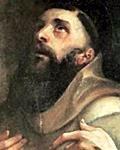
Painting: Pala Bardi, by Maestro del San Francesco, from Santa Croce, Florence. Courtesy Silvia Paoletti.
St Francis of Assisi is the patron saint of the environmental movement. The Canticle is a beautiful statement of his credo, of the one-ness of all life and creation, united in St Francis' perception as expressions of the immense love of the Almighty.
But above all, St Francis lived a very simple life, of poverty – he married Lady Poverty. And he maintained Chastity to Poverty. Hence he was unfailingly one with the poor and suffering.
"Blessed are the poor in spirit: for theirs is the kingdom of heaven."
Gospel of St. Matthew , Sermon on the Mount, 5:3.
So St Francis of Assisi should actually be counted as the First in the procession of Friends of the Poor.
The world might advance in knowledge, in technology, in feats of wealth, in art and aesthetics and metaphysics … but it will remain hollow at the core, and fundamentally bereft spiritually and morally as long as poverty casts a shadow on humankind. But in order to do anything that can impact positively on the lives of the poor, one’s heart must not merely bleed for, but with the poor.
Whatever may be said about Mother Teresa of Calcutta, she too was unfailingly one with the poor, and the poor above anybody else. Abbe Pierre, who passed away recently, was another contemporary exemplar of this.
Today, 4th October, is the Feast Day (i.e. death anniversary) of St Francis of Assisi, one of the most loving and beloved figures associated with the Roman Catholic faith.
St. Francis was born at Assisi in Italy in 1182. After a carefree youth, he turned his back on inherited wealth and committed himself to God. He lived a very simple life of poverty – he married Poverty. He gained a reputation of being a friend of birds and animals. He established the rule of St Francis, which exists today as the Order of St. Francis, or the Franciscans. He died in 1226, aged 44. St Francis of Assisi is the patron saint of the environmental movement.
I first learnt about St Francis through coming across the Prayer associated with his name.
Here's a clip from the film Brother Sun, Sister Moon (1972), directed by Franco Zeffirelli, showing the Prayer.
Lord, make me an instrument of your peace, Where there is hatred, let me sow love; where there is injury, pardon; where there is doubt, faith; where there is despair, hope; where there is darkness, light; where there is sadness, joy;
O Divine Master, grant that I may not so much seek to be consoled as to console; to be understood as to understand; to be loved as to love.
For it is in giving that we receive; it is in pardoning that we are pardoned; and it is in dying that we are born to eternal life.
Some years later I found The Little Flowers of Saint Francis, a collection of beloved stories about St. Francis and the early days of his Order.
But it was only after reading Nikos Kazantzakis’ brilliant, empathic fictionalised biography of St Francis of Assisi, God’s Pauper (published in 1950), that I felt a close and fond bond with him. A reviewer in Amazon.com writes about God’s Pauper:
"Reading Kazantzakis' St. Francis is a consistently joyful, frequently ecstatic experience. A fictionalized account of the life of St. Francis, this novel allows the reader to know the saint almost personally. Told through the eyes of his loyal companion, the story not only chronicles the historic events in the life of St. Francis, but also captures the tumultuous essence of a life lived in longing for ever more service to God. This is one of the best books about St. Francis in existence. "
I was also fortunate to find in the RIMC Library in Dehradun – serendipity - In the Steps of St Francis by Ernest Raymond, another wonderful introduction (published in 1938) to this remarkable and lovable figure, in which the author sketches St Francis’ personality while visiting several places associated with him.
Also in the RIMC Library was the magnificent collector’s item, St. Francis of Assisi: 1226-1926: Essays in Commemoration, edited by Walter Seton, which was published by the University of London in 1926. (This book was given to the library by a master in the school, an Englishman, who had received it shortly after it was published, as a gift from someone in his family!)
Song, music, and poetry were so deeply a part of the nature of Saint Francis that in times of sorrow and sickness as well as of joy and good health he spontaneously gave voice in song to his feelings, his inspirations, and his prayers.
The clearest expression of this aspect of the personality of the Poverello is the "Canticle of Brother Sun".
G. K. Chesterton, in his reflections on the saint, wrote of this work: "It is a supremely characteristic work and much of Saint Francis could be reconstructed from that work alone."
And Eloi Leclercq has written: "The manner in which Francis here looks at the created world is a key to his inner self, for the Canticle undoubtedly has elements that reveal in a special way the personality of its author." The most characteristic Franciscan contribution to poetry and music is found in a body of informal spontaneous hymns called laudi spirituali - songs of praise or, simply, "lauds" -traceable directly to St. Francis and his immediate circle. The practice of spontaneous hymn singing continued from his time onward and in the 14th century was firmly established as the most popular form of religious music.
In music, as in his religious work, St. Francis drew together the sacred, courtly, and popular traditions. The lauds were thus a poetic bridge between the traditional music of the Church, the music of the castle, and the music of the streets. The words always had a religious theme; often they were mere paraphrases of psalms and litanies sung to popular airs, but, above all, they were music and poetry that the people could both sing and feel with their hearts.
The lauds were folk-like in spirit, simple and direct in their appeal, and sung either as solos or jointly with others in unison. The lauds became the special and characteristic expression of the Franciscans.
The Canticle of the Sun (or The Canticle of the Creatures), known definitely to be by St. Francis, is at once the most sublime of all the lauds as well as the most original. The legend goes that when St. Francis was recovering from an illness in a hut outside the convent of St. Clare, the nuns heard from his lips this rapturous new song. The informality, even casualness, of its composition and its rambling rhythms and rhymes make it as simple and unaffected in its form as the Umbrian dialect in which it is written. It is thus characteristically opposed to the canons of scholarly Latin on one hand and to the erotic courtly utterances of the troubadours on the other. Sincerity and deep human feeling dominate the unequal strophes of St. Francis' songs of praise, rather than any attempt at learned communication or poetic elegance.
The text of the Canticle in the original Italian (Umbrian), together with a recitation of this (MP3) is available here.
In translation:
Most High, all-powerful, good Lord, Yours are the praises, the glory, the honor, and all blessing. To You alone, Most High, do they belong, and no man is worthy to mention Your name.
Praised be You, my Lord, with all your creatures, especially Sir Brother Sun, Who is the day and through whom You give us light. And he is beautiful and radiant with great splendor; and bears a likeness of You, Most High One.
Praised be You, my Lord, through Sister Moon and the stars, in heaven You formed them clear and precious and beautiful.
Praised be You, my Lord, through Brother Wind, and through the air, cloudy and serene, and every kind of weather through which You give sustenance to Your creatures.
Praised be You, my Lord, through Sister Water, which is very useful and humble and precious and chaste.
Praised be You, my Lord, through Brother Fire, through whom You light the night and he is beautiful and playful and robust and strong.
Praised be You, my Lord, through our Sister Mother Earth, who sustains and governs us, and who produces varied fruits with colored flowers and herbs.
Praised be You, my Lord, through those who give pardon for Your love and bear infirmity and tribulation. Blessed are those who endure in peace for by You, Most High, they shall be crowned.
Praised be You, my Lord, through our Sister Bodily Death, from whom no living man can escape. Woe to those who die in mortal sin. Blessed are those whom death will find in Your most holy will, for the second death shall do them no harm.
Praise and bless my Lord and give Him thanks and serve Him with great humility.
Here's a clip from Franco Zeffirelli's Brother Sun, Sister Moon (1972), with Donovan singing a song based on the Canticle.
Another interesting video-clip of a song in Italian, sung by Claudio Baglioni to the musical score of Riz Ortolani, from the Italian version of the same film, titled Fratello Sole, Sorella Luna, based on the Canticle is shared below.