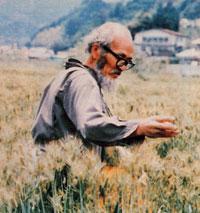
I learnt about the name of Masanobu Fukuoka, and about his celebrated book
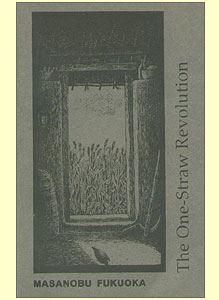
The One-Straw Revolution, in 1985.
Masanobu Fukuoka is one of the most radical and influential agrarian thinkers of the 20th century. 'One Straw' describes the events that led to the development of Fukuoka's concept of '
natural farming'.
Fukuoka was born on 2 February 1913 in Iyo, on a southern island of Japan. After graduating in agriculture, he took a job at the Yokohama Customs Office. At the age of 25, however, he caught acute pneumonia and was hospitalized. Those days spent alone became a turning point in his life. Even after leaving the hospital, he continued to agonize in his mind about matters of life and death. After spending many days in emotional hardship, one morning, a flash of insight came to him:
"There is nothing in this world. No matter what humans try to do, they can never achieve anything. Every thought we have and every action we take is unnecessary." This was the birth of Fukuoka's philosophy, "the theory of uselessness of human knowledge," or the theory of "
mu" (nothingness).
To demonstrate his theories in a concrete and practical way, he decided in 1937 to return to his native mountain village and become a farmer at his father's orange orchard. In 1939, he started to work at an agricultural research station in Kochi Prefecture as an instructor and researcher of scientific farming, and continued there until the end of the 2nd World War. He returned to Iyo in 1947, and thereafter continued to work on his unique natural farming system.
Fukuoka emphasises the basic principles of no tilling, no chemical fertilizer, incorporating and controlling useful weeds and rather than eradicating them. Using these
methods Fukuoka produces greater crops than achieved by chemical based modern farming practices. Year by year the soil becomes richer and more productive.
When he visited America in 1979 and saw California's desertified land, the thought occurred to him that his natural farming method would work to green these regions. Visiting American communities working on natural farming, he kept telling people that modern large-scale farming and cattle-raising were causing desertification. During one of these speaking tours, the head of the United Nations department in charge of combating desertification asked him for technical advice. This was the starting point of Fukuoka's initiative for desert greening all over the globe: in China, India, the Americas, and Africa.
He considers food the most significant factor for human life, and he repeatedly uses the Taoist or Buddhist term "
shindo-fuji" in his books, which literally means that body (
shin) and earth (
do) are inseparable (
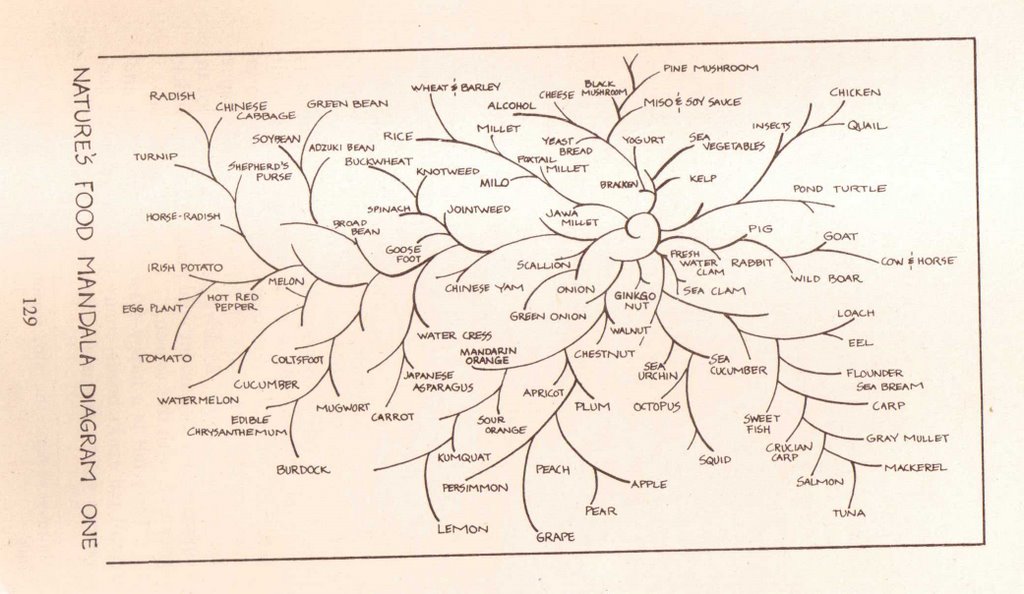
fuji). He says that humans and the environment are united. When people eat food in season and grown on the very land where they live, their bodies can be sound and in harmony with the environment.
His work, and this book, have inspired and changed the lives of people around the world. His message is as relevant today as when the book was written (in 1975).
Fukuoka is a sage-like father-figure in the field of natural farming. He prescribes “do nothing farming”, which is to say, doing nothing but following nature’s way. (As does
Wes Jackson, of the Land Institute in Kansas, who advocates sustainable farming through learning from the prarie).
Masanobu Fukuoka has many disciples and followers in India. One of them is Ardhendu Chatterjee, of
DRCSC, who has devoted his life to practicing and enabling natural farming.