
Showing posts with label indigenous people. Show all posts
Showing posts with label indigenous people. Show all posts
Sunday, July 10, 2011
We won't give up the Fight!
The song says it all. Nothing more remains to be said.
Thank you Meghnath Bhattacharjee. As Fr Beckers told you, we are proud and happy that you are our friend.


Tuesday, December 07, 2010
Anjan Ghosh memorial lecture
The Sociological Association, West Bengal is organising the first Anjan Ghosh Memorial Lecture. Anjan, a social scientist, teacher, activist and public intellectual, passed away suddenly 6 months ago, and today it's only clearer that the void he left can never be filled.
The lecture will be delivered by sociologist and historian, Ramachandra Guha, a former student of Anjan Ghosh. The title of the lecture: "The Tragedy of the Indian Adivasis".
Date: Sat, 18 December 2011
Venue: St Xavier's College auditorium, 30 Park Street, Calcutta
Time: 2 30 pm
All are invited to attend.
There is also another lecture in memory of Anjan Ghosh:
Professor Gyanendra Pandey, Professor in History, Emory University, Atlanta, USA
will give a talk titled
"Subalternity of Difference or the Difference of Subalternity"
Date: Tuesday, December 21, 2010
Time: 3 -5 PM.
Venue: Seminar Room, Centre for Studies in Social Sciences (CSSSC) , Patuli, Calcutta.
The lecture will be delivered by sociologist and historian, Ramachandra Guha, a former student of Anjan Ghosh. The title of the lecture: "The Tragedy of the Indian Adivasis".
Date: Sat, 18 December 2011
Venue: St Xavier's College auditorium, 30 Park Street, Calcutta
Time: 2 30 pm
All are invited to attend.
There is also another lecture in memory of Anjan Ghosh:
Professor Gyanendra Pandey, Professor in History, Emory University, Atlanta, USA
will give a talk titled
"Subalternity of Difference or the Difference of Subalternity"
Date: Tuesday, December 21, 2010
Time: 3 -5 PM.
Venue: Seminar Room, Centre for Studies in Social Sciences (CSSSC) , Patuli, Calcutta.
Sunday, October 11, 2009
Inclusion and "quality"

The sociologist, Andre Beteille, delivered a lecture in Calcutta in March which I attended.
He touched upon academic quality versus inclusion (e.g. through reservation or affirmative action), and said quality need not be compromised. At the end of the lecture, I asked him to elaborate a bit on this issue of quality versus inclusion; some may think inclusion compromises quality, while others may assert that quality itself is arbitrarily defined around certain privileges. What is the meaning of quality in a democratic and inclusive society?
I did not find his answer interesting.
What I meant was:
We are all familiar with the conventional notion that inclusion will compromise “quality”, and that can be argued against, and qualified, like he did … My point was something else: WHAT is this wonderful thing called “QUALITY”? What are the historically, cognitively rooted biases in its definition? Whether western / imperial / colonial, or Brahminical / Manuvadi…
Let me give some examples, both of which are not academic but real things I have encountered.
Let us say a “backward class” peasant’s son joins an agricultural engineering course. Does his whole store of experiential knowledge of cultivation, from his personal knowledge, from his own life and that of his family and community, count for anything in this “scientific domain”? Will it be a one-way traffic, of him receiving the wisdom of that discipline? Or will that discipline be open to receiving his knowledge and try to re-constitute itself on that basis?
Similarly, with, say, an adivasi’s knowledge of flora and fauna and the scientific domain of forestry. Prof Kailash Malhotra (the anthropologist), and Madhu Ramnath (who lived for years among the Gond as one of them and took up “adivasi botany”) have given me fascinating accounts of “adivasi taxonomy” of animal life and plants respectively, from Midnapore and Bastar, again respectively. Would the disciplines of zoology, botany and forestry re-constitute themselves on the basis of such knowledges? Is there a horizontal or equal relationship in the dialogue of knowledges; or a rigid hierarchical one? Does the very definition of existing disciplines have much meaning in the face of the alternative worldview?
Is there a whole new “way of knowing” waiting to be glimpsed by human society, with today’s “backwards”, indigenes and marginals being the emissaries of those songs and tales that have never been heard before?
Sunday, June 28, 2009
Bengal
I had been travelling in some of the districts of north Bengal (Murshidabad, Dakshin Dinajpur and Koch Bihar). That was a most humbling, educative and inspiring experience. Living in Calcutta, life can be bleak. But my travels through rural Bengal filled me with cheer and hope, as I witnessed the promise of a new dawn for the people in the land of Bengal. A watershed in my life, self-discovery, roots, renewal...
Here are some images from my travels. See the complete set of images here.


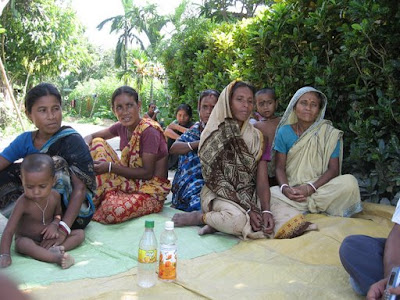
Here are some images from my travels. See the complete set of images here.


Wednesday, January 28, 2009
A Directive of Shame

Last month, I learned from Mireille Fanon Mendes France about Evo Morales' open letter to the European Parliament.
Evo Morales is the first indigenous President of Bolivia. He took the initiative to prepare this text before the European Parliament’s vote on the European directive on immigration which its opponents call the "shameful directive". The directive aims at making Europe a fortress against immigration by harmonizing the rules about the detention and expulsion of immigrants. It was voted by the European Parliament on 18 June 2008. The amendment against the directive that was proposed by the United European Left (GUE-Nordic Green lLeft) got 114 votes, the directive 538.
In the name of the people of Bolivia, and of all my brothers on earth, I make this appeal to the consciences of leaders and citizens, on the text of this "directive for return".
Up until the end of the World War II, Europe was an emigrant continent. Tens of thousands of Europeans departed for the Americas to colonize, to escape hunger, the financial crisis, the wars or European totalitarianisms and the persecution of ethnic minorities.
Today, I am following with concern the process of the so called "Return Directive". The text, validated last June 5th by the Interior Ministers of 27 countries in the European Union, comes up for a vote on June 18 in the European Parliament. I feel that it constitutes a drastic hardening of the detention and expulsion conditions for undocumented immigrants, regardless of the time they have lived in the European countries, their work situation, their family ties, or their will and achievements in integration.
Europeans arrived en masse in Latin and North America, without visas or conditions imposed on them by the authorities. They were simply welcomed, and continue to be, on our American continent, which absorbed the European economic misery and political crisis at that time. They came to our continent to exploit the natural wealth and to transfer it to Europe, with a high cost to the original populations in America. As is the case of our Cerro Rico de Potosi and its fabulous silver mines, which provided this mass of monetary wealth to the European continent from the 16th to the 19th centuries. The people, the wealth and the rights of the migrant Europeans were always respected.
Today, the European Union is the main destination for immigrants around the world. This is a consequence of Europe’s positive image of space and prosperity and public freedom. The great majority of immigrants go to the EU to contribute to this prosperity, not to take advantage of it. They are employed in public works, construction, and in services to people in hospitals, in jobs the Europeans cannot perform or do not want. They contribute to the demographic dynamics of the European continent, maintaining the relationship between the employed and the retired which provides for the generous social security system and helps the dynamics of internal markets and social cohesion. The migrant offers a solution to demographic and financial problems in the EU.
For us, our emigrants represent help in development that Europeans do not provide us in return – since few countries really reach the minimum objective of 0.7% of its GDP in development assistance. Latin America received, in 2006, remittance (monies sent back) totaling 68 billion dollars, or more than the total foreign investment in our countries. On the worldwide level it reached 300 billion dollars which is more than 104 billion authorized for development assistance. My own country, Bolivia, received more than 10% of the GDP in remittance (1.1 billion dollars) equal to a third of our annual exports of natural gas.
It is clear that the flow of immigration benefits Europe, and, to a slight degree, the Third World (since we lose millions of qualified workers, in whom, in one manner or another, the states in question, despite their poverty, have make considerable financial and human investment).
Unfortunately, "Return Directive" project is an enormous complication to this reality. While we can agree that each State or group of States can define their migratory policies in true sovereignty, we cannot accept that the fundamental rights of the people be denied to our compatriots and brother Latin-Americans.
The "Return Directive" foresees the possibility of jailing undocumented immigrants for up to 18 months before their expulsion – they call it "distancing", according to the terms of the directive. 18 months! Without a judgment or justice! As it stands today the proposed text of the directive clearly violates articles 2, 3, 5,6,7,8 and 9 of the Universal Declaration of Human Rights of 1948.
In particular, Article 13 of the Declaration states :
1. All persons have a right to move freely and to choose their residence in the territory of a State.
2. All persons have the right to leave any country, including their own, and to return to their country.
And, the worst of all, is that the possibility exists for the mothers of families with minor children to be arrested, without regard to the family and school situation, in these internment centers where we know that depression, hunger strikes, and suicides take place.
How can we accept without reacting for them to be concentrated in camps, our compatriots and Latin American brothers without documents, of which the great majority have been working and integrating for years? On what side is the duty of humanitarian action? Where is the "freedom of movement", protection against arbitrary imprisonment?
In parallel, the European Union is trying to convince the Andean Community that the Nations (Bolivia, Colombia, Ecuador and Peru) sign an "Association Agreement" that includes the third pillar of the Free Trade Agreement, of the same nature and content as that imposed by the United States. We are under intense pressure from the European Commission to accept conditions of great liberalization of our trade, financial services, intellectual property rights and our public works. In addition under so called "judicial protection" we are being pressured concerning our nationalization of the water, gas and telecommunications, completed on Worldwide Workers’ Day.
I ask, in that case, where is the "judicial protection" for our women, adolescents, children and workers that look for better horizons in Europe? To promote, on one hand, the free circulation of merchandise and flow of currencies and investments, while we face the imprisonment of our brothers who attempt to circulate freely, this is to deny the foundations of liberty and human rights.
Under these conditions, if the "Return Directive" is passed, we will be ethically unable to deepen the negotiations with the European Union, and we reserve the right to legislate that the European Citizens have the same obligations for visas that they impose on the Bolivians from the first of April 2007, according to the diplomatic principle of reciprocity. We have not exercised it up until now, precisely because we were awaiting good signs from the EU.
The world, its continents, its oceans and its poles undergo difficulties of a global scale: global warming, contamination, the slow but sure disappearance of the energy resources and biodiversity while hunger and poverty increase in every country, debilitating our societies. To make migrants, whether they have documents or not, the scapegoats of these global problems, is not the solution. It does not correspond with any reality. The social cohesion problems that Europe is suffering from are not the fault of the migrants, rather the result of the model of development imposed by the North, which destroys the planet and dismembers human societies.
In the name of the people of Bolivia, of all of my brothers on the continent and regions of the world like the Maghreb and the countries of Africa, I appeal to the conscience of the European leaders and deputies, of the peoples, citizens and activists of Europe, for them not to approve the text of the "Return Directive". As it is today, it is a directive of shame.
I also call on the European Union to elaborate, over the next months, a migration policy that is respectful of human rights, which allows us to maintain this dynamic that is helpful to both continents and that repairs once and for all the tremendous historic debt, both economic and ecological, that the European countries owe to a large part of the Third World, and to close once and for all the open veins of Latin America. They cannot fail today in their "policies of integration" as they have failed with their supposed "civilizing mission" from colonial times.
Receive all of you, authorities, Euro parliamentarians, brothers and sisters, fraternal greetings from Bolivia. And in particular our solidarity to all of the "clandestinos".
Evo Morales Ayma
President of the Republic of Bolivia
Saturday, August 04, 2007
Voices from the soil
Yesterday evening, after a long time I had a reunion with my old friend and comrade, Dr Pasupati Prasad Mahato. Pasupati-da is a distinguished anthropologist and social and cultural activist.
We met again today afternoon. He gave me a copy of his recently published book of poems (in Bengali) Manbhum Ma Hamar (Manbhum, My Mother: A Collection of Adivasi Bengali Poetry). The book has been published by Shobar Ganyer Khobor (Calcutta, 2007).
Pasupati-da selected and read out to me two of his poems from this volume, written in his native Purulia dialect. I present them below, together with my translation.

shombuk aajo
ramchandra uakey sidhailo tumi ke hey?
uttar ailo, hami shombhuk, jatitey shudro.
ramchandra sidhailo, tumi ki koirchho?
uttar ailo, hami baed path korchhi.
proja botshol ram, gota desher raja
ragey gur-gurayn, tolwar tainey
ghochang korey dilo shombhuker gola kaitey
shurdrer baed path cholbek nain.
manusanghitar ain, ramchandra rokhok,
ain omainnyo korlaey rashtrodrohi
shasti to patei hobek.
mrityudondo mrityudondo mrityudondo.
shombhuker gola kathchhey ainer rokhokra,
rashter biruddhey judhyo ghoshona,
eeta shoibhek nain,
hamra gonotontrer raja, shoibo nain.
shombuk-ke khujte ramayan ghantley pabi
ekhon jey ramayan choilchhey
otha domey samajsebider dolkhani,
shombhukra ekhon jailey, Bina bicharey.
bichhinotabadi, prithokotabadi,
rashtrodrohi shombhuk,
e’der gharey kota matha!!
shombhukra moirlo 14 march 2007 ey
nandigramey, nandigram tomakey selam.
Shambuk today too
Lord Rama asked him: Who are you?
He replied: I am Shambuk, Shudra by caste.
Lord Rama asked: What are you doing?
He replied: I am reciting the Vedas.
Rama, the ruler of the masses, is the king of the nation
Trembling with rage, drawing his sword,
Decapitated Shambuk with a single stroke.
A Shudra must never recite the Vedas.
The Law of Manusamhita, Lord Rama is its protector
Violation of the law is anti-national.
He must be punished!
Capital Punishment! Capital Punishment! Capital Punishment!
The protectors of the law are decapitating Shambuks
Declaration of war against the state?
This cannot be tolerated,
We are the kings of democracy, we won’t tolerate it.
To find Shambuk search through the Ramayana,
But the Ramayana of today -
Is brimming with the arrogance of social liberators,
Shambuks are in gaol, without trial.
Separatist, secessionist
Treacherous Shambuks,
Who, pray, are these fellows?
Shambuks were killed on 14 March 2007
In Nandigram, Nandigram we salute you!
(Translator's note: Shambuk is a Shudra character in the Ramayana. In the epic, after Rama has assumed the throne of Ayodhya following his return from exile, a Brahmin accuses him of causing the death of his son by his toleration of the Shudra, Shambuk, who has violated the caste hierarchy by engaging in extreme penances. In order to redress the situation, Rama searches for, finds and kills Shambuk. And the Brahmin boy comes back to life.)


Toutor
gota puruliay toutor toutor
domey liyai ke bodo toutor, babur?
court kachariye toutor,
jomi registri-ye toutor
thanay toutor, party office-ey toutor,
panchayat-ey toutor.
uara anchla paitey ghurchhey,
somajsebi-ke bishisto samajsebi boley
shwor ta chaikhey dhekrichhey
bolchhey hami puruliar toutor
chho nachey programme patey,
bidesh jaitey toutor dhor
suratey lebar legbi taw
mota taka niye toutor dhor.
hashpataley bhorti kortey
toutor dhor -
oxygen cylinder patey
toutor dhor
na holey anjona mahato’r
lekhen morbi.
chaila bhorti korbi schooley, toutor dhor,
B.Ed-ey bhorti hobi toutor dhor -
gota puruliyai toutorer desh.
toutor dhorei to legechhilo
koilkata patal railey
ghurli jokhon, tokhon TB,
ley ibar toutor dhor.
Touts
The whole of Purulia is full of touts!
A great competition over who’s the greatest tout of the babus!
Touts in the courts
Touts in the land registration offices
Touts in the police stations, touts in the party offices
Touts in the village government.
They go around with their collection cloth held out
The social liberators are termed as “distinguished social liberators”
Burping after swallowing the cream,
They declare, “We are the touts of Purulia!”
Want to get a chance to go abroad for the Chho dance programme?
Catch the touts.
Want to be a labour supplier to Surat?
Catch touts, with a big pile of money.
Want to get hospital admission?
Catch touts.
Need an oxygen cylinder?
Catch touts.
Or else, you will die, like Anjana Mahato.
Want to admit your child to school? Catch the touts.
Want to be admitted to the Bachelor of Education course? Catch the touts.
The whole of Purulia is tout country .
‘Twas through touts that I got to work
In Calcutta’s metro rail.
When I returned, I had tuberculosis.
There, now to go and catch the touts!
[Translator's note: In colloquial parlance, "tout" refers to fixers or middlemen, an entity with which Bengal society, and especially the Communist Party of India (Marxist), or CPI(M), is brimming. Anjana Mahato is the poet's mother.]
We met again today afternoon. He gave me a copy of his recently published book of poems (in Bengali) Manbhum Ma Hamar (Manbhum, My Mother: A Collection of Adivasi Bengali Poetry). The book has been published by Shobar Ganyer Khobor (Calcutta, 2007).
Pasupati-da selected and read out to me two of his poems from this volume, written in his native Purulia dialect. I present them below, together with my translation.


shombuk aajo
ramchandra uakey sidhailo tumi ke hey?
uttar ailo, hami shombhuk, jatitey shudro.
ramchandra sidhailo, tumi ki koirchho?
uttar ailo, hami baed path korchhi.
proja botshol ram, gota desher raja
ragey gur-gurayn, tolwar tainey
ghochang korey dilo shombhuker gola kaitey
shurdrer baed path cholbek nain.
manusanghitar ain, ramchandra rokhok,
ain omainnyo korlaey rashtrodrohi
shasti to patei hobek.
mrityudondo mrityudondo mrityudondo.
shombhuker gola kathchhey ainer rokhokra,
rashter biruddhey judhyo ghoshona,
eeta shoibhek nain,
hamra gonotontrer raja, shoibo nain.
shombuk-ke khujte ramayan ghantley pabi
ekhon jey ramayan choilchhey
otha domey samajsebider dolkhani,
shombhukra ekhon jailey, Bina bicharey.
bichhinotabadi, prithokotabadi,
rashtrodrohi shombhuk,
e’der gharey kota matha!!
shombhukra moirlo 14 march 2007 ey
nandigramey, nandigram tomakey selam.
Shambuk today too
Lord Rama asked him: Who are you?
He replied: I am Shambuk, Shudra by caste.
Lord Rama asked: What are you doing?
He replied: I am reciting the Vedas.
Rama, the ruler of the masses, is the king of the nation
Trembling with rage, drawing his sword,
Decapitated Shambuk with a single stroke.
A Shudra must never recite the Vedas.
The Law of Manusamhita, Lord Rama is its protector
Violation of the law is anti-national.
He must be punished!
Capital Punishment! Capital Punishment! Capital Punishment!
The protectors of the law are decapitating Shambuks
Declaration of war against the state?
This cannot be tolerated,
We are the kings of democracy, we won’t tolerate it.
To find Shambuk search through the Ramayana,
But the Ramayana of today -
Is brimming with the arrogance of social liberators,
Shambuks are in gaol, without trial.
Separatist, secessionist
Treacherous Shambuks,
Who, pray, are these fellows?
Shambuks were killed on 14 March 2007
In Nandigram, Nandigram we salute you!
(Translator's note: Shambuk is a Shudra character in the Ramayana. In the epic, after Rama has assumed the throne of Ayodhya following his return from exile, a Brahmin accuses him of causing the death of his son by his toleration of the Shudra, Shambuk, who has violated the caste hierarchy by engaging in extreme penances. In order to redress the situation, Rama searches for, finds and kills Shambuk. And the Brahmin boy comes back to life.)


Toutor
gota puruliay toutor toutor
domey liyai ke bodo toutor, babur?
court kachariye toutor,
jomi registri-ye toutor
thanay toutor, party office-ey toutor,
panchayat-ey toutor.
uara anchla paitey ghurchhey,
somajsebi-ke bishisto samajsebi boley
shwor ta chaikhey dhekrichhey
bolchhey hami puruliar toutor
chho nachey programme patey,
bidesh jaitey toutor dhor
suratey lebar legbi taw
mota taka niye toutor dhor.
hashpataley bhorti kortey
toutor dhor -
oxygen cylinder patey
toutor dhor
na holey anjona mahato’r
lekhen morbi.
chaila bhorti korbi schooley, toutor dhor,
B.Ed-ey bhorti hobi toutor dhor -
gota puruliyai toutorer desh.
toutor dhorei to legechhilo
koilkata patal railey
ghurli jokhon, tokhon TB,
ley ibar toutor dhor.
Touts
The whole of Purulia is full of touts!
A great competition over who’s the greatest tout of the babus!
Touts in the courts
Touts in the land registration offices
Touts in the police stations, touts in the party offices
Touts in the village government.
They go around with their collection cloth held out
The social liberators are termed as “distinguished social liberators”
Burping after swallowing the cream,
They declare, “We are the touts of Purulia!”
Want to get a chance to go abroad for the Chho dance programme?
Catch the touts.
Want to be a labour supplier to Surat?
Catch touts, with a big pile of money.
Want to get hospital admission?
Catch touts.
Need an oxygen cylinder?
Catch touts.
Or else, you will die, like Anjana Mahato.
Want to admit your child to school? Catch the touts.
Want to be admitted to the Bachelor of Education course? Catch the touts.
The whole of Purulia is tout country .
‘Twas through touts that I got to work
In Calcutta’s metro rail.
When I returned, I had tuberculosis.
There, now to go and catch the touts!
[Translator's note: In colloquial parlance, "tout" refers to fixers or middlemen, an entity with which Bengal society, and especially the Communist Party of India (Marxist), or CPI(M), is brimming. Anjana Mahato is the poet's mother.]
Thursday, April 12, 2007
Public intellectual of the other India

I had written earlier (here, here and here) about my friend Rahul. Today, Bhupinder has written an appreciation of Rahul’s memoir of his activism in central India in (How the Other Half Lives).
Bhupinder writes:
It is written in the manner of a well read and well-engaged activist, his range of reading is mind boggling, and his experiences as a foot-soldier organizer among the people he chose to work with, fascinating.
But the most exhilarating aspect of the book is is the harmony between thought and action, a constant dialectic between theory and action. Small is the tribe of such people, and fewer still are those who have documented their experience and engagement with some of the poorest of the poor in the country.
He concludes by saying:
Rahul Banerjee has not been able to give back the tongue to the adivasis. But he has learnt their language and spoken for them. And in the process, has etched the ideas and struggles that have defined the sensitivities of our age.
One hopes that he continues to carry forward as a crusading public intellectual of the other India.
Friday, March 23, 2007
Bhagat Singh

"It is easy to kill individuals but you cannot kill the ideas. Great empires crumbled while the ideas survived."
This year marks the birth centenary of Shaheed (martyr) Bhagat Singh (28 Sept 1907 - 23 March 1931). 76 years ago today, Bhagat Singh was hanged in Lahore, with his fellow comrades Rajguru and Sukhdev.
As an Indian and Southasian, the memory of Bhagat Singh is sacred to me. His revolutionary ideals, his bravery, his towering example and efforts for inter-community unity and harmony - are as relevant today as they were during the British Raj.
If Mahatma Gandhi is the Father of the Nation, then Bhagat Singh is the Son of the Nation, the pride of every mother. May such brave sons be born again and again in this land.
Read Vidya Bhushan Rawat's tribute to Bhagat Singh here.
In the evening I attended the release of a commemorative volume on revolutionary martyrs Bhagat Singh, Jatin Das and Chandrasekhar Azad, edited by my dear friend and comrade Sandip Bandopadhyay, educator and writer.

Wednesday, January 03, 2007
Recovering the Lost Tongue

My dear friend from my childhood, Rahul, has put up on the internet his account of his activist journey from 1983, when he fixed his personal life goals to the cause of empowerment of oppressed indigeneous peoples; in 1985 Rahul began working with the Bhil adiviasis (indigenous peoples) in central India. Thank you Rahul for this labour of love.
Rahul's book reminds me of Frederick Engels' words in the Introduction to the English edition of his Socialism: Utopian and Scientific, in which he wrote:
… It thus became necessary to take up the gauntlet thrown down to us, and to fight out the struggle whether we liked it or not.
This, however, though it might not be an over-difficult, was evidently a long-winded business. As is well known, we Germans are of a terribly ponderous Gründlichkeit, radical profundity or profound radicality, whatever you may like to call it. Whenever any one of us expounds what he considers a new doctrine, he has first to elaborate it into an all comprising system. He has to prove that both the first principles of logic and the fundamental laws of the universe had existed from all eternity for no other purpose than to ultimately lead to this newly discovered, crowning theory. And Dr. Dühring, in this respect, was quite up to the national mark. Nothing less than a complete System of Philosophy, mental, moral, natural, and historical, a complete System of Political Economy and Socialism ; and, finally, a Critical History of Political Economy -- three big volumes in octavo, heavy extrinsically and intrinsically, three army corps of arguments mobilized against all previous philosophers and economists in general, and against Marx in particular - in fact, an attempt at a complete "revolution in science" - these were what I should have to tackle. I had to treat of all and every possible subject, from the concepts of time and space to bimetallism, from the eternity of matter and motion to the perishable nature of moral ideas; from Darwin's natural selection to the education of youth in a future society. Anyhow, the systematic comprehensiveness of my opponent gave me the opportunity of developing, in opposition to him, and in a more connected form than had previously been done, the views held by Marx and myself on this great variety of subjects. And that was the principal reason which made me undertake this otherwise ungrateful task.
Here’s an extract from the introduction to Rahul's book.
Recovering the Lost Tongue is in a broad sense a manifesto of Anarcho-Environmentalism. This is told in the epic story telling style of the Bhil adivasis of central India who are its main protagonists. The tales of their struggles as well as the analysis of these are presented through the life experiences of two of the activists associated with the people's movements - the author, and his wife Subhadra Khaperde. The narrative has in addition a rich mixture of various other stories and histories, ancient and modern, local and global. The stories are all liberally laced with humour. There is also an element of suspense as the plot builds up through the various micro narratives, some personal, some organisational, some mythical and some historical, all woven together into the meta-narrative of the overall struggle against destructive modern development. Finally the tale reaches a very entertaining, well-argued and philosophically uncommon climax.
Despite the fact that Anarcho-Environmentalist movements have not been able to make a mass impact big enough to be able to achieve what they have set out to do, they have succeeded in underlining the crucial need for ensuring environmental sanity and socio-economic justice. Analysing in detail the characteristics of the present dominant development model and the reasons for its hegemony, the book ends by charting out a course to keep pegging at changing it for the better. The ending is a positive one, providing a modus operandi whereby even ordinary people can, singly, or in groups, act to bring about a saner socio-economic and environmental dispensation.
The name of the book is taken from a Bhili fable, as it is a description of the organised efforts of marginalised people trying to speak out against their oppression, which they had previously been suffering mutely in a culture of silence.
Read Recovering the Lost Tongue here.
Photo: Bhil father and son, by Peter Stalker, New Internationalist.
Saturday, December 16, 2006
Forest dwellers empowered

A bill that for the first time grants indigenous forest-dwelling communities the right to live in the forests was passed in the Lok Sabha (the lower house of India's parliament) yesterday.
The Scheduled Tribes and Other Traditional Forest Dwellers (Recognition of Forest Rights) Bill was passed with all the three major amendments suggested by the left parties.
“Forests and forest-dwelling people are inseparable. One cannot survive without the other,” minister P.R. Kyndiah said.
“There is a recognition of the fact that forests have the best chance to survive if communities participate in their conservation and regeneration. Insecurity of tenure and fear of eviction are the biggest reasons for Adivasis feeling alienated from forests.”
The bill grants the right to live in the forest, the right to access, use or dispose minor forest produce, the right to entitlement, such as grazing and traditional seasonal resource access, and the right to protect, regenerate, conserve or manage any community forest resource that was traditionally protected and conserved.
First tabled in December 2005, the bill was sent to a joint parliamentary committee to sort out differences. For a year, the pro-forest dweller advocates within and outside parliament fought with environmentalists who claimed the bill would jeopardise the forests and tigers.
Originally, 1980 was to be the cut-off year, which meant that those who had come to reside in forests after that year could be evicted under the law. This has now been changed to December 2005, when the bill was tabled in the House.
The govt initially wanted to restrict the bill to Adivasis (indigenous communities), but there was a demand that it should cover other forest dwellers as well. The government finally accepted this.
Wednesday, December 06, 2006
Dr BR Ambedkar

6 December is also the death anniversary of Dr BR Ambedkar (1891–1956), the architect of free India’s Constitution, and messiah of the Dalits, India’s former untouchable communities. Today is his 50th death anniversary.
If Mahatma Gandhi is the father of the nation in a spiritual, moral and emotional sense, then we are also Dr Ambedkar’s children in a legal, institutional and civic sense.
In a nation recently ravaged by Hindu-Muslim carnage following the partition of India and the birth of Pakistan; in a nation defined by the millennia-old caste system and its notions of purity and commensality and the practice of untouchability, where some human beings were considered non-human, in one fell stroke it was declared in the Preamble of the Constitution of India:
We, the people of India, having solemnly resolved to constitute India into a Sovereign Democratic Republic and to secure to all its citizens:
JUSTICE, social, economic and political;
LIBERTY of thought, expression, belief, faith and worship;
EQUALITY of status and of opportunity;
and to promote among them all FRATERNITY assuring the dignity of the individual and the unity of the Nation ...
If the Muslim question is something India must resolve or perish, then a similar fundamental question which cannot be ignored is the Dalit question. And the Adivasi question (of India’s indigenous peoples).
The Sachar Committee report on Muslim backwardness has been presented (this is available for download here). The last week saw violence erupting in parts of north India following the desecration of a statue of Dr Ambedkar and protests by Dalit activists. And the rights of indigenous and forest-dwelling communities is also a serious issue of public policy debate right now, with some environmentalists raising questions about the supposed negative environmental implications of this. Industrial and mining companies are being given over lands belonging to indigenous communities. And the Maoists-led insurgency in different areas of India where indigenous peoples live has been declared by the Prime Minister to be free India's most serious security threat.
Globalising India is only further marginalising India’s Muslims, Dalits and Adivasis.
Remembering Dr Ambedkar serves to remind ourselves of the grand vision of India’s Constitution and how far we still have to go to realise that vision.
Thursday, October 19, 2006
Canada's aboriginal policy
Reading the current issue of The Economist last night, I came across two Letters to the Editor which caught my attention. One angered me. And the other pleased me.
First the anger. Readers of this blog from Canada might like to respond to this letter, at letters@economist.com.
Minority status
SIR – The principal reason why Canada's aboriginal policy has failed is the unrealistic and unreasonable basis of aboriginal rights (“This land is my land”, September 16th). These are special rights ceded to native minorities simply for having arrived here earlier, but they are rights which are also incompatible with existing federal and provincial legislation on issues such as resource development. Moreover, natives have no moral claim to these rights. The group of First Nations are demanding rights that they denied each other historically. Elaborate warrior cultures attest that conflict and conquest were rampant in pre-Columbian times and there certainly was no conception of dominant newcomers respecting the rights of people who were already there. This does not imply that Canada's First Nations have no legitimate grievances, but settlements should be based on need, common sense and fairness to all Canadians, not on special rights for the few or to right historical wrongs.
Joseph Bako
Vancouver
First the anger. Readers of this blog from Canada might like to respond to this letter, at letters@economist.com.
Minority status
SIR – The principal reason why Canada's aboriginal policy has failed is the unrealistic and unreasonable basis of aboriginal rights (“This land is my land”, September 16th). These are special rights ceded to native minorities simply for having arrived here earlier, but they are rights which are also incompatible with existing federal and provincial legislation on issues such as resource development. Moreover, natives have no moral claim to these rights. The group of First Nations are demanding rights that they denied each other historically. Elaborate warrior cultures attest that conflict and conquest were rampant in pre-Columbian times and there certainly was no conception of dominant newcomers respecting the rights of people who were already there. This does not imply that Canada's First Nations have no legitimate grievances, but settlements should be based on need, common sense and fairness to all Canadians, not on special rights for the few or to right historical wrongs.
Joseph Bako
Vancouver
Tuesday, June 27, 2006
Maoist revolutionaries
 About a month back, I met Rahul Banerji, a social activist from Madhya Pradesh, who was visting his mother in Calcutta. Rahul and I were in school together in Calcutta (1968-72). We met out of the blue in 1988 and have been in touch off-and-on since then. For over 20 years now, Rahul has been working for the rights of the advisasis or indigenous people of central India, and especially against the depredations of corrupt forest officials, contractors, police and politicians. For his efforts he has been thrown in jail several times - on various trumped up charges, including treason. So we had a long dialogue, on various matters. Most interesting for me was our discussion on "Naxalism", in the course of which Rahul made the distinction between "Naxalism" and "Jihadism", two forms of violent political struggle. (A fortnight earlier, at a conference on city planning in Salzburg, Austria, Prof Franz Oswald, from Zurich, phrased something I said as "violence as a planning tool". So this was very much on my mind.).
In the last week of May, historian Ramachandra Guha, together with 5 others, comprising the ‘Independent Citizens’ Initiative’, travelled through the Maoist controlled areas of central India. The hilly and wooded terrain here is now home to a brutal civil war played out away from the national gaze and mostly unreported by the national press. It is, however, a conflict of the gravest importance to the future of India. According to the ministry of home affairs, the Communist Party of India (Maoist) is active in more than one hundred districts of the country, and at least fifty-five are reckoned to be ‘seriously affected’ by revolutionary violence. Two months ago, the prime minister of India said that this constitutes the gravest internal security threat to the nation, surpassing in its gravity the insurgencies in the North-east and in Kashmir.
The Telegraph carried a 4-part article by Guha, on Naxalites, or the Maoist revolutionaries in India.
Part 1, Part 2, Part 3, Part 4
Subscribe to:
Posts (Atom)

