Showing posts with label dates. Show all posts

Thursday, March 24, 2011

Friendship Day


Today, 24th March - henceforth, I shall remember it and observe it as "Friendship Day".

It is the birthday of a very dear friend, Dayan. He died in a car crash eight years ago. He was less than 28.

Though Dayan was 15 years younger than me, he was a beloved friend. We were in the same team, over the space of a few months, that did the web-portal of the Calcutta Municipal Corporation, "CALMANAC", in 2000 (that is now defunct). I connected with him soon after we first met - thanks to some "zany" interests we shared in common. And we became close friends.

On Dayan's birthday, and on the date of his passing, 19 February, I try to communicate with his parents, and visit his grave. I did that today morning. His parents were in Bombay, and so I went alone to the cemetery, with a mass of marigolds.

As it turned out, today was to be devoted to friends, and I zip-zap-zoo-ed across the city on this mission.

Another dear friend, Samrat, who lives in Assam, was in town, and we agreed to meet despite the narrow "window" of available time. (Samrat and i were on a course together seven years ago. He is also much younger than me.) So after remembering Dayan, I went to meet Samrat, in a coffee shop.

Then on to Debra, a close friend from Durban, South Africa, whom I first met in 1992, someone I would never get to meet in the normal course of things. She was in Calcutta for an important conference. She was in a very hectic situation, and the only time we managed to get was a few minutes around noon, when she exit-ed from a heated discussion to meet her friend.

After that Dr S. That is the anthropologist, Dr MKA Siddiqui. He is a father-figure for me. Despite wanting to, I haven't seen him in a long time, owing to one thing and another. As my movements across the city took me very close to his office, I thought I must see him today. So after seeing Debra, I went to Dr S's office. I had in mind to get from him the correct pronunciation of a Farsi poem by Sa'adi which I want to render to song. I could do that. And i could tell him about another friend, Madhu, who spent twenty years as a friend of the Gond people of Bastar. And also share with him my gladness at possibly visiting again a city I love, Nablus, in Palestine. I was there in 1999 and just being there helped me understand something I'd read Aristotle had said: "Men come together in cities in order to live. They remain together in order to live the good life." My friend, Marwan lives there, and it's thanks to him that I might go there again soon and meet him.

In the evening I attended a meeting and film screening organised by Nagarik Mancha, or Citizens' Forum, a civil society group, to look at what "city development" has come to mean in Calcutta. The Secretary of Nagarik Mancha, Naba Dutta, is an old comrade in public action in the cause of people, from over 25 years ago.

It was only today, thanks to this concatenation of friendly events that it occured to me to call 24 March, a day I associate with a dear friend, Dayan, as Friendship Day. I think meaningful public action can only be built on the pillars of friendship.

I remembered a Sufi tale about "friendship":

Ibrahim dreamed he saw the angel Gabriel writing down the names of the friends of God. Ibrahim asked, “Is my name there?” “No,” the angel replied. Ibrahim said, “I am a friend of the friends of God.” Gabriel was silent for a long time. Then he said, “Ibrahim, I am writing your name at the head of this list.”

And I remembered that one of the 99 names of Allah is - Al-WalĂ­, The Protecting Friend.

Here's to friends!

Saturday, January 03, 2009

Chant 4 Change


From my friend Jai Uttal.

Celebrate the Inauguration of Barack Obama with sacred activist Shiva Rea, world-renowned kirtan/chant artists Jai Uttal, Dave Stringer, Gaura Vani & As Kindred Spirits and 400 other conscious revolutionaries. Join us for a full night of chant, dance, expression and teaching within sight of the White House and the Washington Monument. This is the place to be on the night before the Inauguration. Millions are converging on the nation's capital to witness this once-in-a-lifetime event. Be here now at the heart of the movement! Breathe! Chant! Move! Dance! We will lift our hearts and voices to empower ourselves, our new leaders, our city, our country and our world in this revolutionary gathering of sacred sound and movement.

Note: Register in advance. This event will sell out.

Jai Uttal, Shiva Rea and more

www.brownpapertickets.com/event/50783

Church of the Holy City

1611 NW 16th Street

Washington, DC 20009

www.chant4change.com

Tel: 202-316-2472

DuPont Circle Metro accessible. Street parking is very limited. All ages welcome. Children on laps are free. Drinks and light fare available for purchase.

7:00pm - 11:00pm

After Obama's victory, I had written to Jai:

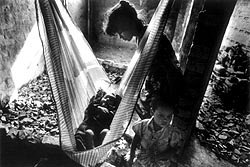
I thought about the music that should inaugurate President Obama's swearing in. The attached picture - the music would convey the expression of grief of the mother, and touch of consolation of her child, and finally a rousing call to the people to make them aware of the gravity and complexity and challenge of what lies ahead and yet give them faith and conviction in their own capability to achieve this, and energise them in every way for that.

Wednesday, September 05, 2007

Teachers' Day

Today, 5 September, is observed as Teachers' Day in India (after the birthday of former President S Radhakrishnan).

Here's the song To Sir With Love, sung by Lulu, from the film of the same title.

Get this widget | Share | Track details

Those schoolgirl days of telling tales and biting nails are gone
But in my mind I know they will still live on and on
But how do you thank someone who has taken you from crayons to perfume?
It isn't easy, but I'll try

If you wanted the sky I would write across the sky in letters
That would soar a thousand feet high 'To Sir, With Love'

The time has come for closing books and long last looks must end
And as I leave I know that I am leaving my best friend
A friend who taught me right from wrong and weak from strong
That's a lot to learn, but what can I give you in return?

If you wanted the moon I would try to make a start
But I would rather you let me give my heart 'To Sir, With Love'

Thursday, June 21, 2007

Sacred Songs blog


Today 21 June, the day of the summer solstice, is World Music Day as well as World Peace & Prayer Day.

To commemorate this day, I have created a Sacred Songs blog.

I started composing and singing devotional songs and chants in 1995, and also began setting to melody verses from sacred texts. I had the opportunity to share these songs with small audiences in different places.

I would like other singers and musicians to listen to these songs and use them as they like. And hence the Sacred Songs blog.

Sarvamangalam, mangalam!

May all living beings, everywhere, be well!


Image: Sculpture, Sacred Songs, by Bob Piercey.

Wednesday, May 02, 2007

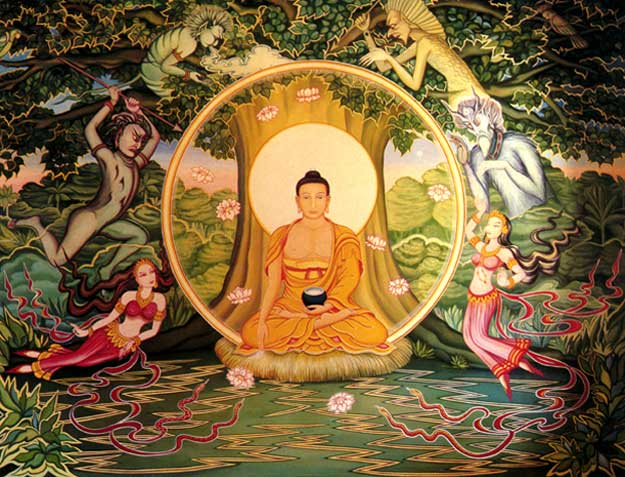
Buddha Purnima


Today is Buddha Purnima, or Vesak, the full-moon associated with the birth, enlightenment and passing away of the Buddha, some 2550 years ago. It is a very auspicious day for Buddhists all over the world.

In an early post, I had written about the Buddha's exclamation on realising enlightenment.

Here are the lines from Sir Edwin Arnold's Light of Asia, which describe Buddha's enlightenment:

... Thus Life's thirst quenches itself
With draughts which double thirst, but who is wise
Tears from his soul this Trishna, feeds his sense
No longer on false shows, files his firm mind
To seek not, strive not, wrong not; bearing meek
All ills which flow from foregone wrongfulness,
And so constraining passions that they die
Famished; till all the sum of ended life -
The Karma - all that total of a soul
Which is the things it did, the thoughts it had,
The 'Self' it wove - with woof of viewless time,
Crossed on the warp invisible of acts -
The outcome of him on the Universe,
Grows pure and sinless; either never more
Needing to find a body and a place,
Or so informing what fresh frame it takes
In new existence that the new toils prove
Lighter and lighter not to be at all,
Thus "finishing the Path;" free from Earth's cheats;
Broken from ties - from Upâdânas - saved
From whirling on the wheel; aroused and sane
As is a man wakened from hateful dreams.
Until - greater than Kings, than Gods more glad! -
The aching craze to live ends, and life glides -
Lifeless - to nameless quiet, nameless joy,
Blessed NIRVANA - sinless, stirless rest -
That change which never changes!

May peace prevail on earth, may all beings be well.

Image: Enlightenment Scene, Temple painting in Bodhgaya, India, by Marianna Rydvald.

Monday, April 16, 2007

Felicitation


I was dwelling on the idea of organising a quiet felicitation programme to commemorate and celebrate 40 years of Subimal Misra’s writing. Various people likely to be interested would have to be contacted, involved and invited. A small public hall could be hired, like Students’ Hall, or Mahabodhi Society Hall, on College Square; or why not in Coffee House itself?! A suitable chief guest could be thought of. There would be a few speeches, tributes and reminiscences. Some extracts would be read out. If one is ambitious, one could even think of a documentary film on Misra being screened (provided someone makes one!). Or a theatrical adaptation of something by him performed. And Subimal Misra would be honoured, with a flower garland, a bouquet of flowers, a shawl and a scroll – in Bangla calligraphy, expressing his readers’ and fellow-citizens appreciation, regard, gratitude and good wishes for him. A readers’ / citizen’s award.

I thought about an appropriate date for this. There must surely be something like “World Literature Day”, which would be a fitting date. So I googled, and discovered that while there is no “World Literature Day”, there is a “World Book & Copyright Day”, instituted by UNESCO. This is on 23 April. “By celebrating this Day throughout the world, UNESCO seeks to promote reading, publishing and the protection of intellectual property through copyright.”

But this would not be suitable at all! Because Subimal Misra does not believe in copyright. So either some other befitting date should be determined – or this can be done on 23 April, with the aspect of Misra’s lifelong shunning and defiance of commercial publishing, and rejection of “copyright”, being highlighted using the occasion of this date.

Perhaps 21 February, the day commemorating the martyrs of the Bengali language movement, known in Bangladesh and West Bengal as Bhasha Andolon Dibosh (Language Movement Day), would be the best date. Since 2000, this is celebrated by UNESCO as "International Mother Language Day". After all, Subimal Misra is most fundamentally a Bengali writer. While being completely rooted in the vernacular, and therefore inevitably in the subaltern, he is at the same time abreast with and speaking of, and to, humanity at large. He looks at the world through the prism of the city of Calcutta and Bengali society and culture.

If it is 21 February – then that will have to be in 2008. And 23 April 2007 is just a week away, that’s too soon! If a really appropriate date in 2007 suggests itself – that would settle it.

Wishful thinking …

Friday, March 23, 2007

Bhagat Singh


"It is easy to kill individuals but you cannot kill the ideas. Great empires crumbled while the ideas survived."

This year marks the birth centenary of Shaheed (martyr) Bhagat Singh (28 Sept 1907 - 23 March 1931). 76 years ago today, Bhagat Singh was hanged in Lahore, with his fellow comrades Rajguru and Sukhdev.

As an Indian and Southasian, the memory of Bhagat Singh is sacred to me. His revolutionary ideals, his bravery, his towering example and efforts for inter-community unity and harmony - are as relevant today as they were during the British Raj.

If Mahatma Gandhi is the Father of the Nation, then Bhagat Singh is the Son of the Nation, the pride of every mother. May such brave sons be born again and again in this land.

Read Vidya Bhushan Rawat's tribute to Bhagat Singh here.

In the evening I attended the release of a commemorative volume on revolutionary martyrs Bhagat Singh, Jatin Das and Chandrasekhar Azad, edited by my dear friend and comrade Sandip Bandopadhyay, educator and writer.

Saturday, December 30, 2006

Touched by Saddam

I was at the Alipore court in Calcutta this morning. There was a hearing scheduled, on a case filed by our company, and I was to give evidence. As I was about to leave the lawyer's chamber to go to the court room, one of our lawyer's juniors received the news from his senior that Saddam Hussein had been hanged today morning, and a tv channel was interviewing him for his analysis of the subject. He is a senior criminal lawyer of the city. Hence he could not appear for the hearing. So a plea was made to the judge for a new date, which was granted.

I was struck by how something happening so far away, this event that is set to rock the world, had also touched me and our company.

Just before 2006 closes, what's in store for 2007 - strife - has been intimated.

Wednesday, December 06, 2006

6th December


6th December 1992 was one of the darkest days in the history of modern India. The Babri mosque in Ayodhya in northern India was destroyed by a mob of vandals. Riots between Hindus and Muslims broke out across towns and cities in north India. Riots hit Calcutta too, with Muslim slums being torched in Tangra in east Calcutta and Metiabruz in west Calcutta.

After the experience of the Great Calcutta Killing of 16 August 1946, and more riots in 1963-64, Calcutta had at least been free of the horror of communal riots. The CPI(M)-led Left Front govt ruling West Bengal since 1977 had made communal harmony a major plank of its policy. But following 6 December 1992, sleeping demons were awakened.

Curfew was enforced in Calcutta in the days following 6 December 1992. For me, that led to an enforced engagement with this question, the Muslim question, something I had hardly thought about earlier. Afterwards, photographer Achinto and I went to Tangra. The people from the burnt out slum were sheltered in the municipal slaughterhouse. I will never forget that sight, a vision of hell.

A germ was planted in me. And that germ went on to take over and transform my life within 5 years. But before that all the habitual assumptions and notions, all the socialised conditioning and subtle prejudice in me had to be plucked out. I was fortunate to meet friends who aided in this.

There is a huge gulf separating Muslims (the overwhelming majority of whom are poor, barely educated, and self-employed) and educated Hindus in India. Its a question of perception and cognition. Very few even bother to recognise that such a gulf exists.

After I started working in Priya Manna Basti in Howrah and started Howrah Pilot Project, 6th December was observed by us as National Renewal Day. In 1998, we organised a cultural programme for the children of Talimi Haq School. A special harmony badge was made and worn by everyone. In 1999, there was ceremony where the Muslim children of Talimi Haq and Hindu children of a nearby school tied rakhis on one another (a wrist band symbolising brotherhood). An elderly community member who had spent much of his life teaching children of Priya Manna Basti was felicitated and honoured. And in 2000, this date fell during Ramadan and so we had a grand iftaar (fast-breaking) gathering for my new-found Muslim activist friends from Calcutta.

The great thinker and poet Mohammad Iqbal wrote the song "Sarey jahaan sey achha Hindustan hamara" (Better than the whole world, our India). But he is also considered to be one of the founding fathers of Pakistan, which was born as a separate homeland for India's Muslims. Iqbal wrote "Shikwa aur Jawaab-e-Shikwa" (Complaint to God, and God's answer), about the miserable plight of Muslims. After I started working in Priya Manna Basti, and began to understand the power of Urdu poetry, I wrote a song "PM Basti ke ham sab sachhey mussalmaan hain" (We are all true Muslims of PM Basti). I wrote my own "Gratitude, and God's Acceptance", to express my feelings for the blessing of India's plural heritage. And I wrote my version of "See the city from here" (the title of poet Faiz's poem), celebrating the love and harmony I found working with the women and children in Priya Manna Basti.

In 1946, leading up to the Direct Action Day, of 16 August, the slogan "haath mein bidi muh mein paan, ladkey lengey Pakistan" (bidi in hand, paan in mouth, we shall fight and take Pakistan) had spread like wildfire in Calcutta. In 1997, in my song Hariyali, I wrote:

Liye haath mein lathi muh mein Ram
Lana hai woh paak sthaan
Sangh hai saathi hoga hi kaam
Layengey woh paak sthaan


Staff in hand, the Lord’s name we sing
This sacred land must we bring
Companions are with us, the work shall be done
This sacred land must be won.

The sacred land, being the land of harmony, where Hindu and Muslim children walk and grow together.

It is 14 years since that dark day of 1992.

In the Ramayana epic, Prince Rama of Ayodhya had to take up 14 years of forest exile to uphold his father's honour. His father died grieving for his son. And before returning home, Rama had to vanquish king Ravana of Lanka to rescue his abducted beloved wife Sita.

Much has happened in these 14 years. In 2002, we had the horrific riots in Gujarat in western India. This was India's intimation of its version of the Final Solution. And just a few days ago, the report of the Sachar Committee was submitted to the govt of India (available for download here). This examined the socio-economic backwardness of the Muslim community in India.

Like never before, the challenge is out in stark terms to all Indians:

Are we a pluralist nation, where everyone has a place of dignity, with justice for all?

Can Hindu and Muslim be as one, two inseparable parts that together make the whole that is India?

Does anyone want such an India?

Photo: Achinto

Dr BR Ambedkar


6 December is also the death anniversary of Dr BR Ambedkar (1891–1956), the architect of free India’s Constitution, and messiah of the Dalits, India’s former untouchable communities. Today is his 50th death anniversary.

If Mahatma Gandhi is the father of the nation in a spiritual, moral and emotional sense, then we are also Dr Ambedkar’s children in a legal, institutional and civic sense.

In a nation recently ravaged by Hindu-Muslim carnage following the partition of India and the birth of Pakistan; in a nation defined by the millennia-old caste system and its notions of purity and commensality and the practice of untouchability, where some human beings were considered non-human, in one fell stroke it was declared in the Preamble of the Constitution of India:

We, the people of India, having solemnly resolved to constitute India into a Sovereign Democratic Republic and to secure to all its citizens:

JUSTICE, social, economic and political;
LIBERTY of thought, expression, belief, faith and worship;
EQUALITY of status and of opportunity;
and to promote among them all FRATERNITY assuring the dignity of the individual and the unity of the Nation ...


If the Muslim question is something India must resolve or perish, then a similar fundamental question which cannot be ignored is the Dalit question. And the Adivasi question (of India’s indigenous peoples).

The Sachar Committee report on Muslim backwardness has been presented (this is available for download here). The last week saw violence erupting in parts of north India following the desecration of a statue of Dr Ambedkar and protests by Dalit activists. And the rights of indigenous and forest-dwelling communities is also a serious issue of public policy debate right now, with some environmentalists raising questions about the supposed negative environmental implications of this. Industrial and mining companies are being given over lands belonging to indigenous communities. And the Maoists-led insurgency in different areas of India where indigenous peoples live has been declared by the Prime Minister to be free India's most serious security threat.

Globalising India is only further marginalising India’s Muslims, Dalits and Adivasis.

Remembering Dr Ambedkar serves to remind ourselves of the grand vision of India’s Constitution and how far we still have to go to realise that vision.

Monday, November 13, 2006

Happy Birthday Rituraj!


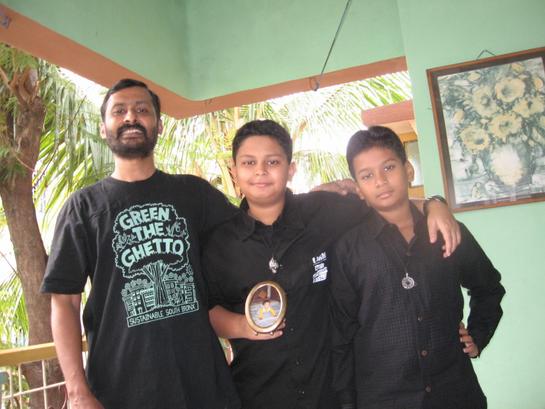
Today is my son Rituraj's birthday. He is 15.

I will never forget Rituraj's first birthday. How much we had looked forward to the coming of that day, and what a celebration there was! I smiled so much to greet all the invited guests that my cheeks started aching; but I didn't mind that at all!

In the picture above, Rituraj holds a picture from his first birthday. Rishiraj (aka Chotu) - don't look so doleful okay!

Thursday, October 19, 2006

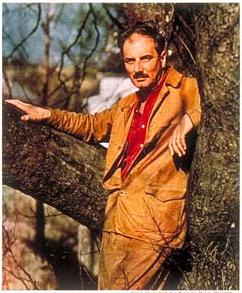
Lewis Mumford


Today, 19 October, is the 111th birth anniversary of Lewis Mumford, American social philosopher, and one of the leading thinkers and writers of the 20th century.

Born in Flushing, New York, Mumford assiduously and single-mindedly devoted himself to writing. Over a period of 60 years, Mumford wrote some thirty books, covering subjects as diverse as the history of cities, the history of machine technology, art and architectural criticism, and literary criticism. He is most widely known for the books The City in History and The Myth of the Machine: The Pentagon of Power. He passed away on 26 January 1990.

Though widely honoured during his lifetime, with fellowships, professorships, awards and honorary doctorates, he remains largely unknown in his native America. Mumford may be seen as one of those who have enabled today’s environmental consciousness. Environmental historian Ramachandra Guha has referred to him as ‘the patron saint of environmentalism’. Mumford's ‘organicist’ philosophy was deeply ecological. His varied concerns converge on the problem of defining an ethic which would fuse the classical socialist values of justice and community with what we would today call environmental values. As early as 1930, we find him writing that the three main threats to modern civilisation were the destruction of forest cover, the depletion of non-renewable resources, and the awesome destructive power of modern weaponry. His first major work, Technics and Civilisation (1934), underlined the links between industrialisation, the increasing intensity of energy use, and pollution.

Mumford recognised that ecological degradation was, at least in part, the outcome of a flawed value system which had “missed the great lesson that both ecology and medicine teach - that man’s great mission is not to conquer Nature by main force but to co-operate with her intelligently and lovingly for his own purposes.” Ecological degradation, he believed, is inescapable in an economic system driven by the belief that quantitative production had no natural limits. Indeed modern technology is profoundly anti-ecological - “driven by the desire to displace the organic with the synthetic and the pre-fabricated”, it exhibits a “barely concealed hostility to living organisms, vital functions, organic associations.”

Mumford anticipated the alternate theorists of today. He was a critic of both capitalism and communism, holding them to be but two variants of a centralising, destructive and violent system of production. But he did not wholly turn his back on modern technology, seeking instead to bend it to serve human and environmental needs.

In an age of specialisation, Mumford was a sociologist, philosopher, cultural historian, art and literary critic, and authority on architecture and city planning, a true Renaissance man. In 1923, Mumford was a founding member of the Regional Planning Association of America, an experimental group that paved the way for several projects in regional development, including the Tennessee Valley Authority. In 1932 Mumford began to write a column of architectural criticism, ‘The Sky Line’, for the New Yorker.

Mumford was deeply influenced in his youth by the work and thought of Patrick Geddes, the eccentric Scottish biologist, town planner, educator and peace activist (1854-1932). For Mumford, Geddes’ work provided the basic direction and the skeleton which he then added flesh to. In 1938, as consultant to the City and County Park Board in Honolulu, Hawaii, the follower of the ‘garden city’ Master prepared a booklet Whither Honolulu? based on his study of the parks and playgrounds of that city. Again, recalling Geddes’ efforts at organising ‘cities exhibitions’, in 1939, Mumford worked on a documentary film The City which was shown at the city planning exhibit at the New York World’s Fair.

Geddes’ young son Alisdair was killed in the First World War. He saw Alisdair in Mumford and wanted him to assist him in his work. Mumford was very oppressed with Geddes seeing in him the return of his dead son. Later, after his own son, who was named Geddes, was killed in the 2nd World War, by which time Patrick Geddes was no more, Mumford became a leading propogator of Geddes’ thinking and diligently assisted his biographers.

Mumford was deeply interested in India. He studied Indian history and religion and closely followed Geddes’ town planning work in India. Mumford was personally acquainted with Radhakamal Mukherjee, the Indian professor of sociology and disciple of Geddes, whose work dwelt on human interactions with nature - which he called ‘social ecology’. Mukherjee has written extensively on the ecological basis of civilisation in Gangetic Bengal, culminating in the emergence of Calcutta as a metropolis - but one that makes a dysfunctional break from its ecological and social roots.

Read the Time magazine cover story on Lewis Mumford (18 April 1938) here.

Wednesday, October 04, 2006

St Francis of Assisi


Today, 4th October, is the Feast Day (i.e. death anniversary) of St Francis of Assisi, one of the most loving and beloved figures associated with the Roman Catholic faith.

St. Francis was born at Assisi in Italy in 1182. After a carefree youth, he turned his back on inherited wealth and committed himself to God. He lived a very simple life of poverty – he married Poverty. He gained a reputation of being a friend of birds and animals. He established the rule of St Francis, which exists today as the Order of St. Francis, or the Franciscans. He died in 1226, aged 44. St Francis of Assisi is the patron saint of the environmental movement.

I first learnt about St Francis through coming across the Prayer associated with his name.

Here's a clip from the film Brother Sun, Sister Moon (1972), directed by Franco Zeffirelli, showing the Prayer.


Lord, make me an instrument of your peace,
Where there is hatred, let me sow love;
where there is injury, pardon;
where there is doubt, faith;
where there is despair, hope;
where there is darkness, light;
where there is sadness, joy;

O Divine Master, grant that I may not so much seek to be consoled as to console;
to be understood as to understand;
to be loved as to love.

For it is in giving that we receive;
it is in pardoning that we are pardoned;
and it is in dying that we are born to eternal life.


Some years later I found The Little Flowers of Saint Francis, a collection of beloved stories about St. Francis and the early days of his Order.

But it was only after reading Nikos Kazantzakis’ brilliant, empathic fictionalised biography of St Francis of Assisi, God’s Pauper (published in 1950), that I felt a close and fond bond with him. A reviewer in Amazon.com writes about God’s Pauper:


"Reading Kazantzakis' St. Francis is a consistently joyful, frequently ecstatic experience. A fictionalized account of the life of St. Francis, this novel allows the reader to know the saint almost personally. Told through the eyes of his loyal companion, the story not only chronicles the historic events in the life of St. Francis, but also captures the tumultuous essence of a life lived in longing for ever more service to God. This is one of the best books about St. Francis in existence. "


I was also fortunate to find in the RIMC Library in Dehradun – serendipity - In the Steps of St Francis by Ernest Raymond, another wonderful introduction (published in 1938) to this remarkable and lovable figure, in which the author sketches St Francis’ personality while visiting several places associated with him.

Also in the RIMC Library was the magnificent collector’s item, St. Francis of Assisi: 1226-1926: Essays in Commemoration, edited by Walter Seton, which was published by the University of London in 1926. (This book was given to the library by a master in the school, an Englishman, who had received it shortly after it was published, as a gift from someone in his family!)

Happy Birthday Lou!


Today is also the birthday of my dear friend Lou Gelehrter. He is 60.

Lou is an architect-planner, and lives and works in Jerusalem and Bucharest. He will be celebrating his birthday in Bucharest with his son Alex, and daughter Avigail.

May you continue to give joy and love to your children and friends Lou!

Monday, October 02, 2006

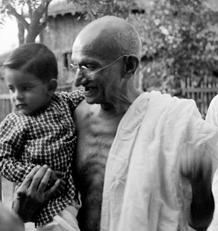
Mahatma Gandhi's talisman


Mahatma Gandhi

2 October 1869 – 30 January 1948


“I will give you a talisman. Whenever you are in doubt, or when the self becomes too much with you, apply the following test. Recall the face of the poorest and the weakest man whom you may have seen, and ask yourself, if the step you contemplate is going to be of any use to him. Will he gain anything by it? Will it restore him to a control over his own life and destiny ? In other words, will it lead to Swaraj (i.e. self-rule) for the hungry and spiritually starving millions ?

Then you will find your doubts and your self melting away.”

Thursday, September 28, 2006

28 September


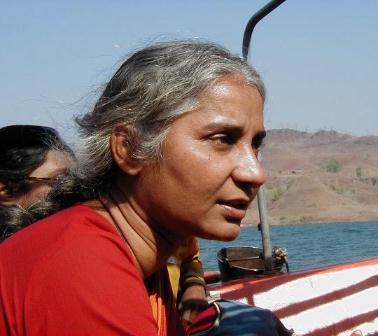
For Medha Patkar


I have written from time to time about various dates which are significant for me.

Among them is today’s date, 28 September.

28 September for me connotes unremitting struggle, for justice, for the oppressed.

The link for me between this date and its meaning - lies in an event on this date, in 1989. This was a massive people’s rally in Harsud, a small town in the state of Madhya Pradesh in India, asserting the will of the people who were going to be ousted and displaced by the Narmada Valley Dams Project:

We shall drown, but we shall not move!

Much water has flown along the dammed Narmada river (the most sacred river in Hindu religious consciousness) since 28 September 1989. And that ancient town of Harsud itself went under-water, in 2004.

But for me that date, and the personal meaning derived from that immense gathering in Harsud of Indian citizen activists and toiling, marginalised people, supported by thousands of others across the country through their local solidarity actions, and the fierce resolve asserted there (and tested repeatedly thereafter) – remains alive, enough to remind me of the struggle for justice whenever I come across the numbers 28 and 9.

Thanks to my association with people like Dr MKA Siddiqui, I have learnt that this is what jihad (in Islam) means: struggle for justice for the oppressed.

An activist, a person with the disposition of working with and for the victims of injustice, struggling for justice – is a jihadi; a struggler for justice is a mujahid, and the term to describe the activism of strugglers for justice would literally translate to Harkat-ul Mujahideen.

Out of his kindly and affectionate disposition, Dr Siddiqui had once told me that I was a true jihadi. No compliment could ever be sweeter and richer!


Post-script: I just learnt, thanks to the website of the International Institute of Social History, that on 28 September 1864, the Saint Martins meeting hall in London was packed to the roof with craftsmen and workers from various countries. The proposal to establish an International Working Men's Association met with great enthusiasm. Karl Marx did not belong to the organizers and was not among the speakers, but he was a member of the presidium and he was chosen (with 54 other persons) in the Preparatory Committee to extend the IWMA. Not before long he would pull the strings of this First International.

Tuesday, September 05, 2006

Teacher's Day

In India, today, 5th September, is observed as Teacher's Day.

This is after the birthday of Sarvapalli Radhakrishnan, a former President of India, a savant and professor of philosophy.

So its a special day for educational institutions, teachers and students. Teacher's Day is observed without fail in schools across India. In various ways, and often very humorously, students express their regard and love for their teachers.

The teacher-student relation is a profound one. And on 5th Sepetmber every year, people are reminded of this.

Tuesday, August 29, 2006

Another birthday

Today is my birthday, I am 46.

The beginning of a hectic week. And this is going to be a challenging year for me, with various personal limitations to overcome, and many long deferred imperative tasks calling for serious attention.

I do not smile very much nowadays. But I do hope on my next birthday I will have something to smile about.

Friday, August 25, 2006

Happy Birthday Calcutta!

Today, 24 August, is considered Calcutta’s “foundation day”. On this day in 1690, Job Charnock of the (British) East India Company landed by boat at a riverbank in Sutanuti (in today’s north Calcutta), and decided to set up a trading post here.

What is now Calcutta was then a collection of villages of fishermen, weavers and other artisans. There were also some rich landlords and traders around. The imperial-colonial kiss-embrace made this into a teeming metropolis.

Happy Birthday Calcutta!

Thursday, August 17, 2006

Independence Day


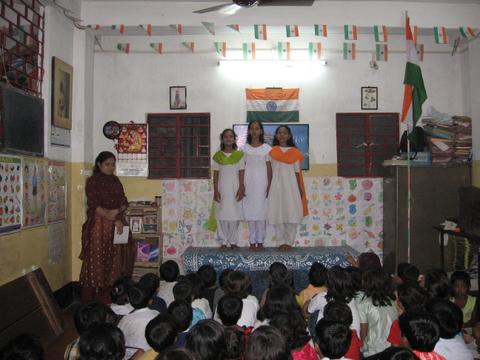
Yesterday, 15 August, was India’s Independence Day, a national holiday. Our Talimi Haq School in Howrah celebrated this with a flag-hoisting and a programme put up by the children and teachers. I attended that.

I was glad I went there. I was very happy to hear all the songs sung by the children, and teachers too. All were moving, rousing patriotic songs, full of meaning and messages. A small boy had learnt the Sanskrit song / prayer Vande Mataram (Hail Motherland) which he rendered perfectly. The songs were all sung very tunefully and with feeling. I was really impressed.

I felt a lot of satisfaction seeing my own dreams come true, notwithstanding years of gruelling failure. I used to sing and teach my songs when the school had been started in 1998. I felt that the beautiful India the songs were adoring was present right here in the two rooms of Talimi Haq School. The future of India depended on these children, and the songs were also exhorting them to walk well and wisely for India.

I was asked to say something in conclusion. I said anything I might want to say has already been said in the songs. 15 August is important for us because it is about freedom which came after long struggles and sacrifices by valiant people. And through that struggle something beautiful was envisioned and the seeds of that were sown– an India which is plural, secular, democratic, wise, just and compassionate. This – here, inside this room – is the India they dreamt of. And as we walk well, wisely and virtuously, so shall India.

I complimented the singers. I referred to the azaan – the call to prayer of the muezzin, from the mosque (which had interrupted our programme briefly). It had been really melodious. I mentioned Bilal, Prophet Mohammed’s companion, whom he had asked to sing the call to prayer because of his beautiful voice. Singing is the greatest skill, its what touches and moves people. So your aspiration for singing, and the effort to sing well – makes me very happy.

Finally, I explained something about the Surah Fatiha, the opening chapter of the Holy Koran, and sang it, thrice, each time in a different style, to convey the depth and range of meaning and feeling contained in this.

Hear / download the Surah Al-Fatiha here (WMA).

Hear / download the Fatiha here (MP3).

Get this widget | Share | Track details


Thus concluded Talimi Haq School’s celebration of Independence Day 2006!