
I had posted several teaching stories about dogs a few days back.
On the way back from my recent trip to south India, I bought Orhan Pamuk's My Name is Red at the airport bookshop.
This is a murder mystery set in the world of miniaturist artists in 16th century Istanbul.
The book has a chapter titled "I am a Dog", in which a voice (and an ear) is given (by a storyteller) to a dog, whose figure is drawn on paper. The dog-voice asks and investigates why there is such animosity towards dogs among clerics and why the very name has come to be the term for all that is base.
I heartily recommend this book!
Showing posts with label dog. Show all posts
Showing posts with label dog. Show all posts
Friday, September 22, 2006


Saturday, September 16, 2006
The Prophet and the dog
There is an anecdote told of Mohammed, the prophet of Islam.
One day, a panting dog feebly approached one of his followers, who took notice of the poor animal. Seeing a puddle of muddy water, he tore a scrap off the hem of his shirt, soaked it in the water and taking the dog in his lap, he moistened its mouth.
Another person, witnessing this, went and told the Prophet that a member of the group had handled a filthy animal, "and therefore he should not be allowed back here again."
Mohammed asked, "What was he doing to the dog ?"
"I don't know, but I saw him moistening its mouth with a torn piece of cloth dipped in muddy water."
"Then," replied the Prophet, "He is a better Muslim than you, because he is kind to animals."
From: khandro
One day, a panting dog feebly approached one of his followers, who took notice of the poor animal. Seeing a puddle of muddy water, he tore a scrap off the hem of his shirt, soaked it in the water and taking the dog in his lap, he moistened its mouth.
Another person, witnessing this, went and told the Prophet that a member of the group had handled a filthy animal, "and therefore he should not be allowed back here again."
Mohammed asked, "What was he doing to the dog ?"
"I don't know, but I saw him moistening its mouth with a torn piece of cloth dipped in muddy water."
"Then," replied the Prophet, "He is a better Muslim than you, because he is kind to animals."
From: khandro
Asanga and the dog

In response to my Sufi dog tales, Dan has been so kind as to send me the following story of Asanga. This is an awesome and inspiring teaching story.
Asanga was one of the most famous Indian Buddhist saints, and lived in the fourth century. He went to the mountains to do a solitary retreat, concentrating all his meditation practice on the Buddha Maitreya, in the fervent hope that he would be blessed with a vision of this Buddha and receive teachings from him.
For six years Asanga meditated in extreme hardship, but did not even have one auspicious dream. He was disheartened and thought he would never succeed with his aspiration to meet the Buddha Maitreya, and so he abandoned his retreat and left his hermitage. He had not gone far down the road when he saw a man rubbing an enormous iron bar with a strip of silk. Asanga went up to him and asked him what he was doing. "I haven't got a needle," the man replied, "so I'm going to make one out of this iron bar. "Asanga stared at him, astounded; even if the man were able to manage it in a hundred years, he thought, what would be the point? He said to himself: "Look at the trouble people give themselves over things that are totally absurd. You are doing something really valuable, spiritual practice, and you're not nearly so dedicated." He turned around and went back to his retreat.
Another three years went by, still without the slightest sign from the Buddha Maitreya. "Now I know for certain," he thought "I'm never going to succeed." So he left again, and soon came to a bend in the road where there was a huge rock, so tall it seemed to touch the sky. At the foot of the rock was a man busily rubbing it with a feather soaked in water. "What are you doing?" Asanga asked. "This rock is so big it's stopping the sun from shining on my house, so I'm trying to get rid of it." Asanga was amazed at the man's indefatigable energy, and ashamed at his own lack of dedication. He returned to his retreat.
Three more years passed, and still he had not even had a single good dream. He decided, once and for all, that it was hopeless, and he left his retreat for good. The day wore on, and in the afternoon he came across a dog lying by the side of the road. It had only its front legs, and the whole of the lower part of its body was rotting and covered with maggots. Despite its pitiful condition, the dog was snapping at passers-by and pathetically trying to bite them by dragging itself along the ground with its two good legs.
Asanga was overwhelmed with a vivid and unbearable feeling of compassion. He cut a piece of flesh off his own body and gave it to the dog to eat. Then he bent down to take off the maggots that were consuming the dog's body. But he suddenly thought he might hurt them if he tried to pull them out with his fingers, and realized that the only way to remove them would be on his tongue. Asanga knelt on the ground, and looking at the horrible festering, writhing mass, closed his eyes. He leant closer and put out his tongue. The next thing he knew, his tongue was touching the ground. He opened his eyes and looked up. The dog was gone; there in its place was the Buddha Maitreya, ringed by a shimmering aura of light.
"At last," said Asanga, "why did you never appear to me before?"
Maitreya spoke softly: "it is not true that I have never appeared to you before. I was with you all the time, but your negative karma and obscurations prevented you from seeing me. Your twelve years of practice dissolved them slightly so that you were at last able to see the dog. Then, thanks to your genuine and heartfelt compassion, all those obscurations were completely swept away and you can see me before you with your very own eyes. If you don't believe that this is what happened, put me on your shoulder and try and see if anyone else can see me."
Asanga put Maitreya on his right shoulder and went to the marketplace, where he began to ask everyone: "What have I got on my shoulder?" "Nothing," most people said, and hurried on. Only one old woman, whose karma had been slightly purified, answered: "You've got the rotting corpse of an old dog on your shoulder, that's all. "
Asanga at last understood the boundless power of compassion that had purified and transformed his karma, and so made him a vessel fit to receive the vision and instruction of Maitreya. Then the Buddha Maitreya, whose name means "loving kindness," took Asanga to a heavenly realm, and there gave him many sublime teachings that are among the most important in the whole of Buddhism.
From: The Tibetan Book of Living and Dying, by Sogyal Rinpoche.
Friday, September 15, 2006
Abu Yazid al-Bestami makes way for a dog
Abu Yazid al-Bestami (also known as Bayazid Bistami), was born in Bestam in north-eastern Persia, where he died in 874 or 877, and where his mausoleum still stands. He is regarded as the founder of the ecstatic (“drunken”) school of Sufism.
One day Abu Yazid was walking with a party of disciples. The road narrowed, and just then a dog approached from the opposite direction. Abu Yazid retired, giving the dog right of way.
The chance thought of disapproval occurred to one of the disciples. “Almighty God honoured man above all creatures. Abu Yazid is the ‘king of the gnostics’ yet with all this dignity, and such a following of disciples, he makes way for a dog. How can that be?”
“Young man,” Abu Yazid replied, “this dog mutely appealed to me, ‘What shortcoming was I guilty of in the dawn of time, and what exceptional merit did you acquire, that I was clad in the skin of a dog whereas you were robed in honour as king of the gnostics?’ This was the thought that came into my head, so I made way for the dog.”
From: Muslim Saints and Mystics: Episodes from the Tadhkirat al-Auliya (‘Memorial of the Saints’) by Farid al-Din Attar, translated by AJ Arberry.
One day Abu Yazid was walking with a party of disciples. The road narrowed, and just then a dog approached from the opposite direction. Abu Yazid retired, giving the dog right of way.
The chance thought of disapproval occurred to one of the disciples. “Almighty God honoured man above all creatures. Abu Yazid is the ‘king of the gnostics’ yet with all this dignity, and such a following of disciples, he makes way for a dog. How can that be?”
“Young man,” Abu Yazid replied, “this dog mutely appealed to me, ‘What shortcoming was I guilty of in the dawn of time, and what exceptional merit did you acquire, that I was clad in the skin of a dog whereas you were robed in honour as king of the gnostics?’ This was the thought that came into my head, so I made way for the dog.”
From: Muslim Saints and Mystics: Episodes from the Tadhkirat al-Auliya (‘Memorial of the Saints’) by Farid al-Din Attar, translated by AJ Arberry.
Sofyan-e Thauri
Sofyan-e Thauri was born in 715 at Kufa and attained high proficiency in Traditions and theology. In 775 he collided with the authorities and was compelled to go into hiding in Mecca; he died in 778 at Basra.
One day Sofyan was eating a piece of bread when a dog happened along. He gave the bread to the dog, bit by bit.
“Why did you not eat it with your wife and child?” he was asked.
“If I give bread to the dog,” he replied, “he keeps watch over me all through the night so that I can pray. If I give it to my wife and child, they hold me back from my devotions.”
From: Muslim Saints and Mystics: Episodes from the Tadhkirat al-Auliya (‘Memorial of the Saints’) by Farid al-Din Attar, translated by AJ Arberry.
One day Sofyan was eating a piece of bread when a dog happened along. He gave the bread to the dog, bit by bit.
“Why did you not eat it with your wife and child?” he was asked.
“If I give bread to the dog,” he replied, “he keeps watch over me all through the night so that I can pray. If I give it to my wife and child, they hold me back from my devotions.”
From: Muslim Saints and Mystics: Episodes from the Tadhkirat al-Auliya (‘Memorial of the Saints’) by Farid al-Din Attar, translated by AJ Arberry.
Maruf-e Karkhi
Maruf-e Karkhi was a prominent mystic of the Baghdad school. He died in 815.
Maruf had an uncle who was the governor of the city. One day he was passing some wasteland when he observed Maruf sitting there eating bread. Before him there was a dog, and Maruf was putting one morsel in his own mouth and then one in the dog’s.
“Are you not ashmed to eat bread with a dog?” cried his uncle.
“It is out of shame that I am giving bread to the poor,” replied Maruf.
Then he raised his head and called to a bird in the air. The bird flew down and perched on his hand, covering his head and eyes with his wings.
“Whosoever is ashamed before God,” said Maruf, “every thing is ashamed before him.”
At once his uncle was filled with confusion.
From: Muslim Saints and Mystics: Episodes from the Tadhkirat al-Auliya (‘Memorial of the Saints’) by Farid al-Din Attar, translated by AJ Arberry.
Maruf had an uncle who was the governor of the city. One day he was passing some wasteland when he observed Maruf sitting there eating bread. Before him there was a dog, and Maruf was putting one morsel in his own mouth and then one in the dog’s.
“Are you not ashmed to eat bread with a dog?” cried his uncle.
“It is out of shame that I am giving bread to the poor,” replied Maruf.
Then he raised his head and called to a bird in the air. The bird flew down and perched on his hand, covering his head and eyes with his wings.
“Whosoever is ashamed before God,” said Maruf, “every thing is ashamed before him.”
At once his uncle was filled with confusion.
From: Muslim Saints and Mystics: Episodes from the Tadhkirat al-Auliya (‘Memorial of the Saints’) by Farid al-Din Attar, translated by AJ Arberry.
Abu Othman al-Hiri
Abu Othman al-Hiri lived in Nishapur, where he died in 911.
"For forty years," said Abu Othman, "whatever state God has kept me in I have not resented, and to whatever state He transferred me I have not been angry."
The following story bears out this assertion. A man who disbelieved in Abu Othman sent him an invitation. Abu Othman accepted, and got as far as the door of his house. The man then shouted at him:
"Glutton, there is nothing here for you. Go home!"
Abu Othman went home. He had gone only a little way when the man called out to him:
"Shaikh, come here!"
Abu Othman returned.
"You are very eager to eat," the man taunted him. "There is still less. Be off with you!"
The shaikh departed. The man summoned him again, and he went back.
"Eat stones, or go home!"
Abu Othman went off once more. Thirty times the man summoned him and drove him away. Thirty times the shaikh came and went, without showing the least discomposure. Then the man fell at his feet and with tears repented, becoming his disciple.
"What a man you are!" he exclaimed. "Thirty times I drove you off with contumely, and you showed not the slightest discomposure."
"This is an easy matter," Abu Othman replied. "Dogs do the same. When you drive them away they go, and when you call them they come, without showing any discomposure. A thing in which dogs equal us cannot really be accounted anything. Men's work is something quite other."
From: Muslim Saints and Mystics: Episodes from the Tadhkirat al-Auliya (‘Memorial of the Saints’) by Farid al-Din Attar, translated by AJ Arberry.
"For forty years," said Abu Othman, "whatever state God has kept me in I have not resented, and to whatever state He transferred me I have not been angry."
The following story bears out this assertion. A man who disbelieved in Abu Othman sent him an invitation. Abu Othman accepted, and got as far as the door of his house. The man then shouted at him:
"Glutton, there is nothing here for you. Go home!"
Abu Othman went home. He had gone only a little way when the man called out to him:
"Shaikh, come here!"
Abu Othman returned.
"You are very eager to eat," the man taunted him. "There is still less. Be off with you!"
The shaikh departed. The man summoned him again, and he went back.
"Eat stones, or go home!"
Abu Othman went off once more. Thirty times the man summoned him and drove him away. Thirty times the shaikh came and went, without showing the least discomposure. Then the man fell at his feet and with tears repented, becoming his disciple.
"What a man you are!" he exclaimed. "Thirty times I drove you off with contumely, and you showed not the slightest discomposure."
"This is an easy matter," Abu Othman replied. "Dogs do the same. When you drive them away they go, and when you call them they come, without showing any discomposure. A thing in which dogs equal us cannot really be accounted anything. Men's work is something quite other."
From: Muslim Saints and Mystics: Episodes from the Tadhkirat al-Auliya (‘Memorial of the Saints’) by Farid al-Din Attar, translated by AJ Arberry.
al-Termedhi
Abu al-Termedhi was driven out of his native town of Termedh and took refuge in Nishapur, where he was preaching in 898. He is regarded as one of the outstanding creative thinkers of Islamic mysticism.
In Termedhi’s time lived a great ascetic who was always criticising him. Now in all the world Termedhi possessed nothing but a cabin. When he returned from his journey to Hejaz, a dog had whelped in that cabin, which had no door. Termedhi did not wish to drive the dog out, and he went and came eighty times in the hope that the dog would have of its own free will carried its puppies out.
That same night the ascetic saw the Prophet in a dream.
“Sirrah, you have put yourself up against a man who eighty times brought succour to a dog,” the Prophet said. “If you desire eternal happiness, go, bind up your loins and serve him.”
The ascetic, too ashamed to answer Termedhi’s greetings, thereafter spent the rest of his life in his service.
From: Muslim Saints and Mystics: Episodes from the Tadhkirat al-Auliya (‘Memorial of the Saints’) by Farid al-Din Attar, translated by AJ Arberry.
In Termedhi’s time lived a great ascetic who was always criticising him. Now in all the world Termedhi possessed nothing but a cabin. When he returned from his journey to Hejaz, a dog had whelped in that cabin, which had no door. Termedhi did not wish to drive the dog out, and he went and came eighty times in the hope that the dog would have of its own free will carried its puppies out.
That same night the ascetic saw the Prophet in a dream.
“Sirrah, you have put yourself up against a man who eighty times brought succour to a dog,” the Prophet said. “If you desire eternal happiness, go, bind up your loins and serve him.”
The ascetic, too ashamed to answer Termedhi’s greetings, thereafter spent the rest of his life in his service.
From: Muslim Saints and Mystics: Episodes from the Tadhkirat al-Auliya (‘Memorial of the Saints’) by Farid al-Din Attar, translated by AJ Arberry.
Thursday, September 14, 2006
Dogs (& monkeys)

I recently came across, in succession, some posts about dogs by bloggers Flitzy, Kathy, Flitzy again, and Darvish. And a hilarious image in Planck’s Constant. There’s also of course Hayden, who regularly writes about dogs.
This brought to mind the several Sufi dog tales I have among my books. I had paid particular attention to this subject, of dog as metaphor, in terms of reflection, associations etc. I had also once shared these stories with a friend who’s particularly close to dogs.
So, as promised to Kathy, I am now transcribing and posting these.
By posting the following five dog tales, I also pay tribute to the late Idries Shah, the author of many books on Sufi philosophy and teachings. Through his books, he has been a dear and intimate friend and guide.
This is a first offering. More to follow, from the stories of Muslim saints and mystics.
In Hindu religious mythology, there is Hanuman, the monkey son of Wind. He is a principal character in the Ramayana epic, the one who helps Lord Rama defeat the evil King Ravana of Lanka, and rescue his abducted wife Sita. Hanuman is an exemplar of devotion. It is said that wherever and whenever the Ramayana is narrated, Hanuman is present in that assembly.
Like with Sufi dog tales, I have thought long and hard about this monkey business. Why a monkey? Together with Hanuman and the army of monkeys who helped Lord Rama, there were also bears, and even a squirrel! There is a tale of how the squirrel got the marking on the top of its fur, for its wish and efforts to help Lord Rama build the bridge across the sea, to Lanka.
I realised that in the racially and socially stratified Indian setting - all this has profound meanings and resonances in the consciousness of a seeker, of someone engaging compassionately with common people, and working for social justice. These meanings cannot be explained by one to another, like feeding regurgitated pre-masticated pap! It is for each seeker to encounter such tales and symbols, discern their significance, and reflect upon them in the mirror of her own life experience and work.
Cartoon: off the mark
The Teacher and the Dog
A Sufi teacher, walking along a road with a student, was assailed by a ferocious dog.
The disciple was furious and cried out:
‘How dare you approach my master in such a manner?’
‘He is more consistent than you are,’ said the Sage, ‘for he barks at anyone, in accordance with his habit and proclivities; while you regard me as your master and are wholly insensitive to the merits of the many illuminates whom we have already passed on this journey, dismissing them without a second glance.’
From: The Way of the Sufi, by Idries Shah.
The disciple was furious and cried out:
‘How dare you approach my master in such a manner?’
‘He is more consistent than you are,’ said the Sage, ‘for he barks at anyone, in accordance with his habit and proclivities; while you regard me as your master and are wholly insensitive to the merits of the many illuminates whom we have already passed on this journey, dismissing them without a second glance.’
From: The Way of the Sufi, by Idries Shah.
The Sufi Who Called Himself a Dog
Maulana Dervish, chief of the Naqshbandi Order and one of its greatest teachers, was sitting one day in his Zavia when a furious cleric forced his way in.
‘You sit there,’ shouted the intruder, ‘dog that you are, surrounded by disciples, obeyed by them in every particular! I, on the other hand, call men to strive towards divine mercy through prayer and austerities as is enjoined upon us.’
At the word ‘dog’, several of the Seekers rose to eject the fanatic.
‘Stay,’, said the Maulana, ‘for “dog” is indeed a good word. I am a dog, who obeys his mater, showing the sheep by signs the interpretation of our Master’s desires. Like a dog I infuriate the interloper and the thief. And I wag my tail in pleasure when my master’s Friends come near.
‘Just as barking and wagging and love are attributes of the dog, we exercise them; for our Master has us, and does not do his own barking and wagging.’
From: The Way of the Sufi, by Idries Shah.
‘You sit there,’ shouted the intruder, ‘dog that you are, surrounded by disciples, obeyed by them in every particular! I, on the other hand, call men to strive towards divine mercy through prayer and austerities as is enjoined upon us.’
At the word ‘dog’, several of the Seekers rose to eject the fanatic.
‘Stay,’, said the Maulana, ‘for “dog” is indeed a good word. I am a dog, who obeys his mater, showing the sheep by signs the interpretation of our Master’s desires. Like a dog I infuriate the interloper and the thief. And I wag my tail in pleasure when my master’s Friends come near.
‘Just as barking and wagging and love are attributes of the dog, we exercise them; for our Master has us, and does not do his own barking and wagging.’
From: The Way of the Sufi, by Idries Shah.
Why the Dog Could Not Drink
Shebli was asked:
‘Who guided you in the Path?’
He said: ‘A dog. One day I saw him, almost dead with thirst, standing by the water’s edge.
‘Every time he looked at his reflection in the water he was frightened, and withdrew, because he thought it was another dog.
‘Finally, such was his necessity, he cast away fear and leapt into the water; at which the “other dog” vanished.
‘The dog found that the obstacle, which was himself, the barrier between him and what he sought, melted away.
‘In this same way my own obstacle vanished, when I knew that it was what I took to be my self. And my Way was first shown to me by the behaviour of – a dog.’
From: The Way of the Sufi, by Idries Shah.
‘Who guided you in the Path?’
He said: ‘A dog. One day I saw him, almost dead with thirst, standing by the water’s edge.
‘Every time he looked at his reflection in the water he was frightened, and withdrew, because he thought it was another dog.
‘Finally, such was his necessity, he cast away fear and leapt into the water; at which the “other dog” vanished.
‘The dog found that the obstacle, which was himself, the barrier between him and what he sought, melted away.
‘In this same way my own obstacle vanished, when I knew that it was what I took to be my self. And my Way was first shown to me by the behaviour of – a dog.’
From: The Way of the Sufi, by Idries Shah.
Etiquette
An inquirer asked Sayed Khidr Rumi:
‘Is there anything which can be called the best and also the worst of human institutions?’
He said:
‘Yes, indeed. There is such a thing, and its name is “etiquette”.
‘The advantage of etiquette and conduct is that it enables the Wise to approach the student without being jeered at, and it makes possible the search by the student without people thinking him ridiculous.
‘The disadvantage of etiquette which makes it the worst of human institutions is that it enables the ignorant to erect their own rules of what is permissible in thought and conduct and what is not. If such people decide that there are certain things which should never be thought or done, then they can effectively prevent the transmission of knowledge.’
The inquirer asked:
‘May I have an instance of how this happens in our teaching?’
Sayed Khidr Rumi said:
‘It has been customary for people, when they read prescribed books and accounts of the doings of the Masters, to say, “This is an analogy which does not apply to me." It also enables them to say. “This is an encounter with a stupid man. I could never think like the man in the tale; therefore the Teacher is in this instance dealing with a completely different type of person.” The reality is that such a person is always the one most in need of teaching, while he is unaware of it.
‘There is the story of the dog who was distressed when a man shouted at him, saying, “look at that mangy creature!” The dog, instead of looking for a sage who would cure his mange, jumped into a pool of water and came out dripping wet. He ran up to the man, wagging his tail, as if to say, “Look, my coat is changed, it is all dampness where before it was a dusty mat!” The man started to curse him even more strongly, because he did not want the dog to shake the water off all over him.
‘The dog became convinced that the man was irrational, while it was simply a matter that one did not understand the other. In he instance of the acts related of the Wise, the doggishness in the student must realise that the sage is talking about a real, not an illusory, improvement in his state.’
From: Thinkers of the East, by Idries Shah.
‘Is there anything which can be called the best and also the worst of human institutions?’
He said:
‘Yes, indeed. There is such a thing, and its name is “etiquette”.
‘The advantage of etiquette and conduct is that it enables the Wise to approach the student without being jeered at, and it makes possible the search by the student without people thinking him ridiculous.
‘The disadvantage of etiquette which makes it the worst of human institutions is that it enables the ignorant to erect their own rules of what is permissible in thought and conduct and what is not. If such people decide that there are certain things which should never be thought or done, then they can effectively prevent the transmission of knowledge.’
The inquirer asked:
‘May I have an instance of how this happens in our teaching?’
Sayed Khidr Rumi said:
‘It has been customary for people, when they read prescribed books and accounts of the doings of the Masters, to say, “This is an analogy which does not apply to me." It also enables them to say. “This is an encounter with a stupid man. I could never think like the man in the tale; therefore the Teacher is in this instance dealing with a completely different type of person.” The reality is that such a person is always the one most in need of teaching, while he is unaware of it.
‘There is the story of the dog who was distressed when a man shouted at him, saying, “look at that mangy creature!” The dog, instead of looking for a sage who would cure his mange, jumped into a pool of water and came out dripping wet. He ran up to the man, wagging his tail, as if to say, “Look, my coat is changed, it is all dampness where before it was a dusty mat!” The man started to curse him even more strongly, because he did not want the dog to shake the water off all over him.
‘The dog became convinced that the man was irrational, while it was simply a matter that one did not understand the other. In he instance of the acts related of the Wise, the doggishness in the student must realise that the sage is talking about a real, not an illusory, improvement in his state.’
From: Thinkers of the East, by Idries Shah.
Bayazid Bistami
Bayazid encountered a dog and started to pull his robe away from it, so that it should not defile him.
The dog, in a human voice, said:
‘If I had been dry, there would have been no purpose in avoiding me. If I had been wet, you could have washed your robe. But the hate which you have towards me can never be cleansed.’
Bayazid said:
‘O enlightened dog, come and stay with me for a while.’
The dog answered:
‘That is impossible, because the world uses me as an epithet, and you are regarded by the world as a paragon.’
Bayazid exclaimed:
‘Alas! I am not fit to live with one whom the whole world regards as inferior: how can I therefore approach the Truth which all regard as the Highest of all?’
From: The Way of the Sufi, by Idries Shah.
The dog, in a human voice, said:
‘If I had been dry, there would have been no purpose in avoiding me. If I had been wet, you could have washed your robe. But the hate which you have towards me can never be cleansed.’
Bayazid said:
‘O enlightened dog, come and stay with me for a while.’
The dog answered:
‘That is impossible, because the world uses me as an epithet, and you are regarded by the world as a paragon.’
Bayazid exclaimed:
‘Alas! I am not fit to live with one whom the whole world regards as inferior: how can I therefore approach the Truth which all regard as the Highest of all?’
From: The Way of the Sufi, by Idries Shah.
Wednesday, August 02, 2006
The Elephant and the Dog
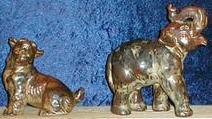
There are several stories in the Jataka Tales (stories of the Buddha’ former lives) about elephants. Here's a happy tale!
Once upon a time a Dog used to go into the stable where the king’s Elephant lived. At first the Dog went there to get the food that was left after the Elephant had finished eating.
Day after day the Dog went to the stable, waiting around for bits to eat. But by and by the Elephant and the Dog came to be great friends. Then the Elephant began to share his food with the Dog, and they ate together. When the Elephant slept, his friend the Dog slept beside him. When the Elephant felt like playing, he would catch the Dog in his trunk and swing him to and fro. Neither the Dog nor the Elephant was quite happy unless the other was nearby.
One day a farmer saw the Dog and said to the Elephant-keeper: “I will buy that Dog. He looks good-tempered, and I see that he is smart. How much do you want for the Dog?”
The Elephant-keeper did not care for the Dog, and he did want some money just then. So he asked a fair price, and the farmer paid it and took the Dog away to the countryside.
The king’s Elephant missed the Dog and did not care to eat when his friend was not there to share the food. When the time came for the Elephant to bathe, he would not bathe. The next day again the Elephant would not eat, and he would not bathe. The third day, when the Elephant would neither eat nor bathe, the king was told about it.
The king sent for his chief servant, saying, “Go to the stable and find out why the Elephant is acting in this way.”
The chief servant went to the stable and looked the Elephant all over. Then he said to the Elephant-keeper: “There seems to be nothing the matter with this Elephant’s body, but why does he look so sad? Has he lost a playmate?”
“Yes,” said the keeper, “there was a Dog who ate and slept and played with the Elephant. The Dog went away three days ago.”
“Do you know where the Dog is now?” asked the chief servant.
“No, I do not,” said the keeper.
Then the chief servant went back to the king and said, “The Elephant is not sick, but he is lonely without his friend, the Dog.”
“Where is the Dog?” asked the king.
“A farmer took him away, so the Elephant-keeper says,” said the chief servant. “No one knows where the farmer lives.”
“Very well,” said the king. “I will send word all over the country, asking the man who bought this Dog to turn him loose. I will give him back as much as he paid for the Dog.”
When the farmer who had bought the Dog heard this, he turned him loose. The Dog ran back as fast as ever he could go to the Elephant’s stable. The Elephant was so glad to see the Dog that he picked him up with his trunk and put him on his head. Then he put him down again.
When the Elephant-keeper brought food, the Elephant watched the Dog as he ate, and then took his own food.
All the rest of their lives the Elephant and the Dog lived together.
Subscribe to:
Posts (Atom)

