Showing posts with label mythology. Show all posts

Saturday, November 15, 2008

Calcutta, secret garden


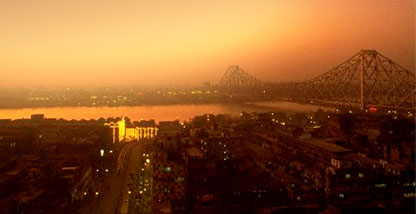
A few days ago, I was moving through the city of Calcutta (where I live). My movements nowadays are very limited and I hardly have occasion to be in the city proper. But when I do, it never fails to affect me, positively. Most of the time that I'm going somewhere on my usual route, I'm extremely angry and disgusted with everything around me that I see and hear. One's sensibilities are assaulted in every way. Anyway, as I was going through parts of the city proper a few days ago, and being in a very, very different frame of mind that day, an ecstatic, euphoric, blissful, inspired state, things took on a different appearance.

I realised Calcutta was still an exquisitely pretty city, notwithstanding everything else. Pretty - like a maidservant. People living in Calcutta would definitely have encountered or observed beauty amidst poverty. Calcutta is like that. The pretty maidservant is a pretty woman, like any pretty woman anywhere, standing out among the crowd. But she is also poor and subject to all the ramifications of that. So to the person who is sensitive to her beauty and aware of her poverty, she remains an enigma, a tragic figure, and a desired but unattainable object. Also inevitable is the fact that the pretty maidservant will also eventually suffer the ravages of her poverty, until her beauty is only a distant memory, perhaps a faint hint of that may be discerned by the perceptive observer. Eliza Doolittle's transformation into a classy lady - was, after all, only a story.

If she is unmarried, her middle-class or wealthy admirer is at a loss regarding what to do about his attraction. For the two can never meet, and that is simply fated to be so. And any attempt to counter this fact can only result in disaster. Or rape, or forced prostitution, which bring their own consequences.

The exquisitely pretty maidservant can only be seen and admired from afar. And in that lies the possibility of transcendence.

Notwithstanding poverty, beauty shall continue to emerge, and shine, howsoever briefly.

King Santanu, in the epic, Mahabharata, was besotted with Satyavati, a fisherman's daughter. He asked for her hand, but her father laid down the condition that their children must inherit the king's throne. Santanu demurred, but his son Bhishma, seeing his father's sad plight, came to his rescue by renouncing the throne and embracing celibacy. And thus was the king's lust and desire fulfilled. But the story did not end there, it ended only with the horrific destruction wrought by the war in Kurukshetra. But though Santanu's desire and lust had to be paid for so dearly, redemption lay in the fact that Satyavati did get justice, albeit because of Bhishma's spontaneous sacrifice.

Reflecting along these lines, the phrase from the nursery rhyme, "... pretty maids all in a row" came to mind. That has an association with Frances Hodgson Burnett's The Secret Garden. So, I thought Calcutta was my own secret garden.

Image: Detail from Judith and her Maidservant by Artemisia Gentileschi.

Friday, November 07, 2008

Punjabi poem about Barack Obama


I was surprised and delighted to find a video clip on YouTube of a poem in Punjabi in praise of Barack Obama by Pashaura Singh Dhillon, an American of Indian origin. A good example of welding the Indian cultural tradition with life in the new country, complete with references to legends and icons.

Tuesday, May 20, 2008

Visvarupa


Over the last 10 years or so, I have been drawn to particular sacred verses, in specific sacred texts. And I have set these to melody, as devotional songs or chants, in Sanskrit, Pali, Arabic, Hebrew etc.

Recently, I happened to pick up the Sanskrit verses from the Bhagavad Gita describing the cosmic vision of Krishna revealed to Arjuna just before the Mahabharata war. These are verses 10-12 in Chapter 11, the chapter on vision of the cosmic form, or Visvarupa. I hope to set these to melody and add it to my small repertoire of songs.

As Robert V Moody writes:

"The verses represent one of the great moments in the Bhagavad Gita. Arjuna, the great warrior, stands on his chariot between the two contending armies of what is about to be an epic internecine battle. With him is his chariot driver who is no less than Krishna, one of the manifestations of Vishnu. Arjuna, mighty warrior though he is, seeing the carnage about to ensue, with his family and friends pitted against each other, loses heart and feels his spirit fading. He wants no part of this battle. Turning to Krishna, he begins to question him. The text, which is something akin to the sermon on the mount for millions of Hindus, is a theological and philosophical discussion of the nature of reality and divinity, and as well as a practical spiritual manual for daily living. Arjuna knows that Krishna is not only a personal friend but also nonetheless a manifestation of the supreme godhead itself. Still,when he asks Krishna to show his real form he is completely unprepared for what he sees. This is the source of the often quoted "...now I am become Death, the destroyer of worlds…" which Robert Oppenheimer used to describe the testing of the first atomic bomb."

I am reproducing the verses below, together with Edwin Arnold's poetic transcreation of the Sanskrit original.


anekavaktranayanamanekaad.hbhutadarshanam.h
anekadivyaabharaNaM divyaanekodyataayudham.h


divyamaalyaambaradharaM divyagandhaanulepanam.h
sarvaashcharyamayaM devamanantaM vishvatomukham.h


Hear these verses in Sanskrit here.

Out of countless eyes beholding,
Out of countless mouths commanding,
Countless mystic forms enfolding
In one Form: supremely standing
Countless radiant glories wearing,
Countless heavenly weapons bearing.

Crowned with garlands of star clusters,
Robed in garb of woven lustres,
Breathing from His perfect Presence
Breaths of every subtle essence
Of all heavenly odours; shedding
Blinding brilliance; overspreading
Boundless, beautiful - all spaces
With His all regarding faces.


divi suuryasahasrasya bhavedyugapadutthitaa
yadi bhaaH sadRishii saa syaadbhaasastasya mahaatmanaH


Hear this verse in Sanskrit here.

So He showed! If there should rise
Suddenly within the skies
Sunburst of a thousand suns
Flooding earth with beams undeemed of,
Then might be that Holy One's
Majesty and radiance dreamed of!

Saturday, August 04, 2007

Voices from the soil

Yesterday evening, after a long time I had a reunion with my old friend and comrade, Dr Pasupati Prasad Mahato. Pasupati-da is a distinguished anthropologist and social and cultural activist.

We met again today afternoon. He gave me a copy of his recently published book of poems (in Bengali) Manbhum Ma Hamar (Manbhum, My Mother: A Collection of Adivasi Bengali Poetry). The book has been published by Shobar Ganyer Khobor (Calcutta, 2007).

Pasupati-da selected and read out to me two of his poems from this volume, written in his native Purulia dialect. I present them below, together with my translation.


shombuk aajo

ramchandra uakey sidhailo tumi ke hey?
uttar ailo, hami shombhuk, jatitey shudro.
ramchandra sidhailo, tumi ki koirchho?
uttar ailo, hami baed path korchhi.

proja botshol ram, gota desher raja
ragey gur-gurayn, tolwar tainey
ghochang korey dilo shombhuker gola kaitey
shurdrer baed path cholbek nain.

manusanghitar ain, ramchandra rokhok,
ain omainnyo korlaey rashtrodrohi
shasti to patei hobek.
mrityudondo mrityudondo mrityudondo.
shombhuker gola kathchhey ainer rokhokra,
rashter biruddhey judhyo ghoshona,
eeta shoibhek nain,
hamra gonotontrer raja, shoibo nain.
shombuk-ke khujte ramayan ghantley pabi
ekhon jey ramayan choilchhey
otha domey samajsebider dolkhani,
shombhukra ekhon jailey, Bina bicharey.
bichhinotabadi, prithokotabadi,
rashtrodrohi shombhuk,
e’der gharey kota matha!!
shombhukra moirlo 14 march 2007 ey
nandigramey, nandigram tomakey selam.

Shambuk today too

Lord Rama asked him: Who are you?
He replied: I am Shambuk, Shudra by caste.
Lord Rama asked: What are you doing?
He replied: I am reciting the Vedas.

Rama, the ruler of the masses, is the king of the nation
Trembling with rage, drawing his sword,
Decapitated Shambuk with a single stroke.
A Shudra must never recite the Vedas.

The Law of Manusamhita, Lord Rama is its protector
Violation of the law is anti-national.
He must be punished!
Capital Punishment! Capital Punishment! Capital Punishment!
The protectors of the law are decapitating Shambuks
Declaration of war against the state?
This cannot be tolerated,
We are the kings of democracy, we won’t tolerate it.
To find Shambuk search through the Ramayana,
But the Ramayana of today -
Is brimming with the arrogance of social liberators,
Shambuks are in gaol, without trial.
Separatist, secessionist
Treacherous Shambuks,
Who, pray, are these fellows?
Shambuks were killed on 14 March 2007
In Nandigram, Nandigram we salute you!

(Translator's note: Shambuk is a Shudra character in the Ramayana. In the epic, after Rama has assumed the throne of Ayodhya following his return from exile, a Brahmin accuses him of causing the death of his son by his toleration of the Shudra, Shambuk, who has violated the caste hierarchy by engaging in extreme penances. In order to redress the situation, Rama searches for, finds and kills Shambuk. And the Brahmin boy comes back to life.)


Toutor

gota puruliay toutor toutor
domey liyai ke bodo toutor, babur?

court kachariye toutor,
jomi registri-ye toutor
thanay toutor, party office-ey toutor,
panchayat-ey toutor.
uara anchla paitey ghurchhey,
somajsebi-ke bishisto samajsebi boley
shwor ta chaikhey dhekrichhey
bolchhey hami puruliar toutor

chho nachey programme patey,
bidesh jaitey toutor dhor
suratey lebar legbi taw
mota taka niye toutor dhor.

hashpataley bhorti kortey
toutor dhor -
oxygen cylinder patey
toutor dhor
na holey anjona mahato’r
lekhen morbi.
chaila bhorti korbi schooley, toutor dhor,
B.Ed-ey bhorti hobi toutor dhor -
gota puruliyai toutorer desh.
toutor dhorei to legechhilo
koilkata patal railey
ghurli jokhon, tokhon TB,
ley ibar toutor dhor.

Touts

The whole of Purulia is full of touts!
A great competition over who’s the greatest tout of the babus!

Touts in the courts
Touts in the land registration offices
Touts in the police stations, touts in the party offices
Touts in the village government.
They go around with their collection cloth held out
The social liberators are termed as “distinguished social liberators”
Burping after swallowing the cream,
They declare, “We are the touts of Purulia!”

Want to get a chance to go abroad for the Chho dance programme?
Catch the touts.
Want to be a labour supplier to Surat?
Catch touts, with a big pile of money.

Want to get hospital admission?
Catch touts.
Need an oxygen cylinder?
Catch touts.
Or else, you will die, like Anjana Mahato.
Want to admit your child to school? Catch the touts.
Want to be admitted to the Bachelor of Education course? Catch the touts.
The whole of Purulia is tout country .
‘Twas through touts that I got to work
In Calcutta’s metro rail.
When I returned, I had tuberculosis.
There, now to go and catch the touts!

[Translator's note: In colloquial parlance, "tout" refers to fixers or middlemen, an entity with which Bengal society, and especially the Communist Party of India (Marxist), or CPI(M), is brimming. Anjana Mahato is the poet's mother.]

Thursday, August 02, 2007

Learning Poetry


I was pleasantly surprised yesterday to stumble upon (on the net) a publication by the UNESCO, gathering the views of poets from across the world on the subject of the teaching of poetry to school students.

Reading and Writing Poetry: The Recommendations of Noted Poets from Many Lands on the Teaching of Poetry in Secondary Schools. Editor Richard W. Halperin, UNESCO, Paris, 2005, in English, French and Spanish. The English version is accessible here (1.3 MB).

44 important poets, from 25 countries, in 5 continents, were asked about the best ways to present poetry to secondary school students. The poets were asked 5 questions:

How would you like to see the purpose of poetry presented to adolescents?

How would you want teachers to differentiate poetic language from prosaic language? Are there teaching methods to stimulate the use of poetry by adolescents to express or understand thematically or emotionally difficult subjects?

How might teachers help motivate young people to visualise images created by poetic texts and cultivate attention to the use of imagery in poetic expression?

How can teachers help students at the secondary school level use poetry to sharpen the understanding of the difference between subjective and objective perception?

Are there any methods used in your country of birth or residence which you personally find effective for the teaching of poetry to secondary school learners which could be used equally well in other parts of the world?


This has ramifications that go beyond “poetry”. How can one help to bring out, like a gardener, all kinds of faculties and sensibilities in a child?

There was no one from Bangladesh, or from Bengal in India, in the UNESCO report’s list of poets – I think Bengali-speaking people must have the largest ppm (poets per million) in the world. But there was Ishfaque Ahmad of Pakistan, who are also a people quite in the sway of poetry, in Urdu and Punjabi, and with towering poet-sage giants from the distant to recent past.

The late Ishfaque Ahmad, authored several plays, novels and short stories in Urdu. I have felt that poetry is a mass phenomenon in the Urdu language, that is unmatched even in Bengali. So it was indeed edifying to read what he had to say. He begins his response by noting:

“For centuries, the poetry in my part of the world (Pakistan) has been a teacher of basic human values and a source of inspiration.”

I am looking forward to studying this report. Though quite a voracious reader, I had never been interested in poetry. But I could not help being susceptible to quite a few phrases, lines or verses, resounding or poignant, entering and staying in my consciousness. And then with the opening of my inner life I found myself subject to poetic imagination and expression. If I remember correctly, Ramana Maharishi had said that the mystic is one who dwells in mythic poetry.

The same inner life that awakened my poetic consciousness also led me to working in Priya Manna Basti, a slum in Howrah, among poor, Urdu-speaking Muslims. I felt that the community here proved that Urdu poetry and literature is not an elite pastime, it is part of the life and thinking of large numbers of people from very humble, labouring backgrounds. And this is not something involving merely passive appreciation, but rather connotes a process of nurturing of certain superior sensibilities, values and attitudes - a bent of spirit, a bearing - on the part of the genuine lover of Urdu poetry and language. Poetry is not a specialised, exotic fancy of some, but part of the mental universe of many.

Through the poetic imagination are the fundamental questions of life, society and the universe sought to be understood. For today’s world, mired in unending conflict and despair, and throwing up fundamental questions, about survival, peace, dignity and justice, it is only through the imagination, i.e. poetry, that the answers can be found.

Sunday, June 17, 2007

Farewell Ramu Gandhi


by Arindam Chakrabarti

Just now, an email message from a friend brought the stunning news that Ramchandra Gandhi was found dead in his room at the India International Centre earlier today, June 13, 2007. “Stunning” is most often used these days as an adjective of physical beauty. There is nothing beautiful about this terrible news. Ramu-da, my elder brother in philosophy — we were “gurubhais”, having done our doctoral research under the same supervisor at Oxford, twelve years apart — was by far the most original philosopher that India had produced in the 20th century since K.C. Bhattacharya. For academic philosophy in India and for the Indian intellectual scene at large, this is an immeasurable loss. This was no age to die at. He should have lived much longer. We should have seen to it that he did. I needed to listen to his sparkling sentences a few more times.

In India International Centre, where RNIs (resident non-Indians) escape from Delhi heat and hubbub to hobnob with changers and interpreters of humankind from all over the globe, Ramchandra Gandhi used to hang out, for the last couple of decades, usually in a corner of the bar or the restaurant, sometimes in the library, or in the lawn. As a public intellectual, he was the court-philosopher of Delhi’s cognitive oligarchy. Although a compulsive talker, he was very selective about interlocutors, and extremely sensitive to the audience’s presence or absence of mind. He would almost always end up sulking about how his ideas were being ignored, on that occasion, as well as generally. And most of them were, I am afraid, because he overwhelmed us with millions of absolutely fresh ideas. It was hard not to disappoint or offend him. He exemplified and held us to steep standards of humane, responsible, honest and authentic thinking. No one could meet such expectations.

Peppered with mannerisms — he would often close his eyes in the middle of a conversation, enacting the depth of the thought he was about to utter, then stretch his mouth in a smile, opening up a pair of gleaming eyes unmistakably resembling classic photographs of the Mahatma, his grandfather — and with silly puns and jokes, his conversation would actually be exceedingly demanding in content and style. Every time you listened to him, there was a new and difficult idea, an unexpected criticism of a political or social ideology or policy that you would expect him to approve of, a radically contemporary reformulation of an utterly unfashionable idea, a scornful rejection of a recent fad tempered with a profound sympathy for where the need for the fad was coming from. And few would see through the paradox-dropping, didactic, sage-like veneer into the recklessly exploratory imaginative mind, restless in its authentic search for tranquillity. Well, he must be tranquil now, leaving us restless.

But I think Ramu would be happy to explore the possibility that this grief over his untimely death is “stunning” even in the sense of being breathtakingly beautiful (may the spirit of Ramu bless this unwitting pun on “breathtaking”). What I mean is best told through a bit of autobiography. My father had just died. Seeing me clean-shaven in the scorching Delhi sun, Ramuda first offers a khadi-towel to protect my scalp, and then inquires with sympathy how my dad died and how the shraaddha ceremony went. I told him, among other things, that I was very struck by one ritual during the shraaddha. Apart from the Bhagavadgita and the Katha Upanishad story of young Nachiketa’s tryst with Death, they recommended that someone recite the Rasa Lila section of Srimadbhagavatam during the funeral rituals. Isn’t is weird, I asked Ramuda, that during the solemn commemoration of one’s just-deceased parent, the bereaved should have to listen to the erotic narration of the love-sport of Sri Krishna with his gopi-girlfriends? He frowned for a while, pursed his lips, and said: “Let me think about this a bit.”

After a few minutes, he got back to me. “How did you miss this allusion Arindam? Don’t you recall the famous thumri sung in the background in the film Satranj Ki Khilari, ‘Baabul mora naihar chhuto hi jaay’?” There he goes, I thought, explaining one obscure thing with something obscurer. “In the antara of that song, you will hear of four carriers — chaar kahaar — lifting up the doli, to take the girl to the house of the beloved. Man’s last journey to the cremation ground is always identified with the grown-up girl’s leaving her ‘parents’ home’ to get united with her loved one at her own true home. Your father’s soul lived gratefully in this ‘parental home’ of his body, but it was always betrothed to a beloved with whom the consummation of his union must be celebrated with the story of divine love. And of course, the world will never approve of this union, because the body thinks it is the legitimate site for your father’s consciousness, and leaving it to enjoy some other union is illicit love, as was the gopis’ dying to dance with Krishna.”

I recall this explanation of the connection between eros and thanatos, when I feel called upon by a counterfactual possibility that the dead Ramchandra challenges me: “Why is my death so stunning?”

This is not an obituary. So, I am not trying to recount the path-breaking work that Ramchandra Gandhi did, the generations of philosophy students that he has inspired as a teacher at St Stephen’s College, Delhi, in Visva-Bharati, Santiniketan, in Pune, in Hyderabad, in California Institute of Integral Studies and elsewhere. His books, his fiction, his dance-dramas (for example, The Last Temptation of Swami Vivekananda) will be — and need to be — commented upon. His strikingly original and meticulously argued defence of a spiritually and socially regenerative logically elegant advaita-based ahimsa needs to be understood and studied by our academics and policy-makers. His famous puns (for example, “Most of India’s elections are naturally rigged, because Indian culture follows rig-veda!”) and his distinctive sense of humour need to be recapitulated.

But, above all, what Ramchandra Gandhi imbibed from his spiritual hero, Ramana Maharshi — the sense of deathlessness in the middle of dying, the sense of deep contemplativeness in the middle of a fun-loving, politically feisty worldliness, the sense of loving union in the middle of leaving for ever — must be kept alive.
Still, in every sense, the news of his sudden death is stunning. To be stunned is for our minds to be arrested. Arresting the operations of the mind is how samadhi is defined by Patanjali. As I am feeling temporarily arrested myself, memories of Ramu Bhai singing for me an old Hindi film song from some rendition of the Ramayana ring in my ears: “Dukhi ek rajdulaari ki hum kathaa sunate hain, hum vyatha sunate hain!”

Professor Gandhi was fond of Sita, around whose kitchen he wove the plot of his only novel. Sita — the “dukhi rajdulaari” — didn’t die. When insults heaped upon insults hurled by her loving husband became too much for her, the ground beneath her feet opened as she sank into the earth. It was a puzzle to me how the logically astute Ramchandra could at the same time shed tears at the unjust sufferings of Sita, and remain so much a devotee of his namesake that he recommended, in print, that, in wisdom, courage and service, mankind ought to evolve into “Hanumankind” (I Am Thou).

For all his non-dualistic love for Ramachandra, he never failed to identify with the lonely and misunderstood life of Janaka’s daughter. Ramu was lonely and misunderstood too. In his brilliance and spiritual quest, and his impossible mixture of contemporariness and traditionalism, he had no peer, or equal compatriot.

His body was apparently found dead, in his room in IIC, and it will be seen going into the same fire used repeatedly to test his adored Sita. Nobody, including Ramu Gandhi himself, saw him dying or ceasing to exist. Nobody could. I would like to imagine that that night when he practised, while going to bed — as he told me he did daily, recalling the first mystical experience of Ramana Maharshi — meditating on “what it is like to be dead” (the title of one of his classic papers published in Philosophy East & West) — his vivid imagination congealed into reality. How much livelier than death can imagination get? His dying thus remained a non-object, a self-witnessed event never to be objectified by any human experience, any mortal description.

The last fire-rite will remember him, remember his Austinian good performances done with his inimitable words, his promising, his apologizing, his warning. The first of the seven flames of the sacrificial fire is called, in the Mundaka Upanishad, “Kali” — the goddess about whom Ramuda wrote a profound piece called “Kali on a bicycle”. Let us pray to that all-devouring flame of Time, mother Kali: “krato smara, kritam smara" (Sacrifice! Remember. Remember the done deed!) — Isha Upanishad.

Wednesday, May 02, 2007

Buddha Purnima


Today is Buddha Purnima, or Vesak, the full-moon associated with the birth, enlightenment and passing away of the Buddha, some 2550 years ago. It is a very auspicious day for Buddhists all over the world.

In an early post, I had written about the Buddha's exclamation on realising enlightenment.

Here are the lines from Sir Edwin Arnold's Light of Asia, which describe Buddha's enlightenment:

... Thus Life's thirst quenches itself
With draughts which double thirst, but who is wise
Tears from his soul this Trishna, feeds his sense
No longer on false shows, files his firm mind
To seek not, strive not, wrong not; bearing meek
All ills which flow from foregone wrongfulness,
And so constraining passions that they die
Famished; till all the sum of ended life -
The Karma - all that total of a soul
Which is the things it did, the thoughts it had,
The 'Self' it wove - with woof of viewless time,
Crossed on the warp invisible of acts -
The outcome of him on the Universe,
Grows pure and sinless; either never more
Needing to find a body and a place,
Or so informing what fresh frame it takes
In new existence that the new toils prove
Lighter and lighter not to be at all,
Thus "finishing the Path;" free from Earth's cheats;
Broken from ties - from Upâdânas - saved
From whirling on the wheel; aroused and sane
As is a man wakened from hateful dreams.
Until - greater than Kings, than Gods more glad! -
The aching craze to live ends, and life glides -
Lifeless - to nameless quiet, nameless joy,
Blessed NIRVANA - sinless, stirless rest -
That change which never changes!

May peace prevail on earth, may all beings be well.

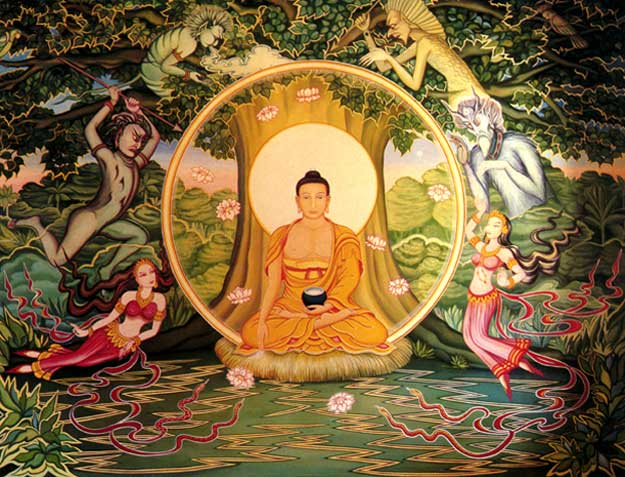
Image: Enlightenment Scene, Temple painting in Bodhgaya, India, by Marianna Rydvald.

Saturday, April 28, 2007

Seeing


When one reads an allegory, its a question of being able to see it as allegorical, notwithstanding the intensive detail within the story.

Mythology is like that; the unrealistic, the fantastic - the magical has to be seen as indicative of transformation, from the lens of one's own life experience.

It calls for the ability to step back and see in perspective.

Illustration: Scene from John Milton’s Paradise Lost, by John Baptist Medina.

Trans-historical


A painting on bark by Kneepad,
of Groote Eylandt, illustrates creation
story from Australian indigenous people.

In Mahayana Buddhism, there are several very sacred texts, of apocryphal origin, which are very mythic in their content, and phantasmagorical in their description.

The Prince who became a Cuckoo: reading this within the specific psycho-social circumstances I was in, and the state of mind-being generated by that - I only saw it as a "manual of planning".

The Lotus of the True Law: became a "manual of long-term planning” (i.e.trans-historic, e.g. for a final outcome that will emerge after several centuries and then endure over millenia).

The Land of Bliss: a "textbook of civics".

During the period I read these texts - everything took on an aura.

The Sufi teaching has this trans-historicity.

Hermann Hesse’s Journey to the East is an example from contemporary times.

Wednesday, December 06, 2006

6th December


6th December 1992 was one of the darkest days in the history of modern India. The Babri mosque in Ayodhya in northern India was destroyed by a mob of vandals. Riots between Hindus and Muslims broke out across towns and cities in north India. Riots hit Calcutta too, with Muslim slums being torched in Tangra in east Calcutta and Metiabruz in west Calcutta.

After the experience of the Great Calcutta Killing of 16 August 1946, and more riots in 1963-64, Calcutta had at least been free of the horror of communal riots. The CPI(M)-led Left Front govt ruling West Bengal since 1977 had made communal harmony a major plank of its policy. But following 6 December 1992, sleeping demons were awakened.

Curfew was enforced in Calcutta in the days following 6 December 1992. For me, that led to an enforced engagement with this question, the Muslim question, something I had hardly thought about earlier. Afterwards, photographer Achinto and I went to Tangra. The people from the burnt out slum were sheltered in the municipal slaughterhouse. I will never forget that sight, a vision of hell.

A germ was planted in me. And that germ went on to take over and transform my life within 5 years. But before that all the habitual assumptions and notions, all the socialised conditioning and subtle prejudice in me had to be plucked out. I was fortunate to meet friends who aided in this.

There is a huge gulf separating Muslims (the overwhelming majority of whom are poor, barely educated, and self-employed) and educated Hindus in India. Its a question of perception and cognition. Very few even bother to recognise that such a gulf exists.

After I started working in Priya Manna Basti in Howrah and started Howrah Pilot Project, 6th December was observed by us as National Renewal Day. In 1998, we organised a cultural programme for the children of Talimi Haq School. A special harmony badge was made and worn by everyone. In 1999, there was ceremony where the Muslim children of Talimi Haq and Hindu children of a nearby school tied rakhis on one another (a wrist band symbolising brotherhood). An elderly community member who had spent much of his life teaching children of Priya Manna Basti was felicitated and honoured. And in 2000, this date fell during Ramadan and so we had a grand iftaar (fast-breaking) gathering for my new-found Muslim activist friends from Calcutta.

The great thinker and poet Mohammad Iqbal wrote the song "Sarey jahaan sey achha Hindustan hamara" (Better than the whole world, our India). But he is also considered to be one of the founding fathers of Pakistan, which was born as a separate homeland for India's Muslims. Iqbal wrote "Shikwa aur Jawaab-e-Shikwa" (Complaint to God, and God's answer), about the miserable plight of Muslims. After I started working in Priya Manna Basti, and began to understand the power of Urdu poetry, I wrote a song "PM Basti ke ham sab sachhey mussalmaan hain" (We are all true Muslims of PM Basti). I wrote my own "Gratitude, and God's Acceptance", to express my feelings for the blessing of India's plural heritage. And I wrote my version of "See the city from here" (the title of poet Faiz's poem), celebrating the love and harmony I found working with the women and children in Priya Manna Basti.

In 1946, leading up to the Direct Action Day, of 16 August, the slogan "haath mein bidi muh mein paan, ladkey lengey Pakistan" (bidi in hand, paan in mouth, we shall fight and take Pakistan) had spread like wildfire in Calcutta. In 1997, in my song Hariyali, I wrote:

Liye haath mein lathi muh mein Ram
Lana hai woh paak sthaan
Sangh hai saathi hoga hi kaam
Layengey woh paak sthaan


Staff in hand, the Lord’s name we sing
This sacred land must we bring
Companions are with us, the work shall be done
This sacred land must be won.

The sacred land, being the land of harmony, where Hindu and Muslim children walk and grow together.

It is 14 years since that dark day of 1992.

In the Ramayana epic, Prince Rama of Ayodhya had to take up 14 years of forest exile to uphold his father's honour. His father died grieving for his son. And before returning home, Rama had to vanquish king Ravana of Lanka to rescue his abducted beloved wife Sita.

Much has happened in these 14 years. In 2002, we had the horrific riots in Gujarat in western India. This was India's intimation of its version of the Final Solution. And just a few days ago, the report of the Sachar Committee was submitted to the govt of India (available for download here). This examined the socio-economic backwardness of the Muslim community in India.

Like never before, the challenge is out in stark terms to all Indians:

Are we a pluralist nation, where everyone has a place of dignity, with justice for all?

Can Hindu and Muslim be as one, two inseparable parts that together make the whole that is India?

Does anyone want such an India?

Photo: Achinto

Tuesday, November 07, 2006

When, when?


"Shouldn't these ancient sufferings of ours finally start to bear fruit?"

Rainer Maria Rilke

Monday, October 09, 2006

From one infinity into another


My journey to India, in 1938, was not taken on my own initiative. It arose out of an invitation from the British Government of India …

By that time I had read a great deal about Indian philosophy and religious history, and was deeply convinced of the value of Oriental wisdom. But I had to travel in order to form my own conclusions, and remained within myself like a homunculus in a retort. India affected me like dream, for I was and remained in search of myself, of the truth peculiar to myself.

The journey formed an intermezzo in the intensive study of alchemical philosophy on which I was engaged at the time. This had so strong a grip upon me that I took along the first volume of the Theatrum Chemicum of 1602, which contains the principal writings of Gerardus Domeus. In the course of the voyage I studied the book from beginning to end. Thus it was that this material belonging to the fundamental strata of European thought was constantly counterpointed by my impressions of a foreign mentality and culture. Both had emerged from original psychic experiences of the unconscious, and therefore had produced the same, similar, or at least comparable insights.

… India honoured me with three doctorates, from Allahabad, Benares and Calcutta - representatives of Islam, of Hinduism, and of British-Indian medicine and science. It was a little too much of a good thing, and I needed a retreat. A ten-day spell in a hospital offered it to me, for in Calcutta I finally came down with dysentery. This was a blessed island in the wild sea of new impressions, and I found a place to stand on from which I could contemplate the ten thousand things and their bewildering turmoil.

When I returned to the hotel, in tolerably good health, I had a dream so characteristic that I wish to set it down here. I found myself, with a large number of my Zurich friends and acquaintances, on an unknown island, presumably situated not far off the coast on southern England. It was small and almost uninhabited. The island was narrow, a strip of land about twenty miles long, running in a north-south direction. On the rocky coast at the southern end of the island was medieval castle. We stood in its courtyard, a group of sightseeing tourists. Before us rose an imposing belfroi, through whose gate a wide stone staircase was visible. We could just manage to see that it terminated above in a columned hall. This hall was dimply illuminated by candlelight. I understood that this was the castle of the Grail, and that this evening there would be a “celebration of the Grail” here. This information seemed to be of a secret character, for a German professor among us, who strikingly resembled old Mommsen, knew nothing about it. I talked most animatedly with him, and was impressed by his learning and sparkling intelligence. Only one thing disturbed me: he spoke constantly about a dead past and lectured very learnedly on the relationship of the British to the French sources of the Grail story. Apparently he was not conscious of the meaning of the legend, nor of its living presentness, whereas I was intensely aware of both. Also, he did not seem to perceive our immediate, actual surroundings, for he behaved as though he were in a classroom, lecturing to his students. In vain I tried to call his attention to the peculiarity of the situation. He did not see the stairs or the festive glow in the hall.

I looked around somewhat helplessly, and discovered that I was standing by the wall of a tall castle; the lower portion of the wall was covered by a kind of trellis, not made of the usual wood, but of black iron artfully formed into a grapevine complete with leaves, twining tendrils, and grapes. At intervals of six feet on the horizontal branches were tiny houses, likewise of iron, like birdhouses. Suddenly I saw a movement in the foliage; at first it seemed to be that of a mouse, but then I saw distinctly a tiny, iron, hooded gnome, a cucullatus, scurrying from one house to the next. “Well,” I exclaimed in astonishment to the professor, “now look at that, will you …”

At that moment a hiatus occurred, and the dream changed. We – the same company as before, but without the professor – were outside the castle, in a treeless, rocky landscape. I knew that something had to happen, for the Grail was not yet in the castle and still had to be celebrated that same evening. It was said to be in the northern part of the island, hidden in a small uninhabited house, the only house there. I knew that it was our task to bring the Grail to the castle. There were about six of us who set out and tramped northwards.

After several hours of strenuous hiking, we reached the narrowest part of the island, and I discovered that the island was actually divided into two halves by an arm of the sea. At the smallest part of this strait the width of the water was about a hundred yards. The sun had set, and night descended. Wearily, we camped on the ground. The region was unpopulated and desolate; far and wide there was not a shrub, nothing but grass and rocks. There was no bridge, no boat. It was very cold; my companions fell asleep, one after the other. I considered what could be done, and came to the conclusion that I alone must swim across the channel and fetch the Grail. I took off my clothes. At that point I awoke.

Here was this essentially European dream emerging when I had barely worked my way out of the overwhelming mass of Indian impressions. Some ten years before, I had discovered that in many places in England the myth of the Grail was still a living thing, in spite of all the scholarship that had accumulated around this tradition. This fact had impressed me all the more when I realised the concordance between this poetic myth and what alchemy had to say about the unum vas, the una medicina, and the unus lapis. Myths which day has forgotten continue to be told by night, and powerful figures which consciousness has reduced to banality and ridiculous triviality are recognised again by the poets and prophetically revived; therefore they can also be recognised “in changed form” by the thoughtful person. The great ones of the past have not died, as we think; they have merely changed their names. “Small and slight, but great in might,” the veiled Kabir enters a new house.

Imperiously, the dream wiped away all the intense impressions of India and swept me back to the too-long neglected concerns of the Occident, which had formerly been expressed in the quest for the Holy Grail as well as in the search for the philosophers’ stone. I was taken out of the world of India, and reminded that India was not my task. But only a part of the way – admittedly a significant one – which should carry me closer to my goal. It was as though the dream were asking me, “What are you doing in India? Rather seek for yourself and your fellows the healing vessel, the servator mundi, which you urgently need. For your state is perilous; you are all in imminent danger of destroying all that centuries have built up.”

…Towards the beginning of spring I set out on my homeward voyage, with such a plethora of impressions that I did not nhave any desire to leave the ship to see Bombay. Instead, I buried myself in my Latin alchemical texts. But India did not pass me by without a trace; it left tracks which lead from one infinity into another infinity.

From: Memories, Dreams, Reflections by Carl Jung.

Passage between legends


“At the end of the (Grail) legend, the life-force is carried back into the world. Anfortas is healed. Repanse de Schoye leaves her angel-like role as the Grail carrier, and enters a new life. With Feirefis, she sets out into the world. It was a grand farewell. At the same time, it was a new beginning. In India, Repanse gave birth to a son who, as Preston John, was to teach a mystic Christianity in the East. Parzival was the new king in Munsalvasche. Together with Condwiramurs, he led a rich life in the service of the Grail. The land that had once turned to desert, began to blossom again.”

The Journey of the Hero, by Friedemann Wieland.

Read about the Grail Legend here.

While symbols that speak to us are culturally specific, they are also part of the symbolic universe that lies within the collective sub-consciousness of humanity at large.

Like the friendship of ancient trees, like the overlapping canopies of huge trees in a forest – there is a passage between the mythologies, the cognitive and linguistic universe of different peoples. After all the human family is one.

A tale of two cities


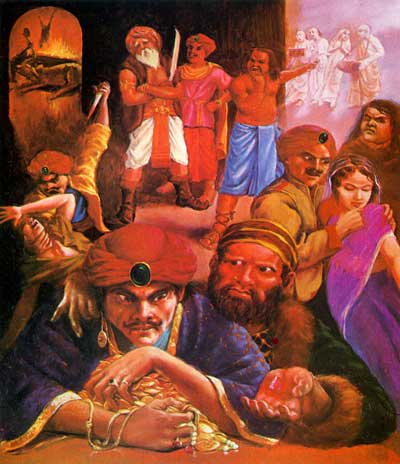
The ancient Hindu epics, Ramayana and Mahabharata, which are aids to instilling an organic consciousness in human society, are also essentially about the cities of Ayodhya, and Hastinapur.
In the same way as an epic serves to guide seekers of truth and wisdom through the slings and fortunes of their own lives by upholding a personalisable figure, such as Lord Rama, and describing his exile and wandering, similarly, the mythic cities are also metaphors for the process of becoming of any city, to an Ayodhya, the city of compassion and justice.

Thus, one can think of the journey of a city, through history, in terms of a cycle of birth, growth, prosperity, stagnation, decay, blight, recrudescence...

Mythology becomes the means for continuous renewal through the living culture of the people, as individual, institutional, city and social life trajectories act out, anew, contemporary versions of the epic events, with consequences that mirror mythic outcomes.

Or shatter mythic patterns and bonds to now enable otherwise unimaginable new possibilities.

The tale of the two cities, of Calcutta and Howrah, may easily be viewed mythically - for instance, in terms of the story of the two brothers, fated to be king and sage respectively, that is common to both Hindu and Islamic thought.

Few cities in the world have experienced what these two did - in terms of their rapid growth and massive industrial edifice, their wealth, and size and scale of their vast rural hinterland, the extent of their regional economic linkages - and the weight of the apathy to their labouring people.

More fundamentally, this process of urban growth was accompanied by profound enlightenment in the social and cultural sphere, through which elite, European-inspired accomplishments and deep-rooted spontaneous folk sensibilities were integrated, to produce giants of creativity, intellect and wisdom - like the revered poet-sage Rabindranath Tagore.

The story of the rise of these cities is also the story of the renewal of a tradition, of awakening, re-connecting with roots, and building with this strength. The subsequent process of decline, decay and blight in the economic, environmental and social spheres in turn leading to a moment when the wheel is again ready to be turned, and a heroic journey begun, through which a barren, arid wasteland is now to be made verdant.

Howrah has always been viewed as a ‘coolie (i.e. labourers’) town’ that did not merit any serious civic effort. The history, the context of resource scarcity, the survival imperative in the people of Howrah, and the parasitic greed and activities of profiteers, all interact to make today’s Howrah the ultimate planning nightmare, or challenge, depending upon one’s perspective.

The very blight that characterises Howrah today, can also be seen as a rare opportunity to shape the Howrah of tomorrow. This is the gift of Howrah’s history.

Thursday, September 14, 2006

Dogs (& monkeys)


I recently came across, in succession, some posts about dogs by bloggers Flitzy, Kathy, Flitzy again, and Darvish. And a hilarious image in Planck’s Constant. There’s also of course Hayden, who regularly writes about dogs.

This brought to mind the several Sufi dog tales I have among my books. I had paid particular attention to this subject, of dog as metaphor, in terms of reflection, associations etc. I had also once shared these stories with a friend who’s particularly close to dogs.

So, as promised to Kathy, I am now transcribing and posting these.

By posting the following five dog tales, I also pay tribute to the late Idries Shah, the author of many books on Sufi philosophy and teachings. Through his books, he has been a dear and intimate friend and guide.

This is a first offering. More to follow, from the stories of Muslim saints and mystics.

In Hindu religious mythology, there is Hanuman, the monkey son of Wind. He is a principal character in the Ramayana epic, the one who helps Lord Rama defeat the evil King Ravana of Lanka, and rescue his abducted wife Sita. Hanuman is an exemplar of devotion. It is said that wherever and whenever the Ramayana is narrated, Hanuman is present in that assembly.

Like with Sufi dog tales, I have thought long and hard about this monkey business. Why a monkey? Together with Hanuman and the army of monkeys who helped Lord Rama, there were also bears, and even a squirrel! There is a tale of how the squirrel got the marking on the top of its fur, for its wish and efforts to help Lord Rama build the bridge across the sea, to Lanka.

I realised that in the racially and socially stratified Indian setting - all this has profound meanings and resonances in the consciousness of a seeker, of someone engaging compassionately with common people, and working for social justice. These meanings cannot be explained by one to another, like feeding regurgitated pre-masticated pap! It is for each seeker to encounter such tales and symbols, discern their significance, and reflect upon them in the mirror of her own life experience and work.


Cartoon: off the mark

Tuesday, September 05, 2006

Father and son

It was the night of 16 November 1992. We had celebrated my son Rituraj’s first birthday three days ago. That had been a grand affair, a very happy occasion of thanksgiving and sharing one's joy with relatives and friends, for being blessed with an angelic child.

I was in bed, Rituraj was sleeping beside me. My wife had left that evening on an out-station trip in connection with her work.

I was awakened in the dead of night by the sound of something like coughing. It was Rituraj. I jumped out of bed and turned the light on. There was something the matter with him. A strange sound emanated from his throat, a terrifying hoarse croaking-choking-coughing-gasping kind of sound. I could see he was having difficulty breathing. And when he got some breath he was crying or trying to cry, but only that frightful sound came out. I tried to give him a drink of water from his bottle, but he was unable to swallow.

Terror seized my heart. Oh my God! He is dying! I imagined he had someting like tetanus and was going to die in front of my eyes. What am I going to tell Rajashi when she returns?

I had no clue whatsoever about what might be the problem. I tried to calm him, by talking to him, saying soothing things, stroking his head. But seeing his condition I only sank deeper into panic.

I opened the doors. Rituraj’s nanny Pratima had heard the sounds and woken up. I went down to the ground floor, where my father lived and woke him up. His maidservant Archana also woke up. I told my father Rituraj seemed to have taken ill. I brought the baby downstairs and laid him on my father’s bed. But he too was clueless, and his helplessness was evident. So I realised it was up to me now to do something.

It was early winter in Calcutta. I wrapped Rituraj in his blanket and asked Pratima to carry him, and we set out for the emergency doctor’s clinic a few minutes walk away. On the way, in the desolate lane was a cow. As we passed it, Rituraj saw the cow from his place on Pratima’s shoulder and, as he was wont to do, said “Hamba”. That was his baby-word for “cow” (from it’s mooing). This only made it all the more poignant for me, but it also heartened me somewhat, that he must be alright.

We reached the emergency clinic – to discover that it was closed down. Back home again. It was close to 3 am. I dug out his paediatrician Dr Radha Narayan’s telephone number and called. After a while, she picked up the phone. I introduced myself, apologised for calling her at this unearthly hour, and explained Rituraj’s condition. She said it sounded like a case of chest congestion and gave me the names of certain medicines, including a broncho-dilator. I noted this down. I left Rituraj in the care of my father and Pratima and Archana, grabbed my wallet and set out, on my bicycle, to the 24-hours medicine shop, about 2 kms away.

Cycling at breakneck speed in the silent, still, desolate, cold night, I reached the shop. It was closed. I decided to try at another place I recalled, half a km away. I found that too closed. My panic and despair grew. I decided to go to another shop, quite a distance away, which I knew would definitely be open. In my state, I became disoriented and lost my sense of direction. I stopped an empty taxi passing by and asked the driver the way.

I was sobbing as I peddled. I knew that I was merely going through an act, of appearing to be doing something, when in reality I was simply avoiding and escaping witnessing my son's death. As far as I could see, when I returned I was going to find Rituraj gone. Oh the horror and despair of that! I wailed plaintively in my grief. How cruelly fate was mocking me with such a blow. I remembered all the unconscionable things I did habitually. No! No! Anything but that! Anything to avert that! And nothing was too high a price for that.

And then for the first time in my life, I turned to prayer. I sobbed out the mantra my father had once shared with me. Make my son well, oh Lord, I prayed, and extract any price from me. Take my life oh Lord, but spare him. I tried to shut out all other thoughts and simply utter the prayer. When I observed myself like this – it only heightened my despair. But in that desolate dead of night, there was no one to see me, I was all alone, and I kept uttering the prayer and peddled on, as if by this very act of will I could reverse fate.

I finally reached the medicine shop, found it open, got the prescribed medicines and headed back homewards. I kept uttering the prayer audibly, and tried to shut out any other thoughts, shut out the remembrance of the terror.

I reached home. Everyone was waiting or me. Pratima and Archana had somehow managed to put Rituraj to sleep on my bed. I woke him up and gave him the medicines, and patted him to sleep again. And I lay down beside him, watching over him until I too dozed off. My sleep was disturbed. In my dreams the horrid sound from Rituraj’s throat kept coming. I dreamt he was well again.

I woke up at dawn and after giving Rituraj another dose of the medicines, rang up my father-in-law and told him what had happened. I said I was bringing Rituraj over right away. I took him there in a taxi. My in-laws had called Tutul, a medical student who lived nearby, who was a close friend of the family. We went right away to a friend of his, Atom, a paediatric intern, who lived nearby.

Atom examined Rituraj. He told us that he had a bad chest congestion. The phlegm had congealed in his chest. And as a result there was also an infection. He said it was fortunate that he had been diagnosed right now. It might otherwise have been too late and quickly led to pneumonia. He prescribed a more precise set of medicines. Rituraj was unwell, but he was going to be alright after a few days.

After the night’s experience – I felt drained. But the whole day I was giddy with relief and gladness. A week later Rituraj was fully recovered. And after my wife returned, I told her what had happened.

When I am in any kind of personal difficulty or unhappiness – I sometimes remember Rituraj’s survival that night. And I remember that I will gladly pay any price, bear any kind of personal pain for the rest of my life, for that gift of his life.

…………….

As a ten year old, I had learnt in school that the Mughal emperor Babur, had prayed for his son Humayun’s life when he was very ill, and exchanged his life for his son’s. Something like that happened with me as well. About a year after Rituraj's respiratory condition, I was very ill, having come down with reactive arthritis consequent to gastroenteritis. My father had suffered a mild cerebral stroke earlier, and in the altered mental state induced by that condition he thought I was dying. He prayed for exchanging his life for mine. I recovered. Shortly after that my father passed away, suddenly, in his sleep.

…………….

When Rituraj was about seven, on the way back after a short holiday in the Lakshwadip islands (off the south-western coast of India), he and I made a quick trip to my grandmother’s village, in Thodupuzha, in the state of Kerala. This was now a bustling municipal town. We went to the house of my grandmother’s cousin, and after a few seconds of introduction-explanation, we were welcomed. That evening we went to the ancient Krishna temple in Thodupuzha. The deity there had been my grandmother’s companion and solace all her life.

The new place, the new topography, the new culture, the new people around, the new traditional village house – perhaps because of all this, a transformation had taken place in Rituraj. I was struck by how angelic he had become. And when Rituraj wore a dhoti (a wrap-around lower garment) to go to the temple – all the people in the house felt Krishna himself had visited their home!

I went to the temple again that night, as the closing rituals were being performed. I took a walk around the temple. This was where my grandmother had been born and grew up, the place where my father had been born. This place represented the cultural roots of my family. I had come here 23 years earlier, to attend a marriage. Now it seemed to me to be the culmination of all my journeys and all my learning. It was the centre of the world. The temple, its layout, the layout of the town around the temple, all seemed to suggest a deep symmetry and pattern.

On this visit to Thodupuzha, I learnt that this temple was famed for healing sick children. The deity in the temple represented the infant Krishna, who had just fought off the attack by the monstrous bird Bakasura. I was told that besides bringing the sick children to the temple, even praying to the deity from faraway saved the children.

…………….

A couple of years ago, Mike Davis, a friend in Melbourne, had come on holiday to Calcutta with his wife and two daughters. He was staying with Mahadev, a common friend. I went to meet them. Mike’s younger daughter, who was about six years old, was quite unwell. They had all returned from a trip where she had caught some kind of infection, and had a high fever. They had seen a doctor then, and medication was being taken. But the symptoms persisted. And they had to catch their return flight later that night. The parents were very anxious and distraught.

I could not bear to see the parents’ agony. So I immediately phoned my boys’ paediatrician and told her I was coming with a little girl who was unwell. And I set off with Mike and his wife and daughter. The doctor examined the girl, prescribed some medicines, and assured the parents that she could travel and that they should not worry.

After many hours of the anxiety gnawing away at them – that cloud over the terrified parents was lifted. I was happy I had been able to help. On the way back to Mahadev’s apartment, I shared with them the stories of Rituraj’s illness when he was one, of Babur and Humayun, of my father and me, and of the temple in our village which was famed for healing sick children.

Doing all one can to help sick children, whether one’s own or anyone else’s, whatever the cost – I think that is one of the most important things in life. This is what led me, in 1996, to start working in the slums of Howrah, where the infant mortality rates are disproportionately high. But sadly, owing to utter collapse of governance at the grassroots, this is not something where one's personal efforts bring any kind of positive result.

Saturday, August 12, 2006

The Ages of Man


I wrote yesterday about the Kali-yuga, the age of corruption.

Here’s an extract about the four Yugas or ages from Hindu Mythology, Vedic and Puranic by WJ Wilkins (first published in London in 1882):

"The four Yugas – viz. the Krita, Treta, Dvapara, and Kali – have characteristic qualities. The Krita is the golden, and Kali the iron age. The Mahabharata gives these characteristics very distinctly.

‘The Krita is that age in which righteousness is eternal. In the time of that most excellent of Yugas everything had been done (Krita), and nothing remained to be done. Duties did not then languish, nor did the people decline. Afterwards, through the influence of time, this Yuga fell into a state of inferiority. In that age there were neither gods, spirits, angels or demons; no buying and selling went on, no efforts were made by men; the fruit of the earth was obtained by their mere wish; righteousness and abandonment of the world prevailed. No disease or decline of the organs of sense arose through the influence of age; there was no malice, weeping, pride or deceit; no contention, no hatred, cruelty, fear, affliction, jealousy, or envy. Hence the Supreme Brahma was the transcendant resort of these Yogis. Then Narayana (Vishnu), the soul of all beings, was white. In that age were born creatures devoted to their duties. They were alike in the object of their trust, in observance, and in their knowledge. At that period the castes, alike in their functions, fulfilled their duties, were unceasingly devoted to one deity, and used one mantra, one rule, and one rite. They had but one Veda (sacred text, of revealed knowledge).

Understand now The Treta, in which sacrifice commenced, righteousness decreased by a fourth, Vishnu became red; and men adhered to truth, and were devoted to a righteousness dependent on ceremonies. Then sacrifies prevailed, with holy arts and a variety of rites. In the Treta mean acted with an object in view, seeking after reward for their rites and their gifts, and no longer disposed to austerities, and to liberality from duty. In this age, however, they were devoted to their own duties and to religious ceremonies.

In the Dvapara age, righteousness was diminished by two quarters, Vishnu became yellow, and the Veda fourfold. Some studied four Vedas, some three, others two, and some none at all. The scriptures being thus divided, ceremonies were celebrated in a great variety of ways; and the people, being occupied with austerity and the bestowal of gifts, became full of passion. Owing to ignorance of the one Veda, Vedas were multiplied. And now from the decline of goodness, few only adhered to truth. When men had fallen away from goodness, many diseases, desires and calamities caused by destiny, assailed them, by which they were severely afflicted, and driven to practise austerities. Others, desiring enjoyments and heavenly bliss, offered sacrifices. Thus, when they had reached the Dvapara, men declined through unrighteousness.

In the Kali, righteousness remained to the extent of one-fourth only. Arrived in that age of darkness, Vishnu became black; practices enjoined by the Vedas, works of righteousness, and rites of sacrifices ceased. Calamities, deseases, fatigue, faults, such as anger etc, distresses, anxiety, hunger, fear prevailed. As the ages revolve, righteousness again declines; when this takes place, the people also decline. When they decay, the impulses which actuate them also decay. The practices generated by this declension of the Yugas frustrate men’s aims. Such is the Kali Yuga, which has existed for a short time. Those who are long-lived act conformity with the character of the age.' … 'Four thousand years are specified as the duration of life in the Krita Yuga, three thousand in the Treta, and two thousand form the period at present established on earth in the Dvapara. There is no fixed measure in the Kali.’

Painting: The Four Ages of Man, by Valentin de Boulogne, oil on canvas, National Gallery, London.

The Age of Kali, and Kalki


I also wrote yesterday about Kalki, the incarnation of Vishnu (who sustains life) who is prophesised to come at the end of the age of Kali.

Here’s a description of Kalki from WJ Wilkins’ Hindu Mythology, Vedic and Puranic:

"It is the hope of the Hindus that he who has so frequently visited the earth to restore order and happiness will come yet again to inaugurate a reign of universal goodness, peace and prosperity. When Vishnu in the form of Krishna re-ascended to heaven, the Fourth or Kali Yuga commenced, which, as its name implies, is an age of strife and dissension. In the “Vishnu Purana” the character of this age is vividly described in words that seem prophetic. At its termination Vishnu is expected to come again, bearing the name Kalki, to put an end to wickedness, and establish a kingdom of righteousness similar to the First or Krita Yuga - the age of Truth. These four ages, in the same order and with similar characteristics, will again and again be experienced until the final end of all things shall come. The following extract from the “Vishnu Purana” will give an idea of the evils of the present age, which Kalki is to remove.

‘The kings will be of churlish spirit, violent temper and ever addicted to falsehood and wickedness. They will inflict death on women, children and cows; they will seize the property of subjects, be of limited power, and will, for the most part, rapidly rise and fall; their lives will be short, their desires insatiable, and they will display but little piety. The people of various countries intermingling with them will follow their example; and the barbarians being powerful in the patronage of princes, whilst purer tribes are neglected, the people will perish. Wealth and piety will decrease day by day, until the world shall be wholly depraved. Property alone will confer rank, wealth will be the only source of devotion, passion will be the sole bond of union between the sexes, falsehood will be the only means of success in litigation, and women will be the objects merely of sensual gratification. Earth will be venerated only for its mineral treasures (i.e. no spot will be peculiarly sacred); … external types will bethe only disctinctions of the several orders of life, dishonesty will be the universal means of subsistence, weakness will be the cause of dependence, menace and presumption will be the subterfuge for learning, liberality will be deviotion, simple ablution will be purification (i.e. gifts will be made from the impulse of ordinary feeling, not in connection with religious rites or as an act of devotion, and ablution will be performed for pleasure or comfort, not religiously with prescribed ceremonies and prayers). … Fine clothes will be dignity, and water afar off will be esteemed a holy spring. The people, unable to bear the heavy burdens imposed upon them by their avaricious sovereigns, will take refuge among the valleys, and be glad to feed upon their wild honey, herbs, roots, fruits, flowers and leaves; their only covering will be the bark of trees, and they will be exposed to cold and wind, and sun and rain. No man’s life will exceed three-and-twenty years. Thus in the Kali Age shall decay flourish, until the human race approached annihilation.’

It is rather strange that the condition of men, in what appeared to the writer of this Purana as the most miserable he could imagine, where their dress was bark and their food consisted of roots and fruits, was in the earliest ages regarded as the most desirable. It was thus the old Rishis (sages) lived, who are held in the greatest esteem.

‘When the practices taught by the Vedas and the institutes of law shall nearly have ceased, and the close of the Kali Age shall be nigh, a portion of that divine being who exists of his own spiritual nature in the character of Brahma, and who is the beginning and the end, and who comprehends all things, shall descend upon the earth. He will be born … as Kalki, endowed with the eight superhuman faculties. By his irresistible might he will destroy all the thieves, and all whose minds are devoted to iniquity. He will then re-establish righteousness upon earth; and the minds of those who live at the end of the Kali Age shall be awakened and be made pellucid as crystal. The men who are changed in virtue of that particular time shall be as the seeds of human beings, and shall give birth to a race who shall follow the laws of the Krita Age, of Age of Purity.’

In the descriptions of Kalki, and in pictures, he is represented as a white man riding upon or bowing down before a white horse, and with a sword in his hand: he is the purifier of the present degenerate age, and the restorer of purity and goodness."

Kalki image

Saturday, August 05, 2006

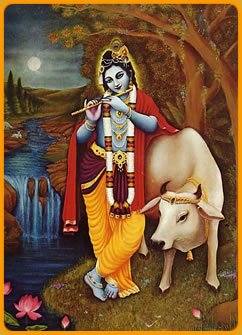
Krishna's Flute


Hazrat Inayat Khan

Krishna is pictured in Hindu symbology with a crown of peacock's feathers, playing the flute. Krishna is the ideal of divine love, the God of love. And the divine love expresses itself by entering into man and filling his whole being. Therefore the flute is the human heart, and a heart which is made hollow will become a flute for the God of love to play upon. When the heart is not empty, in other words, when there is not scope in the heart, there is no place for love.

Rumi, the great poet of Persia, explains this idea more clearly. He says the pains and sorrows the soul experiences through life, are like holes made in a reed flute, and it is by making these holes that a player makes the flute out of a reed. This means that the heart of man is first a reed, and the sufferings and pains it goes through make it a flute, which can then be used by God as the instrument for the music that He constantly wishes to produce. But as every reed is not a flute, so every heart is not His instrument. As the reed can be made into a flute, so the human heart can be turned into an instrument, and can be offered to the God of love.

It is the human heart which becomes the harp of the angels; it is the human heart which is known as the lute of Orpheus. It was on the model of the heart of man that the first instrument of music was made, and no earthly instrument can produce that music which the heart produces, raising the mortal soul to immortality.

The crown of peacock's feathers leads to a further revelation: that it is the music of the heart which can be expressed through the head; it is the knowledge of the head and the love of the heart that together fully express the divine message. The peacock's feather in all ages has been considered as a sign of beauty and knowledge; beauty because it is beautiful, knowledge because it is in the form of an eye. It is by keen observation that man acquires knowledge. Knowledge without love is lifeless. So, with the flute, the crown of peacock's feathers makes the symbol complete.