Showing posts with label prayer. Show all posts

Thursday, September 16, 2010

A Moment of Silence


by Emmanuel Ortiz

Before I begin this poem, I’d like to ask you to join me in a moment of silence in honor of those who died in the World Trade Center and the Pentagon on September 11th, 2001.
I would also like to ask you to offer up a moment of silence for all of those who have been harassed, imprisoned, disappeared, tortured, raped, or killed in retaliation for those strikes, for the victims in Afghanistan, Iraq, in the U.S., and throughout the world.
And if I could just add one more thing…
A full day of silence… for the tens of thousands of Palestinians who have died at the hands of U.S.-backed Israeli forces over decades of occupation.
Six months of silence… for the million and-a-half Iraqi people, mostly children, who have died of malnourishment or starvation as a result of a 12-year U.S. embargo against the country.
… And now, the drums of war beat again.
Before I begin this poem, two months of silence… for the Blacks under Apartheid in South Africa, where “homeland security”
made them aliens in their own country
Nine months of silence… for the dead in Hiroshima and Nagasaki, where death rained down and peeled back every layer of
concrete, steel, earth and skin, and the survivors went on as if alive.
A year of silence… for the millions of dead in Viet Nam —a people, not a war—for those who know a thing or two about the
scent of burning fuel, their relatives bones buried in it, their babies born of it.
Two months of silence… for the decades of dead in Colombia, whose names, like the corpses they once represented, have
piled up and slipped off our tongues.
Before I begin this poem,
Seven days of silence… for El Salvador
A day of silence… for Nicaragua
Five days of silence… for the Guatemaltecos
None of whom ever knew a moment of peace in their living years.
45 seconds of silence… for the 45 dead at Acteal, Chiapas …
1,933 miles of silence… for every desperate body
That burns in the desert sun
Drowned in swollen rivers at the pearly gates to the Empire’s underbelly,
A gaping wound sutured shut by razor wire and corrugated steel.
25 years of silence… for the millions of Africans who found their graves far deeper in the ocean than any building could poke
into the sky.
For those who were strung and swung from the heights of sycamore trees
In the south … the north … the east … the west …
There will be no dna testing or dental records to identify their remains.
100 years of silence… for the hundreds of millions of indigenous people
From this half of right here,
Whose land and lives were stolen,
In postcard-perfect plots like Pine Ridge, Wounded Knee, Sand Creek, Fallen Timbers, or the Trail of Tears
Names now reduced to innocuous magnetic poetry on the refrigerator of our consciousness …
From somewhere within the pillars of power
You open your mouths to invoke a moment of our silence
And we are all left speechless,
Our tongues snatched from our mouths,
Our eyes stapled shut.
A moment of silence,
And the poets are laid to rest,
The drums disintegrate into dust.
Before I begin this poem,
You want a moment of silence…
You mourn now as if the world will never be the same
And the rest of us hope to hell it won’t be.
Not like it always has been.
… Because this is not a 9-11 poem
This is a 9/10 poem,
It is a 9/9 poem,
A 9/8 poem,
A 9/7 poem…
This is a 1492 poem.
This is a poem about what causes poems like this to be written.
And if this is a 9/11 poem, then
This is a September 11th 1973 poem for Chile.
This is a September 12th 1977 poem for Steven Biko in South Africa.
This is a September 13th 1971 poem for the brothers at Attica Prison, New York.
This is a September 14th 1992 poem for the people of Somalia.
This is a poem for every date that falls to the ground amidst the ashes of amnesia.
This is a poem for the 110 stories that were never told,
The 110 stories that history uprooted from its textbooks
The 110 stories that that cnn, bbc, The New York Times, and Newsweek ignored.
This is a poem for interrupting this program.
This is not a peace poem,
Not a poem for forgiveness.
This is a justice poem,
A poem for never forgetting.
This is a poem to remind us
That all that glitters
Might just be broken glass.
And still you want a moment of silence for the dead?
We could give you lifetimes of empty:
The unmarked graves,
The lost languages,
The uprooted trees and histories,
The dead stares on the faces of nameless children …
Before I start this poem we could be silent forever
Or just long enough to hunger,
For the dust to bury us
And you would still ask us
For more of our silence.
So if you want a moment of silence
Then stop the oil pumps
Turn off the engines, the televisions
Sink the cruise ships
Crash the stock markets
Unplug the marquee lights
Delete the e-mails and instant messages
Derail the trains, ground the planes.
If you want a moment of silence, put a brick through the window
of Taco Bell
And pay the workers for wages lost.
Tear down the liquor stores,
The townhouses, the White Houses, the jailhouses, the penthouses
and the Playboys.
If you want a moment of silence,
Then take it
On Super Bowl Sunday,
The Fourth of July,
During Dayton’s 13 hour sale,
The next time your white guilt fills the room where my beautiful brown people have gathered.
You want a moment of silence
Then take it
Now,
Before this poem begins.
Here, in the echo of my voice,
In the pause between goosesteps of the second hand,
In the space between bodies in embrace,
Here is your silence.
Take it.
Take it all.
But don’t cut in line.
Let your silence begin at the beginning of crime.
And we,
Tonight,
We will keep right on singing
For our dead.


Emmanuel Ortiz is a third-generation Chicano/Puerto Rican/Irish-American community organizer and spoken word poet. He is the author of a chapbook of poems, The Word Is a Machete (self-published, 2003), and co-editor of Under What Bandera?: Anti-War Ofrendas from Minnesota y Califas (Calaca Press, 2004). He is a founding member of Palabristas: Latin@ Word Slingers, a collective of Latin@ poets in Minnesota. Emmanuel has lived in Minneapolis, Minnesota; Oakland, California; and the Arizona/Mexico border. He currently lives in Fort Wayne, Indiana, the “buckle of the Bible Belt,” with his two dogs, Nogi and Cuca. In his spare time, he enjoys guacamole, soccer, and naps.

Saturday, June 30, 2007

Sermon to the Birds


Sirocchie mie uccelli, voi siete molto tenute a Dio vostro creatore, e sempre e in ogni luogo il dovete laudare, imperò che v'ha dato la libertà di volare in ogni luogo; anche v'ha dato il vestimento duplicato e triplicato; appresso, perché elli riserbò il seme di voi in nell'arca di Noè, acciò che la spezie vostra non venisse meno nel mondo; ancora gli siete tenute per lo elemento dell'aria che egli ha deputato a voi. Oltre a questo, voi non seminate e non mietete, e Iddio vi pasce e davvi li fiumi e le fonti per vostro bere, e davvi li monti e le valli per vostro refugio, e gli alberi alti per fare li vostri nidi. E con ciò sia cosa che voi non sappiate filare né cucire, Iddio vi veste, voi e' vostri figliuoli. Onde molto v'ama il vostro Creatore, poi ch'egli vi dà tanti benefici, e però guardatevi, sirocchie mie, del peccato della ingratitudine, e sempre vi studiate di lodare Iddio.

This is St Francis of Assisi's "Sermon to the Birds", in Italian. The sermon is reported in Chapter 16, of Part I of The Little Flowers of St Francis of Assisi.

My little sisters, the birds, much bounden are ye unto God, your Creator, and always in every place ought ye to praise Him, for that He hath given you liberty to fly about everywhere, and hath also given you double and triple raiment; moreover He preserved your seed in the ark of Noah, that your race might not perish out of the world; still more are ye beholden to Him for the element of the air which He hath appointed for you; beyond all this, ye sow not, neither do you reap; and God feedeth you, and giveth you the streams and fountains for your drink; the mountains and valleys for your refuge and the high trees whereon to make your nests; and because ye know not how to spin or sow, God clotheth you, you and your children; wherefore your Creator loveth you much, seeing that He hath bestowed on you so many benefits; and therefore, my little sisters, beware of the sin of ingratitude, and study always to give praises unto God.

Painting: Pala Bardi, by Maestro del San Francesco, from Santa Croce, Florence. Courtesy Silvia Paoletti.

Saturday, May 12, 2007

Friends of the Poor


I have written earlier about St Francis of Assisi. In the last week I managed to learn an Italian song based on St Francis’ "Canticle of Brother Sun".

St Francis of Assisi is the patron saint of the environmental movement. The Canticle is a beautiful statement of his credo, of the one-ness of all life and creation, united in St Francis' perception as expressions of the immense love of the Almighty.

But above all, St Francis lived a very simple life, of poverty – he married Lady Poverty. And he maintained Chastity to Poverty. Hence he was unfailingly one with the poor and suffering.

"Blessed are the poor in spirit: for theirs is the kingdom of heaven."

Gospel of St. Matthew , Sermon on the Mount, 5:3.

So St Francis of Assisi should actually be counted as the First in the procession of Friends of the Poor.

The world might advance in knowledge, in technology, in feats of wealth, in art and aesthetics and metaphysics … but it will remain hollow at the core, and fundamentally bereft spiritually and morally as long as poverty casts a shadow on humankind. But in order to do anything that can impact positively on the lives of the poor, one’s heart must not merely bleed for, but with the poor.

Whatever may be said about Mother Teresa of Calcutta, she too was unfailingly one with the poor, and the poor above anybody else. Abbe Pierre, who passed away recently, was another contemporary exemplar of this.

Image: El Greco, Saint Francis in Prayer.

Saturday, April 28, 2007

Ave Maria


Luciano Pavarotti sings Franz Schubert’s "Ave Maria".

The words, in Latin:

Ave Maria
Gratia plena
Maria, gratia plena
Maria, gratia plena
Ave, ave dominus
Dominus tecum
Benedicta tu in mulieribus
Et benedictus
Et benedictus fructus ventris
Ventris tuae, Jesus
Ave Maria


In English translation:

Hail Mary,
Full of grace
Mary, full of grace
Mary, full of grace
Hail, hail the Lord
The Lord is with thee
Blessed art thou amongst women
And blessed,
and blessed is the fruit of thy womb,
of thy womb, Jesus.
Hail Mary

Sunday, April 22, 2007

Samran's story


Samran sent me the link to her short story "Amar pichu chadey na" and suggested I translate this.

I started reading it, and began translating it immediately.

The story is like an exquisite kantha. With great simplicity, skill and subtlety Samran deftly weaves a unique and beautiful tale, encompassing diverse threads and images, a story about herself, a story of the land. I would like to think that the world of writing, the world of literature, has found a fresh new voice, which is rooted in the soil and yet speaks to people, and women, everywhere. Bravo Samran!

......

Ever shadowing me

by Samran Huda

I never trust cats, they are vehicles of ghosts. As there’s no way of recognising which one’s a cat and which one a ghost, all cats were in my suspects list. And if a cat ever somehow passed by my feet, then death was certain. Neither would anyone get the slightest hint of how the death would take place, and when. Why, just recently, a ghost in cat’s guise actually killed a friend of father’s. Simply dug into and tore his throat. And that Tareque uncle couldn’t do a thing. How could he? Can anyone stand up to ghosts and djinns? Hamdu aunty (Hamid uncle’s wife) had come during youngest uncle’s marriage. She taught that whenever one senses a ghost nearby, the mantra must be recited. Apparently the ghosts would then become aware that this person possesses the great mantra, that no harm can be done him.

Ghostie’s my laddie
Witch’s my maid
O my dear cheap thief
What’ll you do to me?


That’s why I never give any cat a chance to pass beneath my feet. When I sit to eat, I sit with both my legs raised and folded on the chair. But the cats too don’t stop following me. Whenever they get the opportunity they stare intently. They let me know that they know my motives. I’ve been timid from my childhood. Fragments of incidents narrated by friends of my age; the kadam tree standing in one corner of the field, solitary in night’s darkness; the dark of night; all the true-false tales told by the maidservant aunties - all made me permanently timid.

That day returning home drenched in the pouring rain I saw mother was sleeping. Glancing from the veranda I saw the rain water flowing like a waterfall down the second-floor tin roof. Checking once again to see if mother was indeed asleep, I was under that waterfall. The rear of the house was usually quite dirty. Even though the rear courtyard was fairly large, it was not used for anything other than throwing garbage. Just beside the spot where I was standing and bathing in the water of this waterfall was a narrow open drain. As I’d slipped and fallen into it earlier, I knew there was really murky foul water there, which came to my knees. Now, in this torrential rain it had turned into a wide stream.

Fee fie foe
To uncle’s house I go
Aunty gave me milk and rice
Ate till I was full so nice
Uncle comes with a mace oh me
Oh lets flee!


I didn’t notice that an unknown cat came and stopped on the sunshade beneath the second-floor railing. As soon as I spotted it, forgetting all about the rain waterfall bath I became statue-still. I stared unblinking at the cat and the cat too gazed specifically at me with its cold fixed eyes. As soon as my wits returned, just as I was about to scream out Mummy and run, as soon as I put out my foot one leg fell straight into that drain. Mother heard the scream as well as the sound of falling. Rushing there and not finding anyone, she shouted out, Who’s that? What’s happened? I somehow managed to utter, Its me Mummy! By then the cat had disappeared. Having slipped and fallen into the drain, I had hurt myself quite a bit, and on top of that mother first landed two round blows on my back and then dragged me along to the water-tap.

I believe girls’ open hair is loved by evil djinns. Granny said that at twilight (just before and after sunset) all the djinns and ghosts roam around. Hence I was not to go out after evening with my hair open. As soon as the evil djinn spotted open hair it came and made a nest. And if the djinn took a liking to that girl then it was an even graver problem. The djinn married the girl, and started a family with her. Humans cannot see djinns with their eyes. Only those whom the djinns wished to be seen by could see them. The girl would talk to and laugh with the djinn. Cook for him. Even while living among everyone, the djinn remained unseen and so people thought she had become mad. And then she was done for! Stratagems for curing the girl’s madness would start. The moulvi sahib would come. He would make her wear many talismans. Reciting the Surah Fatiha, he would impart water sanctified with his breath. "All praise belongs to God alone, Lord of all worlds …" Reciting the Astagafar and blowing repeatedly into a black braid, he made nine knots and tied it to the djinn-possessed girl’s hand. So that the djinn wouldn’t be able to come near the girl any more.

Astag firullaha rabbi min kulli jambi watubu ilika la howla wala kuyata illa billa hil aliul azim

Despite drinking the sanctified water, the girl did not get well. The djinn was not going to leave the girl at any event. Then there are many djinns who take away the girl they fancy. Who are never found again.

That’s why as soon as its evening I tie up my hair tight. I don’t want to go to the veranda after dusk. The kadam tree in the corner of the field is clearly visible. Darkness nestles thickly on this kadam tree. If for some reason I need to go to the veranda, I force my eyes to keep away from this kadam tree. All the time I think someone watches me from there. Two red eyes. Unblinking, as if they are staring at me, as if were I to dare to look, it would call me with a gesture. Night after night, I keep my eyes away from this kadam tree. As soon as its evening I shut the room’s window. The cat that mews and roams around nearby at daytime, and creeps in and sits under the dining table – at night, the same cat sits perched on this kadam tree. Its eyes are red then. It gazes unblinkingly at me.

But when the kadam blooms during the rains, then on most days, I go with Hena, Mili and Setu to pluck those blooms. Setu too loves kadam flowers. Mili and others sing a ditty:

Moon’s risen
Flowers bloomed
Who goes under the kadam tree?
Little girlie will be wedded
With her head fully covered.


Sometimes I go alone too. The kadam tree really draws me. When I wake up in the morning and go to the veranda, my eyes first settle on that kadam tree. Then I can’t see two red eyes. Then it’s not a nest of any evil djinns. Then it’s just a kadam tree. Its branches and leaves sway in the breeze. Rain falls on the flower-bedecked kadam tree. On some days, right in the morning I go out all alone, across that small field, to the base of the kadam tree. My heart thumps in fear. Yet I go. I can’t stay away. That kadam tree really pulls me.

Noni’s dad says, Afa my dear, don’t leave your home at all at night. I see all that happens at night. I ask Noni’s dad, Old Mian, don’t they say anything to you? Noni’s dad, our old watchman answers, but I recite prayers and blow sanctifying breaths over my body and keep my body shut. That’s why they can’t do a thing to me. Otherwise they’d have finished me off long ago! I plead with Old Mian to teach me to shut my body. I too want to go out at night. I want to go beneath the berry tree. I want to pluck that large safeda from the slender winding branches of the safeda tree. I want to stand leaning on the railing of the second-floor and gaze at the night sky. If Old Mian doesn’t teach me body shutting, then I wouldn’t be able to go out at all. All the time I’d have to stay the way I now do, if I ever awaken at night, keeping my eyes shut tight and lying curled up. How Old Mian, turban on his head, staff in hand, walks around the house all night long! Deep into the night, he recites the Darud tunefully:

Nur mohammad sallallah
Mafi kalfi gairullah
All recite with pure hearts
La ilaha il allah


My sleep breaks, I lie with my eyes shut. Does Old Mian see them right now?

I can’t speak to anybody about this fear and anxiety of mine. At exactly nine thirty in the morning Setu appears. Its time to go to school. Setu and I study in the same school. White salwar-kameez, pleated white odna tucked into the broad green belt on the waist. Hurriedly grabbing the tiffin money from mother I go out. Setu and I go to school by cycle-rickshaw. My most favourite class is Rubina Apa’s class. Rubina Apa taught Bengali. Most of the girls felt thirsty during the class. For Rubina Apa was very nice. She didn’t make any girl stand outside the class. As many times as the girls asked questions about the subjects, so many times did she explain.

Not a home, but a bird’s nest, a cataract of torn leaves
Just a little bit of rain and the water drips.
Just a bit of breeze and the shanty quivers
Beneath that live the angels all year long.
Can’t eat to belly’s fill, the few bones sticking out of her chest
Are witness to the days she’s gone without food.
Sweet face, lit bright by her smile
Extinguished by the slap of great deprivation.
Clad in a patchwork of hundreds of torn cloths
That mock the golden hue of her colour.
Not a trace of laughter in your two black eyes
From where a flood of tears flow.

Jasimuddin

She told us stories on the pretext of study. Holding the thread of the tale or poem taught she would wander to a land of many more tales. She spoke of poets. Spoke about writers. The question arose in my mind: so beautiful looking was Rubina Apa, didn’t any djinn take a fancy to her? Rubina Apa didn’t wear a head-scarf. So did Rubina Apa know how to shut her body? I ask Setu. Setu says a djinn’s going to take you away for sure one day!

Every Thursday night Old Mian sees them. Apparently there are four or five of them. Really tall. Moving their immense legs they walk over our house and go towards the hillock behind. My sleep is broken again and again on this night. Even if the curtain moves in the wind of the fan I think someone’s in the room. I recite the Ayatul Kursi and blow on my chest:

Allahu la ilaha illa-aa huyal haiyul quaiyum. La ta’khuju hu sina tu wala naum. Lahu ma fis sama wati wama fil arad …

The night seems terribly long and vast.

Friday, March 16, 2007

Abide with me


Get this widget | Share | Track details


Speaking of military tunes, another sombre melody that I love to hear - which is also played by military bands in England and India - is Abide with me. Written by Henry Lyte, of England, in 1847, it is inspired by Luke 24:29, where the disciples who were traveling to Emmaus asked Jesus to "abide with us, for it is evening and day is almost spent."

Abide with me is an evening hymn. Its word pictures are taken from the experience of the passing day: falling eventide, deepening darkness, growing dimness, and fading glories. In that, it can also be an introspective of the end of life.

But this is also a prayer for living life now. This hymn reminds us to plead with our Lord to abide with us. Stay with us. Be there unchanging when all around us changes. Through cloud and sunshine, abide. "In life and death, O Lord, abide with me."

Mahatma Gandhi loved to hear Abide with me.

Click on the image above to read the lyrics / music.

Hear / download Abide with me here.

Sunday, February 11, 2007

School prayer


When I visited the Rishi Valley School last June, I was pleasantly surprised to hear during a morning assembly the prayer in Hindi, Racha Prabhu.

This was the prayer sung virtually every morning when I was a little boy at the Hindi High School in Calcutta, 1963-68. I had learnt it phonetically, and now only the first few words remained in my memory. As it happened, I had been remembering this earliest prayer I’d sung. So I was really delighted to hear it sung at Rishi Valley.

But it was only during my next visit to Rishi Valley, in January, that I got down to copying the lyrics from the school song book. Having googled for the words once – and been unsuccessful - I discovered that there are several people who are keen to get the lyrics. So I am glad to share this here.

Racha prabhu tu ney yah brahmand sara
Prano sey pyara, tu hi sabsey nyara
Tu hi bhai-bandhu, tu hi jagat janani
Sakal jagat mein ek tera pasara

In translation:

Lord, you have created this wide universe
Dearer than life, you alone are the most wonderful
You alone are brother and friend
You alone are mother of the world
All the worlds are only your expanse.

Wednesday, October 04, 2006

St Francis of Assisi


Today, 4th October, is the Feast Day (i.e. death anniversary) of St Francis of Assisi, one of the most loving and beloved figures associated with the Roman Catholic faith.

St. Francis was born at Assisi in Italy in 1182. After a carefree youth, he turned his back on inherited wealth and committed himself to God. He lived a very simple life of poverty – he married Poverty. He gained a reputation of being a friend of birds and animals. He established the rule of St Francis, which exists today as the Order of St. Francis, or the Franciscans. He died in 1226, aged 44. St Francis of Assisi is the patron saint of the environmental movement.

I first learnt about St Francis through coming across the Prayer associated with his name.

Here's a clip from the film Brother Sun, Sister Moon (1972), directed by Franco Zeffirelli, showing the Prayer.


Lord, make me an instrument of your peace,
Where there is hatred, let me sow love;
where there is injury, pardon;
where there is doubt, faith;
where there is despair, hope;
where there is darkness, light;
where there is sadness, joy;

O Divine Master, grant that I may not so much seek to be consoled as to console;
to be understood as to understand;
to be loved as to love.

For it is in giving that we receive;
it is in pardoning that we are pardoned;
and it is in dying that we are born to eternal life.


Some years later I found The Little Flowers of Saint Francis, a collection of beloved stories about St. Francis and the early days of his Order.

But it was only after reading Nikos Kazantzakis’ brilliant, empathic fictionalised biography of St Francis of Assisi, God’s Pauper (published in 1950), that I felt a close and fond bond with him. A reviewer in Amazon.com writes about God’s Pauper:


"Reading Kazantzakis' St. Francis is a consistently joyful, frequently ecstatic experience. A fictionalized account of the life of St. Francis, this novel allows the reader to know the saint almost personally. Told through the eyes of his loyal companion, the story not only chronicles the historic events in the life of St. Francis, but also captures the tumultuous essence of a life lived in longing for ever more service to God. This is one of the best books about St. Francis in existence. "


I was also fortunate to find in the RIMC Library in Dehradun – serendipity - In the Steps of St Francis by Ernest Raymond, another wonderful introduction (published in 1938) to this remarkable and lovable figure, in which the author sketches St Francis’ personality while visiting several places associated with him.

Also in the RIMC Library was the magnificent collector’s item, St. Francis of Assisi: 1226-1926: Essays in Commemoration, edited by Walter Seton, which was published by the University of London in 1926. (This book was given to the library by a master in the school, an Englishman, who had received it shortly after it was published, as a gift from someone in his family!)

Saturday, September 30, 2006

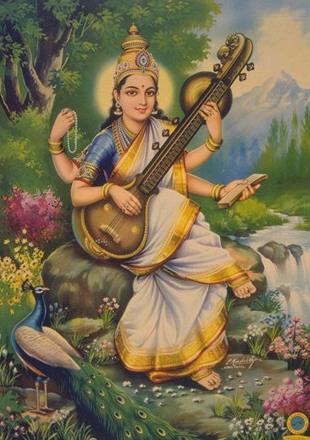
Devi Saraswati


Tomorrow is Saraswati Puja, for (Hindu) south Indians.

Saraswati literally means “one who gives the essence (sara) of our own Self (swa).” She sits on a swan, and carries a veena (a string instrument).

Puja, as I have explained earlier, means worship, with flower offerings.

Devi Saraswati is the Mother of Learning.

Music is the highest art, the distilled essence of all knowledge, which is self-knowledge. Self-effacing devotion, expressed in heart's melody, in a prayer to Devi Saraswati, is accompanied by Divine vision.

In Carnatic music (i.e. the south Indian classical tradition), one of the first songs learnt is “Varaveena”, a prayer, in Sanskrit, a song of adoration, to Saraswati, composed by Appaya Dikshitar (1554-1626), a scholar, sage and saint.


Varaveena mrudu paani
Vanaruha lochana raani
Suruchira bambhara veni

Suranutha kalyaani
Nirupama shubha guna lola

Nirathi jaya prada sheela
Varadaapriya ranganaayaki

Vaanchita phala daayaki
Saraseejaasana janani
Jaya jaya jaya


You hold the divine veena in your soft hands.
You are the queen of the omniscient. Your eyes are like the lotus petals.
Your curly tresses resemble the bees.
Devas worship your auspicious form.
You have unequalled virtuous qualities.
You give endless victory.
You are the munificent consort of the Beautiful Lord.
You grant boons to the deprived.
O Mother of lotus-seated Creator!
Victory to you!


This song is set in Mohanam raga, which is Bhopali raga in the Hindusthani or north Indian classical system.

Shivkumar Kalyanaraman is a professor of computer science in the USA. His website is also a treasure trove of resources on Carnatic music. He has provided the musical notations for this song, as well as an MP3 recording of a teaching of this song.

Thank you Shivkumar, and may Mother Saraswati’s blessings be always with you.

Another rich site is karnATik.

My mother is away in Bombay, otherwise she would have organised the Puja at home, with an offering of sweet and savoury rice, and the placing of books (of students in the house) before the image of Saraswati.

My younger son Rishiraj (aka Chotu), 11, was the last to religiously place all his school books in front of the image at home. This is a day on which there must be no studying! Great for kids at home during vacations! Chotu's in boarding school now, with his brother Rituraj, 15.

My mother will be doing the Puja at her sister’s, in Bombay.

Hence it will only be an 'inner' observation for me. I observed Saraswati Puja by:

conveying my heartfelt good wishes to -

JP, a college-mate and fellow Tamil-ian & Calcuttan (in which fact I take particular pride right now, as JP has recently become the CIO, Global Services, of British Telecom);

Achinto, photographer, with whom I had been out of touch for a long time; and

Dipali, painter, designer, art teacher and friend, and Saraswati incarnate.

Tuesday, September 05, 2006

Father and son

It was the night of 16 November 1992. We had celebrated my son Rituraj’s first birthday three days ago. That had been a grand affair, a very happy occasion of thanksgiving and sharing one's joy with relatives and friends, for being blessed with an angelic child.

I was in bed, Rituraj was sleeping beside me. My wife had left that evening on an out-station trip in connection with her work.

I was awakened in the dead of night by the sound of something like coughing. It was Rituraj. I jumped out of bed and turned the light on. There was something the matter with him. A strange sound emanated from his throat, a terrifying hoarse croaking-choking-coughing-gasping kind of sound. I could see he was having difficulty breathing. And when he got some breath he was crying or trying to cry, but only that frightful sound came out. I tried to give him a drink of water from his bottle, but he was unable to swallow.

Terror seized my heart. Oh my God! He is dying! I imagined he had someting like tetanus and was going to die in front of my eyes. What am I going to tell Rajashi when she returns?

I had no clue whatsoever about what might be the problem. I tried to calm him, by talking to him, saying soothing things, stroking his head. But seeing his condition I only sank deeper into panic.

I opened the doors. Rituraj’s nanny Pratima had heard the sounds and woken up. I went down to the ground floor, where my father lived and woke him up. His maidservant Archana also woke up. I told my father Rituraj seemed to have taken ill. I brought the baby downstairs and laid him on my father’s bed. But he too was clueless, and his helplessness was evident. So I realised it was up to me now to do something.

It was early winter in Calcutta. I wrapped Rituraj in his blanket and asked Pratima to carry him, and we set out for the emergency doctor’s clinic a few minutes walk away. On the way, in the desolate lane was a cow. As we passed it, Rituraj saw the cow from his place on Pratima’s shoulder and, as he was wont to do, said “Hamba”. That was his baby-word for “cow” (from it’s mooing). This only made it all the more poignant for me, but it also heartened me somewhat, that he must be alright.

We reached the emergency clinic – to discover that it was closed down. Back home again. It was close to 3 am. I dug out his paediatrician Dr Radha Narayan’s telephone number and called. After a while, she picked up the phone. I introduced myself, apologised for calling her at this unearthly hour, and explained Rituraj’s condition. She said it sounded like a case of chest congestion and gave me the names of certain medicines, including a broncho-dilator. I noted this down. I left Rituraj in the care of my father and Pratima and Archana, grabbed my wallet and set out, on my bicycle, to the 24-hours medicine shop, about 2 kms away.

Cycling at breakneck speed in the silent, still, desolate, cold night, I reached the shop. It was closed. I decided to try at another place I recalled, half a km away. I found that too closed. My panic and despair grew. I decided to go to another shop, quite a distance away, which I knew would definitely be open. In my state, I became disoriented and lost my sense of direction. I stopped an empty taxi passing by and asked the driver the way.

I was sobbing as I peddled. I knew that I was merely going through an act, of appearing to be doing something, when in reality I was simply avoiding and escaping witnessing my son's death. As far as I could see, when I returned I was going to find Rituraj gone. Oh the horror and despair of that! I wailed plaintively in my grief. How cruelly fate was mocking me with such a blow. I remembered all the unconscionable things I did habitually. No! No! Anything but that! Anything to avert that! And nothing was too high a price for that.

And then for the first time in my life, I turned to prayer. I sobbed out the mantra my father had once shared with me. Make my son well, oh Lord, I prayed, and extract any price from me. Take my life oh Lord, but spare him. I tried to shut out all other thoughts and simply utter the prayer. When I observed myself like this – it only heightened my despair. But in that desolate dead of night, there was no one to see me, I was all alone, and I kept uttering the prayer and peddled on, as if by this very act of will I could reverse fate.

I finally reached the medicine shop, found it open, got the prescribed medicines and headed back homewards. I kept uttering the prayer audibly, and tried to shut out any other thoughts, shut out the remembrance of the terror.

I reached home. Everyone was waiting or me. Pratima and Archana had somehow managed to put Rituraj to sleep on my bed. I woke him up and gave him the medicines, and patted him to sleep again. And I lay down beside him, watching over him until I too dozed off. My sleep was disturbed. In my dreams the horrid sound from Rituraj’s throat kept coming. I dreamt he was well again.

I woke up at dawn and after giving Rituraj another dose of the medicines, rang up my father-in-law and told him what had happened. I said I was bringing Rituraj over right away. I took him there in a taxi. My in-laws had called Tutul, a medical student who lived nearby, who was a close friend of the family. We went right away to a friend of his, Atom, a paediatric intern, who lived nearby.

Atom examined Rituraj. He told us that he had a bad chest congestion. The phlegm had congealed in his chest. And as a result there was also an infection. He said it was fortunate that he had been diagnosed right now. It might otherwise have been too late and quickly led to pneumonia. He prescribed a more precise set of medicines. Rituraj was unwell, but he was going to be alright after a few days.

After the night’s experience – I felt drained. But the whole day I was giddy with relief and gladness. A week later Rituraj was fully recovered. And after my wife returned, I told her what had happened.

When I am in any kind of personal difficulty or unhappiness – I sometimes remember Rituraj’s survival that night. And I remember that I will gladly pay any price, bear any kind of personal pain for the rest of my life, for that gift of his life.

…………….

As a ten year old, I had learnt in school that the Mughal emperor Babur, had prayed for his son Humayun’s life when he was very ill, and exchanged his life for his son’s. Something like that happened with me as well. About a year after Rituraj's respiratory condition, I was very ill, having come down with reactive arthritis consequent to gastroenteritis. My father had suffered a mild cerebral stroke earlier, and in the altered mental state induced by that condition he thought I was dying. He prayed for exchanging his life for mine. I recovered. Shortly after that my father passed away, suddenly, in his sleep.

…………….

When Rituraj was about seven, on the way back after a short holiday in the Lakshwadip islands (off the south-western coast of India), he and I made a quick trip to my grandmother’s village, in Thodupuzha, in the state of Kerala. This was now a bustling municipal town. We went to the house of my grandmother’s cousin, and after a few seconds of introduction-explanation, we were welcomed. That evening we went to the ancient Krishna temple in Thodupuzha. The deity there had been my grandmother’s companion and solace all her life.

The new place, the new topography, the new culture, the new people around, the new traditional village house – perhaps because of all this, a transformation had taken place in Rituraj. I was struck by how angelic he had become. And when Rituraj wore a dhoti (a wrap-around lower garment) to go to the temple – all the people in the house felt Krishna himself had visited their home!

I went to the temple again that night, as the closing rituals were being performed. I took a walk around the temple. This was where my grandmother had been born and grew up, the place where my father had been born. This place represented the cultural roots of my family. I had come here 23 years earlier, to attend a marriage. Now it seemed to me to be the culmination of all my journeys and all my learning. It was the centre of the world. The temple, its layout, the layout of the town around the temple, all seemed to suggest a deep symmetry and pattern.

On this visit to Thodupuzha, I learnt that this temple was famed for healing sick children. The deity in the temple represented the infant Krishna, who had just fought off the attack by the monstrous bird Bakasura. I was told that besides bringing the sick children to the temple, even praying to the deity from faraway saved the children.

…………….

A couple of years ago, Mike Davis, a friend in Melbourne, had come on holiday to Calcutta with his wife and two daughters. He was staying with Mahadev, a common friend. I went to meet them. Mike’s younger daughter, who was about six years old, was quite unwell. They had all returned from a trip where she had caught some kind of infection, and had a high fever. They had seen a doctor then, and medication was being taken. But the symptoms persisted. And they had to catch their return flight later that night. The parents were very anxious and distraught.

I could not bear to see the parents’ agony. So I immediately phoned my boys’ paediatrician and told her I was coming with a little girl who was unwell. And I set off with Mike and his wife and daughter. The doctor examined the girl, prescribed some medicines, and assured the parents that she could travel and that they should not worry.

After many hours of the anxiety gnawing away at them – that cloud over the terrified parents was lifted. I was happy I had been able to help. On the way back to Mahadev’s apartment, I shared with them the stories of Rituraj’s illness when he was one, of Babur and Humayun, of my father and me, and of the temple in our village which was famed for healing sick children.

Doing all one can to help sick children, whether one’s own or anyone else’s, whatever the cost – I think that is one of the most important things in life. This is what led me, in 1996, to start working in the slums of Howrah, where the infant mortality rates are disproportionately high. But sadly, owing to utter collapse of governance at the grassroots, this is not something where one's personal efforts bring any kind of positive result.

Monday, August 14, 2006

Have mercy

I wrote yesterday about our own innate natural urges and faculties, such as that of turning to, or seeking refuge, at times of acute duress and distress.

So there could be “secular” expressions of that inner voice.

Last year, I had heard the Bengali singer Moushumi Bhowmick – and had been overwhelmed and mesmerised by her voice and songs. Rooted in the local Bengali soil and symbols, they took me to another plane altogether, of mood, feeling and fragrance.

Moushumi is also part of an ensemble, Parapar. Their site on MySpace is here.

The first song of Moushumi Bhowmick I heard was a prayer, a song by Ranen Roychowdhury, from Sylhet (now in Bangladesh). The song begins 'Mayani rakhibay moray’ (Keep me with affection). What feeling she impregnated into this humble expression of folk devotion, though she herself is presumably "secular" and non-religious!

Here's the song.

03 Track 3
03 Track 3.wma
Hosted by eSnips

Hear more songs of Moushumi and Parapar here.

I searched for her albums, bought several copies and gave them to my relatives and friends!

One of her songs is Doya koro (Have mercy). That can also be seen as a “prayer”, independent of “religion” or “God”.

In my ecstatic enthusiasm listening to Moushumi Bhowmick’s songs, I translated a few songs, so as to be able to share my own delight and entrancement with others who did not know the Bengali language, who I knew would be powerfully drawn to her songs and would want to sing them. This was not a polished literary translation, but more like a literal translation, which would enable someone who loved a song to know each word of it and thus understand something of the feeling expressed by the singer's voicing of each word.

But the songs are very difficult to translate, because simple common words are so full of nuance of meaning and cultural connotations and associations. Nevertheless, quite insensitively and immodestly, I posted my translation on a public discussion board on the internet, besides sending it to the writer / singer. Thankfully, she responded shortly thereafter, expressing her unhappiness with my “translation”, and especially the song Doya koro (Have mercy), and with my having gone public with this.

I immediately apologised for and retracted my “translation”. Through this experience I got a good introduction to what translation entailed, when it came to literature. That has stood me in very good stead in the translation of Subimal Misra’s writing, which I took up soon thereafter.

But I do want to share the words of the song Doya Koro, through English, with my non-Bengali friends, to illustrate a “secular prayer”. The deceptively simple text of the original, which masks the subtleties conveyed by various words, phrases and tones is very hard to render into any other language, without making it sound prosaic. And this is definitely not the case with the original. My literal, aural conversion into English does not do justice to Moushumi Bhowmick's work. Yet I want to share the words, because I know even that is so rich.

So with a prayer for mercy, I give that below.

Get this widget | Share | Track details

Have mercy
this drought has burnt my whole body
to ashes
have mercy
this city, body, time
all burnt to ashes
have mercy
O dear rain,
shower down
on the thirsty body in the bosom of the city
O dear rain
have mercy,

Have mercy
the blind closed body and mind inside this room
so have mercy
the paralysed sultry suffocation
inside this room with closed doors
where the air can’t play
have mercy
these wall-boundaries
the Picasso scroll hung on the wall
has become salted over
have mercy
O dear storm come
and strike and break down everything
have mercy

Have mercy
this nice luv-luv-loving
I’m tired of playing
have mercy
this being nice, loving, doing good
does not feel very nice
have mercy
I will stand outside just once
once, just once
so have mercy

Listen to more songs by Moushumi Bhowmick here.

Sunday, August 13, 2006

Prayer of the Name

Here's an extract from Abhishiktananda's book Prayer.

There certainly is no set method or technique, still less any short cut, whereby one can be brought into the inner sanctuary, to the summit of that "Horeb" which irresistibly draws anyone who has heard the Spirit's call (cp. 1 Kings 19.8). However, ... there is one practice whose effectiveness has been recognised for centuries in the spiritual traditions alike of India and of Eastern Christianity.

In India this is called namajapa, the prayer of the Name. Nama means name, and japa means prayer; the verbal root jap means "to murmer". It consists of the continual repetition of the name of the Lord in one or other of its traditional forms; either the name by itself, for example, Rama or Hari or Krishna; or else an invocation which contains the name, for example, Om namah Shivaya, "Glory to Shiva".

...As far as possible, the Name is given by a guru. The guru himself chooses a particular mantra (a formula of prayer or invocation) for the disciple, in accordance with the aptitude and needs of the one whom he is initiating into the prayer.

Among Christians the nearest equivalent to the Hindu namajapa is what is called in the Oriental Christian tradition "the Jesus Prayer". Here too the practice is either a simple repetition of the name of Jesus, or else the use of a longer invocation containing the sacred Name. In these days the most widely used invocation is "Lord Jesus, Son of the living God, have mercy on me, a sinner". The best introduction to this form of prayer is The Way of a Pilgrim (translated from the Russian by RM French.)

In this Christian prayer of the Name we are immediately struck by the stress on our sinful condition and our need for forgiveness. This constant prayer for forgiveness, which is equally characteristic of the whole liturgy of the Church, does not, however, in any way indicate a morbid concern with one's spiritual state, as is sometimes held. Rather it is one way of expressing a deeply personal experience of the love of God and the realisation that in forgiving us he reveals most fully his love and almighty power. In the last analysis, to pray forgiveness unites us with the deepest level of the divine mystery.

Hindu prayer is different. Sometimes, no doubt, the Hindu also prays for forgiveness and for divine help: pahi mam, raksha mam, tvam eva sharanam, "Have mercy, save me, you alone are my refuge". But most frequently he is content simply to praise and adore: Om namah Shivaya (Glory to Shiva), Om namah Narayanaya, (Glory to the "Son of Man"). Here too it would be improper to find in this almost exclusive stress on adoration the attitude of a proud Pharisee who feels no need to beg for divine forgiveness. At least in those who are truly spiritual, it is rather the sign of total self-forgetfulness and of lack of concern for all that affects them personally - in Christian terms, the complete trust of a child who knows that his father is caring for his needs and whose only personal wish is to continue gazing at him. Indeed, once God has been known in truth, how could anyone in the Presence of Most High give any thought to himself or his own affairs?