Showing posts with label Thich Nhat Hanh. Show all posts

Wednesday, August 13, 2008

Finding the enemy


I had searched in vain for a poem by Thich Nhat Hanh that I had cut out from a magazine and kept, many years ago, and despaired about not finding this. Yesterday, voila, there it was, ensconced inside the pages of Sri Aurobindo's Savitri.

The Enemy

The enemy is not a person
If you kill people with whom will you live?

The enemy's name is cruelty
The enemy's name is lack of conscience
Its name is hatred, its name bitterness.

The enemy wears a coat of doctrine
The enemy wears the pretence of freedom
It wears hypocrisy, it wears twisted words.

The enemy is not a stranger
It lies inside of each of us.

The enemy's name is false accusation
The enemy's name is ignorance
Its name is ambition, its name is envy.

The enemy's name is covetous eyes
The enemy's name is arrogant head
Its name is a lonely heart, its name is a narrow mind.

The enemy is not a person.
If you kill people with whom will you live?

The enemy is not in the stranger
It lies inside of each of us.

Image: © Yamil Saenz.

Tuesday, January 16, 2007

Singur blog


I discovered a new blog today, on Singur, Nandigram, and the struggle against land acquisition for special economic zones. Its called Singur: Struggle Against Land Acquisition.

Development has to be for people. And the role of the state must be to facilitate the best interests of the people, and especially the poor and vulnerable. Industrialisation, special economic zones, real estate development, whatever - the bottom line must be empowerment of the people and creation of opportunities for their socio-economic advancement. In a state where the govt under the CPI(M) has only concretised the apartheid system of education, so that the poor and low income perpetually remain lowly citizens, consigned to menial servitude - it is difficult to believe that the party has any concern for the people.

The CPI(M) has no interest in empowerment of the people. In the 30 years it has been in power in West Bengal, it could have done so much, to make a difference. In the 6 years since he took over, the present chief minister could also have done much to demonstrate his intentions. But the squalor and indignity in which slumdwellers and poor villagers live only testify to the apathy, incapability and bankruptcy of the party. Its aim is empowerment of the party, at any cost. And to keep people dependent upon the party, even for basic survival. If people were empowered - then why would they need the party?

I am reminded of Thich Nhat Hanh's poem "The Enemy", in which he asks "if you kill people, then with whom will you live?" The CPI(M) would ask: if you empower people, then over whom will you rule?

So whose heart bleeds for the people? Who dreams of their dignity? Not the govt, or the ruling party, or the bureaucracy, or the police, or the media, or the intelligentsia. Elsewhere in India, callous rulers have been booted out in elections. But the CPI(M)'s "election machine" took care of that here. And of course, the absence of any credible opposition.

Hence, in despair, the people are flailing out, in a destructive frenzy, against the govt and the ruling party. But that is only a plea, to the nation's conscience: please do something, please give us hope.

Who hears?

If for decades you neglect the needs of the people, and they suffer deprivation and indignity while a favoured few exult in wealth and comfort - then any "economic growth" is likely to rest on very unstable foundations. In West Bengal, people seem to be rising up spontaneously in revolt, against the large scale land acquisitions for various industrial projects. It is absurd to attribute such outcomes to the instigation of Naxalites or anybody else. Decades of appalling apathy and moral irresponsibility by the affluent urban folk are to blame for the civil war like riots, looting, vandalism that will surely erupt soon in Calcutta.

That's what I had been thinking after hearing all the sanctimonious decrying of the irresponsible disruption of the brave new Bengal that some believe is emerging under Buddhadev's leadership.


Read Dr Mrinal Bose's story on Singur here.

Wednesday, October 25, 2006

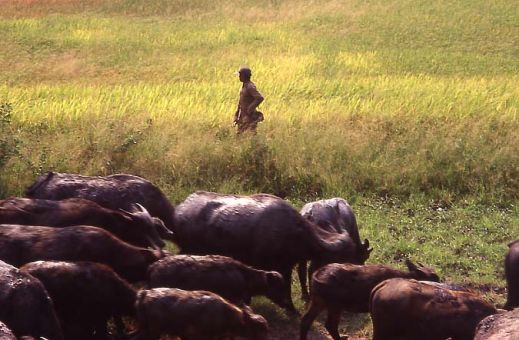
Tending water buffaloes: Buddha


Photo: Copyright Allan Montaine, 1998

Today I wish to tell you about the work of tending water buffaloes – what a good buffalo boy must know and what he must be able to do. A boy who cares well for water buffaloes is a boy who easily recognises each buffalo under his care, knows the characteristics and tendencies of each one, knows how to scrub them, care for their wounds, chase mosquitoes away with smoke, find safe paths for them to walk, love them, find safe and shallow places for them to cross the river, seek fresh grass and water for them, preserve the grazing meadows, and let the older buffaloes serve as good models for the younger ones.

Listen monks, just as a buffalo boy recognises each of his own buffaloes, a monk recognises each of the essential elements of his own body. Just as a buffalo boy knows the characteristics and tendencies of each buffalo, a monk knows which actions of body, speech, and mind are worthy and knows which are not. Just as a buffalo boy scrubs his animals clean, a monk must cleanse his mind and body of desires, attachments, anger and aversions.

Just as a buffalo boy cares for his buffaloes’ wounds, a monk watches over his six sense organs – eyes, ears, nose, tongue, body and mind – so that they do not become lost in dispersion. Just as a buffalo boy protects his buffaloes from mosquito bites by building fires to create smoke the monk uses the teaching of becoming awake to show those around him how to avoid the afflictions of body and mind. Just as the boy finds a safe path for the buffaloes to walk, the monk avoids those paths that lead to desire for fame, wealth and sexual pleasure – places such as taverns and theatres. Just as a buffalo boy loves his buffaloes, the monk cherishes the joy and peace of meditation. As the boy finds a safe, shallow place in the river for the buffaloes to cross, the monk relies on the Four Noble Truths to negotiate his life. As the boy find fresh grass and water for his buffaloes, the monk knows that the Four Establishments of Mindfulness are the nourishment leading to liberation. As the boy reserves the field by not overgrazing them, the monk is careful to preserve the relationship with the nearby community as he begs offerings. As the boy lets the older buffaloes serve as models for the younger ones, the monk depends on the wisdom and experience of their elders.

O monks, a monk who follows these eleven points will attain liberation in the span of six years of practice.

From: Old Paths White Clouds - Walking in the Footsteps of the Buddha, by Thich Nhat Hanh.

Four Noble Truths: suffering; the cause of suffering; the cessation of suffering; and the eight-fold path that leads to the cessation of suffering.

Eight-fold path: right view, right resolve, right speech, right action, right livelihood, right effort, right mindfulness, right concentration.

The four establishments of mindfulness: the establishment of mindfulness of body as body; the establishment of consciousness as consciousness; the establishment of feelings as feelings; the establishment of mental objects as mental objects.

Tuesday, September 12, 2006

Fields of Merit


One day while standing on a high hill, the Buddha looked out over the fields of rice paddy. He turned to Ananda and said, “Ananda, how beautiful are the golden patches of rice that stretch to the horizon. Wouldn’t it be nice to sew our robes in the same checkered pattern?”

Ananda said “Lord it is a wonderful idea. Sewing the monks' robes in the same pattern as rice fields would be lovely. You have said that a monk who practices the Way is like a fertile field in which seeds of virtue and merit have been sown to benefit both the present and future generations. When one makes offerings to such a monk, or studies and practices with him, it is like sowing seeds of virtue and merit. I will tell the rest of the community to sew future robes in the pattern of rice fields. We can call our robes ‘fields of merit’.

The Buddha smiled his approval.

From: Old Paths White Clouds: Walking in the Footsteps of the Buddha, by Thich Nhat Hanh.

Saturday, July 15, 2006

The Enemy

A long time ago I came upon a poem by the Vietnamese Buddhist monk Thich Nhat Hanh, called “The Enemy”. I hope I can find that soon! It said something like:

“the enemy is not a person, if you kill people then with whom shall you live, the enemy’s name is greed, falsehood, hatred, violence…”

I was haunted by that. I was in the middle of a protracted, ugly conflict with a colleague. I was consumed by anger and a sense of self-righteousness. But I was not entirely convinced about my own motivations. Thich Nhat Hanh’s poem struck a deep chord in me, and made me see that it was I who needed to become a better person.

Since then I have been fortunate to know more about Thich Nhat Hanh and his work, and read some of his writings. I am reproducing below some inspiring pieces by him.

Working for peace

In Plum Village in France, we receive many letters from the refugee camps in Singapore, Malaysia, Indonesia, Thailand, and the Philippines, hundreds each week. It is very painful to read them, but we have to do it, we have to be in contact. We try our best to help, but the suffering is enormous, and sometimes we are discouraged. It is said that half the boat people die in the ocean; only half arrive at the shores in Southeast Asia.

There are many young girls, boat people, who are raped by sea pirates. Even though the United Nations and many countries try to help the government of Thailand prevent that kind of piracy, sea pirates continue to inflict much suffering on the refugees. One day we received a letter telling us about a young girl on a small boat who was raped by a Thai pirate.

She was only twelve, and she jumped into the ocean and drowned herself. When you first learn of something like that, you get angry at the pirate. You naturally take the side of the girl. As you look more deeply you will see it differently. If you take the side of the little girl, then it is easy. You only have to take a gun and shoot the pirate. But we cannot do that.

In my meditation I saw that if I had been born in the village of the pirate and raised in the same conditions as he was, I am now the pirate. There is a great likelihood that I would become a pirate. I cannot condemn myself so easily. In my meditation, I saw that many babies are born along the Gulf of Siam, hundreds every day, and if we educators, social workers, politicians, and others do not do something about the situation, in twenty-five years a number of them will become sea pirates. That is certain. If you or I were born today in those fishing villages, we might become sea pirates in twenty-five years. If you take a gun and shoot the pirate, you shoot all of us, because all of us are to some extent responsible for this state of affairs.

After a long meditation, I wrote this poem. In it, there are three people: the twelve-year-old girl, the pirate, and me. Can we look at each other and recognize ourselves in each other? The title of the poem is "Please Call Me By My True Names," because I have so many names. When I hear one of these names, I have to say, "Yes."

From: Being Peace by Thich Nhat Hanh

Please call me by my true names

Do not say that I'll depart tomorrow because even today I still arrive.

Look deeply: I arrive in every second to be a bud on a spring branch, to be a tiny bird, with wings still fragile, learning to sing in my new nest, to be a caterpillar in the heart of flower, to be a jewel hiding itself in a stone.

I still arrive, in order to laugh and to cry, in order to fear and to hope, the rhythm of my heart is the birth and death of all that are alive.

I am the mayfly metamorphosing on the surface of the river, and I am the bird which, when spring comes, arrives in time to eat the mayfly.

I am the frog swimming happily in the clear water of a pond, and I am also the grass-snake who, approaching in silence, feeds itself on the frog.

I am the child in Uganda, all skin and bones, my legs as thin as bamboo sticks, and I am the arms merchant, selling deadly weapons to Uganda.

I am the twelve-year-old girl, refugee on a small boat, who throws herself into the ocean after being raped by a sea pirate, and I am the pirate, my heart not yet capable of seeing and loving.

I am a member of the politburo, with plenty of power in my hands, and I am the man who has to pay his "debt of blood" to my people, dying slowly in a forced labor camp.

My joy is like spring, so warm it makes flowers bloom in all walks of life. My pain is like a river of tears, so full it fills up the four oceans.

Please call me by my true names, so I can hear all my cries and my laughs at once, so I can see that my joy and pain are one.

Please call me by my true names, so I can wake up, and so the door of my heart can be left open, the door of compassion.

From: Being Peace by Thich Nhat Hanh

How to die nonviolently

I wrote a poem for my young brothers and sisters on how to die nonviolently, without hatred. It is called "Recommendation".

Promise me,
promise me this day,
promise me now,
while the sun is overhead
exactly at the zenith,
promise me:

Even as they
strike you down
with a mountain of hatred and violence;
even as they step on you and crush you
like a worm,
even as they dismember and disembowel you,
remember, brother,
remember:
man is not our enemy.

The only thing worthy of you is compassion- invincible, limitless, unconditional. Hatred will never let you face the beast in man.

One day, when you face this beast alone, with your courage intact, your eyes kind, untroubled (even as no one sees them), out of your smile will bloom a flower. And those who love you will behold you across ten thousand worlds of birth and dying.

Alone again, I will go on with bent head, knowing that love has become eternal. On the long, rough road, the sun and the moon will continue to shine.

To practice meditation is to be aware of the existence of suffering. The first Dharma talk that the Buddha gave was about suffering, and the way out of suffering. In South Africa, the black people suffer enormously, but the white people also suffer. If we take one side, we cannot fulfill our task of reconciliation in order to bring about peace.

Are there people who can be in touch with both the black community and the white community in South Africa? If there are not many of them, the situation is bad. There must be people who can get in touch with both sides, understanding the suffering of each, and telling each side about the other.

Are there people doing that kind of understanding and mediation and reconciliation between the two major political blocs on the earth? Can you be more than Americans? Can you be people who understand deeply the suffering of both sides? Can you bring the message of reconciliation?

From: Being Peace by Thich Nhat Hanh