Showing posts with label Achinto. Show all posts

Sunday, December 10, 2006

Farewell Fr Beckers


Yesterday evening, while on the internet, I clicked some link and came upon this picture. It is, of course, a familiar image. I had this as the wallpaper on my computer for a time. My friend KT Ravindran, architect and professor, had once told me that this was Jesus the revolutionary, the image preferred by the liberation theologists.

It is an image that is dear to me. I can go on gazing at it, and become immersed in thoughts, feelings and awarenesses. Yesterday, once again, I looked at this image for a while. I remembered Fr G Beckers, sj.

Today morning, I read in the newspaper that Fr Beckers passed away yesterday evening. He was 82.

I am filled with sadness, and flooded with memories.

Gerard Beckers, a Belgian Jesuit, had been a lecturer in chemistry at St Xavier’s College, Calcutta, since 1960. He joined the Jesuits in 1944. He obtained his DSc in Chemistry in 1953, and came to India in 1954. He was ordained a priest in 1958. He became an Indian citizen in 1978.

I first saw him in August 1976, when he let my mother and me into the college when we had gone to check the college admissions list on a Sunday morning. I joined the college as an undergraduate. You couldn’t miss Fr Beckers. Tall, well-built, erect, rugged face, aquiline features, a sharp beard, always dressed in white khadi kurta-pyjama, and rubber flip-flops, often on his bicycle. Speaking perfect Bangla, albeit with a slight accent, in his deep, rasping, lilting voice, and his ever warm, kindly, caring bearing, and the twinkle in his eyes. It was difficult not to be drawn to him, like a puppy, and simply look up to and love him.

Besides his classroom chemistry teaching, Fr Beckers was a towering figure in social service in Calcutta, West Bengal and eastern India. He had helped to found, and was associated with, several social and activist organisations and initiatives. As coordinator of the college’s National Service Scheme, he organised numerous flood relief, rural reconstruction, literacy and blood donation programmes. When I was a college student, we had blood donation camps in college every few months. Learning that Fr Beckers had donated blood over 200 times, we too made it a point to donate blood every time. Out of the money given by the Central Blood Bank for the donated blood was the Students' Health Home in Calcutta built and supported.

He was affectionately called "Babu" Beckers, meaning "dear one". He was a source of inspiration for thousands of boys, over several generations of students. He brought many into the fold of social concern and action, moulding committed and thinking activists at an early age. (I just spoke on the phone to Meghnath, in Ranchi. He was my contemporary, and a shishya of Fr Beckers. He is a grassroots activist, working for the rights of the indigenous peoples in the Chhotanagpur region of eastern India.) Fr Beckers had been a source of succour and support to many very poor students from humble backgrounds, whom he helped in various ways to complete their education and stand on their own feet with dignity. He was friend-confidant-counsellor to so many students in their troubles and confusions. Fr Beckers was adored. A giant of a man in every respect, and a most gentle one.

If Jesus Christ needed a living example, an ambassador, Babu Beckers was one.

Calcutta, West Bengal and India were privileged to have been home to Fr Beckers. He was another in a long line of European Jesuits who made themselves one with the soil of India and served the people of this land, a land where the gospel of Christ was first brought by St Thomas himself, two millenia ago, where Jesus Christ himself is believed to have come and lived and travelled. How rich one is simply to have passed through the portals of St Xavier's! He was another of the legendary, awe-inspiring figures of this college. (Fr Goreaux, a mathematician and associate of Einstein, was also a beloved professor here when I was in college.)

I taught (economics) at St Xavier’s College for a while (in 1984-85). So now I became acquainted with Fr Beckers as an adult, as an activist and intellectual, as a colleague. After I quit the job, contact with Fr Beckers came to a close. But I would run into people from time to time, to whom he had been a guru.

A few years ago, I began visiting Fr Beckers once in a while, at his room in St Xavier’s College. I was urged to do so by Fr Huart (another Belgian-Indian-Bengali, who was the Vice Principal during my college years) when I bumped into him during an out-of-the-blue visit with my sons to Outram Park, near the college, a special haunt of mine.

Fr Beckers was long retired. We would chat, we shared books and articles. We talked about so many things! I remember telling him about my travels in the Holy Land, and my favourite place, the Dormition church in Jerusalem (where Mother Mary is supposed to have gone into her final sleep).

Fr Beckers was old and frail, afflicted with Parkinson’s disease, and almost blind. But his fire and spirit, though mellow, was still very much alive. He could still think, talk, joke, laugh, reflect. And he was full of his natural loving kindness. How glad I am that I also took my son Rituraj with me once.

Fr Beckers told me about his student Najes Afroz, now a BBC journalist, my contemporary, who had stayed in touch with him. His wife is singer Moushumi Bhowmick. Living in London, Najes and Moushumi's son Arjaan had written an essay in school, on something like "the person who has inspired you the most", about Fr Beckers. He had learnt about Fr Beckers from his father. Arjaan's teacher had been very moved by reading his account, and had written a comment in the note-book lauding such positive parental upbringing. Najes had given Fr Beckers a copy of Arjaan's essay pages, and he shared this to me.

In early 2004, Fr Beckers' 80th birthday was celebrated in Asha Niketan, a mentally challenged persons’ home in Calcutta, an institution he had long been a mentor to. I was there, with photographer Achinto, who had lived and worked in Asha Niketan in his youth. My son Rishiraj was also there. What a beautiful, happy occasion that was!

Being fixed in a groove of daily routine and various preoccupations, I had not visited Fr Beckers for a long time. But I remembered him off and on. Like I did yesterday evening.

Fr Beckers suffered a fall in January and had become bed-ridden after that, his condition progressively worsening. His end came peacefully yesterday evening. His suffering comes to an end, he leaves us to meet his Maker. That is something joyous, yet we grieve his departure. But he will live forever, in the hearts and minds, and through the work and lives, of all those whom he touched.

Fr Beckers had donated his eyes and also pledged his body for medical research. His body will be kept in the college chapel from 7 to 10 am tomorrow morning. A prayer service for him will be held at St Xavier's College at 10 am tomorrow.

I am reminded of the tribute paid to another great guru, Patrick Geddes, by one of his students at Bombay University (where Geddes taught in the 1920s):

"He inspired you; he brought the best out of you; he re-kindled the creative spark in you. It is as a Teacher that he will live in our hearts and memories.

Assuredly there have been very few like him - they hardly come once a century. He just set you on fire with love of this earth and with desire to cleanse it, to beautify and re-beautify it, to build and rebuild it.

What was the secret of his amazing activity? What was his inspiration? It was, we believe, an unbounded love for the humankind with all its faults. No poet, prophet or theologian has regarded man as veritably created in the image of God with a clearer perception, with more absolute certainty of conviction than him."


Farewell, beloved Fr Beckers. Our very grief will once again inspire us to devote ourselves, completely and endlessly, to the service of the people.

“Thy people bless and praise that he may feast in Paradise with Thee.”

Wednesday, December 06, 2006

6th December


6th December 1992 was one of the darkest days in the history of modern India. The Babri mosque in Ayodhya in northern India was destroyed by a mob of vandals. Riots between Hindus and Muslims broke out across towns and cities in north India. Riots hit Calcutta too, with Muslim slums being torched in Tangra in east Calcutta and Metiabruz in west Calcutta.

After the experience of the Great Calcutta Killing of 16 August 1946, and more riots in 1963-64, Calcutta had at least been free of the horror of communal riots. The CPI(M)-led Left Front govt ruling West Bengal since 1977 had made communal harmony a major plank of its policy. But following 6 December 1992, sleeping demons were awakened.

Curfew was enforced in Calcutta in the days following 6 December 1992. For me, that led to an enforced engagement with this question, the Muslim question, something I had hardly thought about earlier. Afterwards, photographer Achinto and I went to Tangra. The people from the burnt out slum were sheltered in the municipal slaughterhouse. I will never forget that sight, a vision of hell.

A germ was planted in me. And that germ went on to take over and transform my life within 5 years. But before that all the habitual assumptions and notions, all the socialised conditioning and subtle prejudice in me had to be plucked out. I was fortunate to meet friends who aided in this.

There is a huge gulf separating Muslims (the overwhelming majority of whom are poor, barely educated, and self-employed) and educated Hindus in India. Its a question of perception and cognition. Very few even bother to recognise that such a gulf exists.

After I started working in Priya Manna Basti in Howrah and started Howrah Pilot Project, 6th December was observed by us as National Renewal Day. In 1998, we organised a cultural programme for the children of Talimi Haq School. A special harmony badge was made and worn by everyone. In 1999, there was ceremony where the Muslim children of Talimi Haq and Hindu children of a nearby school tied rakhis on one another (a wrist band symbolising brotherhood). An elderly community member who had spent much of his life teaching children of Priya Manna Basti was felicitated and honoured. And in 2000, this date fell during Ramadan and so we had a grand iftaar (fast-breaking) gathering for my new-found Muslim activist friends from Calcutta.

The great thinker and poet Mohammad Iqbal wrote the song "Sarey jahaan sey achha Hindustan hamara" (Better than the whole world, our India). But he is also considered to be one of the founding fathers of Pakistan, which was born as a separate homeland for India's Muslims. Iqbal wrote "Shikwa aur Jawaab-e-Shikwa" (Complaint to God, and God's answer), about the miserable plight of Muslims. After I started working in Priya Manna Basti, and began to understand the power of Urdu poetry, I wrote a song "PM Basti ke ham sab sachhey mussalmaan hain" (We are all true Muslims of PM Basti). I wrote my own "Gratitude, and God's Acceptance", to express my feelings for the blessing of India's plural heritage. And I wrote my version of "See the city from here" (the title of poet Faiz's poem), celebrating the love and harmony I found working with the women and children in Priya Manna Basti.

In 1946, leading up to the Direct Action Day, of 16 August, the slogan "haath mein bidi muh mein paan, ladkey lengey Pakistan" (bidi in hand, paan in mouth, we shall fight and take Pakistan) had spread like wildfire in Calcutta. In 1997, in my song Hariyali, I wrote:

Liye haath mein lathi muh mein Ram
Lana hai woh paak sthaan
Sangh hai saathi hoga hi kaam
Layengey woh paak sthaan


Staff in hand, the Lord’s name we sing
This sacred land must we bring
Companions are with us, the work shall be done
This sacred land must be won.

The sacred land, being the land of harmony, where Hindu and Muslim children walk and grow together.

It is 14 years since that dark day of 1992.

In the Ramayana epic, Prince Rama of Ayodhya had to take up 14 years of forest exile to uphold his father's honour. His father died grieving for his son. And before returning home, Rama had to vanquish king Ravana of Lanka to rescue his abducted beloved wife Sita.

Much has happened in these 14 years. In 2002, we had the horrific riots in Gujarat in western India. This was India's intimation of its version of the Final Solution. And just a few days ago, the report of the Sachar Committee was submitted to the govt of India (available for download here). This examined the socio-economic backwardness of the Muslim community in India.

Like never before, the challenge is out in stark terms to all Indians:

Are we a pluralist nation, where everyone has a place of dignity, with justice for all?

Can Hindu and Muslim be as one, two inseparable parts that together make the whole that is India?

Does anyone want such an India?

Photo: Achinto

Saturday, September 30, 2006

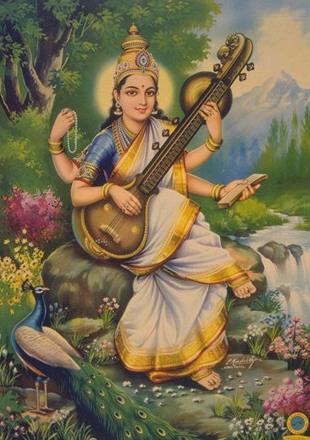
Devi Saraswati


Tomorrow is Saraswati Puja, for (Hindu) south Indians.

Saraswati literally means “one who gives the essence (sara) of our own Self (swa).” She sits on a swan, and carries a veena (a string instrument).

Puja, as I have explained earlier, means worship, with flower offerings.

Devi Saraswati is the Mother of Learning.

Music is the highest art, the distilled essence of all knowledge, which is self-knowledge. Self-effacing devotion, expressed in heart's melody, in a prayer to Devi Saraswati, is accompanied by Divine vision.

In Carnatic music (i.e. the south Indian classical tradition), one of the first songs learnt is “Varaveena”, a prayer, in Sanskrit, a song of adoration, to Saraswati, composed by Appaya Dikshitar (1554-1626), a scholar, sage and saint.


Varaveena mrudu paani
Vanaruha lochana raani
Suruchira bambhara veni

Suranutha kalyaani
Nirupama shubha guna lola

Nirathi jaya prada sheela
Varadaapriya ranganaayaki

Vaanchita phala daayaki
Saraseejaasana janani
Jaya jaya jaya


You hold the divine veena in your soft hands.
You are the queen of the omniscient. Your eyes are like the lotus petals.
Your curly tresses resemble the bees.
Devas worship your auspicious form.
You have unequalled virtuous qualities.
You give endless victory.
You are the munificent consort of the Beautiful Lord.
You grant boons to the deprived.
O Mother of lotus-seated Creator!
Victory to you!


This song is set in Mohanam raga, which is Bhopali raga in the Hindusthani or north Indian classical system.

Shivkumar Kalyanaraman is a professor of computer science in the USA. His website is also a treasure trove of resources on Carnatic music. He has provided the musical notations for this song, as well as an MP3 recording of a teaching of this song.

Thank you Shivkumar, and may Mother Saraswati’s blessings be always with you.

Another rich site is karnATik.

My mother is away in Bombay, otherwise she would have organised the Puja at home, with an offering of sweet and savoury rice, and the placing of books (of students in the house) before the image of Saraswati.

My younger son Rishiraj (aka Chotu), 11, was the last to religiously place all his school books in front of the image at home. This is a day on which there must be no studying! Great for kids at home during vacations! Chotu's in boarding school now, with his brother Rituraj, 15.

My mother will be doing the Puja at her sister’s, in Bombay.

Hence it will only be an 'inner' observation for me. I observed Saraswati Puja by:

conveying my heartfelt good wishes to -

JP, a college-mate and fellow Tamil-ian & Calcuttan (in which fact I take particular pride right now, as JP has recently become the CIO, Global Services, of British Telecom);

Achinto, photographer, with whom I had been out of touch for a long time; and

Dipali, painter, designer, art teacher and friend, and Saraswati incarnate.

Wednesday, August 30, 2006

Achinto


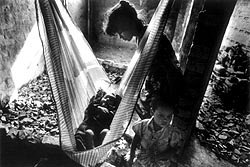
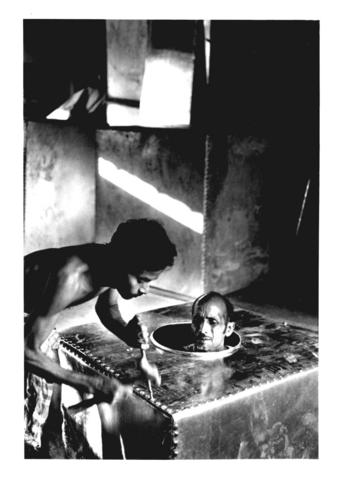
I would also like to pay tribute here to Achinto, the Calcutta-based documentary photographer. I have carried several of his pictures on this blog. He has documented people, labour, community, life,and habitat in India’s cities and villages. But it is the labouring people of Calcutta that he has worked on most extensively – reminding one of the tradition of F Engels, P Mayhew, Jacob Ris, and Walker Evans.

My long association with Achinto has been a very important element in my personal growth. His images brought to life for me something William James had written:

“…the sight of a workman doing something on the dizzy edge of a sky scaling iron construction brought me to my senses very suddenly, and now I perceived by a flash of insight that I had been steeping myself in pure ancestral blindness and looking at life with the eyes of a remote spectator. Wishing for heroism and the spectacle of human nature on the rack I had never noticed the great field of heroism lying around about me. I had failed to see it present and alive. I could only think of it as dead and embalmed, labelled and costumed, as it is in the pages of romance; and yet there it was before me in the daily lives of the labouring classes. ... There everyday of the year, somewhere, is human nature in extremis for you. And wherever a scythe, an axe, a pick or a shovel is wielded, you have it sweating and aching and with its powers of patient enduring racked to the utmost under the length of the hours of the strain.”

Photo: Achinto

Friday, August 04, 2006

Making love


Let’s make love
through looks and smiles,
signs and gestures,
words and terms
of endearment,
and share intimacy
through kind thoughts
speech
and deeds.

Photo: Achinto

Saturday, July 22, 2006

Grandma’s eyes

One afternoon in December 1991, I got a phone call at work from my father-in-law, to tell me that my wife’s grandmother – his mother-in-law – had passed away. He asked me to come down to her house when I could. Grandma was over 80, she’d had a long, eventful life, with many years of hardship and struggle as a young widow with 8 children, as well as several more nieces and nephews she brought up. But she had lived to see all her offspring, and several of her many grandchildren, all do very well in life in every way. My wife was close to her and so I too became acquainted with her through accompanying my wife on visits to her house and to family functions and get-togethers. Grandma had been ailing, and had been in hospital for a few days.

I wound up my work at office and went to her house. My office, Grandma’s house, my in-laws house, as well as the rented apartment I lived in until recently, were all very close to one another, around Gariahat in south Calcutta. When I reached the house in Dover Lane, my wife’s uncles were there. Her body arrived from the hospital. Then eldest uncle told me that Grandma had donated her eyes and instructed her family to see to this. She had passed away around noon. The corneas had to be removed within a few hours. It was already late afternoon. Could I do what was necessary?

I accepted the task and immediately set off, taking a taxi. A friend of mine had been involved in mounting a campaign for body and organ donation, and had managed to get the govt’s support through an order that all the 4 medical college hospitals in Calcutta would receive bodies and collect organs for transplant. I had assisted and participated in his work off and on. So it was just a question of going to the nearest medical college and arranging the collection of the corneas.

I headed towards the National Medical College, near Park Circus. In the usual slow moving traffic, it took a while to get there. I kept the taxi waiting and went into the hospital complex. I had never been here before Any public hospital in Calcutta – a scene of chaos and crowds. Its difficult to make any sense of what is where. No one to ask for help. One is always directed somewhere else. I finally reached the ophthalmology department and found someone to enquire from, only to learn that there was no arrangement for receiving corneas here.

Time was ticking away. The corneas had to be removed quickly otherwise it would be futile. Back to my taxi. I headed towards the Nilratan Sarkar Medical College. I had been there once, for an investitgation by the head of ENT, thanks to my landlady's grandson who was a medical student there. It was not so far off, in Entally. But the traffic was bad now, as it was the beginning of the evening office rush. I reached the hospital complex and kept the taxi waiting. Another scene of even more chaos and crowds. These were supposed to be hospitals, but it was anything but a sterile, hygienic, organised, quiet atmosphere. Again multiple enquiries, again the same frustration, and finally again to a doctor in the ophthalmology department, again only to learn that this hospital too did not receive corneas. I vented my frustration, asserting the govt’s announcement that all the medical college hospitals would receive this. I was told that the reality was that there were no arrangements for this, and that I should go to the Calcutta Medical College, which was the only place with the set-up.

Back again to my taxi. The Calcutta Medical College was a huge complex, it was going to be even more chaotic there. I remembered visiting my university professor many years ago, when he was there for surgery. I had gone to the hospital unit close to the Central Avenue entrance. That had been somewhat more sane and organised. So I headed towards that place.

The Calcutta Medical College was spoken about in reverential terms in my home as I was growing up, with my two aunts and an uncle having studied there before going to England where they settled down and practiced. On one of his visits to Calcutta during my university days, my uncle had taken me on a tour of the college where he had studied and shown me around. I felt the awesome grandeur and gravity of the institution that I had grown up hearing so much about.

It was the peak of the office rush, and I was now in the heart of the city. The traffic was terrible, the vehicles barely moving, just crawling along between long periods of waiting at traffic signals and unending hold-ups. Time was ticking away. I was on the edge, in a rage. That was it. Grandma’s eyes were going to be lost. And I was not going to be able to do anything about it. I went into a panic. I was trembling. Terror seized my heart. My breath broke into sobs and gasps, my voice a distraught bleat, my eyes brimming over and my face melting in grief. No! No! This cannot happen. I have to do it. I just had to flinch and wince and grimace and grit and go on and do it. I accepted the worst. But I was going to see this thing through.

The taxi eventually reached the Central Avenue entrance of Calcutta Medical College. I rushed and ran into the hospital, running from one place and person to another. Things seemed a bit better here. I was directed to an RMO, he was in his room. I ran there, he was not there, I found someone. Shouting and speaking at machine-gun speed I communicated the urgency of the matter. Hearing the shouting, the RMO appeared from somewhere. I said someone’s eyes had to be removed, very quickly, it was almost too late, I had gone from place to place and only been turned away. I shouted out all my anger and frustration. The RMO immediately took control of the situation. He asked me to calm down and said he would do what was necessary. He said there was still time to collect the corneas. He asked me for the address and said the people who would collect Grandma’s eyes would go there at once. He said I could leave and I should not worry.

I was immediately calmed and reassured. I went back to my waiting taxi and the driver who had accompanied me through the whole ordeal. After all the rushing and running and rage and edginess and panic and terror – I felt drained, giddy and exhausted. I collapsed into the seat. It took a while for gladness and satisfaction to sink in. I was pleased. I felt a deep sense of contentment. I returned to Grandma’s house in Dover Lane.

I reported to the people there that it had been more difficult than I had anticipated and that it had looked like I was going to fail, but I was eventually able to do what was necessary. The eyes would be collected soon. And sure enough, soon thereafter, a team arrived in an ambulance, with the special container for the eyes. We were impressed by their serious, brisk and efficient manner. They asked us to vacate the room where Grandma lay. They emerged after a few minutes, with their precious booty. And Grandma’s eyes were covered over with cotton wool.

If I’m not wrong, I think I did later learn that Grandma’s corneas had been put to use for two people.

Several years later, I was narrating this incident to my friend Achinto, acting out the whole thing, re-living that experience. And I concluded by saying: I did it! Because of me, two blind people got sight. Who can give sight to the blind? Only God. So I was God! But what exactly happened? It was Grandma’s pledging of her eyes. It was her family’s desire to fulfil her wish. It was their entrusting me with the responsibility. It was my fierce determination to do this, come what may. It was my persistence, despite all the hindrances and frustrations. It was my having stared at the face of failure and swallowed the terror and pressed on. And it was because of one person, who finally owned up to the responsibility and arranged for the eyes to be taken. All this together - that is God. That is what is immensely powerful, capable of working miracles.

When my life is over, I can go with the small satisfaction that whatever else I might have done or not done in life - I did try my very best to fulfil Grandma’s wish to give sight to others, and I was fortunate to succeed. And so my life would not have been entirely worthless.

Grandma was always knitting something for somebody. She had made me a soft, thin flesh-coloured sweater. And I had always worn that at home in winter, and also as an inner vest whenever I visited any cold place. I’ve worn it for almost 20 years now. Some years ago, it was washed improperly and became stretched, mis-shapen, faded and somewhat coarse. But I still wore it. I was recently searching for it and couldn’t find it. Becoming absent-minded with age, I wasn’t certain whether I hadn’t given this away – maybe to the gardener or someone like that. Then I found it, hidden from sight among a pile of things in a cupboard. Was I was relieved and glad! It would be a terrible thing if I lost it. For me that sweater made by Grandma is like chain mail, something to protect me.

Sunday, July 16, 2006

The city in crisis


I had posted a piece a few days ago called "Who owns the city". Some of the questions raised there were from an essay I wrote in 2000, after attending a meeting of evironmentalists concerned about the impact of the Metro rail extension work on the Tolly's Nullah (canal) in Calcutta. I reproduce that essay here. This may help people to start viewing the city differently, understanding it better and becoming conscious of their own engagement with their city.


THE CITY IN CRISIS: A QUESTION OF OWNERSHIP

The Metro Rail authorities have clarified that the proposed track extension from Tollygunge to Garia would be over the Tolly’s Nullah, with twin sets of concrete posts being erected over the canal. Environmental activists had expressed serious concern over this matter, as this would mean the dying of the water channel that is believed to be the Adi Ganga. Besides its spiritual and cultural connotations, there is the vital matter of drainage. The Tolly’s Nullah is the principal surface water drainage channel for a large part of southern Calcutta and the suburbs. If it dries up, the city would face severe flooding. The possibility of re-introducing navigation on this canal, as part of a city-wide water-based transportation system, would also forever be ruled out.

The Metro authorities have said that they have obtained all the requisite clearances for this and are about to begin the work on the ground. The extension project has received a handsome budgetary allocation, thanks to the city-based Railway Minister, who has asked for the work to be completed very fast. However, the National Rivers Authority under the Ministry of Environment and Forests in New Delhi, has now woken up to the matter. There is also a legal case in process, in the Calcutta High Court, seeking re-excavation of the city canals. The court had ordered for the work to be taken up and funds were made available by the central government for this. But the progress of the work is very slow. A major factor impeding the de-silting work is the presence of dwellings beside the canals. The question of rehabilitation of these dwellers has not yet been substantively addressed.

The stage seems to be set for a confrontation. Not simply between the Metro Rail and environmentalists, but between the different vital aspects of city development. While everyone strongly supports the Metro extension, the severe environmental consequences of the current plan make it non-negotiable. That this is unfortunately labelled as being ‘anti-development’ is only on account of the ‘development’ plan having been entirely inappropriate in the first place.

To be fair to the Metro authorities, once the extension project had been cleared they had approached the state government for land. With the state government having indicated its inability in this respect, the canal itself was chosen to erect the elevated track upon. To the extent possible, the Metro had sought to take other measures, for instance through design parameters of the posts, widening of the canal etc. Regarding the latter, the state government declined to accept the funds offered by the Railways for canal widening, asking for the Metro work to be completed first and saying that they would take up the widening at a later stage.

But the common observer and by-stander to the controversy, the citizen of Calcutta, will only be left more cynical, more bewildered, and feeling more helpless. At root is the whole question of land in Calcutta. This is caught up in a time warp that completely undermines any prospect of wholesome renewal, to become a healthy and thriving metropolis in the twenty-first century world.

If the Metro extension has to now wait for land to be acquired, compensation to be paid, likely litigation to be completed and so on, that would drag on for years. The Lake Gardens fly-over had been held up like this. Completion of the Circular Rail is also held up because of this. So one can understand the pragmatic attitude of the Railways. The land question seems to make the present plan for Metro extension irrefutable. And there lies the rub. This is not something that will be solved with the Metro extension. It is something that is going to haunt and hurt the city increasingly in the coming days.

A huge amount of land in the city is under inappropriate use. About 50 % of the city’s population resides in bastis. These are dense, low-rise settlements, poorly serviced, with people living in cramped shelters. They are spread all over the city. There are closed factories and warehouses in different areas. There are sick and polluting units, over large tracts of land, which are subsidised by the low land rent and wages they pay. There are refugee colonies along infrastructure routes such as highways, canals, rail-tracks. And there are squatters along canals and rail-tracks, whose numbers have only grown over the years. They themselves represent the non-existence of a land and shelter policy; the marginalised poor having no access to legal shelter in the city where they work, squat along canals. But there is also the business of land grabbing, occupation, rental and even sale, by various individuals and groups. While squatters were summarily evicted through the 1980s, now the issue of resettlement is being raised by the authorities. Land-grabbers also often have political backing.

Unless the city’s canals are de-silted, the city will face severe flooding, in its own sewage. The canals cannot be dredged as long as the dwellers are there. There is no land within the city where they can be resettled. Land could be provided outside the city, but at present there is no capability within the city to take up the work of community rehabilitation. The canals have to be constantly maintained. Hence, it would not do for squatters to return once one round of de-silting is completed. But where would the tens of thousands of labouring people, who service the city in various ways, live? Where under present circumstances would the growing numbers in the city’s bastis go?

For any kind of development in the city land is needed. And in the absence of large tracts of vacant land in the city, and the undesirability of city sprawl and appropriation of green land – it is current land use in the city that has to be transformed. Given the large amount of land under bastis and blighted industry, Calcutta has a self-renewal potential that few other cities anywhere in the world have. But let alone the large range of institutional capabilities this entails, there is no basic vision yet in any official quarter of the city’s future. In the meanwhile, illegal constructions come up on basti plots, worsening living conditions there, and eliminating the potential of wholesome renewal.

A vision of the future would also serve to indicate the requisite capabilities for realising the vision. That is not something that can simply be assumed. It is something that has to be built up first. For instance, planned re-use of basti land requires social rehabilitation and community development of a scale and capability that is presently completely non-existent in the city system, within government and within NGOs. That has to be brought into existence first.

Operation Sunshine (to remove hawkers, in 1996) and its aftermath affords a study in the city’s dilemma. It is the lower middle class of the city that needs the hawkers, to buy things at affordable prices. The consequences of congestion, traffic, pollution and so on do not directly enter this citizen’s consciousness. A car-using citizen would have another perspective. But he or she may also be patronising hawkers.

Municipal finance is another matter that nobody pays much attention to, as everyone is involved in protecting their personal interests. Properties are undervalued. It is in the interests of the property owner to keep this low. Due property taxes are not paid. When the amounts in question are large, arrears only benefit the property owner. It may be recalled that a posh city club had its large Corporation tax arrears forcibly recovered. The club’s management committee must surely have included several otherwise upright citizens, corporate and professional leaders. Whither civic sense?

The Corporation is financially crippled. It spends more than it earns. It does not get, from property taxes, what it should. It does not recover costs or charge for its services like water supply or sewage and garbage disposal. It employs a large number of people, engineers, officers, clerical staff and workmen. For all of them, the Corporation is a stable employer. With productivity and probity in question, their personal interests and that of the city system are at loggerheads. Employees are unionised and have in place a means to pursue their sectional interest.

When the question of user charges is raised, the citizen immediately thinks of his pocket and instinctively seeks to resist this. Politicians seek to resist this, distanced as they are from the citizenry, and with no confidence in explaining civic matters to people, collecting user charges and thereafter guaranteeing proper services. Hence, services suffer. And typically, those with least clout in the city, suffer the most. Public health, quality of life, is the casualty.

The city system is linked to ‘politics’. Elite citizens see political parties as catering to their vote banks, who comprise of large numbers of poor and ignorant people, including those involved in criminal activities. They see this as appropriating increasing space in everyday life. A mentality of antagonism, hostility and conflict exists. But the same political machine, cannot be entirely insensitive to the interests of the affluent and business classes either. Thus, when it comes to the crunch, civic amenities in the better-off parts of the city would be sustained at the cost of services to the poorer sections. For the poor and lower-income groups, the city seems to be polarised, with everything stacked against them. Denied rights as citizens, they are compelled to seek ‘political’ strategies to obtain their basic needs. The ‘political’ sphere has to mediate between conflicting interests and is increasingly unable to cope. The reality of the system, akin to a civil war, is becoming exposed.

A number of major city improvement projects are in line. The World Bank and the Asian Development Bank have given large loans for infrastructure improvement, and assistance has been provided by the French and British. The opportunity has therefore arisen of a concerted drive for city improvement. But in the context of all the fault lines running through the city system one may be very skeptical about the outcome. The loans from the World Bank and the ADB come with stringent conditionalities, relating to reform of the Corporation, introduction of user charges, increasing the tax base etc. These go entirely against the city ethos and one may wonder about what will eventually happen. In the context of the overall economic decline in the city, these project funds will ensure that some sustenance continues for some people for some time.

So with all the protection of self-interest, who cares about the city? Who represents the city, in its plurality? Little wonder then, that there seems to be a complete absence of any positive vision, since polarisation has come to be in the nature of things.

The city can be renewed. It can break from its colonial legacy and build itself anew, and become a means for the development of the bio-region around it. The current problems – whether of slums, or of choked canals – could become the key means for renewal. But for any of that to be realised, the question of civic ownership has to be confronted. Who owns the city? Is there a critical mass of people, rooted in the city, aware of its wealth and poverty, who are competent, diligent and honest, who can act, with a sense of urgency and mission, to further the public interest, whose personal interest is this public interest? Who can understand and communicate, in substance, with diverse interests? Who can do justice to all, and be equally fair and stringent to diverse sections? Who have a clear vision of the future that is not a gimmicky formula, but is something that challenges the whole system to rise to it? It is upon the answer to such questions that the future of Calcutta rests.

“The day is short, the work abundant, the labourers inactive, the reward great, and the master of the house urges on”: a Hebrew saying.

Photo: Achinto

Monday, July 10, 2006

The Child in the City


The Child in the City

an exploration in imaging and imagining

Photographs : Achinto
Text, Speech, Song: V Ramaswamy


“In both myths and fairy tales we find ancient knowledge about the human condition – about ourselves. Myths and fairy tales are collective dreams. … Through images they tell us about the creative forces of the soul and also about the enchantments and injuries which can slow life in its course.

… In myths, such an enchantment can be an illness or an emotional flaw. It can be a knot in a person’s thread of life, great poverty, injustice or a curse by which the wells dry up and the land can bear no more fruit. …

In many stories such enchantments are brought about by an uninvited god or goddess…. In symbolic form they represent essential forces and impulses that we suppress, they are the part of ourselves that we send into exile; forces within us that want to enter into consciousness and want to be experienced and honoured as gods.

…Whenever people invite these ‘gods’, when they celebrate and honour their life forces, life can reveal itself in great diversity and fullness. …”

Friedemann Wieland, The Journey of the Hero


The world over today, even as urbanization continues to grow rapidly, we live in cities that are fundamentally unsustainable in environmental terms, and are socially and ethnically divided. Urban policy is unable to confront this challenge, and fails to rise above rhetoric and platitude. This is paradoxical since knowledge and wisdom in technology, research and public action offer transformative possibilities as never before.

What must the city be in order to enable the fulfillment of human destiny?

‘The Child in the City - an exploration in imaging and imagining’ is a photo-text-speech-song presentation, prepared by Achinto, a documentary photographer, and ramaswamy, a social activist, both based in Calcutta, India. This was prepared for the international conference on art, aesthetics and society in Calcutta in December 1997 (a part of the Calcutta Metropolitan Festival of Art organized by the arts community in West Bengal to commemorate the 50th anniversary of India’s independence). Based on a personal inner journey triggered off by the communal riots in Calcutta in December 1992 (in the aftermath of the destruction of a mosque in Ayodhya), “The Child in the City” is a meditation on cities, childhood and justice, juxtaposed with photographic images from Calcutta, one of the most environmentally degraded, poverty-ridden and communally divided metropolises.

It explores language, history, mythology, mysticism, religion, psychology, poetry and planning. An implicit journey, from a sphere dominated by discourse, professions and ideology, towards a subjectivity, of perception, feelings and being.

“The Child in the City” is a celebration of hope in humanity, as exemplified in a child’s sensibility.


"The Child in the City" has been presented at:

Tata Institute of Social Sciences, Mumbai, March 1998
School of Planning and Architecture, New Delhi, November 1998
Bezalel Academy of Arts and Design, Jerusalem, January 1999

Kala Ghoda Arts Festival, Max Mueller Bhavan, Mumbai, February 2001
Round Square conference, The Doon School, Dehradun, March 2001
International Conference on Creativity & the City, Amsterdam, September 2003

Candyland, Centre for Photography, Stockholm, November 2005.

Photo: Achinto

The public sphere


Contemporary German thinker Alexander Kluge writes :

The public sphere is ... what one might call the factory of politics - its site of production. When this site of production - the space in which politics is first made possible at all and communicable - is caught in a scissors-grip between private appropriation and the self-eliminating classical public sphere; when this public sphere threatens to disappear, its loss would be as grave today as the loss of the common land was for the farmer in the Middle Ages ... The loss of land also means a loss of community because, if there is no land on which the farmer may assemble, it is no longer possible to develop a community. The same thing is happening again, on a historically higher plane, in people’s heads, when they are deprived of the public sphere.

For these reasons, this use value, this product, which is the ‘public sphere’, is the most fundamental product that exists. In terms of community, of what I have in common with other people, it is the basis for processes of social change.

From the presentation "The Child in the City".

Photo: Achinto

City of Lights


How will I return to you, my city,
where is the road to your lights ?
My hopes are in retreat,
exhausted by these unlit, broken walls,
and my heart, their leader, is in terrible doubt.

"City of Lights", Faiz Ahmed Faiz

From the presentation "The Child in the City".

Photo: Achinto

Basic questions


When we are confronted with this immense structure of inhumanity, we are driven to some very basic questions.

Does the child have a city?

Whose child is the city?

From the presentation "The Child in the City".

Photo: Achinto

As whole as a broken heart


It is time we employ Antonio Gramsci’s principles of “pessimism of the intellect and optimism of the will”.

"What is, need not be; what may be, can be better than what is."

Alfred de Grazia

Or echoing the words in the Book of Psalms, ‘nothing is as whole as a broken heart.’

From the presentation "The Child in the City".

Photo: Achinto

Saturday, July 08, 2006

Priya Manna Basti, Shibpur, Howrah

All my dawns cross the horizon
and rise from underfoot.
What I stand for
is what I stand on.


Wendell Berry

Photo: Achinto

Crossing the river


“Nine months! A new life is formed and born from a mother's womb. I too was reborn from P.M. Basti.”

From the essay “Across the river”.

Photo: Achinto

Looking back


In April, I was invited by the Norwegian magazine VerdensmagasinetX (The World Magazine X) to contribute an article for their 2 /2006 issue. That occasioned a reflection on my activist vocation.

In 1983, as a student in London, I felt a strong calling to return to my country, India, and devote myself to helping to improve the quality of life of the hundreds of millions of my fellow-citizens whose lives were mired in poverty, illiteracy, ill-health and indignity.

Though well educated, I felt completely ignorant about the real world I lived in. From London I could also see the rest of the world, the Third World, and my own country India. Why are people in my country poor? And how and why was the western world so affluent? What is this world? What happens? How? Why?

I wanted good answers to all such questions. I wanted to be able to see through all that was happening around me. I lived in an international students’ hostel in the heart of London, with students and visitors from all over the world. The city of London offered myriad resources and opportunities which simply overwhelmed me. I began to educate myself: an immense amount of study and reading, films, theatre, television, thinking, discussions, friendships ...

As an Indian living in London in the early 80s, I became radicalised, I became an “activist” by temperament, and an “intellectual” being. And most of all I yearned for “action”, to do something direct, concrete, in a specific place, with, for and on behalf of other people, and especially the poor.

I felt that with all the education and the privileges I had received, I would certainly be able to obtain the modest means I would need for my own sustenance. But what mattered more was the work, and doing this effectively. That too would require resources and money, and I thought about how that could be obtained. Implicitly, at this very beginning of my working life, I had once and for all discarded the concern with personal monetary earning, success and enrichment. My greed, my passion, was the successful overcoming of poverty and backwardness. I wanted to do this for myself, see it for myself, and nothing else. This was the most important thing to do in life as far as I could see, and this required all of one’s intelligence, vigour and purpose.

I returned to Calcutta in 1984, the same city I had grown up in, but now I was no longer my former self; I was a new person, with a new awareness, worldview, perception, sensitivities, concerns, interests. I learnt from a friend about an organisation called Unnayan which was involved in work that I might find of relevance, and so I went there to enquire.

At Unnayan, I met Jai Sen, an architect-planner, the founder and moving force of the organisation, who told me something about Unnayan’s work with the city’s labouring poor and with squatter and refugee communities. They were involved right then in a major initiative of organising squatter communities across Calcutta against forced evictions by the govt., and to seek meaningful solutions to their housing needs.

Thus began my association with Unnayan - something that was to define my life. I was initiated into an activist engagement with the lot of the wretched of the city of Calcutta, which continues even today. I am grateful to Jai Sen, for initiating me into social action for Calcutta’s labouring poor.

In 1990, I wrote an essay about the development of my thinking about human rights, from my student days and through working with squatters in Calcutta. This was published in the IFDA Dossier.

Photo: Achinto

Thursday, July 06, 2006

The city from here

Hearing the gleeful shining India, I can’t be so gleeful, because the India I’m seeing is not shining, its sinking. Sinking India exists, but people have made themselves immune of this reality. But if you yourself were in this reality, if you came face-to-face with the situation, and tried to take responsibility for that – then there wouldn’t be any more glee, life would be an unbearable ordeal and you’d simply wish to be extinguished from earthy existence.

The reality necessarily transforms you. The great Urdu poet of Southasia, Faiz Ahmed Faiz, in his poem “Yahaan sey sheher ko dekho” (See the city from here) wrote about just this.

An extract, from the translation by Agha Shahid Ali:

"There are flames dancing in the farthest corners,
throwing their shadows on a group of mourners.
Or are they lighting up a feast of poetry and wine?
From here you cannot tell, as you cannot tell
whether the colour clinging to those distant doors and walls
is that of roses or of blood."

When you look at the fair city from her slums, your view of the city and of yourself is unavoidably altered.

In 1996, the journal Environment & Urbanization invited photographer Achinto and me to contribute a photo essay on Calcutta. This was inspired by Faiz's poem.

Photo: Achinto

The real Calcutta


Calcutta’s population is about 5 million, and the greater metropolitan area, with a population of 13.2 million (Census, 2001), is spread in a linear north-south alignment along the east and west banks of the Hooghly river, on the two banks of which lie the core cities of Calcutta and Howrah (pop. about 1.5 million).

About 40% of the city population, and a third of the metropolitan population, live in degraded, overcrowded slums lacking in basic civic amenities. This poses acute environmental health risks. Additionally, half a million poor people live in entirely unserviced shanty settlements, with the fear of eviction ever looming over them.

The serious geographic, social and ethnic disparities severely threaten health, the urban environment and social harmony. Muslims constitute just over a fifth of the population of Calcutta city. Over three fourths of the city's Muslim population may be living in slum neighbourhoods. There are deep-rooted and institutionalized attitudinal constraints to improvement in ethnic minority settlements. Socio-economic deprivation and disparity also breeds a criminalised polity and enhances sectarian strife. Illegal building construction, sponsored by the ruling party, dominates life in the Muslim slums.

Howrah, a historically neglected city, is among the most blighted areas. Over half the population here lives in slums, a significant proportion belonging to the minority Muslim community. Available health and infant mortality statistics indicate high morbidity and mortality on account of waterborne diseases. Infant mortality rates in slums may be more than double those in non-slum areas. This stems from the continuing reliance of millions of vulnerable people living in the slum-like bastis on contaminated water sources, in the absence of access to adequate supplies of potable water, and inadequate sanitation.

Despite being a vital and integral part of the city’s sustenance, slumdwellers in the metropolis of Calcutta have, historically, been the city’s unintended citizens, merely exploited but never considered stakeholders in the building and renewal of the city.

In recent years, notwithstanding major slum improvement programmes and investments, aided by multilateral and bilateral international agencies, city development has proceeded in parallel with relentless marginalisation of slum communities.

Outbreaks of epidemics – do not stop at the gates of today’s gated condo-communities.

Photo: Achinto

Reading the city

I first visited the South Park Street Cemetery thirty years ago, soon after I joined St Xavier's College in Calcutta. I had wandered in just out of curiosity. This lay on the way between the college and the bus stop. The cemetery had been opened in 1767 and was in use for the next century or so.

I was immediately struck by the large number of graves of infants, children and young people, all British of course. The marble tablets on the tombs and monuments of different sizes and shapes, bore the grieving lamentations of their family members. I remember coming across the sequential testimony to a whole family being wiped out: young father, younger mother and a couple of infant children, one following the other. I was moved.

It was many years later that I remembered this cemetery and its sad legacy. But in between I was exposed to another aspect of the city, its labouring poor, and the bastis, where they resided. I had come to learn that this section had, historically, always had to struggle for survival in the city, for a place to live.

… Which persists even today, with enormous disparities in living conditions, rooted in people’s insensitivity to the plight of the less privileged sections. We still have class and ethnic prejudice writ large on the city - akin to the “geological fault in the human psyche”, spoken of by the American thinker Lewis Mumford.

… A visit to the Park Street Cemetery should be a part of the self-education of all Calcuttans. The city is like one vast library, of knowledge, values and sensibilities, which exists only to enable even further advances at any point of time. We should learn to read our cities. So that we can then also write, through our life and work, the story of the city of tomorrow

Read the full article here.

Photo: Achinto

What happens to a dream deferred?


Dream deferred
by Langston Hughes

What happens to a dream deferred?
Does it dry up
like a raisin in the sun?
Or does it fester like a sore -
And then run?
Does it stink like rotten meat?
Or crust and sugar over -
like a syrupy sweet?
Maybe it just sags
like a heavy load.
Or does it explode?

The celebrated American poet Langston Hughes' poem is like a documentation of the ripening of social consciousness. It asks: when there is inequity, injustice, how long must the hopes of the disprivileged be smothered?

Photo: Achinto

Manufacturing communal riots

Calcutta is also of course the city that witnessed the Great Killing which began on 16 August 1946, and about 5,000 people were killed in riots. That event put the seal on the Partition of India.

Bastis were the centre of major riots during 1945-47, and again in 1950. Post-riot analyses dwelt upon the degraded conditions prevailing in the bastis, which may be seen as contributing to the build-up of rage that erupts in riots. In December 1992, some Muslim slum areas of Calcutta were rocked by communal riots following the destruction of the Babri mosque in Ayodhya. Looking from within a basti, it is possible to begin to understanding how and why riots actually take place, in the context of the politician-criminal nexus that thrives on deprivation and disempowerment.

The 1992 riots brought to light the criminalisation of the city and the political system. Poverty; lack of any hope from institutions; reliance on hoodlums to deliver anything; olitical patronage to the hoodlums to ensure the party’s dominance and to deliver the votes from a passive vote-bank; ventual autonomy of the hoodlums, who utilise opportunities to settle scores, engage in looting, make a point for bargaining with patrons - who takes responsibility for what is happening in the city? Many people know how things happen, but that has come to be accepted as the norm. The so-called protectors of law and order are themselves complicit with this.

This also recalls the points made in a study on Hyderabad undertaken on behalf of the Planning Commission in the 1980s by Ratna Naidu, about urban decay leading to communal riots. After the riots in Ahmedabad in 1999, the Chief Minister of Gujarat said in an interview : “… because of their geography and location, Hindus and Muslims live close by. Any minor altercation over water supply or sanitation immediately becomes communal. These areas are overcrowded and there is scope for mischief-makers.”

Slum environments are the cauldrons within which communal riots are manufactured.

Photo: Achinto