Showing posts with label resources. Show all posts

Monday, April 27, 2009

Decay of the spirit of Islam?


from The Economist

The Crisis of Islamic Civilisation, by Ali A. Allawi, Yale University Press.

For those (and they are many) who are convinced by the thesis that the West and its values are under remorseless siege from a menacing and resurgent Islam, Ali Allawi’s antithesis may seem a little surprising, even absurd. But the author is a distinguished Iraqi who has twice served in post-Saddam governments in Baghdad and whose last, much-acclaimed book was a searing indictment of American (and Iraqi) failings. Though the two books tackle very different themes, what they have in common is their author’s intimate knowledge of both Islam and the West, and his unflinching honesty.

Mr Allawi calls his new book an “attempt to understand the factors behind the decay of the spirit of Islam”. He locates this decay not in the personal piety of the world’s Muslims—which remains vibrant—but in the collective failure of Muslims, over the past 200 years, to come up with an adequate and effective response to Western modernity. The problem is not that Islam is incapable of finding its own path to modernity. Mr Allawi wholly rejects the popular notion that Islam is inherently incompatible with tolerance, democracy, women’s rights—in short, all that the West holds dear.

The difficulty, he says, is that the predominant Muslim response to the Western challenge has been narrowly political instead of being rooted in the inherited ethos of Islamic civilisation. Seen in this light, the Islamist movements which have received so much attention since the Islamic revival in the 1970s are shallow and passionate. For all their pretence of offering an “Islamic alternative”, they represent, or so he argues, nothing more than Western modernity in Islamic garb.

Mr Allawi calmly and methodically deconstructs an Islamic revival which has failed to live up to its promise. Islamist movements and secular governments anxious to pay lip-service to Islam have, between them, failed spectacularly to anchor themselves in genuinely Islamic principles: principles which, for Mr Allawi, are as much about inner spirituality as outward religiosity. The results are everywhere to be seen. Autocratic governments abuse human rights, whether in Islamic Iran, Saudi Arabia and Sudan or in secular Egypt and Syria. Economies are corrupt and maladministered, and their supposed ethical principles, such as Islamic banking, are a sham. There has been a profound loss of cultural creativity, apparent, for example, in the decay of the Islamic city and its time-honoured traditions of craftsmanship, piety and community.

Mr Allawi buttresses his case with some striking statistics: “The creative output of the twenty or thirty million Muslims of the Abbasid era [750-1258] dwarfs the output of the nearly one-and-a-half billion Muslims of the modern era.” Per head, the income of the wealthiest Muslim country (the United Arab Emirates) is 200 times that of the poorest (Somalia).

Is there a solution? Mr Allawi, himself a Shia Muslim, believes the mystical (or Sufi) tradition must be an integral part of the revival of Islamic civilisation. But here too—although Sufism retains a strong grassroots following in several parts of the Muslim world—he finds himself at odds with both the modernist and puritanical (Wahhabi) strands of Islam, which disdain the individualistic heterodoxy of “folk Islam”.

The West has not helped. Mr Allawi castigates the hysterical Islamophobia which came in the wake of the attacks of September 2001, as well as the hubristic attempts to “reform” Islam in the name of defeating terrorism. He insists that the challenge of recapturing the “spirit of Islam” is a task for Muslims, not outsiders. The stark choice for the Muslim world is between the revival of its civilisation, difficult as that is to achieve, and its secularisation—“the dissolution of Islam into modernity”. Mr Allawi is not sanguine.

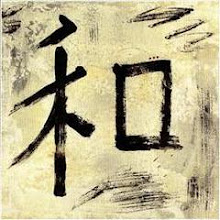
Image: From The Spirit of Islam: Experiencing Islam Through Calligraphy, an exhibition at the Museum of Anthropology, University of British Columbia.

Saturday, July 07, 2007

Gandhi on music & art


Mahadev Desai joined Mahatma Gandhi in 1917 and remained with him till Desai's death in 1942. I came upon a very interesting account, in Mahadev Desai's diary, of a discussion between Mahatma Gandhi and Dilip Kumar Roy, in the end of January 1924. I reproduce that below.


Dilip, son of the well-known dramatist of Bengal, Dwijendralal Roy, visited Gandhi one evening. He had already earned abroad the reputation of a distinguished Indian singer. He had come in the morning and promised to return in the evening to sing some hymns to Bapu.

It was about 8 p.m. when he came. Dilip had brought his sitar. A good number of listeners had collected in the room. Sitting on a sofa opposite to Gandhiji's bed he began singing a song of hymn to Krishna.

"O Lord! O Hari! Gopal! my Love!
Call me I pray to Thee above …


The moving sentiment in the hymn, the charming voice of the
singer and the listners' receptive mood filled the place for a while
with the earnest loving entreaty made in the song. Everyone was, as
it were, wafted to that blissful place and humming the following
lines :

"Of hunger, thirst, I won't complain.
Content with fruit I will remain".


But even before vibrations of that son had died in our ears, the friend began the well-known song of Meerabai, Chakar rakhoji, which thrills with the same ethereal air:

Get this widget | Track details | eSnips Social DNA

"Make me Thy servant - the last stain efface
Of selfhood; be my life an offering
In song's own bliss and bloom's own loveliness.
For beauty holds a mirror to Thee, O King,
Of Beauty's ultimate home - Thy Brindaban!
Whose glory in her bowers will I sing.
And accost Thee daily in Thy golden dawn
In every flower, every purlingst realm
In changing forms deciphering the One.
Here, in Thy happy hunt, where dreamers dream
And Yogis strive through Yoga Thee to meet
And all who visit hail Thy summit gleam,
Thy Meera treads but one way Thee to greet:
She prays: "Besiege my heart at midnight hush
And on banks of Love's blue rill Thy dance repeat."


All of us felt as if we ourselves were 'dancing on Love's blue rill' - that was the effect the performance produced. Profound silence prevailed for a while. Dilip then touched a topic and raised a dialogue.

"I feel, Mahatmaji", he said, "that our beautiful music has been sadly neglected in our schools and colleges."

"It has - unfortunately", Bapu agreed, "I have always said so."

"I am very glad to hear this, Mahatmaji, because, to be frank, I was under the impression that art has no place in the gospel of your austere life. I had often pictured you as a dread saint who was positively against music."

"Against music - I"! exclaimed Mahatmaji, as though stung. "Well, I know, I know," he added resignedly, "there are so many superstitions rife about me that it has now become almost impossible for me to overtake those who have been spreading them. As a result, my friends' only reaction is almost invariably a smile when I claim I am an artist myself."

"I feel so relieved, Mahatmaji" I laughed, "but may not your asceticism be somewhat responsible for such popular misconceptions? The people would find it difficult to reconcile asceticism with art".

"But I do maintain that asceticism is the greatest of all arts. And to think that I should be dubbed an enemy to an art like music because I favour asceticism! I, who cannot even conceive of the evolution of India's religious life without her music! But, indeed, I fail to see anything in much that passes for art in these days. What is needed for the appreciation of any art is to have the heart for it, not any ntimate knowledge of technique or training. Why must my walls be overlaid with pictures, for instance, when they are meant only for sheltering us? I do not need pictures. Nature suffices for my inspiration. Have I not gazed and gazed at the marvellous mystery of the starry vault, hardly ever tiring of that great panorama? Could one conceive of any painting comparable in inspiration to that of the star-tudded sky, the majestic sea, the noble mountains? Beside God's handiwork does not man's fade into insignificance?'

Dilip agreed: "Yes, what man in his senses will claim that the artist's handiwork is even greater than life's?"

Bapu then rushed on and changing the Gita's aphorism, "Yoga is skill in action", he said in effect that skill in action was itself the highest art. "Life must immensely exceed all the arts put together. To me the greatest artist is surely he who lives the finest life. For what is this hot-house art-plant of yours without the life-soul and background of a steady worthy life? What after all does that art amount to which ll the time stultifies life instead of elevating it? No. Art has a place in life, but art is not life. Life, on the contrary, is Art. Art should be subservient to life. It should act as its handmaid, not master. It should be alive to life and the universe."

Source: Mahadev Desai's diary. For resources on Gandhi, visit here. Example, Gandhi on Google Video.

Tuesday, June 19, 2007

Interview with God


"I dreamed I had an interview with God. ..."

A beautiful presentation, of some simple truths accompanied by breathtaking images, here.

Sunday, April 08, 2007

Birdsong


I surprised myself this evening by learning and setting to melody the Sanskrit verses I referred to in my last two posts. My sons Rituraj and Rishiraj had, once again, to suffer my efforts at memorisation all morning.

Two Birds, and Song of Truth could be appropriate titles for these!

I have been invited to a conference in Beit Jalla (near Bethlehem) in August. Given the number of close friends I have in Israel and Palestine and the various things I could and would like to do there, I'm planning to go. That should give me an opportunity to visit my friend Jean Claude, bassist and musician, in Jerusalem. In 2003, we shared a rich and fruitful musical collaboration. I also sang with Palestinian musician friends. So I am looking forward to singing these songs there.

Meanwhile, thanks to the wonders of the internet, I now have the Audacity software and am able to do some rudimentary recording, which is immensely helpful.

Saturday, April 07, 2007

Source of Satyameva Jayate


Yesterday afternoon, I was standing on the street kerb in front of my house, enjoying a smoke, and looking at the tile with the bird image on the gate post (the same as the one on this blog’s mast-head). On the telephone cable passing along the house were two sparrows. From high above on the blooming radha-chura tree in front of the house came the ceaseless tuk-tuk-tuk of the coppersmith. And from a few houses away came the entrancing call of the caged cuckoo.

Looking at the two sparrows, I recalled the verse “two birds sitting on a tree …” I vaguely knew this was from the Upanishads. I went back indoors, and later went to the internet to find the exact verse. I found this very soon, in English translation; it was from the Mundaka Upanishad, and was also repeated in the Svetasvatara Upanishad.

I wanted to get the original Sanskrit verses, I thought I might try to set this to melody. I found that too soon enough. But as I was rapidly scanning the Sanskrit verses of the Mundaka, I came upon “satyameva jayate…” (3.1.6). Extraordinary! This was a great chance discovery!

Quite some time back, I had written a post on Satyameva jayate, the Indian national credo, which means “truth alone is victorious”. Hence searches on satyameva jayate showed up my post, as my sitemeter’s analyses showed me. But there had been several searches from time to time on where this phrase was originally from, which edict it appeared on. I was not aware of the origins of the Indian national credo. I presumed it was simply a phrase in Sanskrit, with the meaning expressing the goal set for the new republic.

But as I now discovered, thanks to the two sparrows on the wire, the national credo was from the Mundaka Upanishad. A concluding verse of this Upanishad declares that its aim is to make man attain Self-Knowledge. “Munda” means head; hence the name indicates that this Upanishad is the Head of all Upanishads.

सत्यमेव जयते नानृतं
सत्येन पन्था विततो देवयानः
येनाऽऽक्रमन्त्यृषयो ह्याप्तकामा
यत्र तत् सत्यस्य परमं निधानम्

satyameva jayate naanritam
satyena pantha vitato devayanah
yenaa kramantyarishayo hyaaptakaamaa
yatra tat satyasya paramam nidhaanam


Meaning:

Only truth prevails, not untruth; by the path of truth is laid out, the Divine way, on which the sages of yore, fulfilled in their desires, attain the supreme treasure of Truth.

A precious education in citizenship for this child of India.

Friday, April 06, 2007

Two birds sitting on a tree


द्वा सुपर्णा सयुजा सखाया समानं वृक्षं परिषस्वजाते
तयोरन्यः पिप्पलं स्वाद्वत्त्यनश्नन्नन्यो अभिचाकशीति

समाने वृक्षे पुरुषो निमग्नोऽनिशया शोचति मुह्यमानः
जुष्टं यदा पश्यत्यन्यमीशमस्य महिमानमिति वीतशोकः

Two birds, inseparable friends, cling to the same tree. One of them eats the sweet fruit, the other looks on without eating.

On the same tree man sits grieving, immersed, bewildered, by his own impotence. But when he sees the other lord contented and knows his glory, then his grief passes away.


Mundaka Upanishad, Svetasvatara Upanishad

Thursday, March 29, 2007

Singing pictures


Painting and singing stories told through scrolls goes back to ancient times in India and Bengal.

Patuas or Chitrakars have plied their craft for generations in the villages of Mednipur district, near Calcutta.

Painting and singing stories on devotional and historical themes, the patuas would travel to surrounding villages, receiving rice, vegetables and a few coins for their recitals.

Competition from radio and television have eroded their traditional way of life.

Recently women began painting and singing. Adding scrolls based on social themes, such as public health and education, they are developing new avenues and markets for their craft.

I learnt about scroll painters when I met patua Dukhushyam Chitrakar in 1987. Over the years, I had helped him get commissions for scroll paintings from various quarters. His son Rahim's scroll, on rebuilding after the tsunami (of December 2004) is pictured above.

My friend Aditinath Sarkar, anthropologist and documentary film-maker, recently made a film Singing Pictures: Women Painters of Naya.

A clip is accessible below. Read more about the patuas here, and about the patua women of Naya here.

Wednesday, March 21, 2007

Allophilia


It isn't often that one reads something that makes one happy. The Economist carries an article on the subject of "allophilia" - liking for other groups. It gave voice to the peculiar malady I suffer from. Its fulfilling to know I am not alone. In 1994, after touring adivasi (i.e. indigenous peoples') villages in interior Orissa in eastern India on a planning study, I felt one was fortunate and blessed to be able to learn from our adivasi communities what civilisation and refinement means. I had also subsequently been fortunate to be nourished by the sensibility of the poor Muslim slumdwellers in Howrah. And yesterday I came upon my friend Rahul's blog, which is dedicated to the naturalist vision of living of the Bhil.

Positive prejudice: Really loving your neighbour

Why holding off from hatred may not be good enough

“I feel comfortable when I hang out with them.” “I'm truly interested in understanding their point of view.” “I feel I can be myself when I am around them.” “To enrich my life, I would try to make more friends (from that group).”

Such warm, exuberant feelings towards other categories of human being—national, religious, racial or social—are the sort of thing that Todd L. Pittinsky, a social psychologist at Harvard University, spends his time probing and testing. This is not just because he too likes to hang around people who accentuate the positive. Mr Pittinsky's hope is to turn the conventional wisdom of “conflict studies” and “race relations” upside down.

There is a huge body of knowledge, he says, on prejudice against races or other categories. What he wants to promote, both as a scholarly tool and policy goal, is “allophilia”—liking for other groups—and the behaviour it inspires. “So much research aims to understand racist and xenophobic attitudes, so much policy aims to counter such attitudes—but people neglect to look at positive attitudes to other groups,” says Mr Pittinsky, a professor at Harvard's Centre for Public Leadership.

He believes that “allophilia” is a measurable state of mind with hard consequences. For example, the attitude of an American voter towards immigration is determined less accurately by party affiliation or social and economic status than by the degree to which he or she simply likes Latinos. And people's choices in charitable giving, study, voluntary work and travel are guided, not surprisingly, by the sort of groups that make them feel good.

More controversially, allophilia theory holds that efforts to fight racism often err in trying to abolish or minimise the difference between groups—telling people that “we and they are really the same” or “we all belong to a bigger group, and that matters more than any slight difference.”

The experience of Bosnia and Rwanda, where murderous hatreds resurfaced after decades of apparent symbiosis, shows that categories are resilient. That is one reason why Mr Pittinsky thinks that “mere tolerance is inherently unstable.”

He is not the only scholar to stress the limits of tolerance alone as an ideal. Robert Hayden, a social anthropologist at the University of Pittsburgh, has coined the term “antagonistic tolerance” to describe the way sacred sites were shared by Christians and Muslims in the Ottoman world, and by Hindus and Muslims in British India. His point? The fact that groups accept a regime or “truce” imposed by an imperial power does not mean they will refrain from competing once they get a chance.

To ex-subjects of the Soviet imperium, talk of officially encouraged admiration for “fraternal” nations, laced with displays of embroidery, cuisine and folk-dancing, sounds cloying. Soviet allophilia finally failed because people saw it was dishonest; it hid the travails of ethnic groups who had suffered deportation and persecution under Stalin. By the end nobody believed in brotherly love.

So by all means, let allophilia be studied, measured and encouraged. Just remember: state-sponsored cultural events may not be the best way to go about it.

Ref:

Pittinsky, T. L., Rosenthal, S. A., & Montoya, R. M. “Moving Beyond Tolerance: Allophilia Theory and Measurement”. Presented to the Society for Personality and Social Psychology, January 2007.

Image: Muria Elder, Chhattisgarh, by Marcus Leatherdale.

Monday, March 19, 2007

Cooking Biryani


A web-surfer reached my blog searching on "Cooking Biryani".

I felt bad that s/he could not find what s/he wanted, especially when s/he had actually reached the right place! For the last few years, through the Howrah Pilot Project (with which I am associated) women in Howrah have been making spices for Biryani and other delectable preparations, which are exported all over the world. Each packet of Biryani masala carries the recipe and cooking instructions. And that text - written in early 2000 - is still in my computer.

So, with apologies and thanks to the dear Biryani recipe searcher, I am reproducing that here. And yes, this is a promotional for our Biryani and other spices.

Ingredients (to serve 5-6 persons)

Meat: 1 kg; Curds / yogurt: 200 gms; Rice (long-grained): 1 kg; Cooking oil: 5 tablespoons; Potatoes: 750 gms; Saffron: 2 pinches; Onion: 1 large; Milk: 1 cup; Ginger paste: 2 tablespoons; Rose water: half cup; Garlic paste: 1 tablespoon; Salt: to taste; Ghee (clarified butter): 100 gms; Bay leaves (tej patta): 2-3 pieces; Red chilli powder: to taste; Chopped pistachios and raisins: 2 tablespoons; Eggs: 2 (boiled); HPP BIRYANI MASALA: 1 packet.

Cut meat into 1 inch cubes.

Fry the boiled eggs (whole) lightly in oil.

Slice the onion into long strips and fry in oil until golden in colour.

Add the meat to the fried onions and then the ginger and garlic paste, add red chilli powder and salt to taste, and put to cook. Cook until the meat is fully done. Note that the meat should not be completely dry but should retain some gravy.

Add the curds / yogurt to the cooked meat, and set aside.

Cut the potatoes in large pieces, add 1 pinch saffron and fry in oil until slightly crisp. Then add half a cup of water and let it cook until the water is dry and the potatoes are well done.

Clean the rice, wash and soak in water for 10 minutes.

Take water in a cooking pot and heat. When it begins to boil, add the rice, salt to taste, and 2-3 bay leaves. Check the rice from time to time.

When the rice is about three-fourths done, drain out the water.

Add all of the BIRYANI MASALA to the cooked meat and mix.

Take a cooking pot and place some meat and potatoes at the bottom. Add a layer of rice. Place another layer of meat and potatoes over the rice. Set in layers like this.

Dissolve 1 pinch of saffron in the rose water and pour on top.

Add the ghee to the milk and pour over the meat-rice.

Sprinkle the chopped pistachios and raisins on top.

Cover the cooking pot thoroughly so that no steam can escape, and cook over a slow fire for 10-15 minutes.

Mix well before serving.

Garnish the serving with slices of the slightly fried boiled eggs.

Biryani is best eaten with raita and green salad. Raita masala is prepared by lightly roasting and then grinding cumin (jeera), dry red chilli and black pepper seeds.

Since biryani is very rich, eating this with a specially prepared ghol(drink) aids digestion. To make the special ghol, grind into a paste green chilli, mint leaves (pudina), black salt and salt. Lightly roast black pepper and cumin (jeera) and grind into a dry powder. Add the paste and powder to the curds / yogurt. Add water to dilute.

Thursday, March 01, 2007

Crazy


Thank you Apple!

Here's to the crazy ones.
The misfits.
The rebels.
The troublemakers.
The round pegs in the square holes.
The ones who see things differently.

They're not fond of rules.
And they have no respect for the status quo.
You can praise them, disagree with them, quote them, disbelieve them, glorify or vilify them.
About the only thing you can't do is ignore them.
Because they change things.
They invent. They imagine. They heal.
They explore. They create. They inspire.
They push the human race forward.
Maybe they have to be crazy.
How else can you stare at an empty canvas and see a work of art?
Or sit in silence and hear a song that's never been written?
Or gaze at a red planet and see a laboratory on wheels?
We make tools for these kinds of people.
While some see them as the crazy ones, we see genius.
Because the people who are crazy enough to think they can change the world... are the ones who do.

Friday, November 10, 2006

Magnificent collection


Last evening, I stumbled upon the British Library's collection of images Svadesh videsh: home from home. What a delight!

Begun by the East India Company in 1801, this fascinating survey of the landscape and architectural heritage of South Asia spans the late-18th to mid-20th centuries. The collection is curated by John Falconer (Curator, Photographs, India Office Collection), who has also written an introduction.

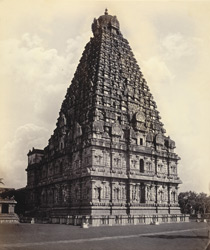
This is a photograph of the monumental Brihadishvara Temple at Thanjavur (Tamil Nadu), the most impressive architectural achievement of the Chola era. The great king Rajaraja I founded construction of the temple around 1010.

The photographer was Edmund David Lyon, who was Governor of Dublin District Prison (Military), 1854-56, and later worked as a professional photographer in India, with a studio in Ootacamund. From 1867-1868 he was commissioned by the Madras and Bombay Governments to photograph archaeological and architectural antiquities and produced an extensive documentary record of South Indian architecture.

Read the curator's introduction here.

View the entire collection here.

Thursday, October 19, 2006

Cuckoo's call!

I was searching on the net yesterday evening - for bird songs.

I found there are quite a few resources on this, and was I delighted!

Check this out.

And this.

And this.

What an awesome work of devotion, to record bird songs, and then make this available to people across the world, free, through the internet.

Life is beautiful!

So I am able to attach a sound clip of the cuckoo (Asian koel) here. Do hear this dear friends!

Saturday, September 30, 2006

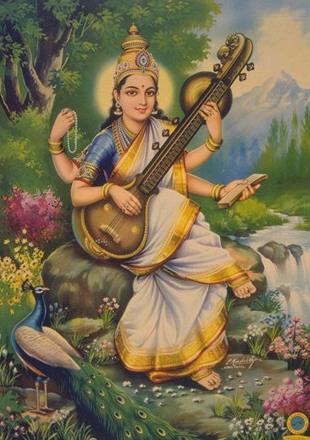
Devi Saraswati


Tomorrow is Saraswati Puja, for (Hindu) south Indians.

Saraswati literally means “one who gives the essence (sara) of our own Self (swa).” She sits on a swan, and carries a veena (a string instrument).

Puja, as I have explained earlier, means worship, with flower offerings.

Devi Saraswati is the Mother of Learning.

Music is the highest art, the distilled essence of all knowledge, which is self-knowledge. Self-effacing devotion, expressed in heart's melody, in a prayer to Devi Saraswati, is accompanied by Divine vision.

In Carnatic music (i.e. the south Indian classical tradition), one of the first songs learnt is “Varaveena”, a prayer, in Sanskrit, a song of adoration, to Saraswati, composed by Appaya Dikshitar (1554-1626), a scholar, sage and saint.


Varaveena mrudu paani
Vanaruha lochana raani
Suruchira bambhara veni

Suranutha kalyaani
Nirupama shubha guna lola

Nirathi jaya prada sheela
Varadaapriya ranganaayaki

Vaanchita phala daayaki
Saraseejaasana janani
Jaya jaya jaya


You hold the divine veena in your soft hands.
You are the queen of the omniscient. Your eyes are like the lotus petals.
Your curly tresses resemble the bees.
Devas worship your auspicious form.
You have unequalled virtuous qualities.
You give endless victory.
You are the munificent consort of the Beautiful Lord.
You grant boons to the deprived.
O Mother of lotus-seated Creator!
Victory to you!


This song is set in Mohanam raga, which is Bhopali raga in the Hindusthani or north Indian classical system.

Shivkumar Kalyanaraman is a professor of computer science in the USA. His website is also a treasure trove of resources on Carnatic music. He has provided the musical notations for this song, as well as an MP3 recording of a teaching of this song.

Thank you Shivkumar, and may Mother Saraswati’s blessings be always with you.

Another rich site is karnATik.

My mother is away in Bombay, otherwise she would have organised the Puja at home, with an offering of sweet and savoury rice, and the placing of books (of students in the house) before the image of Saraswati.

My younger son Rishiraj (aka Chotu), 11, was the last to religiously place all his school books in front of the image at home. This is a day on which there must be no studying! Great for kids at home during vacations! Chotu's in boarding school now, with his brother Rituraj, 15.

My mother will be doing the Puja at her sister’s, in Bombay.

Hence it will only be an 'inner' observation for me. I observed Saraswati Puja by:

conveying my heartfelt good wishes to -

JP, a college-mate and fellow Tamil-ian & Calcuttan (in which fact I take particular pride right now, as JP has recently become the CIO, Global Services, of British Telecom);

Achinto, photographer, with whom I had been out of touch for a long time; and

Dipali, painter, designer, art teacher and friend, and Saraswati incarnate.

Thursday, September 07, 2006

Tribute to Gary Larson

I was introduced to the name and work of American cartoonist Gary Larson in 1988 (by Prof John Archer, architectural historian at the University of Minnesota). That was a valuable gift indeed.

Gary Larson is known for his “Far Side” cartoons. He holds up a mirror to humankind’s everyday idiosyncrasies, vanities and foibles, by reversing the roles of humans and other living (and imaginary) creatures.

Every thinking person should be exposed to the work of Larson. I thought his work was simply brilliant.

In 1995, at the height of his cult following, Gary Larson retired and stopped producing cartoons. His work is available in the various “Far Side” books.

Larson’s retirement – like Charles Schulz’s subsequent retirement and passing away shortly thereafter – was a big blow for me.

When I started net-surfing (in 1998), one of the first things I searched was “Gary Larson”. I thus learnt that he had personally requested his fans to remove unauthorised reproductions of his work.

After a long time, I opened one of his books yesterday – and was immediately absorbed and immersed in his unique brand of black humour and comedy.

I searched in blogger on “Gary Larson”. There are links to images of some of his original works. However, as Larson himself does not want this, I would like to respect his wishes and refrain from reproducing his work.

However, also available on the net are re-creations of his oeuvre: inspired by Larson, and in tribute to him. In fact there’s a contest along these lines, and lots of entries. I thought that was clever and fair. I’m posting two of these below, with many thanks to the artists.

Wednesday, September 06, 2006

Birds of Calcutta


I was thrilled to discover the website "Birds of Kolkata" a few days ago. Wow! What a delightful resource, and what a magnificent public service!

So I'm using an image from this website of the Asian Koel, a common Indian cuckoo (with the permission of the site owner Sumit K Sen).

Ten years ago, I had taken my son Rituraj on a bird-watching morning walk in Calcutta, organised on "Environment Day". Though a lifelong Calcuttan, I was overwhelmed by the range and variety of birds in the very heart of the city, wherever wooded areas are available.

Not far from where I live, are some huge-canopied trees beside a lake. In the evening, at twilight, that place is filled with the sound of thousands of birds chattering away, all perhaps simultaneously trying to tell everyone else all that they did during the day, on and on, until suddenly they become silent, and fall asleep. My boys love to see me enacting this jabberwocky!

Photo: © Sumit K Sen

Saturday, August 12, 2006

Great guy


Yesterday morning, just before leaving home for work, I was speaking to my sister, and I referred to my cousin and said “… oh he can handle any situation … he’s a great guy”.

As I walked to the gate, I thought about this cousin, and I was filled with gladness and admiration. I then remembered how envious and jealous I used to be – and what a good cure for that spontaneous joy is.

The bodhisattva in Buddhist tradition is a “being of light”, one whose life is devoted to compassionate service of humanity and all living beings, bringing every being to light through life after life before seeking his own liberation from the endless cycle of life.

The bearing of a bodhisattva: maitri, mudita, karuna, upeksha. Which means: (selfless) love, spontaneous joy (at/for others), compassion and equanimity.

All these are positive states and feelings, in whose light other states and feelings – such as envy and jealousy – are wiped out.

It’s a simple flip – to go from jealousy, anger, hatred and ill-will to spontaneous joy, appreciation, delight, admiration, warmth, love, devotion. And from such small acts of will against negative feelings, and what the new feelings do within us – we are powerfully transformed, with positive capabilities.

When people encounter the positive, joyful feelings of others – they too are touched, moved, humbled, and their finest qualities are awakened.

We carry such a detritus of needless negativism within ourselves, to our own detriment and ill-health. Positive health, and peace on earth – has ultimately to be built individual by individual, feeling by feeling.


Searching for an image to accompany my post, I came upon this amazing website, of Dwayne Edward Rourke, which I invite you to visit. The image is taken from there.

Sunday, July 02, 2006

Mnemonics of Conscience

Religion, in the sense of cultivation of enlightened sensibility, is an ancient and living force in India. It is like a river that ever absorbs other strands and streams in processes of renewal. The Buddha spoke of "the wheel of Dharma", which he turned through his teaching. He is a key figure in the renewal and revitalisation of Sanatana Dharma, or age-old Religion, which is a natural heritage of humanity

Personal religious practice, as explained in the religious scriptures, is a means to transcend the bonds imposed by one's ego, which in turn is subject to the sensations of flesh. Desire and grasping become the cause of endless suffering as action and reaction feed one another in cycles of birth and rebirth. Lust, rage, greed, attachment, ... are the basic pernicious weaknesses to be combated. Liberation or Moksha lies in dwelling in cosmic or divine consciousness, free from the clouded perception of ego-driven consciousness, or maya.

The path advocated, to go from maya to Moksha involves the nurturing within oneself of higher aspirations, sensibilities and faculties. Sustained personal practice in this direction, in an existential sense, built upon a foundation of unswerving faith, and centred around a Guru or teacher, is each person's road to liberation.

In this context, there abound mnemonics of conscience: the Eight-fold Path; the Three Jewels; the Four Virtues; the Six Evils; and so on. All of these seek to act as incendiary capsules in the seeker's consciousness, whose activation recalls with force the straying seeker's mission. They are means to enable such a remembrance to be induced involuntarily. Thus, for instance, the number six, or six objects, or the sixth of a month, all prick the conscientious seeker's conscience, making him redouble his efforts.

To further embed triggers of conscience deep within the seeker's consciousness, there are tales, like those in the Buddhist Jataka, illustrating specific human qualities, positive and negative. Through their symbolic language, imagery and microscopic view of human behaviour, such tales have powerful resonances in the seeker's psyche. Hence there has always been a close link between India's living faith and her fecund literary imagination.

(I was at a complete loss trying to select an image to accompany this narrative. I’d like to direct readers to this website which has some calligraphic treasures.)