Showing posts with label Upanishads. Show all posts

Sunday, April 08, 2007

Birdsong


I surprised myself this evening by learning and setting to melody the Sanskrit verses I referred to in my last two posts. My sons Rituraj and Rishiraj had, once again, to suffer my efforts at memorisation all morning.

Two Birds, and Song of Truth could be appropriate titles for these!

I have been invited to a conference in Beit Jalla (near Bethlehem) in August. Given the number of close friends I have in Israel and Palestine and the various things I could and would like to do there, I'm planning to go. That should give me an opportunity to visit my friend Jean Claude, bassist and musician, in Jerusalem. In 2003, we shared a rich and fruitful musical collaboration. I also sang with Palestinian musician friends. So I am looking forward to singing these songs there.

Meanwhile, thanks to the wonders of the internet, I now have the Audacity software and am able to do some rudimentary recording, which is immensely helpful.

Saturday, April 07, 2007

Source of Satyameva Jayate


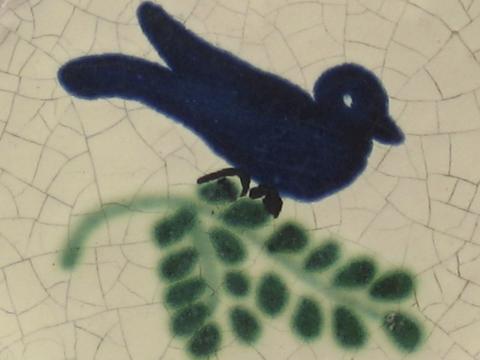
Yesterday afternoon, I was standing on the street kerb in front of my house, enjoying a smoke, and looking at the tile with the bird image on the gate post (the same as the one on this blog’s mast-head). On the telephone cable passing along the house were two sparrows. From high above on the blooming radha-chura tree in front of the house came the ceaseless tuk-tuk-tuk of the coppersmith. And from a few houses away came the entrancing call of the caged cuckoo.

Looking at the two sparrows, I recalled the verse “two birds sitting on a tree …” I vaguely knew this was from the Upanishads. I went back indoors, and later went to the internet to find the exact verse. I found this very soon, in English translation; it was from the Mundaka Upanishad, and was also repeated in the Svetasvatara Upanishad.

I wanted to get the original Sanskrit verses, I thought I might try to set this to melody. I found that too soon enough. But as I was rapidly scanning the Sanskrit verses of the Mundaka, I came upon “satyameva jayate…” (3.1.6). Extraordinary! This was a great chance discovery!

Quite some time back, I had written a post on Satyameva jayate, the Indian national credo, which means “truth alone is victorious”. Hence searches on satyameva jayate showed up my post, as my sitemeter’s analyses showed me. But there had been several searches from time to time on where this phrase was originally from, which edict it appeared on. I was not aware of the origins of the Indian national credo. I presumed it was simply a phrase in Sanskrit, with the meaning expressing the goal set for the new republic.

But as I now discovered, thanks to the two sparrows on the wire, the national credo was from the Mundaka Upanishad. A concluding verse of this Upanishad declares that its aim is to make man attain Self-Knowledge. “Munda” means head; hence the name indicates that this Upanishad is the Head of all Upanishads.

सत्यमेव जयते नानृतं
सत्येन पन्था विततो देवयानः
येनाऽऽक्रमन्त्यृषयो ह्याप्तकामा
यत्र तत् सत्यस्य परमं निधानम्

satyameva jayate naanritam
satyena pantha vitato devayanah
yenaa kramantyarishayo hyaaptakaamaa
yatra tat satyasya paramam nidhaanam


Meaning:

Only truth prevails, not untruth; by the path of truth is laid out, the Divine way, on which the sages of yore, fulfilled in their desires, attain the supreme treasure of Truth.

A precious education in citizenship for this child of India.

Friday, April 06, 2007

Two birds sitting on a tree


द्वा सुपर्णा सयुजा सखाया समानं वृक्षं परिषस्वजाते
तयोरन्यः पिप्पलं स्वाद्वत्त्यनश्नन्नन्यो अभिचाकशीति

समाने वृक्षे पुरुषो निमग्नोऽनिशया शोचति मुह्यमानः
जुष्टं यदा पश्यत्यन्यमीशमस्य महिमानमिति वीतशोकः

Two birds, inseparable friends, cling to the same tree. One of them eats the sweet fruit, the other looks on without eating.

On the same tree man sits grieving, immersed, bewildered, by his own impotence. But when he sees the other lord contented and knows his glory, then his grief passes away.


Mundaka Upanishad, Svetasvatara Upanishad

Monday, December 11, 2006

Sanctified in the mystery of death, and eternal life


Fr Gerard Beckers, sj, 1924-2006

Jesuit, sanyasi, teacher, activist, bodhisattva.

“That which is not shared, is lost: blood, education, and love.”


Thursday, October 19, 2006

Problems ...

JP wrote in his blog today:

For most of my adult life, I’ve been bemused, perplexed, sometimes irritated and occasionally completely taken aback by the error messages spewed out by the applications we build and use. Over the last twenty-five years or so, I’ve watched them improve, but at speeds that make glaciers look agile.

Today, while looking at technorati, I saw this:

Something is wrong! We know about it, and are working furiously to fix it. Please check back later and probably everything will be back up and running.


Problems!

So many problems!

9-11 happened. The space shuttle crashed. The war in Iraq. Laptop batteries exploded. North Korea conducted a nuclear test. The list could go on and on.

Why are we living amidst so many problems today? Was it different earlier?

In the precision instruments manufacturing enterprise I am managing on behalf of my family, we are facing several problems. Some of them are daunting, and produce dismay and despair. But when I read about things like exploding laptop batteries, with companies like Sony involved – it does help to bring a sense of balance.

I guess, with the business of life getting more complex, problems too multiply. But it’s also the case that with the advance of democratic, human rights and social justice consciousness, and a large section of humanity connected and communicating, things are now more transparent than they used to be.

Equally, the notion that life is meant to be free of problems – is childish. Life will be full of problems. And living through this life means confronting and addressing the problems, and learning thereby.

I also wish one’s own problems, and the awareness of problems all around, makes people more understanding and tolerant of others.

I am reminded of the last words of the Buddha (recorded in the Pali texts):

Vaya-dhamma sankhara
Appamadena sampadetha.

“All created things are impermanent .
Strive diligently."

Or as the Lord of Death taught Nachiket in the Katha Upanishad:

"Get up! Wake up! Seek the guidance of an illumined teacher and realize the Self. Sharp like a razor's edge is the path, the sages say, difficult to traverse."

Friday, August 11, 2006

More on Horse's Ass


I had received the e-mail about "Horse's Ass" from a young friend. Here's my reply to him.

You asked:

"And you thought that being a Horse's Ass was not important?"

No one ever thought that a horse's ass was unimportant! In fact there is a lot of evidence to point to the importance with which the horse's ass has been regarded. Your mail about everything being traceable to the HA is only further evidence.

In many languages, across the world, the expression for something utterly value-less is "horse-dung". Why?

In mystic language in diverse cultures (sandhyabhasha in India) , there is a tradition of speaking in riddles, or using a word to mean its opposite. Thus, horse-dung could be a term to denote the ultimate treasure i.e. knowledge i.e. self-knowledge i.e. knowledge of God.

The same knowledge that was realised by young Nachiket in the story in the Katha Upanishad.

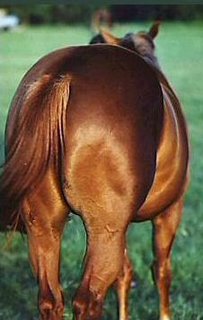
Talking of behinds - it is a fact that the horse has perhaps the most exquisitely-sculpted behind. And it has perhaps the most beautiful tail of all creatures; placed there just to conceal - or adorn - the horse's ass?? The source of that most value-less dung??

In Bangla, every child learns the mischievious expression:

"Shodh bodh ghodar pondh"

Which is like saying: "even-steven, horse's ass".

Some years back, it occurred to me that vulgar expressions are mediums for transmission of precious wisdom, like coded messages to future generations. Such messages are hidden in expressions that are sure to be in common currency, heard by and embedded in the minds of nearly everyone, so that some time someone, somewhere may also reach through to and grasp the inner meaning.

So, the expression "shodh bodh ghodar pondh" could be unravelled, like a puzzle, to discover hidden wisdom.

To me, it seemed to mean:

"searching, and feeling, to attain blissful self-realisation" (or enlightenment, or self-knowledge, or divine vision).

It seemed to be simply the message of Lord Buddha. I was overwhelmed to find the imprint of the greatest teacher on even everyday vulgar expressions!

The horse has often symbolised the mind. Like a wild horse the mind races uncontrollably. Controlling the mind yields a very good vehicle to journey through life. And in that journey, searching for TRUTH, and never failing to FEEL - the light of TRUTH is eventually attained.

Hindu religious mythology refers to the present time as Kali-yuga, or the age of Kali, a period of darkness, ignorance and corruption. Vishnu, the sustainer of Life would incarnate as Kalki, 'the avenger', riding a white horse (seated backwards), to destroy the present world and to take humanity to a different, higher plane.

So my young friend, it appears you are off to a very good start indeed with your interest in the Horse's Ass!
Friday, July 07, 2006

Loose threads

James replied:

Hi Babloo

I have a translation of the Upanishads done by WB Yeats and Shree Purohit, called "The Ten Principal Upanishads". A passage from this work is quoted at the beginning of the Lagahoo Poems from which "World Without End" is taken. I copy below the 2 quotations that precede the work. (Quite surprising that you picked up on some of the loose threads here!)

"Above the senses are the objects of desire, above the objects of desire, mind; above the mind, intellect; above the intellect, manifest nature. Above manifest nature, the unmanifest seed; above the unmanifest seed, God... beyond him, nothing."
Katha Upanishad, translated by Shree Purohit Swami and W. B.Yeats

"Now is the judgement of this world; now the ruler of this world will be cast out."
John, 12:31

Thanks for your mini dissertation on and translation of the mysterious arcana of Hinduism. Always eye- and mind-opening.

Remain in light.