"The true author of a poem is neither the poet nor the reader, but language."Octavio Paz
A delegation of poets from the USA is visiting Calcutta. They are part of the US-Calcutta Literary Exchange. The delegation is led by Yusef Komunyakaa.
An
interaction with some of the members of the delegation was organised yesterday evening by the Calcutta International Foundation for Arts, Literature and Culture, at the Foundation's office on Park Street (overlooking the Park Street Cemetery).
Besides Yusef Komunyakaa, the other American poets present were Catherine Fletcher, Idra Novey, Nathalie Handal and Ed Pavlic. After a stimulating dialogue with artists and writers from Calcutta, they read from their work.
 Yusef Komunyakaa
 received the Pulitzer Prize and Kingsley Tufts Poetry Award for
Neon Vernacular: New & Selected Poems 1977-1989. He was a finalist for the National Book Critics Circle Award for
Thieves of Paradise. His honors include the William Faulkner Prize from the University de Rennes and the Bronze Star for his service in Vietnam, where he served as a correspondent and managing editor of the
Southern Cross. In 1999 he was elected a Chancellor of The Academy of American Poets.
We Never KnowHe danced with tall grass
for a moment, like he was swaying
with a woman. Our gun barrels
glowed white-hot.
When I got to him,
a blue halo
of flies had already claimed him.
I pulled the crumbed photograph
from his fingers.
There's no other way
to say this: I fell in love.
The morning cleared again,
except for a distant mortar
& somewhere choppers taking off.
I slid the wallet into his pocket
& turned him over, so he wouldn't be
kissing the ground.

Catherine Fletcher is an editor for
Rattapallax magazine and the online
World Poetry Map, and the coordinator of the Endangered Language Initiative, a multi-year project of the New York-based People's Poetry Gathering and City Lore. This is dedicated to document, disseminate, and translate poetry in endangered, contested, and threatened languages.
 Idra Novey's
 chapbook of poems
The Next Country won the 2005 Poetry Society of America Chapbook Fellowship and her translations of Brazilian poet Paulo Henriques Britto received a PEN Translation Fund grant; the book,
The Clean Shirt of It, came out in 2007 in the Lannan Translation Series from BOA Editions. Her first book,
The Next Country, received the Kinereth Gensler Award from Alice James Books and will be released in 2008.
Definition of StrangerPerson not a member
of a group. A visitor,
guest, or the breast
that brushes your arm
on the subway. Person
with whom you've had
no acquaintance but who's taken
your rocking chair
from the curbside
and curls up in it
and closes her eyes.
Person in line
behind you now, waiting
for a glass of water,
or of whiskey, of elixir.
Person logging online
at the same second
from the Home Depot in Lima.
Or in search of the Dalai Lama.
Person not privy or party
to a decision, edict, et cetera,
but who's eaten
from the same fork
at the pizzeria
and kissed your wilder sister
on New Year's. Person assigned
to feed the tiger at the zoo
where you slipped your hand
once
into the palm
of somebody else's father.
 Nathalie Handal
 is the author of numerous award-winning books, including
The Lives of Rain and
The Poetry of Arab Women: A Contemporary Anthology (Academy of American Poets Bestseller and Winner of the Pen Oakland/Josephine Miles Award). She is currently finishing Language for a
New Century: Contemporary Poetry from the Middle East, Asia and Beyond (forthcoming).
The WarriorIt was Wednesday, I remember. Maybe it was Thursday. I had arrived early, early enough to drink some good wine alone with a man I thought we all should fear and for a second forgot. Then they arrived. Nothing in me had changed, even after the wine, even after I saw a goat and corpse cut open side by side. Some say this place is cursed, every drop of water sinks the earth. Strange the things one thinks about at moments like this—was I a stranger to the lover who saw my curves and scars, kissed them then slept like a deserter? Strange what comes to you in the dream-shadows of God—children you saw once in Nablus or Ramallah, who told you the hour the dates will grow in Palestine. Then they arrived. Announced—she died yesterday, but I heard she died a year ago, later that evening I found out she will die tomorrow. And then I heard him say, Shut up, there is only one way to fight a war. Become the other. I cross my legs and take his face apart trying to find a way to remember this moment otherwise.
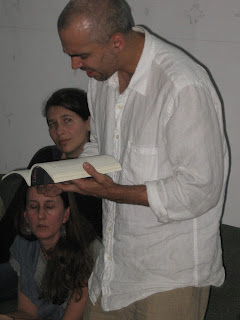 Ed Pavlic
 is Associate Professor of English and director of the UGA Creative Writing Program. He is also author of the book of poems,
Paraph of Bone & Other Kinds of Blue (The American Poetry Review/Copper Canyon Press, 2001), He was the winner of the American Poetry Review/ Honickman First Book Award and the Darwin Turner Award given by African American Review.
Call it in the airLast time I saw you on your feet
we climbed Mt. Shavano to have lunch
on the angel’s hip. Year by year step by step you led me
up past the line where trees grow past
the line where shrubs cling to rocks & you tell
south by the lichen. I hesitate when my lungs begin
to ache, lose a full step for your every two.
We pass the line where grizzlies plunder
pine cone stores of black cat-eared alpine
squirrels. Empty craters that smell of thin green
air. We’re into the zone of the all too recently disturbed
stones where grizzlies find moths that blow
in off the plains of Kansas and Nebraska
to mate in the rubble beyond the tree line.
I don’t want to know any of this, but I do. You do too
but could give a damn. I’m scared & can’t breathe.
I join the invisible crowd & turn back
& you’re bears be damned
on all fours now. I sit on a boulder & gasp
for air & I see you get smaller & smaller
& with each blink I can see
it clearly. You could care about the glacier
angel up the slope. I remember how
you used to tell me I made you safe because
when kidnappers came they’d take the youngest.
The boy. Now I’m bigger than you are, so,
here I am, bait. & there you are
on borrowed time you’re about to give back.
Your liver floating in the numbdark, curled up
like a peach pit on a hissing
radiator, eyes alight with the flamedark
torch in each pulse. & there you go,
a slow drip of Patrón & a whiff of nicotine
for lunch as you search for the line beyond
which elevation the lungs change
to birds & you can go on living without any body at all.