Showing posts with label Aurobindo. Show all posts

Thursday, September 25, 2008

The Fatal Seed


I have been re-reading Sri Aurobindo’s Savitri. I bought a copy to gift to a young friend, Anuradha, as a belated wedding gift. When I met Pratim in Kotagiri recently, he mentioned to me that Savitri had been translated into Bangla by his grandfather, Nolini Kanta Gupta, a close associate of Sri Aurobindo. Immediately I thought I must get the translation, that reading each line of the English original together with the Bangla translation would be a terrific advanced exercise in learning Bangla. Pratim also told me that his mother too had translated Savitri. I said he should try to get this published now.

I was reminded to send a copy of Savitri to my friend James, himself an accomplished poet. So I soon bought another copy for him, as well as a copy of the Bangla translation.

One has to search far and wide nowadays to hear fine Bangla spoken. The language has fallen into decay, thanks to a host of factors like the destruction of the public education system in the state of West Bengal by the party in power for 31 years, the vice-like grip over the mass media and publishing by a particular newspaper group, and the haughty contempt for learning characterising the people of this land, which was once seen to symbolise education and enlightenment. My friend Dr Mrinal Bose recently told me that this particular newspaper was akin to a mirror of the degradation of Bengali culture. So perhaps it will be in the pages of Savitri that I can fulfil my desire to hear refined Bangla.

Going through Savitri, I again tried to find a stand-alone extract that I could share with friends. So this time I found a section in Book 6, Canto 2 (“ The Way of Fate and the Problem of Pain ”). I have titled it “The Fatal Seed”.

A fatal seed was sown in life's false start
When evil twinned with good on earthly soil.
Then first appeared the malady of mind,
Its pang of thought, its quest for the aim of life.
It twisted into forms of good and ill
The frank simplicity of the animal's acts;
It turned the straight path hewn by the body's gods,
Followed the zigzag of the uncertain course
Of life that wanders seeking for its aim
In the pale starlight falling from thought's skies,
Its guides the unsure idea, the wavering will.
Lost was the instinct's safe identity
With the arrow-point of being's inmost sight,
Marred the sure steps of Nature's simple walk
And truth and freedom in the growing soul.
Out of some ageless innocence and peace,
Privilege of souls not yet betrayed to birth,
Cast down to suffer on this hard dangerous earth
Our life was born in pain and with a cry.
Although earth-nature welcomes heaven's breath
Inspiring Matter with the will to live,
A thousand ills assail the mortal's hours
And wear away the natural joy of life;
Our bodies are an engine cunningly made,
But for all its parts as cunningly are planned,
Contrived ingeniously with demon skill,
Its apt inevitable heritage
Of mortal danger and peculiar pain,
Its payment of the tax of Time and Fate,
Its way to suffer and its way to die.
This is the ransom of our high estate,
The sign and stamp of our humanity.
A grisly company of maladies
Come, licensed lodgers, into man's bodily house,
Purveyors of death and torturers of life.
In the malignant hollows of the world,
In its subconscient cavern-passages
Ambushed they lie waiting their hour to leap,
Surrounding with danger the sieged city of life:
Admitted into the citadel of man's days
They mine his force and maim or suddenly kill.
Ourselves within us lethal forces nurse;
We make of our own enemies our guests:
Out of their holes like beasts they creep and gnaw
The chords of the divine musician's lyre
Till frayed and thin the music dies away
Or crashing snaps with a last tragic note.
All that we are is like a fort beset:
All that we strive to be alters like a dream
In the grey sleep of Matter's ignorance.
Mind suffers lamed by the world's disharmony
And the unloveliness of human things.
A treasure misspent or cheaply, fruitlessly sold
In the bazaar of a blind destiny,
A gift of priceless value from Time's gods
Lost or mislaid in an uncaring world,
Life is a marvel missed, an art gone wry;
A seeker in a dark and obscure place,
An ill-armed warrior facing dreadful odds,
An imperfect worker given a baffling task,
An ignorant judge of problems Ignorance made,
Its heavenward flights reach closed and keyless gates,
Its glorious outbursts peter out in mire.
On Nature's gifts to man a curse was laid:
All walks inarmed by its own opposites,
Error is the comrade of our mortal thought
And falsehood lurks in the deep bosom of truth,
Sin poisons with its vivid flowers of joy
Or leaves a red scar burnt across the soul;
Virtue is a grey bondage and a gaol.
At every step is laid for us a snare.
Alien to reason and the spirit's light,
Our fount of action from a darkness wells;
In ignorance and nescience are our roots.
A growing register of calamities
Is the past's account, the future's book of Fate:
The centuries pile man's follies and man's crimes
Upon the countless crowd of Nature's ills;
As if the world's stone load was not enough,
A crop of miseries obstinately is sown
By his own hand in the furrows of the gods,
The vast increasing tragic harvest reaped
From old misdeeds buried by oblivious Time.
He walks by his own choice into Hell's trap;
This mortal creature is his own worst foe.
His science is an artificer of doom;
He ransacks earth for means to harm his kind;
He slays his happiness and others' good.
Nothing has he learned from Time and its history;
Even as of old in the raw youth of Time,
When Earth ignorant ran on the highways of Fate,
Old forms of evil cling to the world's soul:
War making nought the sweet smiling calm of life,
Battle and rapine, ruin and massacre
Are still the fierce pastimes of man's warring tribes;
An idiot hour destroys what centuries made,
His wanton rage or frenzied hate lays low
The beauty and greatness by his genius wrought
And the mighty output of a nation's toil.
All he has achieved he drags to the precipice.
His grandeur he turns to an epic of doom and fall;
His littleness crawls content through squalor and mud,
He calls heaven's retribution on his head
And wallows in his self-made misery.
A part author of the cosmic tragedy,
His will conspires with death and time and fate.
His brief appearance on the enigmaed earth
Ever recurs but brings no high result
To this wanderer through the aeon-rings of God
That shut his life in their vast longevity.
His soul's wide search and ever returning hopes
Pursue the useless orbit of their course
In a vain repetition of lost toils
Across a track of soon forgotten lives.
All is an episode in a meaningless tale.
Why is it all and wherefore are we here?
If to some being of eternal bliss
It is our spirit's destiny to return
Or some still impersonal height of endless calm,
Since That we are and out of That we came,
Whence rose the strange and sterile interlude
Lasting in vain through interminable Time?
Who willed to form or feign a universe
In the cold and endless emptiness of Space?
Or if these beings must be and their brief lives,
What need had the soul of ignorance and tears?
Whence rose the call for sorrow and for pain?
Or all came helplessly without a cause?
What power forced the immortal spirit to birth?
The eternal witness once of eternity,
A deathless sojourner mid transient scenes,
He camps in life's half-lit obscurity
Amid the debris of his thoughts and dreams.
Or who persuaded it to fall from bliss
And forfeit its immortal privilege?
Who laid on it the ceaseless will to live
A wanderer in this beautiful, sorrowful world,
And bear its load of joy and grief and love?
Or if no being watches the works of Time,
What hard impersonal Necessity
Compels the vain toil of brief living things?
A great Illusion then has built the stars.
But where then is the soul's security,
Its poise in this circling of unreal suns?
Or else it is a wanderer from its home
Who strayed into a blind alley of Time and chance
And finds no issue from a meaningless world.
Or where begins and ends Illusion's reign?
Perhaps the soul we feel is only a dream,
Eternal self a fiction sensed in trance.


Photo: Courtesy Rising Star Outreach.

Monday, July 31, 2006

Religion


For a long time now, I have been studying and reflecting on Religion (i.e. all religions), sensing the awesome, profound truths and edifying content of the scriptures of Judaism and Buddhism, the Gospel of Christ, Islam. Not as a 'scholar' but as a seeker. My attitude was to implicitly accept what I was reading, without question or critique, and to try to understand what was written.

Also the sacred texts of the faith I was born into, 'Hindu', like The Upanishads. Thus, for instance, I felt the Srimad Bhagavat - was a scientific treatise on the origin, creation and evolution of the universe.

Advanced human life (of the mind, of spirit) is far more ancient than the western world believes, much has happened which is entirely unknown today, but with clues lying around for those who wish to know and observe.

Exchanges - commerce of soul - have taken place between peoples and cultures from ancient times, exhibiting a sweetness of intercourse incomparable to anything in contemporary life. So much of the wealth of 'secular' (i.e. non-religious) life - is the fruit of spiritual fabrication over millenia. Ordinary life is impregnated with the sacred. Everything around us - is sacred.

I don't like to use the terms 'Hindu' or 'Hinduism' - since that is etymologically and otherwise meaningless. Just like harmonising the 'scientific' and 'spiritual', there is the challenge of harmonising the spiritual and social aspects, retaining spiritual inspiration while working to analyse social mores (with their pseudo-religious trappings).

'Reading Temples', for instance, or 'Reading Ritual' - could be themes for projects, to prepare curricula and learning modules for school students.

Karl Marx wrote: "I hate the whole pack of gods in their heavens..." That was perhaps a more fundamentally spiritual articulation, than all the pious hypocrisies of the so-called religious-minded! If only Dr Marx had actually visited India and lived and travelled here - its interesting to imagine the transformations he might have undergone, from the over-conditioning of Europe. Extraordinary scrutiniser that he was - unfortunately he did not get down to scrutinising the very notion of what is human, which he simply received and swallowed lock, stock and barrel, from his culture, overemphasising the 'material', the 'rational' and the 'economic'.

Bringing up, 'educating' and sensitising future generations properly – is the simple solution to all the sufferings plaguing the world. And here, its as much a question of what not to do, as of what to do. What needs to be done – is simply to follow nature, and the human being's fundamental nature. But centuries of obfuscation have taken their toll...

I had written earlier about Sri Aurobindo's view that "all problems of existence are essentially problems of harmony". And the primary means for achieving harmony is the human personality.

Thinking about Darwin - some years ago, it struck me that while he had worked on the Evolution of the Species - what about the evolution of the human personality (in the image of the Maker)? Study of animal BEHAVIOUR and social life would give powerful leads. Lord Buddha's Jataka Tales - may be seen as a study of evolution of the human personality. In human form and guise, the world is actually full of animals of different kinds. But where is MAN?! The purpose of life on earth - is the realisation of the human personality. Love, knowledge and action (in their most profound sense) – are the three means for the perfection of personality.

Wednesday, July 12, 2006

Harmony


On Shakespeare Sarani in Calcutta, opposite where the British Council was earlier located, is the Sri Aurobindo centre. A large sign-board over the pavement in front of the centre displays a quote from Sri Aurobindo. For a long time, this said:

All problems of existence are essentially problems of harmony.

I don’t suppose one could get any deeper or more profound than that! As if, if there was just one thing to say to about life, then this is it.

Harmony – ultimately it’s a question of whether one wishes for harmony; so that, whatever else may happen or not happen, one can go on putting the onus of harmony on oneself. Harmony within, and harmony externally, until one’s whole being is simply harmony.

And of course there are those who choose to remain content with disharmony. This morning I received a mail from a gentlemen who wrote:

“Lack of freedom (and consequently lack of markets) is (a) policy that impedes development and causes poverty. The other is uncontrolled breeding - the balance between resources and people is what causes poverty. Until markets and a more sane attitude towards uncontrolled breeding is taken, I am afraid that all efforts towards poverty alleviation would be futzing around in the margins.”

It saddened me to read this. Because my study, work, experience and relations with those in poverty all say something else; and because the statement also says a lot about the person saying it – about his disharmony, which never fails to make me shudder and despair.

I have learnt the value of silence, and so instead of engaging in an argument, I prefer to remain quiet. What one thinks or says – really does not make any difference to the truth. The question is whether one has an aspiration for truth – rather than a desire to assert oneself, unmindful of what is obscured in one’s perception. The question is whether one reaches truth, as being. And when one does know truth, then one becomes silent, and the heart beats quietly, with compassion.

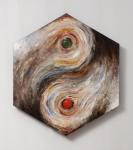
Painting: Harmony, abstract art hexagon oil painting, by Curtis Verdun

Sri Aurobindo & Savitri

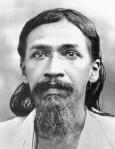
Thinker, spiritual leader, mystic, poet and nationalist, Sri Aurobindo (1872-1950) was perhaps modern India’s most fascinating and enigmatic leader. Educated in Cambridge, where he was a brilliant Classics scholar, he refused a career in the civil service and returned home to India to become a fiery revolutionary. In jail, where he was imprisoned for sedition, Sri Aurobindo turned to meditation and, finding refuge in the French enclave of Pondicherry, perfected there the practice of yoga. His ashram in Pondicherry continues today, with a large international following.
Sri Aurobindo was a prolific writer in English, and his writings cover spiritual discourse, philosophy, cultural history, poetry, linguistics and literary criticism.”

In 1915, he began work on an epic poem, that would occupy him for the remaining thirty five years of his life. The subject of the poem was the love story of Savitri and Satyavan. Eventually, Savitri became a poetic chronicle of his yoga, of equal importance in the corpus of his works to The Life Divine, or The Synthesis of Yoga. It was, moreover, not merely a record of his sadhana (quest), but a part of it. “I used Savitri as a means of ascension”, he wrote in a letter in 1936. “In fact Savitri has not been regarded by me as a poem to be written and finished, but as a field of experimentation to see how far poetry could be written from one’s own yogic consciousness and how that could be made creative.”

The composition of Savitri was an endeavour to come in contact with the ‘overhead planes’ that are the native home of the mantra, and to give body to the language and vision of those planes in revelatory speech.

In its final form, published in two volumes in 1950 and (posthumously) in 1951, Savitri extends to almost 24,000 lines. In Sri Aurobindo’s telling of the story, the girl Savitri, granted as a boon to the childless sage Aswapathy, is regarded as an incarnation of the Divine Mother. Aswapathy is a yogin aspiring ‘for a universal realisation and a new creation’. His upward quest is a metaphor for the process of ‘ascent’ in yoga. Sri Aurobindo’s poetical description of the realms through which Aswapathy must pass constitutes his most detailed account of the geography of the inner worlds.

But he did not create Savitri simply as a chart for the use of future explorers. He meant it as a rhythmical embodiment of his experiences that could awaken sympathetic vibrations in those who read it.

Extracted from Peter Heehs, Sri Aurobindo: A Brief Biography.

Earth’s aspiration


Sri Aurobindo remained hopeful about a poetry that would be more than merely literary output, even though his own work was often criticised.

Here's an extract from Savitri (Book 1, Canto 4). I have titled it "Earth’s aspiration".


… An aspiration in the Night’s profound,
Seed of a perishing body and half-lit mind,
Uplifts its lonely tongue of conscious fire
Towards an undying Light forever lost.
Only it hears, sole echo of its call,
The dim reply in man’s unknowing heart
And meets, not understanding why it came
Or for what reason is the suffering here,
God’s sanction to the paradox of life
And the riddle of the immortal birth in Time.
Along a path of aeons serpentine
In the coiled blackness of her nescient course
The Earth-Goddess toils across the sands of Time.
A Being is in her whom she hopes to know,
A Word speaks to her heart she cannot hear,
A Fate compels whose form she cannot see.
In her unconscious orbit through the Void
Out of her mindless depths she strives to rise,
A perilous life her gain, a struggling joy;
A Thought that can conceive but hardly knows
Arises slowly in her and creates
The idea, the speech that labels more than it lights;
A trembling gladness that is less than bliss
Invades from all this beauty that must die.
Alarmed by the sorrow dragging at her feet
And conscious of the high things not yet won,
Ever she nurses in her sleepless breast
An inward urge that takes from her rest and peace.
Ignorant and weary and invincible
She seeks through the soul’s war and quivering pain
The pure perfection her marred nature needs,
A breath of Godhead on her stone and mire.
A faith she craves that can survive defeat,
The sureness of a love that knows not death,
The radiance of a truth for ever sure.
A light grows in her, she assumes a voice,
Her state she learns to read and the act she has done,
But the one needed truth eludes her grasp,
Herself and all of which she is the sign.
An inarticulate whisper drives her steps
Óf which she feels the force but not the sense;
A few rare intimations come as guides,
Immense divining flashes cleave her brain,
And sometimes in her hours of dream and muse
The truth that she has missed looks out on her
As if far off and yet within her soul.
A change comes near that flees from her surmise
And, ever postponed, compels attempt and hope,
Yet seems too great for mortal hope to dare.
A vision meets her of supernal Powers
That draw her as if mighty kinsmen lost
Approaching with estranged great luminous gaze.
Then is she moved to all that she is not
And stretches arms to what was never hers.
Outstretching arms to the unconscious Void,
Passionate she prays to invisible forms of Gods
Soliciting from dumb Fate and toiling Time
What most she needs, what most exceeds her scope,
A Mind unvisited by illusion’s gleams,
A Will expressive of soul’s deity,
A Strength not forced to stumble by its speed,
A Joy that drags not sorrow as its shade.
For these she yearns and feels them destined hers:
Heaven’s privilege she claims as her own right.
Just is her claim the all-witnessing Gods approve,
Clear in a greater light than reason owns:
Our intuitions are its title deeds;
Our souls accept what our blind thoughts refuse.
Earth’s winged chimeras are Truth’s steeds in Heaven,
The impossible God’s sign of things to be.

Rumi and poetry

Sri Aurobindo’s optimism about poetry may be contrasted with the scepticism of Maulana Jalaludddin Rumi (1207-73), the great Persian poet, philosopher, sage, mystic and Sufi master. And the reaction of ‘literary critics’ to Aurobindo’s work may help us to understand Rumi’s attitude.

The Mathnawi-i- Manawi (Spiritual Couplets) is considered Rumi’s masterwork – six books of poetry and imagery of such power in the original that, according to Sufi writers, its recitation produces a strangely complex exaltation of the hearer’s consciousness. Prof Arberry calls Rumi the greatest mystical poet in the history of mankind. But while excelling in literary and poetic ability beyond all his contemporaries, Rumi constantly affirmed that such an attainment was a minor one compared with Sufihood. He often claimed not to be a poet at all.

What is poetry that I should boast of it,
I possess an art other than the art of the poets.
Poetry is like a black cloud; I am like the moon hidden behind its veil.
Do not call the black cloud the luminous moon in the sky.


Poetry was only a secondary product. He did not regard it as any more than a reflection of the enormous inner reality which was truth, and which he calls love. The greatest love, as he says, is silent and cannot be expressed in words. Although his poetry was to affect men’s minds in a way that can only be called magical, he was never carried away by it to the extent of identifying it with the far greater being of which it was a lesser expression. At the same time, he recognised it as something which could form a bridge between what he ‘really felt’ and what he could do for others.

Rumi assumed the role of critic of poetry. People come to him, he says, and he loves them. In order to give them something to understand, he gives them poetry. But poetry is for them, not for him, however great a poet he may be – “What, after all, is my concern with poetry?” He states categorically that in comparison with the true reality, he has no time for poetry. This is the only nutrition, he says, that his visitors can accept, “so like a good host he provides it.”

The Sufi must never allow anything to stand as a barrier between what he is teaching and those who are learning it. Hence Rumi’s insistence upon the subsidiary role of poetry in the perspective of the real quest. What he had to communicate was beyond poetry. To a mind conditioned to the belief that there is nothing more sublime than poetic expression, such a feeling might produce a sense of shock. It is just this application of impact that is necessary to the Sufi cause, in the freeing of the mind from attachment to secondary phenomena, “idols”.


Ref: Idries Shah, The Sufis, and S H Nasr, Islamic Art and Spirituality.

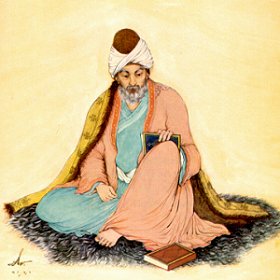
Miniature painting of Rumi by Hossein Behzad