Showing posts with label MP3. Show all posts

Wednesday, May 30, 2007

Cuckoos and their calls

I first came under the spell of cuckoo calls 35 years ago, when I was at school in the RIMC in Dehradun. With the onset of late spring-early summer, the loud, piercing calls of a variety of cuckoos resonated through the verdant school campus. Three distinct calls were imprinted in my memory, and especially one of them, my favourite, which had a hypnotic effect on me.

Through my five years in RIMC, April-May was indelibly associated in my memory with these bird calls. But I never spotted the birds.

I knew nothing about birds then (or now). I assumed the “coo-ooh” must be a cuckoo’s call, though I had never seen one. It was only a few years ago that I managed to spot a cuckoo calling, perched high and hidden on a tree. I later learnt that this was the Asian Koel. (Koel, or koyal or kukil are among the Indian names for the bird.)

Here is a picture of the Asian Koel.


Its call can be heard here.

Many years after passing out from the school, I began revisiting RIMC. And each time I partook of the bird calls. I tried my best to spot the particular bird whose call enthralled me, but it was always too high up on a tall tree, and never visible.

Last week I was at the RIMC again, to attend the centenary celebrations of Hugh Catchpole, a former Master and Principal of the school. (Pictures from the Catchpole centenary celebrations are accessible here.) Almost immediately after I reached the school, I heard my favourite bird call. And following the sound, my son Rishiraj and I spotted the bird, in silhouette, perched at the very top of a tree. So now I had a clue and could try to find out what bird it was.

And thus did I come to know that this was the Indian Cuckoo.

Here is a picture.


Its call can be heard here.

The bird is known locally in Uttarakhand as "Ka Phal Pa-kyo", based on its four-syllable note, which announces that the wild Ka fruit (a fig) is ripe. The same bird is known as “Bau-Kotha-Kou Pakhi” in Bangladesh and West Bengal. (The Bengali song "Ei udaashi haowaay pothey pothey mukulguli jhorey" by Rabindranath Tagore, refers to the cukoo's call by this name. See song no. 223 here.) Again, based on its call, which is here interpreted as the anguished cry of a bereaved husband, asking his still wife to say something.

And I learnt about the Common Hawk Cuckoo, also known as the Brainfever bird (for its call).

Here is a picture.


Its call can be heard here.

So it was a culmination of sorts for me, at the very site of the beginning.

Meanwhile, I had of course started this blog, with its title inspired by the Buddhist tale, The Prince who became a Cuckoo. That was a spur-of-the-moment decision. But it is most apt. I can’t have enough of cuckoos’ calls, and especially that of the Indian Cuckoo.

Saturday, May 12, 2007

Friends of the Poor


I have written earlier about St Francis of Assisi. In the last week I managed to learn an Italian song based on St Francis’ "Canticle of Brother Sun".

St Francis of Assisi is the patron saint of the environmental movement. The Canticle is a beautiful statement of his credo, of the one-ness of all life and creation, united in St Francis' perception as expressions of the immense love of the Almighty.

But above all, St Francis lived a very simple life, of poverty – he married Lady Poverty. And he maintained Chastity to Poverty. Hence he was unfailingly one with the poor and suffering.

"Blessed are the poor in spirit: for theirs is the kingdom of heaven."

Gospel of St. Matthew , Sermon on the Mount, 5:3.

So St Francis of Assisi should actually be counted as the First in the procession of Friends of the Poor.

The world might advance in knowledge, in technology, in feats of wealth, in art and aesthetics and metaphysics … but it will remain hollow at the core, and fundamentally bereft spiritually and morally as long as poverty casts a shadow on humankind. But in order to do anything that can impact positively on the lives of the poor, one’s heart must not merely bleed for, but with the poor.

Whatever may be said about Mother Teresa of Calcutta, she too was unfailingly one with the poor, and the poor above anybody else. Abbe Pierre, who passed away recently, was another contemporary exemplar of this.

Image: El Greco, Saint Francis in Prayer.

Wednesday, April 11, 2007

Tariq Ramadan interview

Owing to a link error with this post, I am re-posting it, deleting the earlier one.


Tariq Ramadan, president of European Muslim Network and Research Fellow, European Studies Centre and Middle East Centre, St. Anthony's College, Oxford University, was interviewed by Ian Buruma, author of Murder in Amsterdam: The Death of Theo Van Gogh and the Limits of Tolerance, and Henry R. Luce Professor of Democracy, Human Rights & Journalism at Bard College, NY, at the Salzburg Seminar Session on "Immigration and Inclusion: Rethinking National Identity", in March 2007.

Download / listen to the interview here.

JP has also written about issues of identity, socio-economics, democracy, freedom and communication here.

Friday, March 16, 2007

The Last Post


An important event during the Rimcollians' reunion at the RIMC in Dehradun is the wreath-laying ceremony at the War Memorial in the school. This honours all the Old Boys who made the supreme sacrifice, of their lives, during battle. The list of names on the War Memorial begins from the Second World War, and continues to the present (in anti-insurgency operations).

The wreath-laying by a senior Old Boy, to the playing of the Last Post by buglers is a sombre and unfailingly moving experience for all the Old Boys present. Being back in school during the reunion, everyone is joyously transported to their childhood. But the War Memorial ceremony, and the Last Post, remind us that some others with similar happy children's laughter were suddenly snatched away, by the very heroism inculcated by the school. There is pin-drop silence, its as if even the leaves on the trees are still.

The 'Last Post' bugle call is used at military funerals, memorials and times of Remembrance. It symbolises the 'end of the soldier's day' in so far as the dead soldier has finished his duty and can rest in peace.

Hear / download the Last Post here.

Abide with me


Get this widget | Share | Track details


Speaking of military tunes, another sombre melody that I love to hear - which is also played by military bands in England and India - is Abide with me. Written by Henry Lyte, of England, in 1847, it is inspired by Luke 24:29, where the disciples who were traveling to Emmaus asked Jesus to "abide with us, for it is evening and day is almost spent."

Abide with me is an evening hymn. Its word pictures are taken from the experience of the passing day: falling eventide, deepening darkness, growing dimness, and fading glories. In that, it can also be an introspective of the end of life.

But this is also a prayer for living life now. This hymn reminds us to plead with our Lord to abide with us. Stay with us. Be there unchanging when all around us changes. Through cloud and sunshine, abide. "In life and death, O Lord, abide with me."

Mahatma Gandhi loved to hear Abide with me.

Click on the image above to read the lyrics / music.

Hear / download Abide with me here.

Monday, March 05, 2007

Jessore Road


Samran pointed me to a video on YouTube of Bangla singer Moushumi Bhowmick’s song Jessore Road.

I first heard this at a concert of Moushumi’s in Calcutta two years ago, with her group Parapar. The song is inspired by Allen Ginsberg’s long poem September on Jessore Road.

Millions of babies watching the skies
Bellies swollen, with big round eyes
On Jessore Road - long bamboo huts
Noplace to shit but sand channel ruts

Millions of fathers in rain
Millions of mothers in pain
Millions of brothers in woe
Millions of sisters nowhere to go …


An audio recitation of the poem by Allen Ginsberg is accessible here.

The lyrics of Moushumi's song:

Shoto shoto chokh akashta daekhe
Shoto shoto shoto manusher dol
Joshor road-er du'dhaare boshot
Bansher chhauni, kadamaatijol

Kadamati makha manusher dol
Gadagadi hoye akashta daekhe
Akashe boshot maura ishwar
Naalish janabe ora bolo kaake?

Gharheen ora, ghum nei chokhe
Juddhe chhinno ghar-bari-desh
Mathar bhitore bomaaru bimaan
Ei kaalo raat kobe hobe shesh?

Shoto shoto mukhe haay ekattor
Joshor road je koto katha bole
Ato maura mukh, aadhmaura paaye
Purbo Bangla Kolkata chole

Shomoy cholechhe raajpath dhore
Joshor Roadete manush michhil
September, haay ekattor
Goru gari kada, rasta pichhil

Lokkho manush bhaat cheye moray
Lokkho manush shoke bhese jaay
Gharheen bhashe shoto shoto lok
Lokkho janani paagoler praay

Refugee ghare khide-paoa shishu
Petgulo shob phule phenpe othe
Eituku shishu ato boro chokh
Dishehara ma kaar kachhe chhote?

September, haay ekattor
Ato ato shudhu masher mukh
Juddho mrityu tobuo shopno
Phashaler maath phele asha shukh

Kaar kachhe boli bhaat-ruti katha
Kaake boli koro koro koro traan
Kaake boli ogo mrityu thamao
Moray jaoa buke ene dao praan

Kando kando tumi manusher dol
Tomar shorir khoto diye dhaka
Jananir kole aadhpeta shishu
E kemon bancha, benche moray thaka?

Chhoto chhoto tumi manusher dol
Tomar ghareo mrityur chhaya
Gulite chhinno deho-mon-maati
Ghar chhere chhoto maati michhe maya.

September, haay ekattor
Ghar bhenge gechhe juddher jhore
Joshor Road-er du'dhaare manush
Ato ato lok, shudhu keno moray?

The third and fourth stanzas of Moushumi’s version (the concluding lines in the video clip) in my poor translation:

They are homeless, their eyes sleepless,
Shelter-Home-Nation wiped out by war,
Bomber planes inside their heads.
When will this black night come to an end?

Hundreds and hundreds of faces, O ’71!
Jessore Road tells so many tales!
So many dead faces on half-dead feet,
East Bengal walks to Calcutta.


The tragedy of East Bengal in 1971, leading to the formation of Bangladesh – I was a 11-year old in Calcutta then. In the summer of 1971, my aunt Indu, a physician in London, had come as a volunteer doctor to work in the refugee camps near Calcutta. Such devastation nearby and such a sea of humanity converging in and around Calcutta. I will never forget, and that tragedy binds together the hearts of people of Bengal across the two sides of the border.

Get this widget | Share | Track details

Thursday, March 01, 2007

The multifarious word

Here is an Indian professor's patient elaboration of all the various usages and meanings of a particular word.

It is hilarious!

Get this widget | Share | Track details

Download the MP3 here.

Thursday, October 19, 2006

Cuckoo's call!

I was searching on the net yesterday evening - for bird songs.

I found there are quite a few resources on this, and was I delighted!

Check this out.

And this.

And this.

What an awesome work of devotion, to record bird songs, and then make this available to people across the world, free, through the internet.

Life is beautiful!

So I am able to attach a sound clip of the cuckoo (Asian koel) here. Do hear this dear friends!

Wednesday, October 04, 2006

The Canticle of Brother Sun


Song, music, and poetry were so deeply a part of the nature of Saint Francis that in times of sorrow and sickness as well as of joy and good health he spontaneously gave voice in song to his feelings, his inspirations, and his prayers.

The clearest expression of this aspect of the personality of the Poverello is the "Canticle of Brother Sun".

G. K. Chesterton, in his reflections on the saint, wrote of this work: "It is a supremely characteristic work and much of Saint Francis could be reconstructed from that work alone."

And Eloi Leclercq has written: "The manner in which Francis here looks at the created world is a key to his inner self, for the Canticle undoubtedly has elements that reveal in a special way the personality of its author."
The most characteristic Franciscan contribution to poetry and music is found in a body of informal spontaneous hymns called laudi spirituali - songs of praise or, simply, "lauds" -traceable directly to St. Francis and his immediate circle. The practice of spontaneous hymn singing continued from his time onward and in the 14th century was firmly established as the most popular form of religious music.

In music, as in his religious work, St. Francis drew together the sacred, courtly, and popular traditions. The lauds were thus a poetic bridge between the traditional music of the Church, the music of the castle, and the music of the streets. The words always had a religious theme; often they were mere paraphrases of psalms and litanies sung to popular airs, but, above all, they were music and poetry that the people could both sing and feel with their hearts.

The lauds were folk-like in spirit, simple and direct in their appeal, and sung either as solos or jointly with others in unison. The lauds became the special and characteristic expression of the Franciscans.

The Canticle of the Sun (or The Canticle of the Creatures), known definitely to be by St. Francis, is at once the most sublime of all the lauds as well as the most original. The legend goes that when St. Francis was recovering from an illness in a hut outside the convent of St. Clare, the nuns heard from his lips this rapturous new song. The informality, even casualness, of its composition and its rambling rhythms and rhymes make it as simple and unaffected in its form as the Umbrian dialect in which it is written. It is thus characteristically opposed to the canons of scholarly Latin on one hand and to the erotic courtly utterances of the troubadours on the other. Sincerity and deep human feeling dominate the unequal strophes of St. Francis' songs of praise, rather than any attempt at learned communication or poetic elegance.


The text of the Canticle in the original Italian (Umbrian), together with a recitation of this (MP3) is available here.

In translation:


Most High, all-powerful, good Lord,
Yours are the praises, the glory, the honor, and all blessing.
To You alone, Most High, do they belong,
and no man is worthy to mention Your name.

Praised be You, my Lord, with all your creatures,
especially Sir Brother Sun,
Who is the day and through whom You give us light.
And he is beautiful and radiant with great splendor;
and bears a likeness of You, Most High One.

Praised be You, my Lord, through Sister Moon and the stars,
in heaven You formed them clear and precious and beautiful.

Praised be You, my Lord, through Brother Wind,
and through the air, cloudy and serene, and every kind of weather
through which You give sustenance to Your creatures.

Praised be You, my Lord, through Sister Water,
which is very useful and humble and precious and chaste.

Praised be You, my Lord, through Brother Fire,
through whom You light the night
and he is beautiful and playful and robust and strong.

Praised be You, my Lord, through our Sister Mother Earth,
who sustains and governs us,
and who produces varied fruits with colored flowers and herbs.

Praised be You, my Lord, through those who give pardon for Your love
and bear infirmity and tribulation.
Blessed are those who endure in peace
for by You, Most High, they shall be crowned.

Praised be You, my Lord, through our Sister Bodily Death,
from whom no living man can escape.
Woe to those who die in mortal sin.
Blessed are those whom death will find in Your most holy will,
for the second death shall do them no harm.

Praise and bless my Lord and give Him thanks
and serve Him with great humility.


Here's a clip from Franco Zeffirelli's Brother Sun, Sister Moon (1972), with Donovan singing a song based on the Canticle.

Another interesting video-clip of a song in Italian, sung by Claudio Baglioni to the musical score of Riz Ortolani, from the Italian version of the same film, titled Fratello Sole, Sorella Luna, based on the Canticle is shared below.


Reference: Websites of Franciscan Friars and the University of Massachusetts Lowell.

Saturday, September 30, 2006

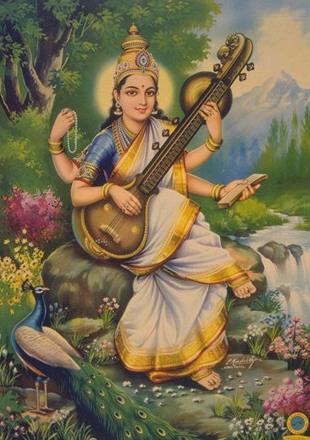
Devi Saraswati


Tomorrow is Saraswati Puja, for (Hindu) south Indians.

Saraswati literally means “one who gives the essence (sara) of our own Self (swa).” She sits on a swan, and carries a veena (a string instrument).

Puja, as I have explained earlier, means worship, with flower offerings.

Devi Saraswati is the Mother of Learning.

Music is the highest art, the distilled essence of all knowledge, which is self-knowledge. Self-effacing devotion, expressed in heart's melody, in a prayer to Devi Saraswati, is accompanied by Divine vision.

In Carnatic music (i.e. the south Indian classical tradition), one of the first songs learnt is “Varaveena”, a prayer, in Sanskrit, a song of adoration, to Saraswati, composed by Appaya Dikshitar (1554-1626), a scholar, sage and saint.


Varaveena mrudu paani
Vanaruha lochana raani
Suruchira bambhara veni

Suranutha kalyaani
Nirupama shubha guna lola

Nirathi jaya prada sheela
Varadaapriya ranganaayaki

Vaanchita phala daayaki
Saraseejaasana janani
Jaya jaya jaya


You hold the divine veena in your soft hands.
You are the queen of the omniscient. Your eyes are like the lotus petals.
Your curly tresses resemble the bees.
Devas worship your auspicious form.
You have unequalled virtuous qualities.
You give endless victory.
You are the munificent consort of the Beautiful Lord.
You grant boons to the deprived.
O Mother of lotus-seated Creator!
Victory to you!


This song is set in Mohanam raga, which is Bhopali raga in the Hindusthani or north Indian classical system.

Shivkumar Kalyanaraman is a professor of computer science in the USA. His website is also a treasure trove of resources on Carnatic music. He has provided the musical notations for this song, as well as an MP3 recording of a teaching of this song.

Thank you Shivkumar, and may Mother Saraswati’s blessings be always with you.

Another rich site is karnATik.

My mother is away in Bombay, otherwise she would have organised the Puja at home, with an offering of sweet and savoury rice, and the placing of books (of students in the house) before the image of Saraswati.

My younger son Rishiraj (aka Chotu), 11, was the last to religiously place all his school books in front of the image at home. This is a day on which there must be no studying! Great for kids at home during vacations! Chotu's in boarding school now, with his brother Rituraj, 15.

My mother will be doing the Puja at her sister’s, in Bombay.

Hence it will only be an 'inner' observation for me. I observed Saraswati Puja by:

conveying my heartfelt good wishes to -

JP, a college-mate and fellow Tamil-ian & Calcuttan (in which fact I take particular pride right now, as JP has recently become the CIO, Global Services, of British Telecom);

Achinto, photographer, with whom I had been out of touch for a long time; and

Dipali, painter, designer, art teacher and friend, and Saraswati incarnate.

Tuesday, September 12, 2006

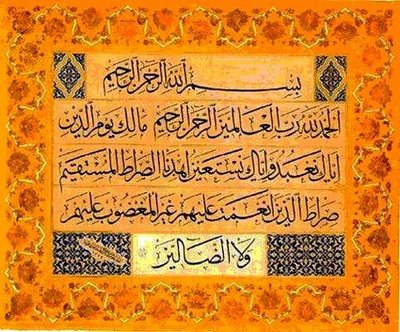
The Fatiha


Bismillah ar Rahman ar Rahim!

Al Hamdu lil Laahe Rabbil Aalameen
Ar Rahmaan ar Rahim
Maaliki yaum id din
Ya quanah budo
Wahiya khanastaiin
Ih dinah as siraat al mustaquiim
Siraat al lazina
An amteh ilaihiim gaiiril madhdubi
Al aiihim waladdu aaleen

Aameen!


Hear / download the Surah Al-Fatiha here (WMA)

Hear / download the Fatiha here (MP3).

The Opening

In the name of God, the Compassionate, the Merciful!

All praise belongs to God alone
Lord of all worlds,
The Compassionate, the Merciful,
Ruler of the Day of Judgement.
It is You that we worship
And to You we appeal for help.
Show us the straight way,
The way of those You have graced,
Not of those on whom is Your wrath,
Nor of those who wander astray.

Amen

Get this widget | Share | Track details

Singing the Fatiha


Among followers of the Islamic faith, any good task, any auspicious occasion, is marked by the recitation of the Fatiha. The Fatiha is considered the distilled essence of the whole Koran. When we inaugrated our office-community centre in PM Basti in early 1998, as we were amidst and working with a Muslim community, we organised a Fatiha recitation ceremony.

After the Talimi Haq School was started in 1998 in Priya Manna Basti, Howrah, the teachers began the classes every afternoon with the students standing and reciting the Surah Fatiha, or the first chapter of the Koran, whose title means “the opening”.

With the daily recitation of the Fatiha, the phonetic sounds were instilled in my mind. When I was in Jerusalem in late 1998, hearing Arabic spoken around me, I remembered the Fatiha and was eager to know what exactly this meant. When I visited my friend Prof Marwan Haddad in Nablus, he gave me a set of children’s Islamic education CDs for our Talimi Haq School.

Back in India, I began listening to one CD in particular, which taught the correct pronunciation and recitation style of several verses from the Koran. I listened to the Fatiha, again and again and again, until I knew it thoroughly and had mastered it. I also referred to the English translation and internalised the meaning of each word, so that it could be expressed in a manner that conveyed the meaning and tone of this verse.

Some years earlier, I had set to melody a traditional Hindu prayer (in Sanskrit) to Ganesa, the Lord of Obstacles. In Hindu custom, any good task, any auspicious occasion, is marked by the recitation of a prayer to Lord Ganesa. So after I had learnt the Fatiha, I sought to fit this to that same melody. I felt there was an underlying oneness in the conception, intent and meaning of the prayer to Ganesa and the Fatiha. I was soon able to render the Fatiha in this melody.

Visiting Jerusalem again in early 2003, I met another friend, Omar Youssef, an architect-planner. Omar is also an accomplished player of the oud, a Middle Eastern string instrument. So Omar and I shared our music and songs. He also took me meet his friends at the Naqleh Esheber centre in Beit Hanina. This is a well-known organization involved in social communication with youth. Naqleh Eshaber is an animated character created by them for their programmes on social and environmental themes; he is thumb-sized, but with a heart as large as the heavens!

As someone born in a Hindu family and now adhering to no particular faith, I was a bit wary about singing the Fatiha in front of practicing Muslims in the Middle East. But their response was very positive! I was overjoyed!

Before I returned home, I visited the Naqleh Esheber centre again with Omar. This time there was also a group of teen boys and girls, and I shared my Fatiha composition with them; once again, with very positive response.

Listening to Omar’s accompaniment on the oud – I got a completely new turn to my melody, and this was resonating in my head.

When I returned to Calcutta – I learnt that a close friend, Dayan, had been killed in a car crash. I was devastated. Before I had left, Dayan had helped me to record some of my songs, including the Fatiha. We were supposed to do a final version. But that was not to be.

Dayan had shared my Fatiha song with his parents (his father is Shia, mother Sunni). So when I went to visit them they asked me to sing this. After the new turn given by Omar’s oud, and now this tragic setting: my melody took a further new turn. The grief-stricken heart plaintively submits to the dictates of the Almighty.

I sang the Fatiha at Dayan’s memorial gathering.

In 2005, I sang the Fatiha for Imam Muhammad Ashafa, from Nigeria. He told me he was an examiner of students in Islamic seminaries, and said he would give me 88 out of 100 for my recitation! And after hearing me sing the Fatiha at the Talimi Haq School in February 2007, blogger Sadiq wrote: "... when you were reciting the Fatiha, I was crying. ... that's the best i have ever heard in my entire life."

Hear / download the Surah Al-Fatiha here (WMA):

Hear / download the Fatiha here (MP3).

Get this widget | Share | Track details

Thursday, August 17, 2006

Independence Day


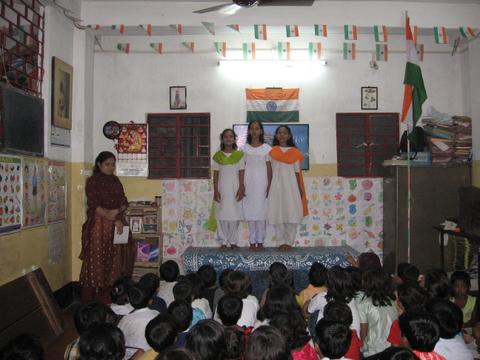
Yesterday, 15 August, was India’s Independence Day, a national holiday. Our Talimi Haq School in Howrah celebrated this with a flag-hoisting and a programme put up by the children and teachers. I attended that.

I was glad I went there. I was very happy to hear all the songs sung by the children, and teachers too. All were moving, rousing patriotic songs, full of meaning and messages. A small boy had learnt the Sanskrit song / prayer Vande Mataram (Hail Motherland) which he rendered perfectly. The songs were all sung very tunefully and with feeling. I was really impressed.

I felt a lot of satisfaction seeing my own dreams come true, notwithstanding years of gruelling failure. I used to sing and teach my songs when the school had been started in 1998. I felt that the beautiful India the songs were adoring was present right here in the two rooms of Talimi Haq School. The future of India depended on these children, and the songs were also exhorting them to walk well and wisely for India.

I was asked to say something in conclusion. I said anything I might want to say has already been said in the songs. 15 August is important for us because it is about freedom which came after long struggles and sacrifices by valiant people. And through that struggle something beautiful was envisioned and the seeds of that were sown– an India which is plural, secular, democratic, wise, just and compassionate. This – here, inside this room – is the India they dreamt of. And as we walk well, wisely and virtuously, so shall India.

I complimented the singers. I referred to the azaan – the call to prayer of the muezzin, from the mosque (which had interrupted our programme briefly). It had been really melodious. I mentioned Bilal, Prophet Mohammed’s companion, whom he had asked to sing the call to prayer because of his beautiful voice. Singing is the greatest skill, its what touches and moves people. So your aspiration for singing, and the effort to sing well – makes me very happy.

Finally, I explained something about the Surah Fatiha, the opening chapter of the Holy Koran, and sang it, thrice, each time in a different style, to convey the depth and range of meaning and feeling contained in this.

Hear / download the Surah Al-Fatiha here (WMA).

Hear / download the Fatiha here (MP3).

Get this widget | Share | Track details


Thus concluded Talimi Haq School’s celebration of Independence Day 2006!