Showing posts with label Subimal Misra. Show all posts

Wednesday, July 21, 2010

The book is out!


The Golden Gandhi Statue from America: Early Stories, by Subimal Misra, translated by V Ramaswamy, Harper Perennial, an imprint of HarperCollins Publishers India, 2010. Price: Rs 199.

The collection includes fifteen stories, written by Subimal Misra during 1968-73, a turbulent period in the history of Calcutta and West Bengal.

Review in New Indian Express, Chennai.

Review in The Statesman, Calcutta

Review in The Telegraph, Calcutta.

Review in Afternoon Despatch & Courier, Mumbai.

2nd review in Afternoon Despatch & Courier.

Review in Times of India.

Review in the blog Jabberwock.

Review in the blog Writers Read.

Review in the e-zine Muse India.

Review by a blogger.

Review in The Book Review.

Subimal Misra interview in Tehelka.

Arunava Sinha's comment.

My deepest thanks to everyone who made this book possible.

The book can be purchased online and from leading bookshops in the metro cities (of India).

The project to translate the short fiction of Subimal Misra continues.

Thursday, April 26, 2007

P Lal


I have written about Sasthi Brata, and Subimal Misra. But it was remiss of me not to have expressed my reverence for Purushottam Lal. Born in 1929, P Lal is a teacher, literature scholar, poet, writer, trans-creator, publisher, editor and book-maker, who made Calcutta his home.

Writers Workshop, started by P Lal in 1958, has published over 3,000 titles.

“Alternative publishing is desperately needed whenever commercial publication rules. WW is not a professional publishing house. It does not print well-known names. It makes names known and well known, and then leaves them in the loving clutches of the so-called “free market” (which can be and is very cut-throat and very expensive). It is not sad, it is obnoxious, to plead, as publishers do, “I will not publish poetry because it does not sell”. Most English book publishing today in boom-time India and outside is book-dumping. There is a nexus between high-profile PR-conscious book publishers, semi-literate booksellers, moribund public and state libraries, poorly informed and nepotistic underlings in charge of book review pages and supplements of most national newspapers and magazines, and biased bulk purchases of near worthless books by bureaucratic institutions set up – believe it or not! – to inform, educate and elevate the reading public.

…WW goes in for serious creative writing.”

(from "Writers Workshop - A Credo", by P. Lal)


Among writers and poets whose early work was published by WW are Vikram Seth, Nissim Ezekiel, Jayanta Mahapatra, Ruskin Bond, Pritish Nandy and Chitra Banerjee Divakaruni.

Yesterday I finally got myself a copy of P Lal’s Calcutta - A Long Poem. With some books, the resonances associated, even before reading, are so powerful that its almost impossible to read. The book becomes a very special magical instrument, of sens-ation.

From the very dedication, to Fr Thomas Merton. Just reading the Preface yesterday - I was plunged in Merton, and thus, Abraham Joshua Heschel (with whom Merton shared a correspondence and friendship towards the end of his life), both of whom are very dear to me through their writings.

That P Lal knew Merton, and met him just before his accidental death (which I did not know about) …

This morning I ventured to the book’s Prelude, and "Mr Mervyn D'Mello". So many resonances, so many things separated in space-time yet now co-existent through my reading.

For more than 20 years, Calcutta has been my life and life-work. And since 2005, I have been engaged in translating the stories of Subimal Misra. Reading Calcutta - A Long Poem - I have gained an altogether new perspective. P Lal has entirely anticipated Subimal Misra's concerns and work, and also mine.

For me, reading Calcutta now is like coming full circle, knowing myself and my city, Calcutta - my "valley of sorrows" too - anew.

I wish the world of literature / publishing had something like an "Oscar" for Lifetime Achievement. P Lal would be a unique and apt recipient of such an award. Perhaps the Nobel Prize itself could be such an award. Nothing would give me greater happiness than to see this conferred on him in his lifetime. But irrespective of that, I would still venerate him within myself, and as a Calcuttan, take pride in him and consider myself fortunate to live in the same city as him.

P Lal's essay "Indian Influences on English, American and European Literature" is accessible here. The concluding section of this essay talks about The Beatles. I recall attending a lecture-audio presentation by P Lal on this subject at the British Council in Calcutta in late 1976.

I was happy to see an entry on P Lal on Wikipedia.

Read Anjana Basu’s tribute to P Lal.

Tuesday, April 17, 2007

Be original!


I spoke to Subimal Misra yesterday evening, and sought his approval of the idea of a programme to felicitate him. He thanked me and said he was touched by the honour I was expressing – but he had spent a lifetime in anti-establishment praxis. He did not believe in sitting apart from people, on a stage or dias. And in relation to “people”, he added that as much as one has to have a sensitivity towards and commitment in favour of the downtrodden, equally, people have to educate themselves to be able to engage with Subimal Misra’s writing.

I realised that if I wanted to felicitate Misra, I should invite him to my house and do whatever I wanted.

Dr Mrinal Bose too wrote to me on this subject: By all means garland, bouquet and such things should be avoided on the occasion. It should be unconventional. Come on, think!

Once again, I am grateful to Dr Bose for having made me aware of my limitations, my bankruptcy of imagination and colonised thinking. Surely someone like Subimal Misra deserves better. Something unique and original, like his writing, like his life.

I was reminded of an exchange between Patrick Geddes and Mahatma Gandhi.

In late March 1918, while in Indore, Geddes had a brief exchange of correspondence with Mahatma Gandhi. His second letter, an eight page one, referred to the Hindi Conference then just held in Indore. He asked Gandhi, the President of the Conference, why Indians have merely copied the customary and orderly ritual of every British congress - when there were other examples in the West: the Highland gatherings with splendid Herculean feats, dance and pipe music; the revival of Provencal life and culture by Frederic Mistral (their Robert Burns and Rabindranath Tagore in one), who reopened the Graeco-Roman theatre of their region, and who, with his Nobel Prize money, built the Musee Provencal. The letter concluded with a plea to rival and even surpass all these examples, "and so make the needed step beyond your present enlarged edition of the English public meeting."

But there was a two-page P.S., which included an explanation of his town planning efforts. He said that Gandhi's pandal (open air platform with canopy) was a good example of "seeking the needed material environment for effective action - the fulcrum of your lever, before you can move the world." But he suggested that what was needed was no mere transient pandal, and with its poor acoustics, but the open air theatre and ampitheatre, the supreme material achievement of the Hellenic culture.

In the same P.S. he also referred to Gandhi's plea for the union of the Hindi with the Urdu vocabulary, and reminded him of how modern English owes its best qualities to the long mingling of Saxon and French.

Gandhi's reply came within a week. He thanked Geddes for his letter, expressed his broad concurrence with Geddes' views, and said he would treasure the letter. Could he make public use of it? Finally, he asked Geddes for advice on how he may build cheap and durable houses - from the foundation to the roof.

Monday, April 16, 2007

Felicitation


I was dwelling on the idea of organising a quiet felicitation programme to commemorate and celebrate 40 years of Subimal Misra’s writing. Various people likely to be interested would have to be contacted, involved and invited. A small public hall could be hired, like Students’ Hall, or Mahabodhi Society Hall, on College Square; or why not in Coffee House itself?! A suitable chief guest could be thought of. There would be a few speeches, tributes and reminiscences. Some extracts would be read out. If one is ambitious, one could even think of a documentary film on Misra being screened (provided someone makes one!). Or a theatrical adaptation of something by him performed. And Subimal Misra would be honoured, with a flower garland, a bouquet of flowers, a shawl and a scroll – in Bangla calligraphy, expressing his readers’ and fellow-citizens appreciation, regard, gratitude and good wishes for him. A readers’ / citizen’s award.

I thought about an appropriate date for this. There must surely be something like “World Literature Day”, which would be a fitting date. So I googled, and discovered that while there is no “World Literature Day”, there is a “World Book & Copyright Day”, instituted by UNESCO. This is on 23 April. “By celebrating this Day throughout the world, UNESCO seeks to promote reading, publishing and the protection of intellectual property through copyright.”

But this would not be suitable at all! Because Subimal Misra does not believe in copyright. So either some other befitting date should be determined – or this can be done on 23 April, with the aspect of Misra’s lifelong shunning and defiance of commercial publishing, and rejection of “copyright”, being highlighted using the occasion of this date.

Perhaps 21 February, the day commemorating the martyrs of the Bengali language movement, known in Bangladesh and West Bengal as Bhasha Andolon Dibosh (Language Movement Day), would be the best date. Since 2000, this is celebrated by UNESCO as "International Mother Language Day". After all, Subimal Misra is most fundamentally a Bengali writer. While being completely rooted in the vernacular, and therefore inevitably in the subaltern, he is at the same time abreast with and speaking of, and to, humanity at large. He looks at the world through the prism of the city of Calcutta and Bengali society and culture.

If it is 21 February – then that will have to be in 2008. And 23 April 2007 is just a week away, that’s too soon! If a really appropriate date in 2007 suggests itself – that would settle it.

Wishful thinking …

Full circle


Around March 2005, I googled “Sasthi Brata”. I had been talking to writer Amit Chaudhuri at a family function where he was also present. He told me that he was putting together a collection of writings about Calcutta. I asked whether he was including anything by Sasthi Brata. He said that he was well aware of the writer's name, but had been unable to get any of his books anywhere.

Sasthi Brata (born 1939) catapulted to renown with the publication of his (autobiographical) My God Died Young (in 1968). This was followed by his book Confessions of an Indian Woman Eater. I read My God Died Young in 1978-79, during my final year in college. He captured and conveyed beautifully the ethos of student life in Calcutta, in the late-50s, which, being a student myself in the same city, albeit two decades later, I found rivetting.

Sasthi Brata was a contemporary of my aunt Indu (my father's youngest sister). Also born in 1939, she was a student at the Calcutta Medical College, and knew Sasthi from debating competitions (he studied physics in Presidency College, next door). Sasthi Brata left for England in the 60s, as did my aunt.

Sasthi Brata’s name is hardly known among younger readers in Calcutta and India today. And after his initial two books, he seems to have paled into oblivion. What a strange turn of events. But also sad, because he was prodigiously talented and capable, far more so than many of the host of Indian writers in English who are all the rage now.

Sasthi and Indu – were brilliant students of Calcutta in the late-50s. As students, they related not merely to the subjects they studied at university, but to literature, life and the world, to society and politics. They were culturally strongly rooted, very left-wing, and repulsed by and rebelled against everything around them. And both migrated to England, which was like a natural progression for people of this city who were formed like them. But their brilliance had to contend with the complex personal and psychological dilemmas they carried inside them - which could also be seen as being specific to their circumstances, of the cusp of time-place they were born and grew up in. And eventually succumb.

Another - and even more brilliiant - contemporary of theirs, a friend of Indu, was Gayatri Chakravarty. She too left the country and settled eventually in the USA. But she was able to realise the promise of her student days, unlike shooting stars Sasthi and Indu.


The city of Calcutta too fell into blight soon after, from the mid-60s, with none of its own brilliant offspring there to help renew the city, when it needed them most.

After I googled “Sasthi Brata”, I came upon an article about him by one Mrinal Bose. I emailed him in appreciation. And thus began our friendship. We met for the first time in August 2005, and went to a bar in Barrackpore to sit and talk. Sasthi Brata’s name figured in our discussion. Accompanying me on my visit to Dr Mrinal Bose was my friend Abhijit. A few days later Abhijit sent me the link to Sasthi Brata’s website. Visiting that, I emailed him. I mentioned that Indu was my aunt and that she has been unwell for long and was in hospital. I was pleasantly surprised to get his email reply. He told me his first two books were being re-issued. He also wrote: "I am sorry to hear about Indu. I saw her last some years ago ... Please give her my love, if you contact her. Perhaps I could visit her in hospital, if she would like it."

It was during that encounter with Dr Mrinal Bose that I first heard the name of Subimal Misra. He had been scathing about the quality of contemporary Bengali writing and so I asked him to name one writer in the contemporary Bengali literary scene whose work he considered important. And he came up with Subimal Misra’s name. I said I would translate his writing.

Dr Bose gave me Subimal Misra’s phone number a few days later (from one of Misra’s books). I rang up the author to enquire about getting his books, and expressed my intention to translate. Misra directed me to a couple of bookshops in College Street, and also to a publisher who had brought out compilations of his stories and novels. I followed this up immediately, and obtained whatever was available. The books lay in my study for a month and a half as I went about my usual busy work schedule. On the last day of Durga Puja 2005, at home and having nothing to do in the afternoon, I picked up a collection of Misra's early short stories and began reading the first one. That was “Haran Majhi”. And thus began my project.

After completing my first round of translation of “Haran Majhi”, I telephoned Subimal Misra and told him that I had actually begun the translation project and just completed one story. I sent this to him, by courier. And since then – for the last one and a half years – we have been in touch, over the phone, through long, long conversations. I called him yesterday, and he wished me for the Bengali New Year. I told him I had marked the occasion of the New Year by putting up a blog of his stories.

Yesterday evening, after posting a story on the Subimal Misra stories blog, I accompanied my sons to a bookshop where they wanted to get some books with their saved money. A fortnight ago, another friend, Nilanjan, had met me to urge me to translate a selection of “alternative” texts on Calcutta that he was compiling. I had proposed a selection from My God Died Young, and so this had to be obtained. I had seen Sasthi Brata’s newly re-issued books in this bookshop some months back. So I got My God... yesterday.

Skimming through My God Died Young, I was immediately captivated. I am going to enjoy reading it. And of course I was taken back to 1979, when I first read it. But I would be able to appreciate this much more, and with greater depth now. Thanks to the re-issue, a new generation of readers have become acquainted with this book. See for instance the responses here and here.

I like to think that after four decades, Calcutta has awakened, to a new dawn, a new spring. Attending Bertie, Mel and Fuzz's concert last week (see here and here) reinforced this feeling in me. Well, if that's the case, its only fitting that Sasthi's book makes a reappearance now.

I should write to Sasthi Brata now, to tell him I have his book and am savouring the prospect of reading this.
Sunday, April 15, 2007

Subimal Misra stories blog


Yesterday afternoon, as I read retired civil servant and scholar D Bandopadhyay's article in The Statesman, quoting National Sample Survey data, about intimations of great Bengal famine like conditions in parts of West Bengal, I remembered Zainul Abedin's sketches from the Bengal famine (1943). As well as Subimal Misra's short-story haran majhir bidhoba bou-er moda ba shonar gandhi-murti, written in 1969. Eventually that led to my deciding to start a blog-site to share my translations of Subimal Misra's short stories.

And thus I also made the connection, for the first time: 1943. The year of the great Bengal famine, the year Zainul Abedin travelled through the countryside and saw starving people dying by the roadside on their way to the cities in search of food, and made a series of sketches, called chiyattorer monontor, rendered in Chinese ink and brush on cheap packing paper, which were published in a Calcutta daily called Swadhinota (meaning, independence). The year Subimal Misra was born. Little wonder then that he went on to do what he did. Could it have been otherwise?

Misra's story haran majhir bidhoba bou-er moda ba shonar gandhi-murti - also about starvation, and about relentless pauperisation, represents another work like Zainul Abedin's, this time in post-independence Bengal, in the late 60s. It is as iconic. It was first published in a literary magazine in 1969, and then anthologised in his first published volume, which bore the title of this story.

This year marks 40 years of Subimal Misra's writing. I hope I will be able to organise a quiet felicitation. Through the Subimal Misra stories blog, I pay tribute to this unique and valiant figure in the world of literature.

Zainul Abedin (1914-1976) was memorialised in Bangladesh as Shilpacharya, or great teacher of the arts. Subimal Misra is for me Sahityacharya, a great teacher of literature.

The new blog, titled Anti-stories, is accessible here.

Wednesday, December 06, 2006

Story translation

I just discovered that another short story (or rather "anti-story") by Subimal Misra translated (from Bangla) by me has been published in Hackwriters.com.

Here's the link.

I am looking to get a collection of Misra's stories (translated by me) published. I am waiting for the interest of a publisher / literary agent.

Thursday, November 30, 2006

Béla Tarr


I heard about the Hungarian film-maker and screenwriter Béla Tarr from writer Subimal Misra.

Misra had heard from his friends that the following films of Béla Tarr were screened at the recently concluded Calcutta Film Festival:

Őszi almanach (Almanac of Fall, 1984), Kárhozat (Damnation, 1987, made in collaboration with Hungarian novelist László Krasznahorkai), and Sátántangó (1994, an adaptation of Krasznahorkai's epic novel, which took over seven years to realize, a 430 minutes masterpiece).

Thus did I learn about Béla Tarr (born 1955), one of the most distinguished film directors of our time.

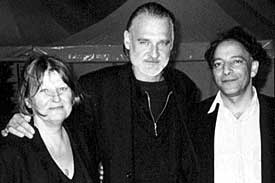
The picture above shows Béla Tarr (centre) with his wife and editor Agnes Hranitzky, and producer Paul Sadoun.

Here are some resources on Béla Tarr:

Wikipedia entry

Article by
Peter Hames

Interview by
Eric Schlosser

Article by
Jonathan Rosenbaum

Reviews of various Tarr films

Here'a clip from Béla Tarr's film Sátántangó.


And here's an interview with Béla Tarr, made during the 12th Sarajevo Film Festival (August 2006).

Monday, August 14, 2006

Threads

After my posts yesterday on Religion, I was chatting with my friend Dr Mrinal Bose. He is a practising physician, a man of science and rationality, a secular man, and a humanist. And an aesthete, at least in regard to literature.

As a medical man, he is aware of human psychology, and in his training had spent some time in clinical psychiatry and been quite drawn to this work. He knows his physiology and biochemistry! Yet we can talk about matters like “spirituality” or “Religion”. He knows I am sharing my personal experience when I say something, and accepts and respects this. But he has his views.

He said: “If man had not created religion, the world would have been a better place.”

My response was: If man had not created religion, there would still be natural law, and Religion (with a capital R) is nothing but that. There is also self-knowledge, of body-mind, states, and self-realisation, which man has attained for thousands of years. The marriage of Religion to worldly concerns, of power and wealth, is another matter, and also inevitable. But that need not stop someone from looking at Religion differently, even specific religions and their associated beliefs, practices and rituals, and seeing all of this as something magnificent, which raises humanity to living light. For instance, how can someone know what a pilgrimage is for the inner-world of the devout?

Dr Bose also referred to something a renowned Bangladeshi writer had said in an interview, to the effect that only people who had the time engaged with religion. Peasants and workers did not have time for religion.

I agreed with him. I remembered the Buddhist teaching about a human life with the opportunity to learn - being as rare an occurrence as if a deep sea turtle which surfaces once in millenia came up precisely inside a tube that happened to be floating by at exactly the same time and place! And hence the necessary injunction, to utilise this life to the fullest, to strive to come to awareness, and to help bring other living beings to light.

I also mentioned that it was humble labouring folk, peasants, craftsmen and workers, who exhibited faith and devotion, and the "spiritual" impulse (in the innate sense, rather than any particular sect) was also found among the labouring folk. Hence a person like Kabir, the 15th century weaver, poet and mystic of India. He was heard and revered by the common folk, in whose language and idiom he gave voice to his deep spiritual feelings and insights. Not surprisingly, he attracted people of diverse faiths, and particularly Hindus and Muslims; his own faith was always ambiguous; he quoted Hindu and Islamic precepts, and also forswore external rituals and formal piety and places of worship. His songs and poems still resound in vast parts of India.

When I relate to Dr Bose, I see him as a friend, someone I like and respect and think well off. Because that is what my relation to him has occasioned. Yes, there are some things people could say, which are likely to shock and hurt me, and make me distance myself from them. But equally, there are matters on which I don’t let people’s words or views interfere with my relationship with them, and interfere with the fine commonality shared in other matters. That view is only one small part of them. We can still be one in essence.

I feel a commitment to try to think deeply about what someone I like says, which seems to run counter to my own thoughts and feelings, to see whether that statement can very exactly represent some aspect of my own view on that subject. And very often one finds that there need not really be any disagreement. Besides, merely hearing something one does not like to hear, which offends, or irritates – one need not then let this harden into a feeling of resentment or ill-will against the person.

Dr Bose is very blunt. And disarmingly so! I once sent him a set of synopses of stories (for films) that I had worked on over the years. He said: “Be original dammit, these are formulaic shit” (or something to that effect). I did get a bit of a start! But now, I am supremely grateful for that honest feedback. That helped to open up for me a new dimension of being. And so I always like to get some sharp critical outburst from him!

Dr Bose had also introduced me to the name and work of the Bengali writer Subimal Misra. That led to my taking up translation of his short stories. He also pointed out the parallels between the work of Misra and that of Elfriede Jelinek, the Austrian writer. Through Dr Bose’s feedback about originality, and my exposure to the writings of (and about) Misra and Jelinek – though I’ve been a serious reader for more than half my life, and nursed a wish to write (literary fiction, non-fiction) for years, for the first time in my life I awakened to some fundamental questions, some new considerations and discernments, some new realisations, decisions and choices.

Why write? Write what? Why? For whom? Why? How?

Have mercy

I wrote yesterday about our own innate natural urges and faculties, such as that of turning to, or seeking refuge, at times of acute duress and distress.

So there could be “secular” expressions of that inner voice.

Last year, I had heard the Bengali singer Moushumi Bhowmick – and had been overwhelmed and mesmerised by her voice and songs. Rooted in the local Bengali soil and symbols, they took me to another plane altogether, of mood, feeling and fragrance.

Moushumi is also part of an ensemble, Parapar. Their site on MySpace is here.

The first song of Moushumi Bhowmick I heard was a prayer, a song by Ranen Roychowdhury, from Sylhet (now in Bangladesh). The song begins 'Mayani rakhibay moray’ (Keep me with affection). What feeling she impregnated into this humble expression of folk devotion, though she herself is presumably "secular" and non-religious!

Here's the song.

03 Track 3
03 Track 3.wma
Hosted by eSnips

Hear more songs of Moushumi and Parapar here.

I searched for her albums, bought several copies and gave them to my relatives and friends!

One of her songs is Doya koro (Have mercy). That can also be seen as a “prayer”, independent of “religion” or “God”.

In my ecstatic enthusiasm listening to Moushumi Bhowmick’s songs, I translated a few songs, so as to be able to share my own delight and entrancement with others who did not know the Bengali language, who I knew would be powerfully drawn to her songs and would want to sing them. This was not a polished literary translation, but more like a literal translation, which would enable someone who loved a song to know each word of it and thus understand something of the feeling expressed by the singer's voicing of each word.

But the songs are very difficult to translate, because simple common words are so full of nuance of meaning and cultural connotations and associations. Nevertheless, quite insensitively and immodestly, I posted my translation on a public discussion board on the internet, besides sending it to the writer / singer. Thankfully, she responded shortly thereafter, expressing her unhappiness with my “translation”, and especially the song Doya koro (Have mercy), and with my having gone public with this.

I immediately apologised for and retracted my “translation”. Through this experience I got a good introduction to what translation entailed, when it came to literature. That has stood me in very good stead in the translation of Subimal Misra’s writing, which I took up soon thereafter.

But I do want to share the words of the song Doya Koro, through English, with my non-Bengali friends, to illustrate a “secular prayer”. The deceptively simple text of the original, which masks the subtleties conveyed by various words, phrases and tones is very hard to render into any other language, without making it sound prosaic. And this is definitely not the case with the original. My literal, aural conversion into English does not do justice to Moushumi Bhowmick's work. Yet I want to share the words, because I know even that is so rich.

So with a prayer for mercy, I give that below.

Get this widget | Share | Track details

Have mercy
this drought has burnt my whole body
to ashes
have mercy
this city, body, time
all burnt to ashes
have mercy
O dear rain,
shower down
on the thirsty body in the bosom of the city
O dear rain
have mercy,

Have mercy
the blind closed body and mind inside this room
so have mercy
the paralysed sultry suffocation
inside this room with closed doors
where the air can’t play
have mercy
these wall-boundaries
the Picasso scroll hung on the wall
has become salted over
have mercy
O dear storm come
and strike and break down everything
have mercy

Have mercy
this nice luv-luv-loving
I’m tired of playing
have mercy
this being nice, loving, doing good
does not feel very nice
have mercy
I will stand outside just once
once, just once
so have mercy

Listen to more songs by Moushumi Bhowmick here.

Monday, July 03, 2006

The duke in his domain

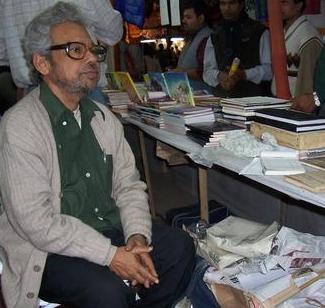
In 1957, Truman Capote wrote an article on Marlon Brando titled “The Duke in His Domain”. (This link is to an extract of the article, accessible from the New Yorker site. The full article is occasionally accessible from the New Yorker archives here. For the full article - email me on the id given in my profile.) I thought that title was very apt for this picture of Bengali writer Subimal Misra sitting with his books in the little magazines pavilion of the Calcutta Book Fair (January 2006).

Since late last year, I have been quite deeply involved in translating the short stories of Misra. And engaged in a close relationship with Misra (almost entirely over the phone, in terms of communication) , who gave me the green signal and his blessings and trust. I hope to get a volume of his stories in English published.

Ankur Saha has written a good introduction to Misra in the Bengali e-zine Parabaas.

Subimal Misra has been described as the father of the experimental novel in Bengali and the leading anti-establishment writer in this language. He has steadfastly disavowed recognition and commercial publication, writing only for non-commercial literary publications (or "little magazines") and spurned invitations from major Bengali publications. Misra’s first collection of stories, titled Haran majhir bidhoba bou-er moda ba shonar gandhimurti ("Haran Majhi's widowed wife's corpse or the Gandhi statue of gold"), was published in 1971. Over 20 volumes of his stories (or “anti-stories”), novellas, novels (or “anti-novels”), plays and essays have been published. Most of these have been published and distributed by the author himself. Misra’s most recent book of stories and essays, Kika Cutout was published in 2006. Now a retired school-teacher, he lives in Calcutta.

As I mentioned in an earlier post, two stories of Misra translated by me are carried in Hackwriters.com.

Misra has tried to bring the style of Jean Luc Godard into Bengali writing. Dostoevsky, Joyce, Jean Paul Sartre, Burroughs, Fellini, Ritwik Ghatak are among other important points of his reference /inspiration.

For a serious reader of literature, Misra is a writer to take note of. For the evidence of his story-telling ability from his earliest work; the status-quo demolishing implict in his life and work; the quality and power of what he has written (from 1967) and continues to write; for frontally taking on the entire domain of commercial publishing and Bengali literature; for forging and adhering steadfastly to a lonely alternative path of writing-publishing-selling. And in the whole process raising so many questions, that seize and shake a reader lulled and dulled into deeply uncritically internalised notions, assumptions, beliefs, attitudes. He is largely unknown, even to serious readers, though many well-known writers and intellectuals are familiar with his name and there is a sizeable band of Bengali readers in India and Bangladesh who are avid readers of his work.

I was struck by the remarkable parallels between the work of Misra and Elfriede Jelinek, the Austrian writer who was awarded the Nobel in 2004. Again it was my friend Dr Mrinal Bose (who introduced me to the name of Subimal Misra) who suggested a correspondence between these two writers, from such widely different cultures and backgrounds. Reading Jelinek’s lecture at the Nobel awards ceremony, the presentation speech on behalf of the Swedish Academy and an article about her writing, and subsequently 3 of her books (Women as Lovers, Wonderful, wonderful times, and Lust) which I immediately got and read – in several instances one felt one was reading Misra’s writings or hearing about his work and stance.

Writers such as Jelinek or Misra must inevitably furrow a very lonely path. They are difficult to read, difficult to like. But if someone reaches through to what the writer is trying to say or do, why, and how - then they assume great significance and power in one's consciousness.

Last evening I spoke to Misra. It struck me that the blog-sphere is a fantasy come true for him: costless, free, open, infinitely accessible to all, for ever. Yet Misra has no idea about what the internet or blog-sphere is, yes he has heard about the internet and e-mail, he has seen computers – when he dictates his writing for data entry at the printer’s shop. But he is essentially utterly removed from the net-world. He is a humble man of poor means living reclusively in a tiny apartment in a remote suburb of Calcutta, entirely within the “vernacular-subaltern” sphere, though from that ground he reaches out to and engages with world literature, experimental / alternative writing and cinema. A little man who stands tall in the world of literature - while sitting firm, in his dukedom, of Bengali little magazines!

Tuesday, June 27, 2006

First post

Yesterday I visited the blog of Ahmad Saidullah, from Hamilton, Canada, after receiving his invitation. Being a lover of literature, that was a most delightful experience.

As I was responding to him by e-mail, telling him something about myself and my work, and providing URL links to some of my articles and related information, it struck me that blogging was just like this.

We learn from and are formed by the internet, we contribute to the internet, we engage in relationships through the internet... Virtuality and reality enmesh.

Since early 2005, I have had a wonderful friendship with Dr Mrinal Bose, a physician and writer who lives in Sodepur (a suburb north of Calcutta). We became acquainted through the internet. We did meet as well, thrice so far. And thanks to him, since late last year I have been reading and translating the short stories of the Bengali writer Subimal Misra. (A couple of the translated stories were published in Hackwriters.com recently, and one of the readers, Mr IK Shukla, from USA, sent the link to Ahmad Saidullah and then forwarded his comment to me. Ahmad has been extremely generous in reading through my stories and giving detailed suggestions for corrections.) In April, Mrinal sent me the manuscript of his first novel, which he completed in 2001. I have been editing that.

We exchange e-mails regularly, mostly serious and reflective, with our dialogue touching on diverse subjects concerning us. This morning I received a mail from him, where he wrote about Haruki Murakami. In my reply to him I copied a poem I had written some years ago. Once again it struck me that I could be doing such things on a blog.

Yesterday I also heard from my friend Lou Gelehrter, who lives and works in Jerusalem and Bucharest. He sent me his blog link. With everybody blogging, it was time for me to start!

So I googled "how to do a blog site", and soon after, this first post. So here goes!

Photo: Jean Cassagne