Showing posts with label Howrah. Show all posts

Thursday, January 24, 2008

On Design


In India one would find ‘good design’ – but in an entirely venal form. Here is a perfect fusion, but of evil intent and meticulously crafted horrid method. Here is design, but oriented to maximise exploitation of consumers as well as degradation of society as a whole...

So I wrote in an article titled "Design is Love", in the December 2007 issue of Mail of the Month of the Association for Design and Advertising (Sweden).

Read the full article here.

Image: From DesignBoom's Love Your Earth graphic design competition.

Saturday, December 09, 2006

Toilet Bus


I had written about how scores of millions of Indians suffer indignity in silence, for lack of a toilet. The worst sufferers are poor women in the slums of urban India. I had tried to initiate a programme to install sanitary toilets in Howrah slums. But this could not move ahead because of entrenched vested interests in the Howrah Municipal Corporation; there was a profitable racket to pocket the govt’s insanitary toilet conversion subsidy without actually constructing a sanitary toilet.

A host of factors - tenure, permissions, space etc -prevent necessary toilets from being constructed in the slums. So I have long been interested in a Toilet Bus for poor women in slums. I wanted to start a project to develop, launch and manage a 'mobile toilet' facility.

I was seized by the idea of converting a decommissioned double-decker bus into a "Toilet Bus" to cater to poor women in slums like Priya Manna Basti in Howrah. Such a bus would be parked near the slum for a certain duration at particular times of the day. The refuse (which would accumulate in a safe storage tank in the vehicle) would then be disposed off at a dedicated land site, using a twin sanitary pit system. Once full, the pit would be closed and a new one used. When the second pit was full, the first one would be reopened. The refuse would be inert and could be removed and used as manure.

The toilet bus needn’t have its own engine and driver-cab. It could be hauled and conveyed, with the cab unit conveying, parking and picking up a number of such toilet buses.

Besides giving immediate relief to a good number of poor slum women, this would also serve to highlight the sanitation issue and create wider public awareness of this problem. It would also be possible to organise the beneficiary women in self-help groups through this initiative. And this would serve as a demonstration of a programme that could also be taken up by others, including the municipal corporation.

The venture would be a non-profit one, but it would also generate revenue from user charges towards meeting costs.

Just over two years ago, I contacted the relevant departments of the West Bengal govt for the necessary sanctions and assistance. I am yet to hear from them.

Meanwhile the dream lives on!

Monday, October 09, 2006

A tale of two cities


The ancient Hindu epics, Ramayana and Mahabharata, which are aids to instilling an organic consciousness in human society, are also essentially about the cities of Ayodhya, and Hastinapur.
In the same way as an epic serves to guide seekers of truth and wisdom through the slings and fortunes of their own lives by upholding a personalisable figure, such as Lord Rama, and describing his exile and wandering, similarly, the mythic cities are also metaphors for the process of becoming of any city, to an Ayodhya, the city of compassion and justice.

Thus, one can think of the journey of a city, through history, in terms of a cycle of birth, growth, prosperity, stagnation, decay, blight, recrudescence...

Mythology becomes the means for continuous renewal through the living culture of the people, as individual, institutional, city and social life trajectories act out, anew, contemporary versions of the epic events, with consequences that mirror mythic outcomes.

Or shatter mythic patterns and bonds to now enable otherwise unimaginable new possibilities.

The tale of the two cities, of Calcutta and Howrah, may easily be viewed mythically - for instance, in terms of the story of the two brothers, fated to be king and sage respectively, that is common to both Hindu and Islamic thought.

Few cities in the world have experienced what these two did - in terms of their rapid growth and massive industrial edifice, their wealth, and size and scale of their vast rural hinterland, the extent of their regional economic linkages - and the weight of the apathy to their labouring people.

More fundamentally, this process of urban growth was accompanied by profound enlightenment in the social and cultural sphere, through which elite, European-inspired accomplishments and deep-rooted spontaneous folk sensibilities were integrated, to produce giants of creativity, intellect and wisdom - like the revered poet-sage Rabindranath Tagore.

The story of the rise of these cities is also the story of the renewal of a tradition, of awakening, re-connecting with roots, and building with this strength. The subsequent process of decline, decay and blight in the economic, environmental and social spheres in turn leading to a moment when the wheel is again ready to be turned, and a heroic journey begun, through which a barren, arid wasteland is now to be made verdant.

Howrah has always been viewed as a ‘coolie (i.e. labourers’) town’ that did not merit any serious civic effort. The history, the context of resource scarcity, the survival imperative in the people of Howrah, and the parasitic greed and activities of profiteers, all interact to make today’s Howrah the ultimate planning nightmare, or challenge, depending upon one’s perspective.

The very blight that characterises Howrah today, can also be seen as a rare opportunity to shape the Howrah of tomorrow. This is the gift of Howrah’s history.

Monday, September 11, 2006

Greatest challenge facing Calcutta


There are a number of very serious threats to the long term health and well-being of Calcutta.

The city is sprawling eastwards over the sensitive wetlands (which are part of the Sundarban deltaic eco-system). For over a decade and a half now, the impact of this has been felt on the city’s drainage system. Within the city, there are severe disparities and inequities in provision of civic services. Maintenance and development of service infrastructure is hostage to the free-riding and pillaging by the powerful and rich.

Environmental health is consequently seriously threatened by water-borne and malarial diseases. Lack of access to adequate supplies of drinking water, which is compounded by inadequate sanitation – this is the principal environmental problem for Calcutta. Municipal statistics from Howrah suggest that infant mortality rates in slums are significantly higher than that in non-slum areas. A third of the metropolitan population lives in slum settlements, where the conditions are most degraded. In some areas, service latrines are used by over a hundred persons.

The city as a whole becomes a zone of conflict and violence, between the haves and the have-nots, with the middle-classes getting it from both sides. The degraded and poverty-ridden slums of the city are like subterranean boiler-rooms producing crime and riots, which can make city life nightmarish.

Frontally addressing such questions, with a view to humane transformation, is the greatest challenge facing the metropolis of Calcutta.

Rebuilding Calcutta from below


Something like the Unnayan renewal proposal calls for institutional ownership and capability that is currently non-existent. Nor has the civic consciousness of the citizens reached a stage of taking unequivocal and unassailable ownership for the future of the city – something that would then drive city planning and management.

The lack of public ownership of public domain concerns – that is the key limitation.

Privatisation of the public domain is the character of the age, and to see that happening through an apparent public domain concern is terrible, with deep damage. Building such civic ownership – when formal authorities and institutions are riddled with incompetence, apathy and corruption – is the foundational infrastructural requirement.

City and metropolitan renewal has thus perhaps necessarily to begin with community and slum renewal. Planning wisdom has to discern that empowering the vulnerable, for social and economic betterment, improved shelter and habitat, and building public ownership and cooperative action for environmental justice - may be the foundation and catalyst for rebuilding the blighted city. Public ethics is the key to renewal.

Whose city? We have to move from an elitist fixation with the city, which in the ultimate analysis is very limiting, and devoid of imagination.

In systemic terms, lack of awareness and disempowerment of large numbers of the poor allows the free-riding and pillage, and this makes the city a fount of inefficiency, unreason, ugliness, all of which should be seen and felt to be as distasteful as they are. Hence, improvement in the lot of the disenfranchised should be in the direct long term interest of anyone wanting the city to be a thriving, well managed, efficient place.

Slum renewal begins the process of infrastructure upgradation and improved urban management – which the city can only benefit from.

Public ethics, public domain activity – is a subject that needs to be looked at, and not assumed. Public issues are typically used instrumentally for private ends. Instead organisational means must be used instrumentally to serve public ends.

In a capital-starved environment, it is only the potential value of land under present depressed use that offers the resources to address the huge social development and infrastructure gap that Calcutta suffers. Howrah, with its huge tracts of industrial land, presently under closed, sick and obsolescent industry, could provide the answer. And this could also afford the means to begin the long-term process of laying the much needed infrastructure.

Post-script

The well-being of Calcutta can be seen in the light of the highly polluted state of the river Hooghly, along whose two banks the metropolis lies. But the nearly extinct Hooghly dolphin, locally known as shushuk or shishumar - with powerful mythological resonances and identified as a protector of children - still finds cause to leap up from the polluted river, and cheer the onlooker. There may be hope yet for its cousins in the Brahmaputra, Karnali, Yamuna and Indus.

Friday, September 08, 2006

International Literacy Day & Calcutta

Today, 8th September, is International Literacy Day.

This date has powerful resonances for me. On this day, in 1998, we had organised a women and children’s rally, in Priya Manna Basti, a jute-workers’ settlement in Howrah, the blighted industrial city across the river from Calcutta.

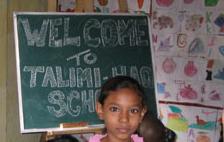
That was a very special occasion indeed, in the early days of our community empowerment initiative in Howrah slums. We had been working on women’s literacy (in Urdu), and we had also just started Talimi Haq School (Right to Education School), a non-formal learning centre for poor and working children. Hence we thought it was appropriate to observe Literacy Day.

There was also a funny aside to that successful rally. We had made arrangements for biryani (a fragrant, succulent rice and meat dish) to be cooked, to feed all the rallyists after the programme. The responsibility for the biryani had been given to a local man, who had solicitously volunteered to help. On the morning of the rally, Amina and Huma, my colleagues in PM Basti, discovered that this man had other plans of his own. He had organised a party for his wife’s birthday. And the feast for his party – was to be our rally biryani! And so they intervened, ejected the fellow and took charge of the cooking. And everything eventually turned out fine.

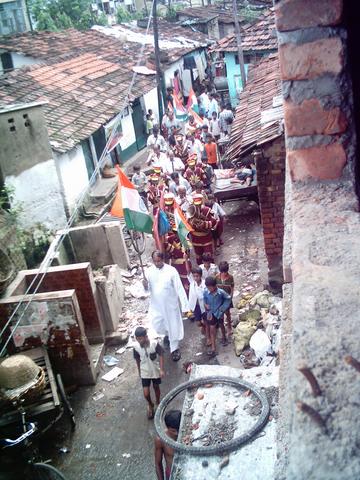
Most of all, I remember singing out resonantly with the children, as our rally wound its way through the narrow slum lanes, the beautiful song that used to be broadcast over national television in the late-80s, under the National Literacy Mission:

Padna likhna sikho, o mehnat karne walo
Padna likhna sikho, o bhook se ladne walo

Ah aah ih eeh ko pehchano, alif ko likhna sikho
Kuh kha guh ghah ko apna hatiyaar banana sikho
Andhere se ujiyare tak paer badhana sikho

Padna likhna sikho, o mehnat karne walo
Padna likhna sikho, o bhook se ladne walo

In translation:

Learn to read and write O toiling people
Learn to read and write O you who’re battling hunger

Learn to recognise Ah Aah Ih Eeh, learn to write Alif
Learn to make Kuh Kha Guh Ghah your weapons
Learn to extend your foot from darkness towards light

Learn to read and write O toiling people
Learn to read and write O you who’re battling hunger

We observed International Literacy Day for a couple of years after that, with other women’s programmes. Then I swallowed the fact of our failure and inability to do anything substantive in the face of the utter perverse apathy and unresponsiveness of the authorities and institutions, and let this day pass. But my colleagues in Howrah, and especially Amina and Binod, always remember this day and observe it in some fashion.

To people in India - Calcutta and Bengal used to be identified with learning, culture, the arts, political consciousness etc. Even today, educated people of the older generation in other parts of the country hold this city and state in high regard. But the reality today is somewhat different.

I know that in my lifetime I shall not see a literate Calcutta, or even a Calcutta where every child receives basic education. And nothing I might do personally will make a difference. I know that those who have the power and responsibility to address such matters – just don’t care. Nor do the systems exist to enable such goals. Yet, I go on, trying to do whatever little I can, to make a small difference, to a few children, in one place.

I am in, of and for my city. But yet I stand apart, and am an exile in my own land. When one is out in the streets of Calcutta, at every moment everything all around defies law, orderliness, civility, rationality, taste, aesthetics, hygiene, sense, concern for the other. The image of the person of Calcutta that I am constantly filled with – is of a base, brutish, boorish, ugly, foul, filthy, violent, selfish, blind, malevolent, hateful, herd-driven, mob-mentality, beast.

And yet even that is not the full truth. A visitor to the city can also conclude that this is a warm, humane city, of sensitive, refined, aware people. Nature in this city – is also similarly ambiguous: this is the most frightfully hot, humid, infernal place; and yet, a gentle breeze, the quality of light, the feel-fragrance of the air, can be uplifting and endearing.

Poverty, squalor, filth, apathy, civic indiscipline etc – are also of course there in other cities of India. But yet perhaps Calcutta strikes one as different, and especially symbolic of all these things. There is also the long tradition of westerners’ gaze on Calcutta, which offends the educated, middle-class and affluent people here; they’d like their city to be well thought of, without themselves having to do anything in their lives towards that.

A concerned, aware citizen has to grapple with all this for herself, come to her own understanding, which is informed, unbiased, rational and compassionate, and act accordingly.

I like to think that there must be a higher reason and purpose behind Calcutta’s travails, something of significance for all of humanity. It is here that all the issues and challenges of life are out in the raw. Calcutta is something elemental. Here, every day, at every moment, darkness and light, knowledge and ignorance, apathy and compassion, high and low, good and evil - confront each other and battle. It is a theatre of humanity, the kitchen and alchemical laboratory of life, where the “human” is cooked and distilled.

I hope like the biryani which we successfully rescued, something fragrant and delicious results!

Wednesday, September 06, 2006

Crime in the city

Shirazi had recently posted a piece in his blog titled “What Makes Criminals”. That made interesting reading. Among the factors he highlighted was the sense of hopelessness in the labouring sections.

In my response to his piece, I wrote:

“Hopelessness - sadly, some people like to thrive on other people's despair and hopelessness. I have been working for 10 years in a workers' slum in Howrah, India. Here "crime" or "illegality" touches everyone's lives, whether they know it or not. (For instance, illegal electricity is the only electricity available to the ordinary slumdweller. And supplying illegal electricity is an important livelihood source for the people!) The "legal", the "good", is not an option available to people. They have also been socialised in the "illegal" from their infancy. The "legal" and "good" society around them does not want to embrace them, and they are unable to gain full access to this domain. Is not the society that countenances all this, the whole system of governance that perpetuates this, the chain of social and economic exploitation and double standards (in-humanity) - as criminal, if not more than the individual criminal??? But the individual petty criminals do get caught, jailed or even killed eventually. But the larger factors live on unabated.”

In April, while at the TARU office in Delhi, I came upon the March 2006 issue of the journal Seminar, on Calcutta. One of the articles in this issue was by the veteran writer Sumanta Banerjee, titled “The underside of a city divided”. I was really struck by the author’s brilliant insight into this city, and its changing mores. Today I remembered this article and was glad to find it on the net.

I reproduce below some extracts from Sumanta Banerjee’s article.

Sunday, August 20, 2006

Baird Cornell & a Calcutta photoblog

Baird Cornell is an artist based in Munich, Germany. He was in Calcutta recently. A friend at the Goethe Institute in Calcutta put him in touch with me.

Baird has visited India many times. He is here now working on a project that seeks to explore the impact of politics, economy and religion on culture, in the rapidly changing context of globalisation. He is interested in looking at the interface between two cultutes, one sustained by an indigenous value tradition, and the other by an urban environment waking to the issues of economic self-empowerment.

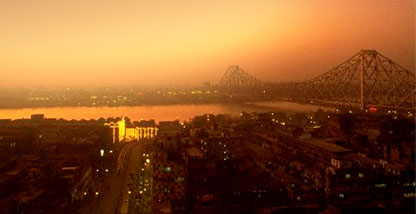
Calcutta and Howrah lie on on the two sides of the river Hooghly, linked by the Howrah Bridge (the most travelled bridge in the world). Millions of economic immigrants come to the city of Calcutta, crossing the Howrah Bridge. Rural crosses over into the urban, on the Rabindra Setu (the name of the Howrah bridge, after Bengal’s famous poet sage Rabindranath Tagore, 1861-1941), over the sacred river. Baird is struck by these metaphors.

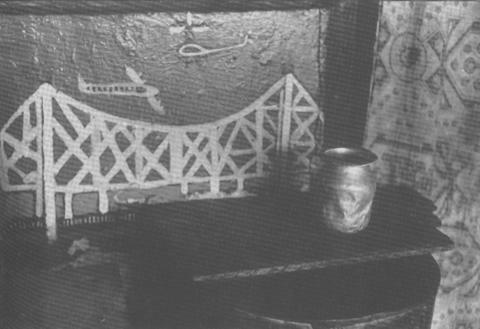
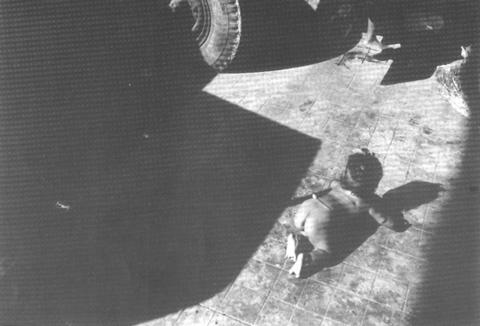
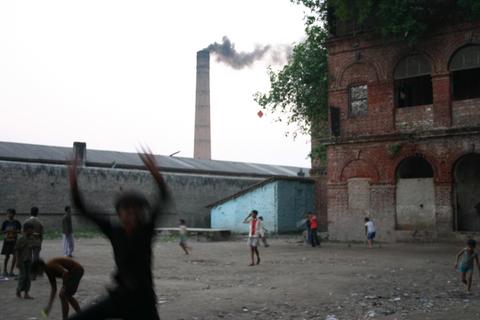
One of his project activities is giving digital cameras to young people from each side of the river to use on the other side. I put him in touch with the volunteer teachers at the Talimi Haq School in Howrah. Yesterday I collected the complete set of images taken by the teachers. I found the results very interesting. I shall keep posting images from this collection!

Tuesday, July 25, 2006

Earth-shattering


In August 1997, on the occasion of the 50th anniversary of India’s independence, I felt that the best way to commemorate this, to pay homage to the memory of Mahatma Gandhi, the father of the nation, was to work to eliminate service latrines from the slums of Howrah.

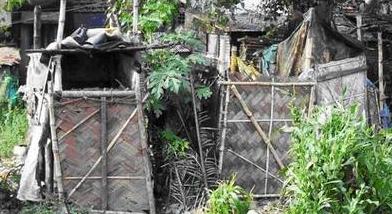
A ‘service latrine’ is a toilet that has to be manually cleaned out, by lowly sweepers. This is an arrangement that was widespread in old towns and cities across India. The image of a person carrying a basket of excreta on his / her head – had been the subject of a call to conscience by Mahatma Gandhi. But it was only in 1986 that the govt. of India finally enacted a law banning such ‘manual scavenging’. Local bodies had to ensure the implementation of this and a programme was subsequently initiated to provide a subsidy for the conversion of service latrines into sanitary toilets.

We had found and demonstrated through a pilot project the solution to this apparently insoluble problem, which affected thousands of people, and was responsible for severe environmental health risks. The lives of hundreds of people had been positively transformed. And very foul spots, in the midst of the metropolis, were rehabilitated.

And now, we had researched and developed a community-based programme for the complete elimination of service latrines from Howrah’s slums. We had surveyed slum households and learnt about their situation and the willingness to pay for the toilets. We had engaged with a leading housing finance company and got them to give loans for building toilets. We had got the approval of the metropolitan development authority, who also agreed to advance the govt subsidy component up-front, for 10 toilet units at a time.

I felt like a scientist who has made an earth-shattering new discovery, expanding the frontiers of knowledge and transforming human life. (As a 11-year old, I had read with rapt awe Eve Curie's biography of Madame Curie which my mother had presented on new year's day in 1972, with the inscribed exhortation: "Go through this book like a book worm & may it inspire you to great deeds.")

Read the full essay here.

Monday, July 17, 2006

Reunion

Yesterday afternoon we had an old students' reunion at the Talimi Haq School in Howrah. I had thought about this for a long time, and also spoken to Amina and Binod who run the school. I had visited Howrah a few days ago after almost 4 months. The school reunion was planned, and it took place on Sunday, 20 March 2005.

It is difficult to express all the feelings from looking, as an observer, at all that had happened since I started working in Howrah in 1996-97. I had been at the Howrah office-centre virtually everyday, 6 days a week, from 1998 to 2000. In mid-2000, after I joined the CALMANAC website assignment, my visits became infrequent. After this assignment was over, for a month or so I again went there everyday. But then I began getting more and more into my new duty / responsibility, the family business. Through 2001 and 2002, I went about once a week. In 2003 and 2004, this became even less frequent. I went only for specific purposes. But I had remained in close and regular contact, with Prodyut, Amina and Binod, and earlier Ranjit and Anguri. And of course I worried about the funds to keep the school running.

To my surprise I learnt that since its inception in June 1998, over 400 children had studied here for some length of time. I was particularly keen that a group of boys who had studied in the very first year attend. I had taught them myself - arithmetic, singing - and developed a close rapport with them.

Some 30-40 ex-students came for the reunion, and together with a good number of the small children currently studying - there was quite a crowd in our school room. It was hot and sweaty inside the room, but that did not affect anybody's enthusiasm. Some boys who had been studying here until quite recently, were now strapping lads. Some girls from a few years ago were now very pretty adolescents. Among them a girl living across the lane who had joined after I had asked her father to send her to our school.

Photographs taken over the years were displayed on a wall - a school function on Independence Day, a picnic to the Botanical Gardens, a visit to the Science Museum, visitors from Britain. Looking at some of the pictures, I felt a lump in my throat and my eyes clouded over. Some of the tiny kids in the pictures were big boys and girls now.

The programme began with a short welcome address by me. I said like every school and college, Talimi Haq School too should have a reunion of the ex-students. They should feel happy and proud to have belonged to a special school, which set them off on their journey in education and life. Where they learnt something, and can remember a time of happiness, fun and frolic. For the current students, it will give them a feeling that they are studying in a special school, which is looked up to and with which ex-students feel an attachment. This a special school as its name proclaims. Education is a right of all, so this is a school for that. So many children have come here and then gone on to other schools, where they are now studying, or have even graduated from. And thus is the stream of education in this locality advancing. The students learn Urdu, English, Arithmetic, cleanliness, good behaviour, correct values. But at root, the teachers here give love and affection to the children. Boys and girls who were unable to continue with their schooling - learnt at least something here. All ex-students should know that this is their place, like their home. And we at the school consider you all as our own. You have a right to this place, it is yours. You can come whenever you want, when you are happy come and share your happiness with us. When you are feeling sad and burdened, come here and find a shoulder to rest on. And you will always be in our thoughts, and we hope you will drop in every now and then. We remember all those who are unable to come today. We remember in particular all the teachers who have taught here over the years and we miss their presence very much. I hope there will be a lot of happiness today, a lot of fun, jokes and anecdotes, remembering of joy and mischief, songs, recollection of old times.

There was a juice break. Several of the small children were given their juice and coaxed to go home to make space for the ex-students. Some of the boys and girls came to chat with me and I enquired about their studies.

A number of skits and songs were then presented by ex-students, which had the audience in splits. A group of boys sang a song I had composed, "PM Basti ke ham sab sachhey Mussalmaan hain" (“we are all true Muslims, from PM Basti”). A video recording of a women and children's rally on International Literacy Day in 1998 was played.

Amina and another new teacher asked me to sing. I sang three songs, including my composition "Hari aur Ali galey miley jab" ("When Hari and Ali embrace"). Finally there was an hour-long antakshari session, between boys and girls, with a male teacher, Binod, and a lady teacher, Rehana as the referees. The competition was fierce, and the enthusiasm quite explosive. The boys exulted in singing out love songs teasingly, but the girls were not going to be outdone in knowledge of songs and singing.

Packets of savouries and sweets had been prepared, to give to everyone - but because many more than estimated had turned up, everyone had to share. Two boys asked me to share their sweets.

The CPI(M) was organising an Anti-Imperialism Human Chain in the evening. I had invited the local councillor to attend a meeting with a group of visiting architecture students and faculty from Sweden next week. She had requested that the school teachers and older children join the human chain. So we all proceeded to the Grand Trunk Road, and stood in the chain for 10 minutes. Returning to the office, I bid them goodbye and said I really enjoyed myself.

The programme was shadowed for me by sadness and uncertainty, as I got the news that the building was going to be pulled down after 10 days and a new construction put up. This had been in the offing but nothing concrete had materialised. But yesterday morning my colleague Prodyut had been called by the landlord for a meeting. I remembered when we moved to this office, in early 1998, exactly 7 years ago. Every tiny detail in the office had been visualised and rendered with so much thought and feeling. And the school had been started shortly after that. So much had happened here, so much of me had been formed in this space. The bitter irony of the reunion happening right now was difficult to swallow. Where would we go? Would the school have to close down? Where will we keep all the things in the room? Maybe something will work out, everything will turn out alright - but something was over, a chapter had come to an end. I shouldn’t feel burdened by sadness over the past that's coming to a close, one should look forward practically to the new.

At home later in the evening, I spoke to Prodyut over the phone and he assured me that there was no cause for concern. After all we had a proper deed of occupation and payment of deposit. A new agreement deed for premises in the new construction would have to be prepared. The landlord was also going to find us an alternative temporary accommodation. And until all this was sorted out there was no question of vacating our centre.

At night, Rajashi, my wife, who had also attended the school reunion, told me that from being at the reunion I should be proud and happy about the school. She referred to something I had told her once, that everyone should have the right to failure. She said a lot of successful people would not have done something like this.

Saturday, July 15, 2006

West Bengal scenario


The "machinery" with which the CPI(M) was able to win elections in the past was completely stymied this time around. All this came as a great shock to local grassroots party workers. No one could imagine that this could actually happen. CPM activists were saying that if these arrangements had been made in 2001, the CPM / Left Front would have lost that election.

But given the lack of any viable alternative, and out of a kind of pauper’s dependence on the one who throws coins to him, the people voted the party back into power.

Party's and governments are ultimately about winning elections. With election victories being delivered through money and muscle power, politics was necessarily criminalised. The party was hostage to its criminal-lumpen section and their overlords.

Now the party is realising that this section has become redundant. They cannot do anything on election day. It is the people who will vote you in or out, so one better work for and with the people.

As the criminal-lumpen section is redundant and thus unnecessary, they can also be dispensed with, and the deep toll taken by this nexus can be cast out.

Something else has also emerged quite strongly. The real struggle is within the CPM, between the old guard and the new generation, the latter led by Buddhadev Bhattacharya. The old guard and the CPM led by Jyoti Basu till 2000 (and with continuing but waning influence) - is basically an enemy of the people and of pro-poor development, utterly bankrupt, incompetent, corrupt. And Buddhadev is an enemy of this, for his own reasons. Even if one is totally against all his current policies - e.g. land of poor farmers for foreign and local real estate developers and industries, out and out embrace of foreign capital etc - he has to be seen as someone doing something, anything, rather than nothing.

The CPM headquarters has no option but to support him. They cannot afford to lose their bastion of West Bengal. They have realized that the state and its people cannot be taken for granted any longer. They may vote for them, in the absence of any credible and organized opposition, but the party can sense the dismay and anger against their failure to deliver in real and tangible terms. The danger is not so much from any political opposition, but from itself, in terms of its utter incapability to deliver, anything to anybody.

West Bengal has also seen a surge of new Maoist violence against the state, in some of the most backward tribal areas.

West Bengal was / is in danger of becoming a completely redundant backwater of the Indian and global economy. That would be disastrous for pro-poor concerns too. Through Buddhadev, the state is being brought back to the global capitalist economic fold. Such things are also rather easier to do, compared to addressing fundamental and long term issues of poverty and social justice. And someone or the other must be there, in power, to do all that.

There was almost a conspiracy of media / big bourgeoisie to ensure that the Buddhadev-led CPM came back to power. There being no organised credible, reliable political opposition in WB, the alternative would be disastrous, chaotic and anarchic, and especially so for the promoter lobby that has been the first to benefit hugely from Buddhadev. Even party workers were surprised by the extent of “bourgeoisie” and media support to the CPI(M)!

In Howrah, there was a dramatic turnaround in the Urdu-speaking labouring Muslim pockets. The CPM has failed this poor section completely, even while getting re-elected by them. But this time the Samajwadi Party entered this niche (anti-CPM, anti-BJP) and worked hard and steadily. Opposition party workers and even some CPM supporters joined the Samajwadi band. Voter turnout was immense, in some pockets 100%, and without any false representation. As if there was a mass movement within the Muslim section to vote for Samajwadi, i.e. against the CPM. As a result of this swing, the CPM legislator won marginally, because of the non-Muslim votes. This was a CPM stronghold area, earlier represented by a powerful member, who was also a criminal don; he passed away a few years ago.

People have to awaken to the new situation of "free and fair elections" and evolve appropriate means to ensure public debate, which is the essence of democracy and elections. The focus has shifted to media, and the media has been dominated by the big bourgeoisie's shrill support for Buddhadev.

With the civil society and intelligentsia of the state completely compromised, co-opted and bankrupt, progressive anti-establishment and pro-poor forces in the state - have now to engage with Buddhadev, and explore the scope for strong pro-poor policies and ongoing steady, diligent work for long-term ends, in livelihood, education, healthcare, housing and infrastructure.

The forceful exit of Muslim support would also be an assertion of the acute poverty and hardship Muslims in West Bengal are facing (which is only in line with the situation faced by the Scheduled Castes and Scheduled Tribes), and a rude warning to deliver.

If that space is there, if he is open to such engagement to integrate equity and social justice concerns into his reform and economic drive, so as to build a wide popular support base for himself and his team, then it brings a positive new opportunity for progressive civil society.

If that space is not there - then Buddhadev can be seen for what he is, a promoters’ lackey. And people will have to ponder over how and through whom the real issues can be taken up. Maybe its time for a new political party in WB, a progressive, democratic, secular, development-oriented front.

But whatever the case, it must be conceded that Buddhadev has come into his own now, and I for one have been surprised that he had it in him to take on the corrupt party. He may not know how to or have the wherewithal to improve the quality of life of the poor in West Bengal; but being an old party hack, he would know how to fight and manoeuvre and manipulate. In an institutional and systemic sense, change was needed, and he is bringing change.

There is hope!

Saturday, July 08, 2006

God, in the shit

… As coordinator of the pilot project, I was a possessed soul. After a tour through some of the slum localities, where one had to literally walk over a slush of excreta – I felt a flush of awakening. I felt my moment had arrived. While anybody would run far away from and shun such places – except if they had to live there – I decided to remain there, and address this problem of service latrines, come what may. I felt thrilled by the challenge. The apparent insolubility of the problem, its neglect, the foul environment, the revulsion of officials and authorities to engage with this, the unending rebuttals of habitual prejudice- and conflict-oriented perceptions – one of my senior project colleagues had opined “Decent people don’t go to Howrah” – all this only strengthened my resolve. I became completely alienated from the society and city I had been part of. Everything took on a mystic and mythic aura in my consciousness. The poor slumdweller living amidst excreta became my ‘Daridra Narayan’, God in the garb of the poor. Yes, I had found my God, in the shit. I had found the meaning and purpose of my life. And nothing was going to stop me. And Prodyut was there beside me, to help me in my work. …

…The crossing of the river, and going to Howrah – transformed my life, something I could never have even imagined just before that. Yet this was only something residing deep within me, the plaintive plea of my soul, that the Almighty entrust a poor Muslim child to me, to love and nurture as my own.

Extract from an essay, “The most basic human right”.

Crossing the river


“Nine months! A new life is formed and born from a mother's womb. I too was reborn from P.M. Basti.”

From the essay “Across the river”.

Photo: Achinto

Thursday, July 06, 2006

The real Calcutta


Calcutta’s population is about 5 million, and the greater metropolitan area, with a population of 13.2 million (Census, 2001), is spread in a linear north-south alignment along the east and west banks of the Hooghly river, on the two banks of which lie the core cities of Calcutta and Howrah (pop. about 1.5 million).

About 40% of the city population, and a third of the metropolitan population, live in degraded, overcrowded slums lacking in basic civic amenities. This poses acute environmental health risks. Additionally, half a million poor people live in entirely unserviced shanty settlements, with the fear of eviction ever looming over them.

The serious geographic, social and ethnic disparities severely threaten health, the urban environment and social harmony. Muslims constitute just over a fifth of the population of Calcutta city. Over three fourths of the city's Muslim population may be living in slum neighbourhoods. There are deep-rooted and institutionalized attitudinal constraints to improvement in ethnic minority settlements. Socio-economic deprivation and disparity also breeds a criminalised polity and enhances sectarian strife. Illegal building construction, sponsored by the ruling party, dominates life in the Muslim slums.

Howrah, a historically neglected city, is among the most blighted areas. Over half the population here lives in slums, a significant proportion belonging to the minority Muslim community. Available health and infant mortality statistics indicate high morbidity and mortality on account of waterborne diseases. Infant mortality rates in slums may be more than double those in non-slum areas. This stems from the continuing reliance of millions of vulnerable people living in the slum-like bastis on contaminated water sources, in the absence of access to adequate supplies of potable water, and inadequate sanitation.

Despite being a vital and integral part of the city’s sustenance, slumdwellers in the metropolis of Calcutta have, historically, been the city’s unintended citizens, merely exploited but never considered stakeholders in the building and renewal of the city.

In recent years, notwithstanding major slum improvement programmes and investments, aided by multilateral and bilateral international agencies, city development has proceeded in parallel with relentless marginalisation of slum communities.

Outbreaks of epidemics – do not stop at the gates of today’s gated condo-communities.

Photo: Achinto