Showing posts with label poetry. Show all posts

Thursday, November 04, 2010

Farewell, P. Lal


Calcutta lost one of her illustrious sons yesterday, when Purushottam Lal, teacher of literature, poet, writer, trans-creator and publisher, passed away yesterday, at the age of 81.

A magnetic personality, he had inspired generations of students, poets and writers. He represented the best of Calcutta's cosmopolitanism and intellectual vitality.

He shall be deeply missed, and Calcutta will never be the same again.

The Alumni Association of St. Xavier's College (where Professor Lal taught for a substantial portion of his life) will hold a memorial service for him on Saturday, 13th November at 3 PM.

My earlier post on Prof Lal is here.

Read P. Lal's obituary in The Economist here.

Thursday, September 16, 2010

A Moment of Silence


by Emmanuel Ortiz

Before I begin this poem, I’d like to ask you to join me in a moment of silence in honor of those who died in the World Trade Center and the Pentagon on September 11th, 2001.
I would also like to ask you to offer up a moment of silence for all of those who have been harassed, imprisoned, disappeared, tortured, raped, or killed in retaliation for those strikes, for the victims in Afghanistan, Iraq, in the U.S., and throughout the world.
And if I could just add one more thing…
A full day of silence… for the tens of thousands of Palestinians who have died at the hands of U.S.-backed Israeli forces over decades of occupation.
Six months of silence… for the million and-a-half Iraqi people, mostly children, who have died of malnourishment or starvation as a result of a 12-year U.S. embargo against the country.
… And now, the drums of war beat again.
Before I begin this poem, two months of silence… for the Blacks under Apartheid in South Africa, where “homeland security”
made them aliens in their own country
Nine months of silence… for the dead in Hiroshima and Nagasaki, where death rained down and peeled back every layer of
concrete, steel, earth and skin, and the survivors went on as if alive.
A year of silence… for the millions of dead in Viet Nam —a people, not a war—for those who know a thing or two about the
scent of burning fuel, their relatives bones buried in it, their babies born of it.
Two months of silence… for the decades of dead in Colombia, whose names, like the corpses they once represented, have
piled up and slipped off our tongues.
Before I begin this poem,
Seven days of silence… for El Salvador
A day of silence… for Nicaragua
Five days of silence… for the Guatemaltecos
None of whom ever knew a moment of peace in their living years.
45 seconds of silence… for the 45 dead at Acteal, Chiapas …
1,933 miles of silence… for every desperate body
That burns in the desert sun
Drowned in swollen rivers at the pearly gates to the Empire’s underbelly,
A gaping wound sutured shut by razor wire and corrugated steel.
25 years of silence… for the millions of Africans who found their graves far deeper in the ocean than any building could poke
into the sky.
For those who were strung and swung from the heights of sycamore trees
In the south … the north … the east … the west …
There will be no dna testing or dental records to identify their remains.
100 years of silence… for the hundreds of millions of indigenous people
From this half of right here,
Whose land and lives were stolen,
In postcard-perfect plots like Pine Ridge, Wounded Knee, Sand Creek, Fallen Timbers, or the Trail of Tears
Names now reduced to innocuous magnetic poetry on the refrigerator of our consciousness …
From somewhere within the pillars of power
You open your mouths to invoke a moment of our silence
And we are all left speechless,
Our tongues snatched from our mouths,
Our eyes stapled shut.
A moment of silence,
And the poets are laid to rest,
The drums disintegrate into dust.
Before I begin this poem,
You want a moment of silence…
You mourn now as if the world will never be the same
And the rest of us hope to hell it won’t be.
Not like it always has been.
… Because this is not a 9-11 poem
This is a 9/10 poem,
It is a 9/9 poem,
A 9/8 poem,
A 9/7 poem…
This is a 1492 poem.
This is a poem about what causes poems like this to be written.
And if this is a 9/11 poem, then
This is a September 11th 1973 poem for Chile.
This is a September 12th 1977 poem for Steven Biko in South Africa.
This is a September 13th 1971 poem for the brothers at Attica Prison, New York.
This is a September 14th 1992 poem for the people of Somalia.
This is a poem for every date that falls to the ground amidst the ashes of amnesia.
This is a poem for the 110 stories that were never told,
The 110 stories that history uprooted from its textbooks
The 110 stories that that cnn, bbc, The New York Times, and Newsweek ignored.
This is a poem for interrupting this program.
This is not a peace poem,
Not a poem for forgiveness.
This is a justice poem,
A poem for never forgetting.
This is a poem to remind us
That all that glitters
Might just be broken glass.
And still you want a moment of silence for the dead?
We could give you lifetimes of empty:
The unmarked graves,
The lost languages,
The uprooted trees and histories,
The dead stares on the faces of nameless children …
Before I start this poem we could be silent forever
Or just long enough to hunger,
For the dust to bury us
And you would still ask us
For more of our silence.
So if you want a moment of silence
Then stop the oil pumps
Turn off the engines, the televisions
Sink the cruise ships
Crash the stock markets
Unplug the marquee lights
Delete the e-mails and instant messages
Derail the trains, ground the planes.
If you want a moment of silence, put a brick through the window
of Taco Bell
And pay the workers for wages lost.
Tear down the liquor stores,
The townhouses, the White Houses, the jailhouses, the penthouses
and the Playboys.
If you want a moment of silence,
Then take it
On Super Bowl Sunday,
The Fourth of July,
During Dayton’s 13 hour sale,
The next time your white guilt fills the room where my beautiful brown people have gathered.
You want a moment of silence
Then take it
Now,
Before this poem begins.
Here, in the echo of my voice,
In the pause between goosesteps of the second hand,
In the space between bodies in embrace,
Here is your silence.
Take it.
Take it all.
But don’t cut in line.
Let your silence begin at the beginning of crime.
And we,
Tonight,
We will keep right on singing
For our dead.


Emmanuel Ortiz is a third-generation Chicano/Puerto Rican/Irish-American community organizer and spoken word poet. He is the author of a chapbook of poems, The Word Is a Machete (self-published, 2003), and co-editor of Under What Bandera?: Anti-War Ofrendas from Minnesota y Califas (Calaca Press, 2004). He is a founding member of Palabristas: Latin@ Word Slingers, a collective of Latin@ poets in Minnesota. Emmanuel has lived in Minneapolis, Minnesota; Oakland, California; and the Arizona/Mexico border. He currently lives in Fort Wayne, Indiana, the “buckle of the Bible Belt,” with his two dogs, Nogi and Cuca. In his spare time, he enjoys guacamole, soccer, and naps.
Friday, November 07, 2008

Punjabi poem about Barack Obama


I was surprised and delighted to find a video clip on YouTube of a poem in Punjabi in praise of Barack Obama by Pashaura Singh Dhillon, an American of Indian origin. A good example of welding the Indian cultural tradition with life in the new country, complete with references to legends and icons.

Monday, October 20, 2008

Bliss


Bliss is it in this dawn to be alive.

But to be in Bengal is very heaven.


Image: Bengal Landscape, Gaganendranath Tagore, National Gallery of Modern Art, New Delhi.

Wednesday, August 13, 2008

Finding the enemy


I had searched in vain for a poem by Thich Nhat Hanh that I had cut out from a magazine and kept, many years ago, and despaired about not finding this. Yesterday, voila, there it was, ensconced inside the pages of Sri Aurobindo's Savitri.

The Enemy

The enemy is not a person
If you kill people with whom will you live?

The enemy's name is cruelty
The enemy's name is lack of conscience
Its name is hatred, its name bitterness.

The enemy wears a coat of doctrine
The enemy wears the pretence of freedom
It wears hypocrisy, it wears twisted words.

The enemy is not a stranger
It lies inside of each of us.

The enemy's name is false accusation
The enemy's name is ignorance
Its name is ambition, its name is envy.

The enemy's name is covetous eyes
The enemy's name is arrogant head
Its name is a lonely heart, its name is a narrow mind.

The enemy is not a person.
If you kill people with whom will you live?

The enemy is not in the stranger
It lies inside of each of us.

Image: © Yamil Saenz.

Tuesday, July 08, 2008

Plaint


Two years ago I had posted a poem of mine, titled Rama's Plaint. That was written in 1999. Yesterday I happened to add another (concluding?) verse.

They emphasise difference, they ascribe values
Rama looks, wistful and forlorn
’Tis the one earth that fattens all
But teaches some to write the tale.


Painting: Chalk & Cheese, David Weston.

Tuesday, May 20, 2008

Visvarupa


Over the last 10 years or so, I have been drawn to particular sacred verses, in specific sacred texts. And I have set these to melody, as devotional songs or chants, in Sanskrit, Pali, Arabic, Hebrew etc.

Recently, I happened to pick up the Sanskrit verses from the Bhagavad Gita describing the cosmic vision of Krishna revealed to Arjuna just before the Mahabharata war. These are verses 10-12 in Chapter 11, the chapter on vision of the cosmic form, or Visvarupa. I hope to set these to melody and add it to my small repertoire of songs.

As Robert V Moody writes:

"The verses represent one of the great moments in the Bhagavad Gita. Arjuna, the great warrior, stands on his chariot between the two contending armies of what is about to be an epic internecine battle. With him is his chariot driver who is no less than Krishna, one of the manifestations of Vishnu. Arjuna, mighty warrior though he is, seeing the carnage about to ensue, with his family and friends pitted against each other, loses heart and feels his spirit fading. He wants no part of this battle. Turning to Krishna, he begins to question him. The text, which is something akin to the sermon on the mount for millions of Hindus, is a theological and philosophical discussion of the nature of reality and divinity, and as well as a practical spiritual manual for daily living. Arjuna knows that Krishna is not only a personal friend but also nonetheless a manifestation of the supreme godhead itself. Still,when he asks Krishna to show his real form he is completely unprepared for what he sees. This is the source of the often quoted "...now I am become Death, the destroyer of worlds…" which Robert Oppenheimer used to describe the testing of the first atomic bomb."

I am reproducing the verses below, together with Edwin Arnold's poetic transcreation of the Sanskrit original.


anekavaktranayanamanekaad.hbhutadarshanam.h
anekadivyaabharaNaM divyaanekodyataayudham.h


divyamaalyaambaradharaM divyagandhaanulepanam.h
sarvaashcharyamayaM devamanantaM vishvatomukham.h


Hear these verses in Sanskrit here.

Out of countless eyes beholding,
Out of countless mouths commanding,
Countless mystic forms enfolding
In one Form: supremely standing
Countless radiant glories wearing,
Countless heavenly weapons bearing.

Crowned with garlands of star clusters,
Robed in garb of woven lustres,
Breathing from His perfect Presence
Breaths of every subtle essence
Of all heavenly odours; shedding
Blinding brilliance; overspreading
Boundless, beautiful - all spaces
With His all regarding faces.


divi suuryasahasrasya bhavedyugapadutthitaa
yadi bhaaH sadRishii saa syaadbhaasastasya mahaatmanaH


Hear this verse in Sanskrit here.

So He showed! If there should rise
Suddenly within the skies
Sunburst of a thousand suns
Flooding earth with beams undeemed of,
Then might be that Holy One's
Majesty and radiance dreamed of!

Saturday, February 09, 2008

American poets


"The true author of a poem is neither the poet nor the reader, but language."

Octavio Paz


A delegation of poets from the USA is visiting Calcutta. They are part of the US-Calcutta Literary Exchange. The delegation is led by Yusef Komunyakaa.

An interaction with some of the members of the delegation was organised yesterday evening by the Calcutta International Foundation for Arts, Literature and Culture, at the Foundation's office on Park Street (overlooking the Park Street Cemetery).

Besides Yusef Komunyakaa, the other American poets present were Catherine Fletcher, Idra Novey, Nathalie Handal and Ed Pavlic. After a stimulating dialogue with artists and writers from Calcutta, they read from their work.


Yusef Komunyakaa received the Pulitzer Prize and Kingsley Tufts Poetry Award for Neon Vernacular: New & Selected Poems 1977-1989. He was a finalist for the National Book Critics Circle Award for Thieves of Paradise. His honors include the William Faulkner Prize from the University de Rennes and the Bronze Star for his service in Vietnam, where he served as a correspondent and managing editor of the Southern Cross. In 1999 he was elected a Chancellor of The Academy of American Poets.

We Never Know

He danced with tall grass
for a moment, like he was swaying
with a woman. Our gun barrels
glowed white-hot.
When I got to him,
a blue halo
of flies had already claimed him.
I pulled the crumbed photograph
from his fingers.
There's no other way
to say this: I fell in love.
The morning cleared again,
except for a distant mortar
& somewhere choppers taking off.
I slid the wallet into his pocket
& turned him over, so he wouldn't be
kissing the ground.


Catherine Fletcher is an editor for Rattapallax magazine and the online World Poetry Map, and the coordinator of the Endangered Language Initiative, a multi-year project of the New York-based People's Poetry Gathering and City Lore. This is dedicated to document, disseminate, and translate poetry in endangered, contested, and threatened languages.


Idra Novey's chapbook of poems The Next Country won the 2005 Poetry Society of America Chapbook Fellowship and her translations of Brazilian poet Paulo Henriques Britto received a PEN Translation Fund grant; the book, The Clean Shirt of It, came out in 2007 in the Lannan Translation Series from BOA Editions. Her first book, The Next Country, received the Kinereth Gensler Award from Alice James Books and will be released in 2008.

Definition of Stranger

Person not a member
of a group. A visitor,
guest, or the breast
that brushes your arm
on the subway. Person
with whom you've had
no acquaintance but who's taken
your rocking chair
from the curbside
and curls up in it
and closes her eyes.
Person in line
behind you now, waiting
for a glass of water,
or of whiskey, of elixir.
Person logging online
at the same second
from the Home Depot in Lima.
Or in search of the Dalai Lama.
Person not privy or party
to a decision, edict, et cetera,
but who's eaten
from the same fork
at the pizzeria
and kissed your wilder sister
on New Year's. Person assigned
to feed the tiger at the zoo
where you slipped your hand
once
into the palm
of somebody else's father.


Nathalie Handal is the author of numerous award-winning books, including The Lives of Rain and The Poetry of Arab Women: A Contemporary Anthology (Academy of American Poets Bestseller and Winner of the Pen Oakland/Josephine Miles Award). She is currently finishing Language for a New Century: Contemporary Poetry from the Middle East, Asia and Beyond (forthcoming).

The Warrior

It was Wednesday, I remember. Maybe it was Thursday. I had arrived early, early enough to drink some good wine alone with a man I thought we all should fear and for a second forgot. Then they arrived. Nothing in me had changed, even after the wine, even after I saw a goat and corpse cut open side by side. Some say this place is cursed, every drop of water sinks the earth. Strange the things one thinks about at moments like this—was I a stranger to the lover who saw my curves and scars, kissed them then slept like a deserter? Strange what comes to you in the dream-shadows of God—children you saw once in Nablus or Ramallah, who told you the hour the dates will grow in Palestine. Then they arrived. Announced—she died yesterday, but I heard she died a year ago, later that evening I found out she will die tomorrow. And then I heard him say, Shut up, there is only one way to fight a war. Become the other. I cross my legs and take his face apart trying to find a way to remember this moment otherwise.


Ed Pavlic is Associate Professor of English and director of the UGA Creative Writing Program. He is also author of the book of poems, Paraph of Bone & Other Kinds of Blue (The American Poetry Review/Copper Canyon Press, 2001), He was the winner of the American Poetry Review/ Honickman First Book Award and the Darwin Turner Award given by African American Review.

Call it in the air

Last time I saw you on your feet
we climbed Mt. Shavano to have lunch
on the angel’s hip. Year by year step by step you led me
up past the line where trees grow past
the line where shrubs cling to rocks & you tell
south by the lichen. I hesitate when my lungs begin
to ache, lose a full step for your every two.
We pass the line where grizzlies plunder
pine cone stores of black cat-eared alpine
squirrels. Empty craters that smell of thin green
air. We’re into the zone of the all too recently disturbed
stones where grizzlies find moths that blow
in off the plains of Kansas and Nebraska
to mate in the rubble beyond the tree line.
I don’t want to know any of this, but I do. You do too
but could give a damn. I’m scared & can’t breathe.
I join the invisible crowd & turn back
& you’re bears be damned
on all fours now. I sit on a boulder & gasp
for air & I see you get smaller & smaller
& with each blink I can see
it clearly. You could care about the glacier
angel up the slope. I remember how
you used to tell me I made you safe because
when kidnappers came they’d take the youngest.
The boy. Now I’m bigger than you are, so,
here I am, bait. & there you are
on borrowed time you’re about to give back.
Your liver floating in the numbdark, curled up
like a peach pit on a hissing
radiator, eyes alight with the flamedark
torch in each pulse. & there you go,
a slow drip of Patrón & a whiff of nicotine
for lunch as you search for the line beyond
which elevation the lungs change
to birds & you can go on living without any body at all.

Saturday, December 29, 2007

"Those who eat their fill speak to the hungry of wonderful times to come"


From A German War Primer

by Bertolt Brecht


AMONGST THE HIGHLY PLACED
It is considered low to talk about food.
The fact is: they have
Already eaten.


Poverty and Wealth by William Powell Frith, 1888.

The lowly must leave this earth
Without having tasted
Any good meat.

For wondering where they come from and
Where they are going
The fine evenings find them
Too exhausted.

They have not yet seen
The mountains and the great sea
When their time is already up.

If the lowly do not
Think about what's low
They will never rise.

THE BREAD OF THE HUNGRY HAS
ALL BEEN EATEN
Meat has become unknown. Useless
The pouring out of the people's sweat.
The laurel groves have been
Lopped down.
From the chimneys of the arms factories
Rises smoke.

THE HOUSE-PAINTER SPEAKS OF
GREAT TIMES TO COME
The forests still grow.
The fields still bear
The cities still stand.
The people still breathe.

ON THE CALENDAR THE DAY IS NOT
YET SHOWN
Every month, every day
Lies open still. One of those days
Is going to be marked with a cross.

THE WORKERS CRY OUT FOR BREAD
The merchants cry out for markets.
The unemployed were hungry. The employed
Are hungry now.
The hands that lay folded are busy again.
They are making shells.


THOSE WHO TAKE THE MEAT FROM THE TABLE
Teach contentment.
Those for whom the contribution is destined
Demand sacrifice.
Those who eat their fill speak to the hungry
Of wonderful times to come.
Those who lead the country into the abyss
Call ruling too difficult
For ordinary men.

WHEN THE LEADERS SPEAK OF PEACE
The common folk know
That war is coming.
When the leaders curse war
The mobilization order is already written out.

THOSE AT THE TOP SAY: PEACE
AND WAR
Are of different substance.
But their peace and their war
Are like wind and storm.

War grows from their peace
Like son from his mother
He bears
Her frightful features.

Their war kills
Whatever their peace
Has left over.

ON THE WALL WAS CHALKED:
They want war.
The man who wrote it
Has already fallen.


Per Capita by Jean-Michel Basquiat, 1981.

THOSE AT THE TOP SAY:
This way to glory.
Those down below say:
This way to the grave.


Social Mobility by Michael Elmgreen & Ingar Dragset,
2005.

THE WAR WHICH IS COMING
Is not the first one. There were
Other wars before it.
When the last one came to an end
There were conquerors and conquered.
Among the conquered the common people
Starved. Among the conquerors
The common people starved too.

THOSE AT THE TOP SAY COMRADESHIP
Reigns in the army.
The truth of this is seen
In the cookhouse.
In their hearts should be
The selfsame courage. But
On their plates
Are two kinds of rations.


U.S. Army Tank Crew, Tamiya
Military Miniature Series

WHEN IT COMES TO MARCHING MANY DO NOT
KNOW
That their enemy is marching at their head.
The voice which gives them their orders
Is their enemy's voice and
The man who speaks of the enemy
Is the enemy himself.

IT IS NIGHT
The married couples
Lie in their beds. The young women
Will bear orphans.

GENERAL, YOUR TANK IS A POWERFUL VEHICLE
It smashes down forests and crushes a hundred men.
But it has one defect:
It needs a driver.


US Air Force B-52 bomber returning from a mission
in Iraq with empty bomb racks under its wings.

General, your bomber is powerful.
It flies faster than a storm and carries more than an elephant.
But it has one defect:
It needs a mechanic.

General, man is very useful.
He can fly and he can kill.
But he has one defect:
He can think.


The Thinker, Auguste Rodin,
1902.

Thursday, August 30, 2007

Come, walk with me


I had written about my friend Rahul’s memoirs of his activist struggles. Thanks to the wonders of blog-communication, Prof Swarup, an elderly Indian now settled in Australia, offered to extend financial assistance towards publication of Rahul’s memoirs. And now his manuscript is being actively prepared for publication by some very fine and distinguished people in the BlogBharti team. Rahul’s manuscript is a fascinating account of the India that his – and my – generation inherited and tried to engage with.

In his account, Rahul has referred to the inspiration he derived from the song “Chal mere saath hi chal”. I was remembering this song today morning. This is a ghazal, by the Urdu poet, Hasrat Jaipuri (who was also a renowned lyricist of Hindi cinema). The song has been evocatively rendered by the brothers’ duo Ahmed Hussain and Mohd Hussain. I first heard this at a concert of the Hussain brothers in Hyderabad, exactly 10 years ago. A few months later, I found a cassette-album of theirs (titled "Guldasta") in a shop in Ahmedabad, which included the song.

Anyone who has walked a difficult path, alone, along a "road less travelled", and shared with another an unconventional intimacy – would appreciate this song. Its also a favourite of my colleague Amina (who mistakenly thought I had composed it after hearing me sing it!).

Listen to the ghazal here (link provided by Bhupinder).

chal mere saath hi chal, ae meri jaan-e-ghazal
in samajon ke baneye huey bandhan se nikal
chal…

hum vahan jayen jahan pyar pe pehere na lagey
dil ki daulat pe jahan koi lutere na lagey
kab hai badla ye zamana, tu zamane ko badal
chal…

pyar sachcha ho to rahen bhi nikal ati hain
bijliyan arsh se khud rasta dikhlati hai
tu bhi bijli ki tarah gam ke andheron se nikal
chal

apne milne pe jahan koi bhi ungli na utthey
apni chahat pe jahan koi bhi dushman na hanse
chhed de pyar se tu sazey, mohabbat pey ghazal
chal...

peechey mat dekh na shamil ho gunahgaron mein
samne dekhke, manzil hai teri taaron mein
baat banti hai agar dil mey, iradey ho atal
chal…

Let me attempt a translation:

Come walk with me alone, O my life-inspiration,
Break out of these socially constructed bonds
Come...

We shall go where there’s no surveillance on love
Where no thieves set upon hearts’ wealth
When has this world ever changed, you must change the world
Come...

When love’s true, the ways also emerge
The bolts of lightening from the heavens verily show the road
Do emerge too like lightening from the darknesses of grief
Come...

Where no fingers are pointed about our union
Where no enemy scoffs at our desires
Do tease out melodies with love, a poem on love
Come...

Don’t look back, don’t join the wrong-doers
Look ahead, your destination is in the stars
If your heart speaks, may your intentions be unshakable
Come...

Saturday, August 04, 2007

Voices from the soil

Yesterday evening, after a long time I had a reunion with my old friend and comrade, Dr Pasupati Prasad Mahato. Pasupati-da is a distinguished anthropologist and social and cultural activist.

We met again today afternoon. He gave me a copy of his recently published book of poems (in Bengali) Manbhum Ma Hamar (Manbhum, My Mother: A Collection of Adivasi Bengali Poetry). The book has been published by Shobar Ganyer Khobor (Calcutta, 2007).

Pasupati-da selected and read out to me two of his poems from this volume, written in his native Purulia dialect. I present them below, together with my translation.


shombuk aajo

ramchandra uakey sidhailo tumi ke hey?
uttar ailo, hami shombhuk, jatitey shudro.
ramchandra sidhailo, tumi ki koirchho?
uttar ailo, hami baed path korchhi.

proja botshol ram, gota desher raja
ragey gur-gurayn, tolwar tainey
ghochang korey dilo shombhuker gola kaitey
shurdrer baed path cholbek nain.

manusanghitar ain, ramchandra rokhok,
ain omainnyo korlaey rashtrodrohi
shasti to patei hobek.
mrityudondo mrityudondo mrityudondo.
shombhuker gola kathchhey ainer rokhokra,
rashter biruddhey judhyo ghoshona,
eeta shoibhek nain,
hamra gonotontrer raja, shoibo nain.
shombuk-ke khujte ramayan ghantley pabi
ekhon jey ramayan choilchhey
otha domey samajsebider dolkhani,
shombhukra ekhon jailey, Bina bicharey.
bichhinotabadi, prithokotabadi,
rashtrodrohi shombhuk,
e’der gharey kota matha!!
shombhukra moirlo 14 march 2007 ey
nandigramey, nandigram tomakey selam.

Shambuk today too

Lord Rama asked him: Who are you?
He replied: I am Shambuk, Shudra by caste.
Lord Rama asked: What are you doing?
He replied: I am reciting the Vedas.

Rama, the ruler of the masses, is the king of the nation
Trembling with rage, drawing his sword,
Decapitated Shambuk with a single stroke.
A Shudra must never recite the Vedas.

The Law of Manusamhita, Lord Rama is its protector
Violation of the law is anti-national.
He must be punished!
Capital Punishment! Capital Punishment! Capital Punishment!
The protectors of the law are decapitating Shambuks
Declaration of war against the state?
This cannot be tolerated,
We are the kings of democracy, we won’t tolerate it.
To find Shambuk search through the Ramayana,
But the Ramayana of today -
Is brimming with the arrogance of social liberators,
Shambuks are in gaol, without trial.
Separatist, secessionist
Treacherous Shambuks,
Who, pray, are these fellows?
Shambuks were killed on 14 March 2007
In Nandigram, Nandigram we salute you!

(Translator's note: Shambuk is a Shudra character in the Ramayana. In the epic, after Rama has assumed the throne of Ayodhya following his return from exile, a Brahmin accuses him of causing the death of his son by his toleration of the Shudra, Shambuk, who has violated the caste hierarchy by engaging in extreme penances. In order to redress the situation, Rama searches for, finds and kills Shambuk. And the Brahmin boy comes back to life.)


Toutor

gota puruliay toutor toutor
domey liyai ke bodo toutor, babur?

court kachariye toutor,
jomi registri-ye toutor
thanay toutor, party office-ey toutor,
panchayat-ey toutor.
uara anchla paitey ghurchhey,
somajsebi-ke bishisto samajsebi boley
shwor ta chaikhey dhekrichhey
bolchhey hami puruliar toutor

chho nachey programme patey,
bidesh jaitey toutor dhor
suratey lebar legbi taw
mota taka niye toutor dhor.

hashpataley bhorti kortey
toutor dhor -
oxygen cylinder patey
toutor dhor
na holey anjona mahato’r
lekhen morbi.
chaila bhorti korbi schooley, toutor dhor,
B.Ed-ey bhorti hobi toutor dhor -
gota puruliyai toutorer desh.
toutor dhorei to legechhilo
koilkata patal railey
ghurli jokhon, tokhon TB,
ley ibar toutor dhor.

Touts

The whole of Purulia is full of touts!
A great competition over who’s the greatest tout of the babus!

Touts in the courts
Touts in the land registration offices
Touts in the police stations, touts in the party offices
Touts in the village government.
They go around with their collection cloth held out
The social liberators are termed as “distinguished social liberators”
Burping after swallowing the cream,
They declare, “We are the touts of Purulia!”

Want to get a chance to go abroad for the Chho dance programme?
Catch the touts.
Want to be a labour supplier to Surat?
Catch touts, with a big pile of money.

Want to get hospital admission?
Catch touts.
Need an oxygen cylinder?
Catch touts.
Or else, you will die, like Anjana Mahato.
Want to admit your child to school? Catch the touts.
Want to be admitted to the Bachelor of Education course? Catch the touts.
The whole of Purulia is tout country .
‘Twas through touts that I got to work
In Calcutta’s metro rail.
When I returned, I had tuberculosis.
There, now to go and catch the touts!

[Translator's note: In colloquial parlance, "tout" refers to fixers or middlemen, an entity with which Bengal society, and especially the Communist Party of India (Marxist), or CPI(M), is brimming. Anjana Mahato is the poet's mother.]

Thursday, August 02, 2007

Learning Poetry


I was pleasantly surprised yesterday to stumble upon (on the net) a publication by the UNESCO, gathering the views of poets from across the world on the subject of the teaching of poetry to school students.

Reading and Writing Poetry: The Recommendations of Noted Poets from Many Lands on the Teaching of Poetry in Secondary Schools. Editor Richard W. Halperin, UNESCO, Paris, 2005, in English, French and Spanish. The English version is accessible here (1.3 MB).

44 important poets, from 25 countries, in 5 continents, were asked about the best ways to present poetry to secondary school students. The poets were asked 5 questions:

How would you like to see the purpose of poetry presented to adolescents?

How would you want teachers to differentiate poetic language from prosaic language? Are there teaching methods to stimulate the use of poetry by adolescents to express or understand thematically or emotionally difficult subjects?

How might teachers help motivate young people to visualise images created by poetic texts and cultivate attention to the use of imagery in poetic expression?

How can teachers help students at the secondary school level use poetry to sharpen the understanding of the difference between subjective and objective perception?

Are there any methods used in your country of birth or residence which you personally find effective for the teaching of poetry to secondary school learners which could be used equally well in other parts of the world?


This has ramifications that go beyond “poetry”. How can one help to bring out, like a gardener, all kinds of faculties and sensibilities in a child?

There was no one from Bangladesh, or from Bengal in India, in the UNESCO report’s list of poets – I think Bengali-speaking people must have the largest ppm (poets per million) in the world. But there was Ishfaque Ahmad of Pakistan, who are also a people quite in the sway of poetry, in Urdu and Punjabi, and with towering poet-sage giants from the distant to recent past.

The late Ishfaque Ahmad, authored several plays, novels and short stories in Urdu. I have felt that poetry is a mass phenomenon in the Urdu language, that is unmatched even in Bengali. So it was indeed edifying to read what he had to say. He begins his response by noting:

“For centuries, the poetry in my part of the world (Pakistan) has been a teacher of basic human values and a source of inspiration.”

I am looking forward to studying this report. Though quite a voracious reader, I had never been interested in poetry. But I could not help being susceptible to quite a few phrases, lines or verses, resounding or poignant, entering and staying in my consciousness. And then with the opening of my inner life I found myself subject to poetic imagination and expression. If I remember correctly, Ramana Maharishi had said that the mystic is one who dwells in mythic poetry.

The same inner life that awakened my poetic consciousness also led me to working in Priya Manna Basti, a slum in Howrah, among poor, Urdu-speaking Muslims. I felt that the community here proved that Urdu poetry and literature is not an elite pastime, it is part of the life and thinking of large numbers of people from very humble, labouring backgrounds. And this is not something involving merely passive appreciation, but rather connotes a process of nurturing of certain superior sensibilities, values and attitudes - a bent of spirit, a bearing - on the part of the genuine lover of Urdu poetry and language. Poetry is not a specialised, exotic fancy of some, but part of the mental universe of many.

Through the poetic imagination are the fundamental questions of life, society and the universe sought to be understood. For today’s world, mired in unending conflict and despair, and throwing up fundamental questions, about survival, peace, dignity and justice, it is only through the imagination, i.e. poetry, that the answers can be found.

Friday, June 22, 2007

Dreams


Hold fast to dreams
For if dreams die
Life is a broken-winged bird
That cannot fly.

Hold fast to dreams
For when dreams go
Life is a barren field
Frozen with snow.

Langston Hughes

Thursday, May 17, 2007

The Important Thing


by Shinmin Sakamura


To be a true human being
It is more important to undress
Than to dress,
It is more important to forget
Than to know,
It is more important to forsake
Than to acquire.

Photo: Claude Renault.

Saturday, May 12, 2007

Friends of the Poor


I have written earlier about St Francis of Assisi. In the last week I managed to learn an Italian song based on St Francis’ "Canticle of Brother Sun".

St Francis of Assisi is the patron saint of the environmental movement. The Canticle is a beautiful statement of his credo, of the one-ness of all life and creation, united in St Francis' perception as expressions of the immense love of the Almighty.

But above all, St Francis lived a very simple life, of poverty – he married Lady Poverty. And he maintained Chastity to Poverty. Hence he was unfailingly one with the poor and suffering.

"Blessed are the poor in spirit: for theirs is the kingdom of heaven."

Gospel of St. Matthew , Sermon on the Mount, 5:3.

So St Francis of Assisi should actually be counted as the First in the procession of Friends of the Poor.

The world might advance in knowledge, in technology, in feats of wealth, in art and aesthetics and metaphysics … but it will remain hollow at the core, and fundamentally bereft spiritually and morally as long as poverty casts a shadow on humankind. But in order to do anything that can impact positively on the lives of the poor, one’s heart must not merely bleed for, but with the poor.

Whatever may be said about Mother Teresa of Calcutta, she too was unfailingly one with the poor, and the poor above anybody else. Abbe Pierre, who passed away recently, was another contemporary exemplar of this.

Image: El Greco, Saint Francis in Prayer.

Wednesday, May 02, 2007

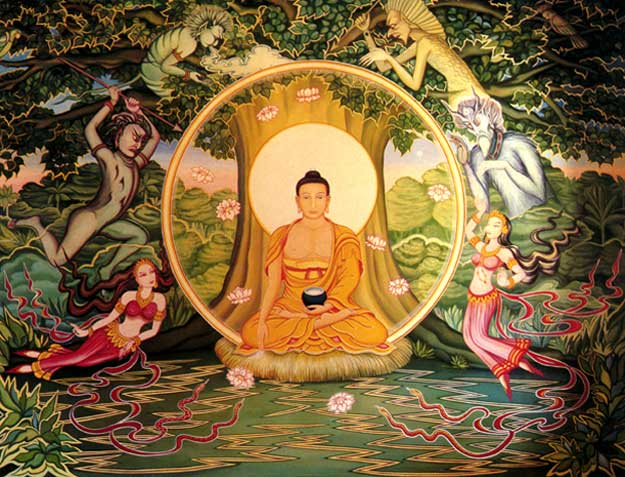
Buddha Purnima


Today is Buddha Purnima, or Vesak, the full-moon associated with the birth, enlightenment and passing away of the Buddha, some 2550 years ago. It is a very auspicious day for Buddhists all over the world.

In an early post, I had written about the Buddha's exclamation on realising enlightenment.

Here are the lines from Sir Edwin Arnold's Light of Asia, which describe Buddha's enlightenment:

... Thus Life's thirst quenches itself
With draughts which double thirst, but who is wise
Tears from his soul this Trishna, feeds his sense
No longer on false shows, files his firm mind
To seek not, strive not, wrong not; bearing meek
All ills which flow from foregone wrongfulness,
And so constraining passions that they die
Famished; till all the sum of ended life -
The Karma - all that total of a soul
Which is the things it did, the thoughts it had,
The 'Self' it wove - with woof of viewless time,
Crossed on the warp invisible of acts -
The outcome of him on the Universe,
Grows pure and sinless; either never more
Needing to find a body and a place,
Or so informing what fresh frame it takes
In new existence that the new toils prove
Lighter and lighter not to be at all,
Thus "finishing the Path;" free from Earth's cheats;
Broken from ties - from Upâdânas - saved
From whirling on the wheel; aroused and sane
As is a man wakened from hateful dreams.
Until - greater than Kings, than Gods more glad! -
The aching craze to live ends, and life glides -
Lifeless - to nameless quiet, nameless joy,
Blessed NIRVANA - sinless, stirless rest -
That change which never changes!

May peace prevail on earth, may all beings be well.

Image: Enlightenment Scene, Temple painting in Bodhgaya, India, by Marianna Rydvald.

Thursday, April 26, 2007

P Lal


I have written about Sasthi Brata, and Subimal Misra. But it was remiss of me not to have expressed my reverence for Purushottam Lal. Born in 1929, P Lal is a teacher, literature scholar, poet, writer, trans-creator, publisher, editor and book-maker, who made Calcutta his home.

Writers Workshop, started by P Lal in 1958, has published over 3,000 titles.

“Alternative publishing is desperately needed whenever commercial publication rules. WW is not a professional publishing house. It does not print well-known names. It makes names known and well known, and then leaves them in the loving clutches of the so-called “free market” (which can be and is very cut-throat and very expensive). It is not sad, it is obnoxious, to plead, as publishers do, “I will not publish poetry because it does not sell”. Most English book publishing today in boom-time India and outside is book-dumping. There is a nexus between high-profile PR-conscious book publishers, semi-literate booksellers, moribund public and state libraries, poorly informed and nepotistic underlings in charge of book review pages and supplements of most national newspapers and magazines, and biased bulk purchases of near worthless books by bureaucratic institutions set up – believe it or not! – to inform, educate and elevate the reading public.

…WW goes in for serious creative writing.”

(from "Writers Workshop - A Credo", by P. Lal)


Among writers and poets whose early work was published by WW are Vikram Seth, Nissim Ezekiel, Jayanta Mahapatra, Ruskin Bond, Pritish Nandy and Chitra Banerjee Divakaruni.

Yesterday I finally got myself a copy of P Lal’s Calcutta - A Long Poem. With some books, the resonances associated, even before reading, are so powerful that its almost impossible to read. The book becomes a very special magical instrument, of sens-ation.

From the very dedication, to Fr Thomas Merton. Just reading the Preface yesterday - I was plunged in Merton, and thus, Abraham Joshua Heschel (with whom Merton shared a correspondence and friendship towards the end of his life), both of whom are very dear to me through their writings.

That P Lal knew Merton, and met him just before his accidental death (which I did not know about) …

This morning I ventured to the book’s Prelude, and "Mr Mervyn D'Mello". So many resonances, so many things separated in space-time yet now co-existent through my reading.

For more than 20 years, Calcutta has been my life and life-work. And since 2005, I have been engaged in translating the stories of Subimal Misra. Reading Calcutta - A Long Poem - I have gained an altogether new perspective. P Lal has entirely anticipated Subimal Misra's concerns and work, and also mine.

For me, reading Calcutta now is like coming full circle, knowing myself and my city, Calcutta - my "valley of sorrows" too - anew.

I wish the world of literature / publishing had something like an "Oscar" for Lifetime Achievement. P Lal would be a unique and apt recipient of such an award. Perhaps the Nobel Prize itself could be such an award. Nothing would give me greater happiness than to see this conferred on him in his lifetime. But irrespective of that, I would still venerate him within myself, and as a Calcuttan, take pride in him and consider myself fortunate to live in the same city as him.

P Lal's essay "Indian Influences on English, American and European Literature" is accessible here. The concluding section of this essay talks about The Beatles. I recall attending a lecture-audio presentation by P Lal on this subject at the British Council in Calcutta in late 1976.

I was happy to see an entry on P Lal on Wikipedia.

Read Anjana Basu’s tribute to P Lal.

Friday, April 13, 2007

My city


After having been filled with rage, sadness and despair about Calcutta, my city has suddenly started captivating me. A few days ago driving past a pond I thought that Calcutta must be unique among cities in the world for the large number of ponds, tanks, lakes and water-bodies spread throughout the city. From the Laldighi (opposite the Writers' Buildings) and the Manohar Das Tarag (opposite the Chowringhee-Lindsay Street crossing) in the very heart of the city, to hundreds upon hundreds of small, medium and large water-bodies all over the city, and especially in its fringes.

Though water-bodies are being quietly (illegally) filled up and built on, there is a law in place, there are enforcement authorities, and public and community awareness about protecting these are growing. I would like to think Calcutta shall always have her water-bodies.

I wished I could fly over my city like a bird and have an aerial view of all the water-bodies!

Travelling to some far-flung areas, I realised I had really traversed this city through my life and work: central, north, south, east and west; day, and night. How well I knew this city, and what a feeling of intimacy and satisfaction I feel about that. The city feels like a beautiful green sheet over which my body is spread out in embrace.

Summer in Calcutta can be harsh. Around 20 November last year, I thought - now the pleasant season is here; for 3 months one will enjoy it. Towards the end of February, I was thinking, sadly, about the torrid summer to come. But the summer was late in coming. And even before its shown its fury - the cool north-wester showers and gales are here already, with no delay. How kind and loving nature is, to help us bear the coming 2 months of heat and extreme humidity before the monsoon rains descend.

In the past I have felt that Calcutta was the worst place on earth. I felt it was a maggot-infested carcass. I used to feel I was cursed to be living in Calcutta. I used to say that when people sinned grieviously, they were reborn to live in Calcutta, to pay for their sins. But now I think Calcutta must be the most pleasant, comfortable and gentle place to live in, among all the metro cities in India. It is also perhaps the cleanest, prettiest and most well-maintained city among all the metro cities. While all my rage and despair arose from society, culture and politics, it is my growing sensitivity to NATURE in my city and fond attachment to her common folk that makes me feel this way now. After a very long time, simply being here makes me happy. I feel like a member of a proud, privileged elite.

I cannot but remember the lines of the great 19th century Persian and Urdu poet of India, Mirza Ghalib:

One should be grateful that such a city as Calcutta exists. Where else in the world is there a city so refreshing? To sit in the dust of Calcutta is better than to grace the throne of another dominion. By God, had I not been a family man, with regard for the honor of my wife and children, I would have cut myself free and made my way there. There I would have lived till I died, in that heavenly city, free from all cares. How delightful are its cool breezes, and how pleasant is its water. How excellent are its pure wines and its ripe fruits!

If all the fruits of Paradise lay there outspread before you,
The mangoes of Calcutta still would haunt your memory.


And also :

Ah me, my friend! The mention of Calcutta’s name
Has loosed a shaft that pierces to my very soul.
Its greenery and verdure take away your breath;
Its women’s charms are such that none escapes them whole.

... All freshness and all sweetness are its luscious fruits;
Its mellow wines are pleasing beyond all compare.


Image: Radar image of Calcutta, source - NASA.

Sunday, March 18, 2007

Nandigram sms


feley diye marxbaad
copy holo baghdad
buddho ke boley bush
mon aaj khub khush
cholo kori fondi
dhoro aaro nandi

Casting aside Marxism
Baghdad's been copied.
Bush tells Buddha
I'm really happy today
Come lets conspire
To grab more Nandis.

Nandigram: Joy Goswami


Poet Joy Goswami has written two poems to symbolise people's outrage and protest against the Nandigram massacre. I am reproducing them below, in Bangla, together with my attempted translation.

Tumi aar tomaar cadre

1.

daley daley motor bike-ey
dhukey podey, kaara dhukey podey
bhorbela kaara dhukey podey

jaana jaay na - kintu taar-i porey
ey-gramey o-gramey, ghorey ghorey

abaadhey krishakrokto jhorey
jagroto krishokrokto jhorey

2.

ostro proyoger odhikaari
tumi aar tomaar cadre

aamraa shudhu khun hotey paari
mukh bujey khun hotey paari

ey-i aamaader odhikaar
ey-i ekmaatro odhikaar

You and your cadre

1.

They enter in droves on motorbikes
Who enters?
Who enters at dawn?

Its not possible to know -
but just after that
in this village and that village,
in home after home

Peasantblood flows without letup
Awakened peasantblood flows

2.

You and your cadre
have the right to use arms

We can only be murdered
Remain silent and get murdered

That's our right
That's our singular right

Shashok-er proti

aapni jaa bolben aami thik
taa-i korbo, taa-i khaabo, taa-i porbo, taa-i gayey mekhey
bedaatey berobo.
aamaar nijer jomi chhedey diye choley jaabo kothati na-boley

bolben, golaay dori diyey jhuley thako shaararaat. taa-i thakbo. pordin jokhon
bolben eybaar nemey esho
tokhon kintu lok laagbey aamaakey naamaatey
eka-eka naamtey paarbo na

otuku paarini boley oporadh neben na jaeno

For the oppressor

Whatever you say, I shall do exactly
that, I'll eat exactly that, wear exactly that, apply exactly that on my body
And leave to go out.
I'll abandon my own land and go away without so much as a word.

Tell me, put a rope around your neck and hang all night. I'll stay like that.
But the next day
when you say, now come down
You'll need people to bring me down
I won't be able to come down by myself

Don't take offence that I couldn't do that bit