Showing posts with label Hazrat Inayat Khan. Show all posts

Tuesday, September 12, 2006

Hazrat Inayat Khan’s elaboration


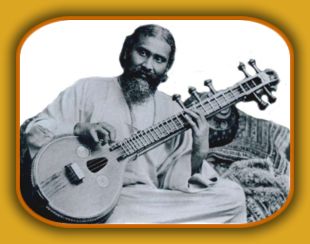
Hazrat Inayat Khan, founder of the Sufi Order in the west, was born in India in 1882. A master of classical Indian music by the age of twenty, he relinquished a brilliant career to devote himself to the spiritual path. In 1910, he left India to became one of the first teachers of the Sufi tradition in the west. For a decade and a half he travelled throughout Europe and the United States, giving lectures and guiding an ever-growing group of seekers. In 1926, he returned to India, where he died the following year.

I discovered Inayat Khan’s writings in 1998. I came across the following prayer, which seemed to me an elaboration of the Fatiha.


Praise be to Thee, Most Supreme God,
Omnipotent, Omnipresent, All-pervading, the Only Being.
Take us in Thy Parental Arms, raise us from the denseness of the earth,
Thy Beauty do we worship, to Thee do we give willing surrender.
Most Merciful and Compassionate God, the Idealized Lord of the whole humanity,
Thee only do we worship, and towards Thee Alone do we aspire.
Open our hearts towards Thy Beauty, illuminate our souls with Divine Light,
O Thou, the Perfection of Love, Harmony and Beauty,
All-powerful Creator, Sustainer, Judge and Forgiver of our shortcomings,
Lord God of the East and of the West,
of the worlds above and below,
and of the seen and unseen beings.
Pour upon us Thy Love and Thy Light,
give sustenance to our bodies, hearts and souls,
use us for the purpose that Thy Wisdom chooseth,
and guide us on the path of Thine Own Goodness.
Draw us closer to Thee every moment of our life,
until in us be reflected Thy Grace, Thy Glory, Thy Wisdom, Thy Joy and Thy Peace.

Amen

Saturday, August 05, 2006

The symbology of religious ideas

Hazrat Inayat Khan

Zirat represents a mystical awakening, experienced through working upon oneself, freeing the mind from unwanted thoughts and regrets which, like weeds, present a hindrance on the path of inner culture. The word Zirat means agriculture, referring in this context to the symbolic work of the farmer digging out old roots to prepare the soil for the new crop, and watching over the various stages in the cultivation of the precious seed.

The wise have given lessons to the world in different forms suited to the evolution of the people at a particular time, and the first and most original form of education that the wise gave to the world was symbolical. This method of teaching has been valued in all ages, and will always have its importance. That is not beauty which is not veiled. In the veiling and unveiling of beauty is the purpose of life. Beauty is that which is always out of reach. You see it and you do not see it. You touch it and you cannot touch it. It is seen and yet veiled; it is known and yet unknown. And therefore words are often inadequate to express the beauty of Truth. Therefore symbolism is adopted by the wise.

The religions of the ancient Egyptians, of the Greeks, of the Hindus, and of the Parsis, all have symbols which express the essential truth hidden under each of them. There is symbolism in Christianity and in many other religions. Man has often rebelled against symbolism, but this is natural, as man has always revolted against things he cannot understand. There has been a wave of opposition to symbolism in both the East and the West. In the East it came in the period of Islam, and in the West it re-echoed in the Reformation. No doubt when the sacred symbols are made into patents by the religions which want to monopolize the whole truth for themselves, it encourages that tendency in human nature which is always ready either to accept or to reject things. However, one can say without exaggeration that symbology has served to keep the ancient wisdom intact for ages. There are many ideas relating to human nature, to the nature of life, to God and His many attributes, and to the path towards the goal, which can be and have been expressed in symbols.

To a person who sees only the surface of life, symbols mean nothing. The secret of symbols is revealed to souls who can see through life, whose glance penetrates through objects. Verily, the things of the world disclose themselves to the seer and in this uncovering beauty is hidden. There is a great joy in understanding, especially in understanding things which mean nothing to most people. It requires intuition to read symbols, even something deeper than intuition, namely insight. To the one to whom symbols speak of their nature and of their secret, each symbol is in itself a living manuscript. Symbology is the best means of learning the mysteries of life, and also one of the best ways of passing on ideas which will continue to live after the teacher has passed away. It is speaking without speaking; it is writing without writing. The symbol may be said to be an ocean in a drop.

The symbol of the dove


Hazrat Inayat Khan

The bird represents the wayfarer of the sky, and at the same time it represents a being who though it belongs to the earth is capable of dwelling in the skies. The former explanation of the bird represents the idea of a soul whose dwelling place is heaven, and the latter represents the dweller on earth being able to move about in the higher spheres; and both these explanations give the idea that the spiritual man, dwelling on the earth, is from heaven. They also explain that the spiritual man is the inhabitant of the heavens and is only dwelling on earth for a while.

The pigeon is used as a messenger, to carry a message from one place to another, and therefore the symbol of the dove is a natural one to represent the messenger from above. Spiritual bliss is such a wonderful experience that if a bird or an animal were to have it, it would never return to its own kind. But it is to man's credit that after touching that point of great happiness and bliss he comes back into the world of sorrows and disappointments and delivers his message.

This quality can also be seen in the pigeon: when the pigeon is sent it goes, but it faithfully comes back to its master. The spiritual man performs this duty doubly: he reaches higher than the human plane, touches the divine plane, and brings the message from the divine to the human plane. In this way, instead of remaining on the divine plane, he returns to be among his fellowmen for their welfare, which is no small sacrifice. Besides he performs a duty to God, from whom he brings the message which he delivers to humanity. He lives as a human being, subject to love, hate, praise, and blame; he passes his life in the world of attachment and the life that binds him with a thousand ties on all sides; and yet he does not forget the place whence he has come, and he constantly and eagerly looks forward to reaching the goal for which he is bound. Therefore in both these journeys, from earth to heaven and from heaven to earth, the idea of the dove proves to be the most appropriate of all.

Krishna's Flute


Hazrat Inayat Khan

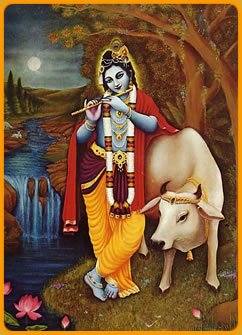
Krishna is pictured in Hindu symbology with a crown of peacock's feathers, playing the flute. Krishna is the ideal of divine love, the God of love. And the divine love expresses itself by entering into man and filling his whole being. Therefore the flute is the human heart, and a heart which is made hollow will become a flute for the God of love to play upon. When the heart is not empty, in other words, when there is not scope in the heart, there is no place for love.

Rumi, the great poet of Persia, explains this idea more clearly. He says the pains and sorrows the soul experiences through life, are like holes made in a reed flute, and it is by making these holes that a player makes the flute out of a reed. This means that the heart of man is first a reed, and the sufferings and pains it goes through make it a flute, which can then be used by God as the instrument for the music that He constantly wishes to produce. But as every reed is not a flute, so every heart is not His instrument. As the reed can be made into a flute, so the human heart can be turned into an instrument, and can be offered to the God of love.

It is the human heart which becomes the harp of the angels; it is the human heart which is known as the lute of Orpheus. It was on the model of the heart of man that the first instrument of music was made, and no earthly instrument can produce that music which the heart produces, raising the mortal soul to immortality.

The crown of peacock's feathers leads to a further revelation: that it is the music of the heart which can be expressed through the head; it is the knowledge of the head and the love of the heart that together fully express the divine message. The peacock's feather in all ages has been considered as a sign of beauty and knowledge; beauty because it is beautiful, knowledge because it is in the form of an eye. It is by keen observation that man acquires knowledge. Knowledge without love is lifeless. So, with the flute, the crown of peacock's feathers makes the symbol complete.