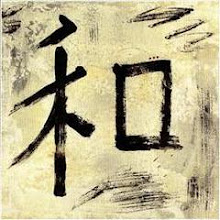

Once there was a man who wanted to have a lion tattooed on his back.
He went to a tattoo artist and told him what he wanted.
But as soon as he felt the first few pricks, this man began to moan and grown: ‘You are killing me. What part of the lion are you making?’
‘I am just doing the tail now,’ said the artist.
‘Then let us leave out the tail,’ howled the other.
So the artist started again. And again the client could not stand the pricks. ‘What part of the lion is it this time?’ he cried, ‘for I cannot stand the pricks.’
‘This time,’ said the tattooist, ‘it is the lion’s ear.’
‘Let us have a lion without an ear,’ gasped the patient.
So the tattooist tried again. No sooner had the needle entered his skin that the victim squirmed again: ‘Which part of the lion is it this time?’
‘This is the lion’s stomach,’ wearily answered the artist.
‘I don’t want a lion with a stomach,’ said the other man.
Exasperated and distraught, the tattoo artist stood awhile. Then he threw his needle down and cried: ‘A lion without a head, with no tail, without a stomach? Who could draw such a thing? Even God did not!’
Rumi
From: The Way of the Sufi, by Idries Shah.
Showing posts with label Idries Shah. Show all posts
Showing posts with label Idries Shah. Show all posts
Sunday, September 24, 2006


Why the Dervish Hides Himself
Rumi’s son asked him:
‘How and why is the dervish hidden? Is this done by superficial disguise? Is there something within himself which he conceals?’
The Master said:
‘It might be done in any way. Some write love-poems, and people think that they mean ordinary love. The dervish may hide his true position in the Way by adopting a calling. There are writers; and some, like Baba Farid, are traders. Still others follow various different outer activities.
‘This may be done for the sake of defence against the shallow. Some purposely act in a manner which society might disapprove.
‘The Prophet has therefore said: “God has hidden the Men of Greatest Knowledge.”
‘A device may be adopted by the Followers of the Way to gain peace, when they might otherwise be hindered.’
The master then recited:
Ever-knowing – as they hide and seek.
Appearing other than they are – to the ordinary man;
In inward light they roam – making miracles come to pass.
Yet they are really known – to none.
Munaqib el-Arifin
From: The Way of the Sufi, by Idries Shah.
‘How and why is the dervish hidden? Is this done by superficial disguise? Is there something within himself which he conceals?’
The Master said:
‘It might be done in any way. Some write love-poems, and people think that they mean ordinary love. The dervish may hide his true position in the Way by adopting a calling. There are writers; and some, like Baba Farid, are traders. Still others follow various different outer activities.
‘This may be done for the sake of defence against the shallow. Some purposely act in a manner which society might disapprove.
‘The Prophet has therefore said: “God has hidden the Men of Greatest Knowledge.”
‘A device may be adopted by the Followers of the Way to gain peace, when they might otherwise be hindered.’
The master then recited:
Ever-knowing – as they hide and seek.
Appearing other than they are – to the ordinary man;
In inward light they roam – making miracles come to pass.
Yet they are really known – to none.
Munaqib el-Arifin
From: The Way of the Sufi, by Idries Shah.
The Teacher
Seek the appearance of a Teacher who does not seem to be the kind of teacher expected by the thinker or the pious. This is because among the thinkers and the pious there are some who will recognise him in any case. But those who have merit and ability for the way and are not accustomed to the behaviour of the thinking and the pious will reject the Teacher if he wears the appearance of those whom they do not understand.
Najmuddin Kubra
From: The Way of the Sufi, by Idries Shah.
Najmuddin Kubra
From: The Way of the Sufi, by Idries Shah.
The Design
A Sufi of the Order of the Naqshbandis was asked:
‘Your Order’s name means, literally, “The Designers”. What do you design, and what use is it?’
He said:
‘We do a great deal of designing, and it is most useful. Here is a parable of one such form.
‘Unjustly imprisoned, a tinsmith was allowed to recive a rug woven by his wife. He prostrated himself upon the rug day after day to say his prayers, and after some time he said to his jailers:
‘ “I am poor and without hope, and you are wretchedly paid. But I am a tinsmith. Bring me tin and tools and I shall make small artefacts which you can sell in the market, and we shall both benefit.”
‘The guards agreed to this, and presently the tinsmith and they were both making a profit, from which they bough food and comforts for themselves.
‘Then, one day, when the guards went to the cell, the door was open, and he was gone.
‘Many years later, when this man’s innocence had been established, the man who had imprisoned him asked him how he had escaped, what magic he had used. He said:
‘ “It’s a matter of design, and design within design. My wife is a weaver. She found the man who had made the locks of the cell door, and got the design from him. This she wove into the carpet, at the spot where my head touched in prayer five times a day. I am a metal-worker, and this design looked to me like the inside of a lock. I designed the plan of the artefacts to obtain the materials to make the key – and I escaped.”
‘That,’ said the Naqshbandi Sufi, ‘is one of the ways in which man may make his escape from the tyranny of his captivity.’
From: Thinkers of the East, by Idries Shah.
‘Your Order’s name means, literally, “The Designers”. What do you design, and what use is it?’
He said:
‘We do a great deal of designing, and it is most useful. Here is a parable of one such form.
‘Unjustly imprisoned, a tinsmith was allowed to recive a rug woven by his wife. He prostrated himself upon the rug day after day to say his prayers, and after some time he said to his jailers:
‘ “I am poor and without hope, and you are wretchedly paid. But I am a tinsmith. Bring me tin and tools and I shall make small artefacts which you can sell in the market, and we shall both benefit.”
‘The guards agreed to this, and presently the tinsmith and they were both making a profit, from which they bough food and comforts for themselves.
‘Then, one day, when the guards went to the cell, the door was open, and he was gone.
‘Many years later, when this man’s innocence had been established, the man who had imprisoned him asked him how he had escaped, what magic he had used. He said:
‘ “It’s a matter of design, and design within design. My wife is a weaver. She found the man who had made the locks of the cell door, and got the design from him. This she wove into the carpet, at the spot where my head touched in prayer five times a day. I am a metal-worker, and this design looked to me like the inside of a lock. I designed the plan of the artefacts to obtain the materials to make the key – and I escaped.”
‘That,’ said the Naqshbandi Sufi, ‘is one of the ways in which man may make his escape from the tyranny of his captivity.’
From: Thinkers of the East, by Idries Shah.
I’ll Make You Remember

One day Latif the Thief ambushed the commander of the Royal Guard, captured him and took him to a cave.
‘I am going to say something that, no matter how much you try, you will be unable to forget,’ he told the infuriated officer.
Latif made his prisoner take off all his clothes. Then he tied him, facing backwards, on a donkey.
‘You may be able to make a fool of me,’ screamed the soldier, ‘but you’ll never make me think of something if I want to keep it out of my mind.’
‘You have not yet heard the phrase which I want you to remember,’ said Latif. ‘I am turning you loose now, for the donkey to take back to town. And the phrase is:
‘ “I’ll catch and kill Latif the Thief, if it takes me the rest of my life!’ ”
From: Thinkers of the East, by Idries Shah.
Eat No Stones
A hunter, walking through some woods, came upon a notice. He read the words:
STONE-EATING IS FORBIDDEN
His curiosity was stimulated, and he followed a track which led past the sign until he came to a cave at the entrance to which a Sufi was sitting.
The Sufi said to him:
‘The answer to your question is that you have never seen a notice prohibiting the eating of stones because there is no need for one. Not to eat stones may be called a common habit.
‘Only when the human being is able simultaneously to avoid other habits, even more destructive than eating stones, will he be able to get beyond his present pitiful state.’
From: The Way of the Sufi, by Idries Shah.
STONE-EATING IS FORBIDDEN
His curiosity was stimulated, and he followed a track which led past the sign until he came to a cave at the entrance to which a Sufi was sitting.
The Sufi said to him:
‘The answer to your question is that you have never seen a notice prohibiting the eating of stones because there is no need for one. Not to eat stones may be called a common habit.
‘Only when the human being is able simultaneously to avoid other habits, even more destructive than eating stones, will he be able to get beyond his present pitiful state.’
From: The Way of the Sufi, by Idries Shah.
Saturday, September 23, 2006
The Most Great Name
A fakir in India asked a Sufi whether he would tell him the Most Great Name: the Hundredth Name of Allah. Those who know it can perform miracles, altering the course of life and of history. None may know it until he is worthy.
The Sufi said:
'In accordance with tradition, I must first give you the test which will show your capacity. You must go to the gate of this city and remain there until nightfall, returning to me then to describe something which you will have witnessed.'
The fakir eagerly did as he was told. After nightfall he came back and gave his report to the sage in these terms:
'As instructed, I positioned myself at the city gate in a condition of alertness. The incident which most impressed me during the day concerned an old man. He wanted to enter our city with a huge load of firewood on his back.
'The gatekeeper insisted on his paying a tax on the value of his goods. The old man, being penniless, asked that he be allowed to sell his wood first. Realising that he was friendless and helpless, the gatekeper forced him to hand over his wood, which he stole for himself. The old man was driven away with cruel blows.'
The Sufi said:
'What were your feelings when you saw this?'
The fakir answered:
'I desired even more strongly to know the Most Great Name. Had I known it, the case would have been different for that unfortunate and innocent wood-cutter.'
The Sufi said:
'O man born to attain felicity! I myself learned the Hundredth Name from my own Master, after he had tested my resolution and ascertained whether I was an impulsive emotionalist or a servant of man, and after he had subjected me to experiences which would allow me to see my own thoughts and conduct.
'The Hundredth Name is for the service of all mankind, all the time. My Master was none other than the wood-cutter whom you saw today, by the city gate.
From: Thinkers of the East, by Idries Shah.
The Sufi said:
'In accordance with tradition, I must first give you the test which will show your capacity. You must go to the gate of this city and remain there until nightfall, returning to me then to describe something which you will have witnessed.'
The fakir eagerly did as he was told. After nightfall he came back and gave his report to the sage in these terms:
'As instructed, I positioned myself at the city gate in a condition of alertness. The incident which most impressed me during the day concerned an old man. He wanted to enter our city with a huge load of firewood on his back.
'The gatekeeper insisted on his paying a tax on the value of his goods. The old man, being penniless, asked that he be allowed to sell his wood first. Realising that he was friendless and helpless, the gatekeper forced him to hand over his wood, which he stole for himself. The old man was driven away with cruel blows.'
The Sufi said:
'What were your feelings when you saw this?'
The fakir answered:
'I desired even more strongly to know the Most Great Name. Had I known it, the case would have been different for that unfortunate and innocent wood-cutter.'
The Sufi said:
'O man born to attain felicity! I myself learned the Hundredth Name from my own Master, after he had tested my resolution and ascertained whether I was an impulsive emotionalist or a servant of man, and after he had subjected me to experiences which would allow me to see my own thoughts and conduct.
'The Hundredth Name is for the service of all mankind, all the time. My Master was none other than the wood-cutter whom you saw today, by the city gate.
From: Thinkers of the East, by Idries Shah.
The Dervish under a Vow of Solitude
A dervish under a vow of solitude sat in a desert as a king passed with his retinue. Being in a special state of mind he took no notice, not even raising his head as the procession passed.
The king, emotionally overcome by his regal pretensions, was angry and said: 'These wearers of the patchwork robe are as impassive as animals, possessing neither politeness nor due humility.'
His vizier approached the dervish, saying: 'O dervish! The Sultan of the whole of the Earth has just passed by you. Why did you not pay the required homage?'
The dervish answered: 'Let the Sultan look for homage from those who seek to benefit from his goodwill. Tell him, too, that kings are created for the protection of their subjects. Subjects are not created for the service of kings.'
From: The Way of the Sufi, by Idries Shah.
The king, emotionally overcome by his regal pretensions, was angry and said: 'These wearers of the patchwork robe are as impassive as animals, possessing neither politeness nor due humility.'
His vizier approached the dervish, saying: 'O dervish! The Sultan of the whole of the Earth has just passed by you. Why did you not pay the required homage?'
The dervish answered: 'Let the Sultan look for homage from those who seek to benefit from his goodwill. Tell him, too, that kings are created for the protection of their subjects. Subjects are not created for the service of kings.'
From: The Way of the Sufi, by Idries Shah.
Ajnabi (Stranger)
The Sufi Master Ajnabi said:
'Write to Mulla Firoz and tell him that I have no time to engage him in correspondence, and therefore have nothing to say to his letter.'
The disciple Amini said:
'Is it your intention to annoy him with this letter?'
Ajnabi said:
'He has been annoyed by some of my writings. This annoyance has caused him to write to me. My purpose in writing the passage which angers him was to anger such as he.'
Amini said:
'And this letter will anger him further?'
Ajnabi said:
'Yes. When he was enraged at what I wrote, he did not observe his own anger, which was my intention. He thought that he was observing me, whereas he was only feeling angry. Now I write again, to arouse anger, so that he will see that he is angry. The objective is for the man to realise that my work is a mirror in which he sees himself.'
Amini said:
'The people of the ordinary world always regard those who cause anger as ill-intentioned.'
Ajnabi said:
'The child may regard the adult who tries to remove a thorn from his hand as ill-intentioned. Is that a justification for trying to prevent the child from growing up?'
Amini said:
'And if the child harbours a grudge against the adult who removes the thorn?'
Ajnabi said:
'The child does not really harbour that grudge, because something in him knows the truth.'
Amini asked him:
'But what happens if he never gets to know himself, and yet continues to imagine that others are motivated by personal feelings?'
Ajnabi said:
'If he never gets to know himself, it makes no difference as to what he thinks of other people, because he can never have any appreciation of what other people are really like.'
Amini asked:
'Is it not possible instead of arousing anger a second time to explain that the original writing was composed for this purpose, and to invite the Mulla to review his personal feelings?'
Ajnabi said:
'It is possible to do this, but it will have no effect. Rather it will have an adverse effect. If you tell the man your reason he will imagine that you are excusing yourself, and this will arouse in him sentiments which are harmful only to him. Thus, by explaining you are actually acting to his detriment.'
Amini said:
'Are there no exceptions to this rule, than man must learn through realising his own state, and that his state cannot be explained to him?'
Ajnabi said:
'There are exceptions. But if there were enough exceptions to make any difference to the world, we would not by now have any Mulla Firozes left.'
From: Thinkers of the East, by Idries Shah.
'Write to Mulla Firoz and tell him that I have no time to engage him in correspondence, and therefore have nothing to say to his letter.'
The disciple Amini said:
'Is it your intention to annoy him with this letter?'
Ajnabi said:
'He has been annoyed by some of my writings. This annoyance has caused him to write to me. My purpose in writing the passage which angers him was to anger such as he.'
Amini said:
'And this letter will anger him further?'
Ajnabi said:
'Yes. When he was enraged at what I wrote, he did not observe his own anger, which was my intention. He thought that he was observing me, whereas he was only feeling angry. Now I write again, to arouse anger, so that he will see that he is angry. The objective is for the man to realise that my work is a mirror in which he sees himself.'
Amini said:
'The people of the ordinary world always regard those who cause anger as ill-intentioned.'
Ajnabi said:
'The child may regard the adult who tries to remove a thorn from his hand as ill-intentioned. Is that a justification for trying to prevent the child from growing up?'
Amini said:
'And if the child harbours a grudge against the adult who removes the thorn?'
Ajnabi said:
'The child does not really harbour that grudge, because something in him knows the truth.'
Amini asked him:
'But what happens if he never gets to know himself, and yet continues to imagine that others are motivated by personal feelings?'
Ajnabi said:
'If he never gets to know himself, it makes no difference as to what he thinks of other people, because he can never have any appreciation of what other people are really like.'
Amini asked:
'Is it not possible instead of arousing anger a second time to explain that the original writing was composed for this purpose, and to invite the Mulla to review his personal feelings?'
Ajnabi said:
'It is possible to do this, but it will have no effect. Rather it will have an adverse effect. If you tell the man your reason he will imagine that you are excusing yourself, and this will arouse in him sentiments which are harmful only to him. Thus, by explaining you are actually acting to his detriment.'
Amini said:
'Are there no exceptions to this rule, than man must learn through realising his own state, and that his state cannot be explained to him?'
Ajnabi said:
'There are exceptions. But if there were enough exceptions to make any difference to the world, we would not by now have any Mulla Firozes left.'
From: Thinkers of the East, by Idries Shah.
Thursday, September 14, 2006
Dogs (& monkeys)

I recently came across, in succession, some posts about dogs by bloggers Flitzy, Kathy, Flitzy again, and Darvish. And a hilarious image in Planck’s Constant. There’s also of course Hayden, who regularly writes about dogs.
This brought to mind the several Sufi dog tales I have among my books. I had paid particular attention to this subject, of dog as metaphor, in terms of reflection, associations etc. I had also once shared these stories with a friend who’s particularly close to dogs.
So, as promised to Kathy, I am now transcribing and posting these.
By posting the following five dog tales, I also pay tribute to the late Idries Shah, the author of many books on Sufi philosophy and teachings. Through his books, he has been a dear and intimate friend and guide.
This is a first offering. More to follow, from the stories of Muslim saints and mystics.
In Hindu religious mythology, there is Hanuman, the monkey son of Wind. He is a principal character in the Ramayana epic, the one who helps Lord Rama defeat the evil King Ravana of Lanka, and rescue his abducted wife Sita. Hanuman is an exemplar of devotion. It is said that wherever and whenever the Ramayana is narrated, Hanuman is present in that assembly.
Like with Sufi dog tales, I have thought long and hard about this monkey business. Why a monkey? Together with Hanuman and the army of monkeys who helped Lord Rama, there were also bears, and even a squirrel! There is a tale of how the squirrel got the marking on the top of its fur, for its wish and efforts to help Lord Rama build the bridge across the sea, to Lanka.
I realised that in the racially and socially stratified Indian setting - all this has profound meanings and resonances in the consciousness of a seeker, of someone engaging compassionately with common people, and working for social justice. These meanings cannot be explained by one to another, like feeding regurgitated pre-masticated pap! It is for each seeker to encounter such tales and symbols, discern their significance, and reflect upon them in the mirror of her own life experience and work.
Cartoon: off the mark
The Teacher and the Dog
A Sufi teacher, walking along a road with a student, was assailed by a ferocious dog.
The disciple was furious and cried out:
‘How dare you approach my master in such a manner?’
‘He is more consistent than you are,’ said the Sage, ‘for he barks at anyone, in accordance with his habit and proclivities; while you regard me as your master and are wholly insensitive to the merits of the many illuminates whom we have already passed on this journey, dismissing them without a second glance.’
From: The Way of the Sufi, by Idries Shah.
The disciple was furious and cried out:
‘How dare you approach my master in such a manner?’
‘He is more consistent than you are,’ said the Sage, ‘for he barks at anyone, in accordance with his habit and proclivities; while you regard me as your master and are wholly insensitive to the merits of the many illuminates whom we have already passed on this journey, dismissing them without a second glance.’
From: The Way of the Sufi, by Idries Shah.
The Sufi Who Called Himself a Dog
Maulana Dervish, chief of the Naqshbandi Order and one of its greatest teachers, was sitting one day in his Zavia when a furious cleric forced his way in.
‘You sit there,’ shouted the intruder, ‘dog that you are, surrounded by disciples, obeyed by them in every particular! I, on the other hand, call men to strive towards divine mercy through prayer and austerities as is enjoined upon us.’
At the word ‘dog’, several of the Seekers rose to eject the fanatic.
‘Stay,’, said the Maulana, ‘for “dog” is indeed a good word. I am a dog, who obeys his mater, showing the sheep by signs the interpretation of our Master’s desires. Like a dog I infuriate the interloper and the thief. And I wag my tail in pleasure when my master’s Friends come near.
‘Just as barking and wagging and love are attributes of the dog, we exercise them; for our Master has us, and does not do his own barking and wagging.’
From: The Way of the Sufi, by Idries Shah.
‘You sit there,’ shouted the intruder, ‘dog that you are, surrounded by disciples, obeyed by them in every particular! I, on the other hand, call men to strive towards divine mercy through prayer and austerities as is enjoined upon us.’
At the word ‘dog’, several of the Seekers rose to eject the fanatic.
‘Stay,’, said the Maulana, ‘for “dog” is indeed a good word. I am a dog, who obeys his mater, showing the sheep by signs the interpretation of our Master’s desires. Like a dog I infuriate the interloper and the thief. And I wag my tail in pleasure when my master’s Friends come near.
‘Just as barking and wagging and love are attributes of the dog, we exercise them; for our Master has us, and does not do his own barking and wagging.’
From: The Way of the Sufi, by Idries Shah.
Why the Dog Could Not Drink
Shebli was asked:
‘Who guided you in the Path?’
He said: ‘A dog. One day I saw him, almost dead with thirst, standing by the water’s edge.
‘Every time he looked at his reflection in the water he was frightened, and withdrew, because he thought it was another dog.
‘Finally, such was his necessity, he cast away fear and leapt into the water; at which the “other dog” vanished.
‘The dog found that the obstacle, which was himself, the barrier between him and what he sought, melted away.
‘In this same way my own obstacle vanished, when I knew that it was what I took to be my self. And my Way was first shown to me by the behaviour of – a dog.’
From: The Way of the Sufi, by Idries Shah.
‘Who guided you in the Path?’
He said: ‘A dog. One day I saw him, almost dead with thirst, standing by the water’s edge.
‘Every time he looked at his reflection in the water he was frightened, and withdrew, because he thought it was another dog.
‘Finally, such was his necessity, he cast away fear and leapt into the water; at which the “other dog” vanished.
‘The dog found that the obstacle, which was himself, the barrier between him and what he sought, melted away.
‘In this same way my own obstacle vanished, when I knew that it was what I took to be my self. And my Way was first shown to me by the behaviour of – a dog.’
From: The Way of the Sufi, by Idries Shah.
Etiquette
An inquirer asked Sayed Khidr Rumi:
‘Is there anything which can be called the best and also the worst of human institutions?’
He said:
‘Yes, indeed. There is such a thing, and its name is “etiquette”.
‘The advantage of etiquette and conduct is that it enables the Wise to approach the student without being jeered at, and it makes possible the search by the student without people thinking him ridiculous.
‘The disadvantage of etiquette which makes it the worst of human institutions is that it enables the ignorant to erect their own rules of what is permissible in thought and conduct and what is not. If such people decide that there are certain things which should never be thought or done, then they can effectively prevent the transmission of knowledge.’
The inquirer asked:
‘May I have an instance of how this happens in our teaching?’
Sayed Khidr Rumi said:
‘It has been customary for people, when they read prescribed books and accounts of the doings of the Masters, to say, “This is an analogy which does not apply to me." It also enables them to say. “This is an encounter with a stupid man. I could never think like the man in the tale; therefore the Teacher is in this instance dealing with a completely different type of person.” The reality is that such a person is always the one most in need of teaching, while he is unaware of it.
‘There is the story of the dog who was distressed when a man shouted at him, saying, “look at that mangy creature!” The dog, instead of looking for a sage who would cure his mange, jumped into a pool of water and came out dripping wet. He ran up to the man, wagging his tail, as if to say, “Look, my coat is changed, it is all dampness where before it was a dusty mat!” The man started to curse him even more strongly, because he did not want the dog to shake the water off all over him.
‘The dog became convinced that the man was irrational, while it was simply a matter that one did not understand the other. In he instance of the acts related of the Wise, the doggishness in the student must realise that the sage is talking about a real, not an illusory, improvement in his state.’
From: Thinkers of the East, by Idries Shah.
‘Is there anything which can be called the best and also the worst of human institutions?’
He said:
‘Yes, indeed. There is such a thing, and its name is “etiquette”.
‘The advantage of etiquette and conduct is that it enables the Wise to approach the student without being jeered at, and it makes possible the search by the student without people thinking him ridiculous.
‘The disadvantage of etiquette which makes it the worst of human institutions is that it enables the ignorant to erect their own rules of what is permissible in thought and conduct and what is not. If such people decide that there are certain things which should never be thought or done, then they can effectively prevent the transmission of knowledge.’
The inquirer asked:
‘May I have an instance of how this happens in our teaching?’
Sayed Khidr Rumi said:
‘It has been customary for people, when they read prescribed books and accounts of the doings of the Masters, to say, “This is an analogy which does not apply to me." It also enables them to say. “This is an encounter with a stupid man. I could never think like the man in the tale; therefore the Teacher is in this instance dealing with a completely different type of person.” The reality is that such a person is always the one most in need of teaching, while he is unaware of it.
‘There is the story of the dog who was distressed when a man shouted at him, saying, “look at that mangy creature!” The dog, instead of looking for a sage who would cure his mange, jumped into a pool of water and came out dripping wet. He ran up to the man, wagging his tail, as if to say, “Look, my coat is changed, it is all dampness where before it was a dusty mat!” The man started to curse him even more strongly, because he did not want the dog to shake the water off all over him.
‘The dog became convinced that the man was irrational, while it was simply a matter that one did not understand the other. In he instance of the acts related of the Wise, the doggishness in the student must realise that the sage is talking about a real, not an illusory, improvement in his state.’
From: Thinkers of the East, by Idries Shah.
Bayazid Bistami
Bayazid encountered a dog and started to pull his robe away from it, so that it should not defile him.
The dog, in a human voice, said:
‘If I had been dry, there would have been no purpose in avoiding me. If I had been wet, you could have washed your robe. But the hate which you have towards me can never be cleansed.’
Bayazid said:
‘O enlightened dog, come and stay with me for a while.’
The dog answered:
‘That is impossible, because the world uses me as an epithet, and you are regarded by the world as a paragon.’
Bayazid exclaimed:
‘Alas! I am not fit to live with one whom the whole world regards as inferior: how can I therefore approach the Truth which all regard as the Highest of all?’
From: The Way of the Sufi, by Idries Shah.
The dog, in a human voice, said:
‘If I had been dry, there would have been no purpose in avoiding me. If I had been wet, you could have washed your robe. But the hate which you have towards me can never be cleansed.’
Bayazid said:
‘O enlightened dog, come and stay with me for a while.’
The dog answered:
‘That is impossible, because the world uses me as an epithet, and you are regarded by the world as a paragon.’
Bayazid exclaimed:
‘Alas! I am not fit to live with one whom the whole world regards as inferior: how can I therefore approach the Truth which all regard as the Highest of all?’
From: The Way of the Sufi, by Idries Shah.
Wednesday, July 12, 2006
Rumi and poetry
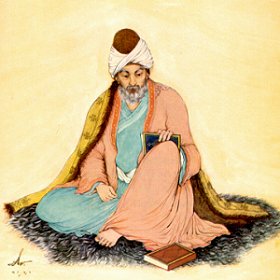 Sri Aurobindo’s optimism about poetry may be contrasted with the scepticism of Maulana Jalaludddin Rumi (1207-73), the great Persian poet, philosopher, sage, mystic and Sufi master. And the reaction of ‘literary critics’ to Aurobindo’s work may help us to understand Rumi’s attitude.
The Mathnawi-i- Manawi (Spiritual Couplets) is considered Rumi’s masterwork – six books of poetry and imagery of such power in the original that, according to Sufi writers, its recitation produces a strangely complex exaltation of the hearer’s consciousness. Prof Arberry calls Rumi the greatest mystical poet in the history of mankind. But while excelling in literary and poetic ability beyond all his contemporaries, Rumi constantly affirmed that such an attainment was a minor one compared with Sufihood. He often claimed not to be a poet at all.
What is poetry that I should boast of it,
I possess an art other than the art of the poets.
Poetry is like a black cloud; I am like the moon hidden behind its veil.
Do not call the black cloud the luminous moon in the sky.
Poetry was only a secondary product. He did not regard it as any more than a reflection of the enormous inner reality which was truth, and which he calls love. The greatest love, as he says, is silent and cannot be expressed in words. Although his poetry was to affect men’s minds in a way that can only be called magical, he was never carried away by it to the extent of identifying it with the far greater being of which it was a lesser expression. At the same time, he recognised it as something which could form a bridge between what he ‘really felt’ and what he could do for others.
Rumi assumed the role of critic of poetry. People come to him, he says, and he loves them. In order to give them something to understand, he gives them poetry. But poetry is for them, not for him, however great a poet he may be – “What, after all, is my concern with poetry?” He states categorically that in comparison with the true reality, he has no time for poetry. This is the only nutrition, he says, that his visitors can accept, “so like a good host he provides it.”
The Sufi must never allow anything to stand as a barrier between what he is teaching and those who are learning it. Hence Rumi’s insistence upon the subsidiary role of poetry in the perspective of the real quest. What he had to communicate was beyond poetry. To a mind conditioned to the belief that there is nothing more sublime than poetic expression, such a feeling might produce a sense of shock. It is just this application of impact that is necessary to the Sufi cause, in the freeing of the mind from attachment to secondary phenomena, “idols”.
Ref: Idries Shah, The Sufis, and S H Nasr, Islamic Art and Spirituality.
Miniature painting of Rumi by Hossein Behzad
Subscribe to:
Posts (Atom)

