Showing posts with label elephant. Show all posts

Monday, September 18, 2006

Vishwa Karma Puja


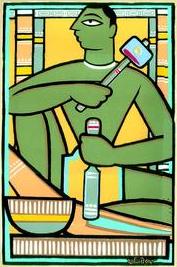
Vishwa Karma, the divine architect of the universe.

Son of Brahma, the Creator, personification of the creative power that welds heaven and earth together.

The divine carpenter carries a club in his right hand and holds tools in his left.

Revealer of
Sthapatya Veda, the science of mechanics and architecture.

Lord of the Arts.

Executor of a thousand handicrafts, most eminent of artisans, fashioner of all the ornaments, on whose craft all men subsist, and whom, a great and immortal God, they continually worship.


From the Rig Veda.


Today, 17 September, is the day of Vishwa Karma Puja in eastern India.

Vishwa Karma means “(the one who guides) the world’s work”. “Puja”, derived from Tamil, means worship or adoration, with flower offerings.

Factory workers, mechanical workshops, artisans, craftsmen etc all worship Lord Vishwa Karma on this day. It is a happy holiday for all industrial establishments. Images of Vishwa Karma, with his vehicle, an elephant, are installed in the premises. A variety of fruit offerings are made to the Lord. And there is a feast for workers, staff and their families. Vishwa Karma Puja used to be a grand affair in large industrial establishments in Calcutta. In the evenings staff associations would put up major stage productions.

In my childhood, on this day the sky in Calcutta used to be dotted with thousands of kites. In fact, non-Hindu boys used to know this as the “kite puja” day. It was the day, towards the end of the rainy (monsoon) season, on which kite flying peaked. That association with kites continues, especially for the humble folk; but in the main, kite flying has simply declined over the years due to various factors.

Boys – and men too – would fly kites from the roof terraces of their homes, or from open fields. As a song by the Bengali singer Anjan Dutt reminds us, the roof tempted and called out to the restless boy! Kite flying – was a serious sport.

Preparing the kite string (manja): using a boiled arrowroot starch base, with a garnishing of glass powdered in a mortar-pestle, and a colour of choice added; applied carefully by hand to the string strung out between lamp-posts, using small pieces of cloth; and then waiting for the string to dry; and finally reeling the crisp sharp string into the latai (the spindle-reel). This was an elaborate and sombre ritual, undertaken on the day before Vishwa Karma Puja. Rather like the elaborate preparations for pujas in my own household, which began with grinding rice flour, for making delectable sweet and savoury offerings. There was muted but feverish excitement and anticipation - of flying the kite on the day; of taunting others to fight; playing the kite and string, and trying to fathom the opponent's weakness; and then the ecstatic cry: Bokatta! I’ve cut you! Lope! Try to catch it! And finally trying to catch the flailing-sinking cut kite's on one's own string.

I never learnt to fly a kite. But I was happy to be slave, assistant and latai-holder to a master, Dhiren, the servant in our house, who was about 6 years older than me. He was outstanding, in kites as well as in marbles games, spinning tops (which also involved a fight between opponents, to break the other's top with one's top), and in dan-guli (known as guli-danda in north India), another folk sport, where a small piece of wood was sought to be hit to great distances with a longer stick.

All this required immense interest, commitment, effort, skill and talent. The expert or champion commanded great respect and awe. Slums were never too far away from the "decent folk's" neighbourhoods, and so play often involved mixed groups. Sadly, the talented champions from poor families were left behind by their better-off playmates, who went to good schools; childhood mates were parted by unequal social opportunities. One remained in a small, closed ambit; for the other it was ever-expanding horizons.

The industrial economy of Calcutta and the state of West Bengal has died over the last 4 decades. Workers of closed factories were driven to suicide. With tertiarisation of the economy, Viswa Karma Puja is today observed more by bus drivers and conductors, taxi drivers and cycle rickshaw pullers.

The last 15 years or so has seen old houses giving way to apartment blocks. Open fields and vacant plots have all gone. People do not have access to kite-flying spaces anymore. Integration between classes has waned, and disparites, alienation, polarisation and hostility has grown.

And there are so many more attractions for middle class children nowadays, from satellite television to video and computer games to amusement parks and arcades … hence children's games and sport like kite flying, marbles, spinning tops, dan-guli etc - all of which obsessed kids and teenagers in Calcutta 35-40 years ago, as well as their earlier generations - have all been forgotten. The better off sections have moved on, to new allures, leaving the traditional things to the socio-economically weak and marginal.

Calcutta used to be the centre of kite-making in India. But the kite trade in Calcutta is in poor shape today.

Though its a Sunday, I will be at our factory. This is a small manufacturing enterprise started by my late father in 1967, which I am now managing on behalf of my family. We manufacture precision instruments for industrial, scientific and medical applications. It started out as an import substitution venture; 4 years ago I began working towards export, and today our instruments are supplied worldwide. But there’s a long way to go – to secure our place in a globalising world – and much work to be done.

A sumptuous feast will be prepared. I will be serving and eating with our staff and workers. And in the evening I leave for a work-related trip, to the place of my family's roots, in south India, to return after 4 days.

May Lord Vishwa Karma’s blessings help to secure the quality of people’s lives everywhere!


Painting: Vishwa Karma, by Jamini Roy.

Wednesday, August 02, 2006

Elephant empathy


A couple of days ago, I wrote about evolution of the human personality, study of animal behaviour and social life, and Lord Buddha's Jataka Tales. Here’s an arresting report from The Economist (July 27th 2006).

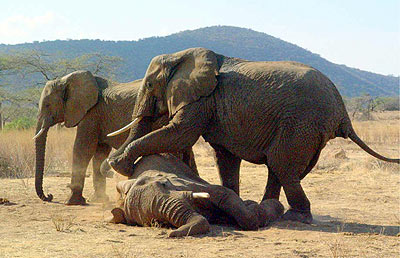
Elephants, proverbially, never forget. This photograph suggests that they may even remember their dead. It comes from a paper about to be published in Applied Animal Behaviour Science by Iain Douglas-Hamilton, a Kenyan zoologist, and his colleagues. The question of whether intelligent mammals such as elephants have similar emotional reactions to those of people is much debated in zoological circles. Mr Douglas-Hamilton's researchers were able to observe the reaction of other elephants to the death of Eleanor, the matriarch of a group called the First Ladies. The picture shows an elephant from a neighbouring group pulling at her body. On several occasions before she died, other elephants had tried to help her stand up. Such behaviour is in contrast to that shown by most animals to sick or dead individuals. They just ignore them.

The Elephant, from The Dhammapada

Let me share with friends the (23rd) chapter from The Dhammapada (the Buddha's Path of Wisdom), titled "The Elephant".


As an elephant in the battlefield withstands
arrows shot from bows all around, even so shall
I endure abuse. There are many, indeed,
who lack morality.

Tamed elephants can be led into a crowd,
and the king mounts a tamed elephant. So too,
best among people is the subdued one who
endures abuse.

Excellent are well-trained mules,
thoroughbred Sindhu horses and noble tusker
elephants. But better still is the person
who has subdued oneself.

Not by these mounts, however, can
one go to the Untrodden Land (Nirvana), as one
who is self-tamed goes by one's own tamed and
well-controlled mind.

In must during rut, the tusker named
Dhanapalaka is uncontrollable. Held in captivity,
the tusker does not touch a morsel, but only
longingly calls to mind the elephant forest.

When a person is sluggish and gluttonous,
lazy, rolling around in bed like a fat pig--that
sluggard undergoes rebirth again and again.

Formerly this mind wandered about as
it liked, where it wished, according to its pleasure,
but now I shall thoroughly master it with wisdom,
as a mahout controls an elephant in rut.

Delight in heedfulness! Guard well your
thoughts! Draw yourself out of this bog of evil,
even as an elephant draws oneself out of the mud.

If for company you find a wise and
prudent friend, one who leads a good life, you should
overcome all impediments and keep this person's
company, joyously and mindfully.

But if for company you cannot find a wise
and prudent friend, one who leads a good life,
then, like a king who leaves behind a conquered
kingdom or a lone elephant in the elephant forest,
you should go your own way alone.

Better it is to live alone, there is no
fellowship with a fool. Live alone and do no evil;
be carefree like an elephant in the elephant forest.

Good are friends when need arises; good
is contentment with just what one has; good is
merit when life is at an end; and good is the
abandoning of all suffering (through enlightenment).

Good it is to serve one's mother; good
it is to serve one's father; good it is to serve
the Sangha; and good it is to serve the holy people.

Good is virtue until life's end; good is
faith that is steadfast; good is the acquisition
of wisdom; and good is the avoidance of evil.

The Elephant and the Dog


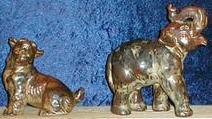
There are several stories in the Jataka Tales (stories of the Buddha’ former lives) about elephants. Here's a happy tale!

Once upon a time a Dog used to go into the stable where the king’s Elephant lived. At first the Dog went there to get the food that was left after the Elephant had finished eating.

Day after day the Dog went to the stable, waiting around for bits to eat. But by and by the Elephant and the Dog came to be great friends. Then the Elephant began to share his food with the Dog, and they ate together. When the Elephant slept, his friend the Dog slept beside him. When the Elephant felt like playing, he would catch the Dog in his trunk and swing him to and fro. Neither the Dog nor the Elephant was quite happy unless the other was nearby.

One day a farmer saw the Dog and said to the Elephant-keeper: “I will buy that Dog. He looks good-tempered, and I see that he is smart. How much do you want for the Dog?”

The Elephant-keeper did not care for the Dog, and he did want some money just then. So he asked a fair price, and the farmer paid it and took the Dog away to the countryside.

The king’s Elephant missed the Dog and did not care to eat when his friend was not there to share the food. When the time came for the Elephant to bathe, he would not bathe. The next day again the Elephant would not eat, and he would not bathe. The third day, when the Elephant would neither eat nor bathe, the king was told about it.

The king sent for his chief servant, saying, “Go to the stable and find out why the Elephant is acting in this way.”

The chief servant went to the stable and looked the Elephant all over. Then he said to the Elephant-keeper: “There seems to be nothing the matter with this Elephant’s body, but why does he look so sad? Has he lost a playmate?”

“Yes,” said the keeper, “there was a Dog who ate and slept and played with the Elephant. The Dog went away three days ago.”

“Do you know where the Dog is now?” asked the chief servant.

“No, I do not,” said the keeper.

Then the chief servant went back to the king and said, “The Elephant is not sick, but he is lonely without his friend, the Dog.”

“Where is the Dog?” asked the king.

“A farmer took him away, so the Elephant-keeper says,” said the chief servant. “No one knows where the farmer lives.”

“Very well,” said the king. “I will send word all over the country, asking the man who bought this Dog to turn him loose. I will give him back as much as he paid for the Dog.”

When the farmer who had bought the Dog heard this, he turned him loose. The Dog ran back as fast as ever he could go to the Elephant’s stable. The Elephant was so glad to see the Dog that he picked him up with his trunk and put him on his head. Then he put him down again.

When the Elephant-keeper brought food, the Elephant watched the Dog as he ate, and then took his own food.

All the rest of their lives the Elephant and the Dog lived together.