Showing posts with label maid-servant. Show all posts

Wednesday, July 09, 2008

End of days


It has once again been demonstrated that the prime sport or means of entertainment in India is politics, or rather the antics of political parties in their greed for power (which brings immense loot). Sadly, the coming Beijing Olympics will not enable our political champions to display their prowess. Neither will India's incomparable free media, that great pillar of our democracy, be able to exhibit its dumbing prowess.

Like the froth and foam bubbling over a cesspool, the political arena in again in ferment. The CPI(M)-led Left had suddenly found itself in the position of being able to rail against the USA. Like King Canute, commanding the tide to stop. But the reality is that the CPI(M) is just a criminal mafia pretending to be a political party. All their oh-so-pious pronouncements sound hilarious when juxtaposed with what happens in, through and in the name of the party in its base of power, West Bengal.

If the Left had to pull down the govt - there were many reasons to do this. The current inflation; the farmer suicides; the collapse of public systems; the obscene socio-economic disparities - were all ground enough. If they could be so adamantly against the nuclear deal with the USA, why did they not show that same adamant attitude on matters that affect the daily lives of the masses, those in whose name they claim to act? If the Congress has patently failed in the last 4 years, then so has the Left because they were propping up the govt. They thought they would have power without responsibilities. They thought they would have the cake and eat it too. And now they are the laughing stock of the country, fit to be thrown where they rightly belong, the refuse heap of history.

Thankfully, whatever enabled the CPI(M) to keep returning to power has begun to collapse, and the party is facing one electoral setback after another. It can now only sit back and watch its demise which is unstoppable, like a terminal patient. They are helpless against the poison fruits of all that they sowed and nurtured for so many years.

People here are now talking about the end of Ceaucescu. Ministers in West Bengal would now know that they may be pulled out of their cars and lynched on the streets. By their own party members perhaps, for thus the latter could hope to evade a similar fate and have a chance for a future under the new regime. Ironically, it is only the Constitution and the rule of law that can save the lives of the party leaders from the visceral ire of the people, when they cared a fig for the Constitution and rule of law in all their time in power and rigorously supervised over the erasure of the rule of law.

But the passing of the CPI(M) rule does not signify anything positive in substantive terms. Status quo will be maintained, but with the spoils of power now being taken by the Trinamul. For instance, the auto rickshaw mafia and the private bus mafia and the land development mafia will all continue, but they will owe allegiance to Mamata didi.

At the centre - anything can happen. Ants are in everyone's pants. Everyone has egg on their face. But the only party really gleeful right now, the only one whose stock is set to rise metorically, is Trinamul. With the stock markets in a tail-spin and with inflation shooting, the best investment right now would be on Trinamul. The gates for entry into a share of the spoils from their being in power will be closed very soon.

Mayavati is a prime PM candidate in the next national elections. I have had a feeling for some time that Mayavati would be assasinated, possibly with US involvement.

But who is at the centre - does that matter at all in terms of making a positive difference to the people? With global economic forces at play, what can a national govt of a poor nation do? The current crisis of inflation and the govt's helplessness to deal with it illustrates that. What is more relevant is the spread of militant insurgency, of the naxal-maoist variety. This undermines the state from below, even as its significance is whittled away from above.

The inevitable civil war / showdown between people in India, essentially the haves and the have-nots, comes closer. No more beating around the bush, no more mediation of the state. So, in Calcutta, maid-servants, cycle rickshaw-pullers, drivers etc would ransack their babu-masters' homes and help themselves to the swag. Those who can, will protect themselves in every way they can. The business of security will flourish.

Tuesday, June 19, 2007

The hidden violence at the heart of middle-class existence


Tumpa Manna’s mother with
her daughter’s photo.

by Bhaswati Chakravorty

Malda is very cold in winter. Sixteen-year-old Rimpi Datta shivers in the early morning dark, as she gets ready in her little darma hut on the banks of the Mahananda to run the freezing route to her employer’s house. She has to ring the bell exactly at six. It would not have been so bad if she could enter after that. But the lady of the house, after noting the time of Rimpi’s bell, sleeps for another half- an-hour or forty minutes. But she turns into a wide-awake fury if Rimpi is late.

For the last two years, Rimpi has been having weeping fits, her mother told me. She does not want to work in that house any more. But jobs for a growing girl in the ‘safety’ of a woman-only household are not easy to come by. And without Rimpi’s contribution to the wages her mother earns by working as domestic help too, the younger daughter cannot go to school and the little family, with a disabled older boy, cannot eat.

Not one of the women domestic workers I spoke to that day could explain why employers revel in cruelty. But Rimpi is lucky. She is paid wages, however meagre, and she does have a home to return to. The little ones who are trapped in their employers’ houses far away from home are immensely more vulnerable. Earlier this month in Durgapur, 12-year-old Gobardhan Mahato managed to escape the torture of his mistress and was taken to the police station. He used to be beaten up with serving spoons and sharp objects, often denied food and water, and never paid the Rs 400 promised him as wages. His home is in Purulia. His employer is a senior manager at the Durgapur Steel Plant. Towards the end of May in Howrah, 11-year-old Sumita Oraon was rescued from the clutches of her employers. They assaulted her and locked her up.

The torture on Sumita is of a familiar type. In 2004, Rashida Khatoon, 11 years old, ran away when her mistress, a lawyer’s wife, kicked her face to wake her one morning, and then scratched her till she bled. Rashida had been regularly beaten and her back repeatedly cut with a knife for the eight months she had been employed. The same year, 9-year-old Guria was rescued from her employers, a WHO officer and his teacher wife, by neighbours, after they had been beating and kicking her regularly for two years. They also attacked her with a knife. Eleven-year-old Sonia Khatoon was rescued from her employers in Garden Reach, Calcutta, miles away from her village in North 24 Parganas, with 11 wounds in her head, burns with a hot metal spatula on her face and neck, bruises on her back and stripes from a belt all over her body. She was no longer quite sane.

The list could go on. The weapons of torture provide a fascinating glimpse into the violent criminality that nestles behind the most respectable veneers, and which expresses itself innovatively when it is ‘safe’. Total vulnerability offers this sense of security. Torture is often sexual too, but in some perverse way, that is more explicable. Pure physical torture is usually the secret addiction of the woman of the house. It is only the child washing the clothes and scouring the pots who can hold a mirror up to the hidden soul of middle-class existence.

Just having a tiny, illiterate, half-starved child completely in one’s power within closed doors is not enough to create the sense of security. Part of it comes from a silent but active complicity of equals. I accompanied a member of an NGO to the home of Tumpa Manna, a 14-year-old who was supposed to have hanged herself in her employer’s flat a stone’s throw away from her parents’ slum. Two nights before her death, the girl told her mother that she would not work there anymore. Her mother promised to collect her in three days’ time. The police suddenly picked up Tumpa’s family in the middle of the second night, whisked them to the flat, allowed them a glimpse of the girl’s body laid out — not hanging — with her face undistorted, and then pushed them out. Her father was taken away by the police, locked up for the night and made to sign on a piece of blank paper. A TV channel later showed that the paper said, “My daughter has committed suicide.”

We met only the grandmother, who gave us these details. Tumpa’s parents, who had two younger children, had apparently left for their home in the Sunderbans. But the neighbours had more to say. At three in the morning, the weekly haat was being set up close to the flat. Hearing screams, some people rushed to the door, where they were told that someone was delivering a baby inside. The police came for Tumpa’s family an hour after that.

The police seemed very cooperative, but we made no headway in spite of repeated visits. Until a member of the family complained, there was nothing we could do. Tumpa’s employers had said they found her hanging when they went to check on her. The women in the slum asked us why they should suddenly go to the girl’s room in the middle of the night.

Perhaps because of such unanswerable questions, a crowd from the slum protested in front of the housing estate, threw stones and broke a few windshields. When we talked to other members of the estate, we found that the attitude towards Tumpa’s neighbours in the slum ranged from irritation to hostility. The class lines were nakedly drawn.

Ultimately, this is the security on which the violence-loving housewife and her sexually inclined male kin depend most. There is no other way to explain the string of “suicides” of domestic help that the media keep reporting. There is no deterrent. Cases, if poor people do dare to file them, go very slowly. And there is always money to silence them.

The employers of Sumita and Gobardhan have been arrested. It would be interesting to see what follows. That would show whether things are changing.

Wednesday, December 27, 2006

Domestic workers contest elections


by Samyabrata Ray Goswami
As Mumbai gets ready for the elections to the country’s richest municipal corporation, domestic workers have thrown their hats in the ring. Other than a slice of the Greater Mumbai Municipal Corporation’s yearly pie of Rs 80,000 million to improve their lot, they are seeking a say in its working.

This is a first in the country, but not surprising in a city where the poorer classes have grown more and more aware of political empowerment since the drive to erase urban slums began in Mumbai’s chase of the Shanghai dream.

“I am what they call a migrant. But who is not? Even Sonia Gandhi is a migrant,” said 40-year-old Malan Sonawane, a domestic help contesting the polls from ward 87 in low-income Golibar.

“All working-class people are migrants at some level or the other. Does it mean they will have no rights where they work? As a domestic worker, I also represent the pain and helplessness of other poor people whom this city would use but not claim as its own.”

Sonawane is a member of the domestic workers’ union Ghar Kamghar Mulkarni Sanghatana, which is putting up candidates in 20 of the 227 poll-bound wards. With its 25,000 members, the Sanghatana is the largest domestic workers’ union in the state and has the backing of the CPI labour arm, Aituc.

The Sanghatana is part of a Left-led front of affiliates of the CPI, CPM and Prakash Ambedkar’s Bharatiya Republican Party, which is fielding 75 candidates. They are expected to win only four seats or so.

Sonawane is one of the few Sanghatana candidates expected to win, and shoulders the challenge of scripting a Left presence in Mumbai’s elected bodies after years.

“We are not expecting much. But in this city, where the Left hasn’t won a single seat in any kind of election for years, it certainly matters even if we win just two or three seats,” said Dhruv Redkar of Aituc.

Sitting in her kitchen, rustling up a family meal before she has to rush to her job at a nearby high-rise, Sonawane is unaware of her role in the Left movement.

“I don’t know about these big things. If I win, we can bargain hard as a group in the area. The police trouble us; the landlords trouble us; the employers trouble us. We are at other people’s mercy — if they don’t like our face, we are done for. There are no guarantees. I hope to ensure some guarantees if I am elected,” she said.

Saturday, December 16, 2006

Maidservants arise!


Some years ago, I had written about the maidservants of Calcutta. They are perhaps the single largest category of women workers among the poor and vulnerable in the city. They are based in the city's slums. And it is in the relations between employers and domestic workers that the ugly, exploitative, double-faced character of India's privileged classes is most manifest.

I had argued that it was high time for a major initiative to empower this section, through trade union type organisation, training, counselling, community development efforts, and advocacy. I suggested that at least a pilot initiative be taken up.

So I was very happy to read yesterday that over 25,000 maidservants in Mumbai (Bombay) went on strike on 14 December.

Around one hundred thousand homes in the city's suburbs, from Bandra and Juhu to Khar and Santacruz, were hit by the unexpected strike. The larger of the two unions of domestic workers in the city, the Ghar Kamgar Mulkarni Sanghatan (affiliated to the Communist Party of India's labour wing AITUC), joined the strike.

Surekha Maity, 54, whose husband is a farmer in Midnapore, said she was participating in the strike because she needed the union to help her negotiate salary and perks with prospective employers as well as maid agencies.

“I worked as a live-in help with a family in Lokhandwala for eight years. One fine day, they chucked me out and the agency that brought me to Mumbai did not stand by me. That’s when I got to know the union people. Now whenever they need me, I am here for them,” she said. Hailing from Bengal, Bihar and Nepal, women like Surekha cook and clean in the suburbs.

The union office in Goregaon wore a festive look on Thursday as president Babli Raut addressed a gathering of domestic workers, their spouses and children, all turned out in their best clothes. Later the women, along with a few enthusiastic men, took out a rally.

Friday, October 20, 2006

Calcutta 107


On the road again …

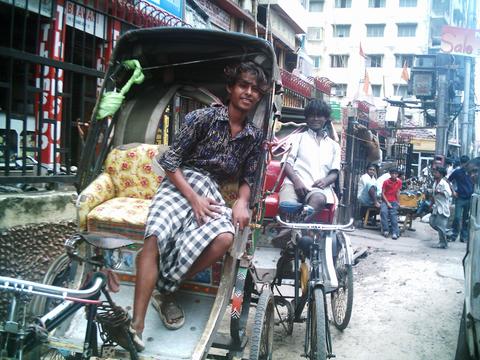
Cycle-rickshaw pullers are among the most vulnerable section of the urban poor. The ramshackle physical condition of the cycle-rickshaw in Calcutta – is a good indicator of the state of West Bengal under CPI(M)’s rule. Social attitudes among the Bengali middle-class can also be discerned in their interactions with rickshaw-pullers: he is spoken to as “tui” (the second person intimate, which one uses with children), as opposed to the more common “apni” (second person respectful) with which anyone, even a stranger, is addressed.

The work is very arduous and debilitating. Though the daily earning of the puller would be about Rs 100-150 ($ 2-3), they are typically addicted to gutka (tobacco), alcohol and gambling. That is the culture of the profession. It is a tough and violent life. The puller’s wife would typically be a maid-servant in a middle-class home, washing utensils and clothes, sweeping and mopping. Quite often, she is abandoned after bearing a few children. The life expectancy of a puller would be less than 50. A puller’s son – would, typically, also become a puller.

The girls / women: in this domain, at the age of 13, their whole life may be seen by an outsider as lying ahead of them. Often, by the age of 19, their whole life is actually behind them. Born to an under-nourished, under-age mother; under-nourished; married early; by 19, they may have had 2-3 children, and been left by their husbands. With little or no education or marketable skills, she is consigned to a gruelling life on the edge of penury, perpetually sickly, in low-waged servitude, merely to survive and raise her children. Her daughters - would also enter this life.

And so it goes on ...

This is the story of hundreds of thousands in the city. Adolescent girls from poor households are extremely vulnerable. But that is not something on anyone's radar, its not an issue for anyone. We see it all around us, and yet are blind to it. But actually we benefit from what exists. Its not a concern of public policy. I'm sorry, there's no 'public policy' in the first place, in this ancient civilisation. I mean where civilisation was left behind in ancient times. The Indus valley civilisation was distinguished by its focus on public matters, such as water & sanitation, hygiene, food storage, association. Now there's no "public domain".

But you would'nt know all this when you first meet them. They are up-standing human beings, with a sense of self, with a sense of dignity, aware of their equality with anybody else in a democratic society, articulate; being crushed relentlessly by life, but miraculously struggling on, waging a million tiny ineffectual mutinies to live on. Man does not live by bread alone, they say. Yes. Here, as important as bread is dignity. In big ways is that dignity assaulted. In tiny ways do they seek to salvage it.

Tuesday, September 05, 2006

Father and son

It was the night of 16 November 1992. We had celebrated my son Rituraj’s first birthday three days ago. That had been a grand affair, a very happy occasion of thanksgiving and sharing one's joy with relatives and friends, for being blessed with an angelic child.

I was in bed, Rituraj was sleeping beside me. My wife had left that evening on an out-station trip in connection with her work.

I was awakened in the dead of night by the sound of something like coughing. It was Rituraj. I jumped out of bed and turned the light on. There was something the matter with him. A strange sound emanated from his throat, a terrifying hoarse croaking-choking-coughing-gasping kind of sound. I could see he was having difficulty breathing. And when he got some breath he was crying or trying to cry, but only that frightful sound came out. I tried to give him a drink of water from his bottle, but he was unable to swallow.

Terror seized my heart. Oh my God! He is dying! I imagined he had someting like tetanus and was going to die in front of my eyes. What am I going to tell Rajashi when she returns?

I had no clue whatsoever about what might be the problem. I tried to calm him, by talking to him, saying soothing things, stroking his head. But seeing his condition I only sank deeper into panic.

I opened the doors. Rituraj’s nanny Pratima had heard the sounds and woken up. I went down to the ground floor, where my father lived and woke him up. His maidservant Archana also woke up. I told my father Rituraj seemed to have taken ill. I brought the baby downstairs and laid him on my father’s bed. But he too was clueless, and his helplessness was evident. So I realised it was up to me now to do something.

It was early winter in Calcutta. I wrapped Rituraj in his blanket and asked Pratima to carry him, and we set out for the emergency doctor’s clinic a few minutes walk away. On the way, in the desolate lane was a cow. As we passed it, Rituraj saw the cow from his place on Pratima’s shoulder and, as he was wont to do, said “Hamba”. That was his baby-word for “cow” (from it’s mooing). This only made it all the more poignant for me, but it also heartened me somewhat, that he must be alright.

We reached the emergency clinic – to discover that it was closed down. Back home again. It was close to 3 am. I dug out his paediatrician Dr Radha Narayan’s telephone number and called. After a while, she picked up the phone. I introduced myself, apologised for calling her at this unearthly hour, and explained Rituraj’s condition. She said it sounded like a case of chest congestion and gave me the names of certain medicines, including a broncho-dilator. I noted this down. I left Rituraj in the care of my father and Pratima and Archana, grabbed my wallet and set out, on my bicycle, to the 24-hours medicine shop, about 2 kms away.

Cycling at breakneck speed in the silent, still, desolate, cold night, I reached the shop. It was closed. I decided to try at another place I recalled, half a km away. I found that too closed. My panic and despair grew. I decided to go to another shop, quite a distance away, which I knew would definitely be open. In my state, I became disoriented and lost my sense of direction. I stopped an empty taxi passing by and asked the driver the way.

I was sobbing as I peddled. I knew that I was merely going through an act, of appearing to be doing something, when in reality I was simply avoiding and escaping witnessing my son's death. As far as I could see, when I returned I was going to find Rituraj gone. Oh the horror and despair of that! I wailed plaintively in my grief. How cruelly fate was mocking me with such a blow. I remembered all the unconscionable things I did habitually. No! No! Anything but that! Anything to avert that! And nothing was too high a price for that.

And then for the first time in my life, I turned to prayer. I sobbed out the mantra my father had once shared with me. Make my son well, oh Lord, I prayed, and extract any price from me. Take my life oh Lord, but spare him. I tried to shut out all other thoughts and simply utter the prayer. When I observed myself like this – it only heightened my despair. But in that desolate dead of night, there was no one to see me, I was all alone, and I kept uttering the prayer and peddled on, as if by this very act of will I could reverse fate.

I finally reached the medicine shop, found it open, got the prescribed medicines and headed back homewards. I kept uttering the prayer audibly, and tried to shut out any other thoughts, shut out the remembrance of the terror.

I reached home. Everyone was waiting or me. Pratima and Archana had somehow managed to put Rituraj to sleep on my bed. I woke him up and gave him the medicines, and patted him to sleep again. And I lay down beside him, watching over him until I too dozed off. My sleep was disturbed. In my dreams the horrid sound from Rituraj’s throat kept coming. I dreamt he was well again.

I woke up at dawn and after giving Rituraj another dose of the medicines, rang up my father-in-law and told him what had happened. I said I was bringing Rituraj over right away. I took him there in a taxi. My in-laws had called Tutul, a medical student who lived nearby, who was a close friend of the family. We went right away to a friend of his, Atom, a paediatric intern, who lived nearby.

Atom examined Rituraj. He told us that he had a bad chest congestion. The phlegm had congealed in his chest. And as a result there was also an infection. He said it was fortunate that he had been diagnosed right now. It might otherwise have been too late and quickly led to pneumonia. He prescribed a more precise set of medicines. Rituraj was unwell, but he was going to be alright after a few days.

After the night’s experience – I felt drained. But the whole day I was giddy with relief and gladness. A week later Rituraj was fully recovered. And after my wife returned, I told her what had happened.

When I am in any kind of personal difficulty or unhappiness – I sometimes remember Rituraj’s survival that night. And I remember that I will gladly pay any price, bear any kind of personal pain for the rest of my life, for that gift of his life.

…………….

As a ten year old, I had learnt in school that the Mughal emperor Babur, had prayed for his son Humayun’s life when he was very ill, and exchanged his life for his son’s. Something like that happened with me as well. About a year after Rituraj's respiratory condition, I was very ill, having come down with reactive arthritis consequent to gastroenteritis. My father had suffered a mild cerebral stroke earlier, and in the altered mental state induced by that condition he thought I was dying. He prayed for exchanging his life for mine. I recovered. Shortly after that my father passed away, suddenly, in his sleep.

…………….

When Rituraj was about seven, on the way back after a short holiday in the Lakshwadip islands (off the south-western coast of India), he and I made a quick trip to my grandmother’s village, in Thodupuzha, in the state of Kerala. This was now a bustling municipal town. We went to the house of my grandmother’s cousin, and after a few seconds of introduction-explanation, we were welcomed. That evening we went to the ancient Krishna temple in Thodupuzha. The deity there had been my grandmother’s companion and solace all her life.

The new place, the new topography, the new culture, the new people around, the new traditional village house – perhaps because of all this, a transformation had taken place in Rituraj. I was struck by how angelic he had become. And when Rituraj wore a dhoti (a wrap-around lower garment) to go to the temple – all the people in the house felt Krishna himself had visited their home!

I went to the temple again that night, as the closing rituals were being performed. I took a walk around the temple. This was where my grandmother had been born and grew up, the place where my father had been born. This place represented the cultural roots of my family. I had come here 23 years earlier, to attend a marriage. Now it seemed to me to be the culmination of all my journeys and all my learning. It was the centre of the world. The temple, its layout, the layout of the town around the temple, all seemed to suggest a deep symmetry and pattern.

On this visit to Thodupuzha, I learnt that this temple was famed for healing sick children. The deity in the temple represented the infant Krishna, who had just fought off the attack by the monstrous bird Bakasura. I was told that besides bringing the sick children to the temple, even praying to the deity from faraway saved the children.

…………….

A couple of years ago, Mike Davis, a friend in Melbourne, had come on holiday to Calcutta with his wife and two daughters. He was staying with Mahadev, a common friend. I went to meet them. Mike’s younger daughter, who was about six years old, was quite unwell. They had all returned from a trip where she had caught some kind of infection, and had a high fever. They had seen a doctor then, and medication was being taken. But the symptoms persisted. And they had to catch their return flight later that night. The parents were very anxious and distraught.

I could not bear to see the parents’ agony. So I immediately phoned my boys’ paediatrician and told her I was coming with a little girl who was unwell. And I set off with Mike and his wife and daughter. The doctor examined the girl, prescribed some medicines, and assured the parents that she could travel and that they should not worry.

After many hours of the anxiety gnawing away at them – that cloud over the terrified parents was lifted. I was happy I had been able to help. On the way back to Mahadev’s apartment, I shared with them the stories of Rituraj’s illness when he was one, of Babur and Humayun, of my father and me, and of the temple in our village which was famed for healing sick children.

Doing all one can to help sick children, whether one’s own or anyone else’s, whatever the cost – I think that is one of the most important things in life. This is what led me, in 1996, to start working in the slums of Howrah, where the infant mortality rates are disproportionately high. But sadly, owing to utter collapse of governance at the grassroots, this is not something where one's personal efforts bring any kind of positive result.