Showing posts with label Buddhism. Show all posts

Wednesday, August 13, 2008

Finding the enemy


I had searched in vain for a poem by Thich Nhat Hanh that I had cut out from a magazine and kept, many years ago, and despaired about not finding this. Yesterday, voila, there it was, ensconced inside the pages of Sri Aurobindo's Savitri.

The Enemy

The enemy is not a person
If you kill people with whom will you live?

The enemy's name is cruelty
The enemy's name is lack of conscience
Its name is hatred, its name bitterness.

The enemy wears a coat of doctrine
The enemy wears the pretence of freedom
It wears hypocrisy, it wears twisted words.

The enemy is not a stranger
It lies inside of each of us.

The enemy's name is false accusation
The enemy's name is ignorance
Its name is ambition, its name is envy.

The enemy's name is covetous eyes
The enemy's name is arrogant head
Its name is a lonely heart, its name is a narrow mind.

The enemy is not a person.
If you kill people with whom will you live?

The enemy is not in the stranger
It lies inside of each of us.

Image: © Yamil Saenz.

Monday, July 16, 2007

Time to fill water


Ayi paniya bharan ki bela... That translates to "its time to fill water". Thus goes a phrase from the song "Bhor Aayi Gaya Andhiyara" in the Hindi film Bawarchi (1972). The lyrics are by Kaifi Azmi, and the music was composed by Madan Mohan.

Get this widget Share Track details

bhor ayi gaya andhiyara
sarey jag mey hua ujiyara
nachey jhoomey yeh man matwara...

ayi paniya bharan ki bela
laga jamuna ke tat par mela
mil ke bharlo e bharlo o sajni
boley chan chan key ghunguru madila...


Dawn's come, darkness' gone
The whole world's in light
This heart dances and swirls in intoxication...

Its time to fill water
Its like a fair on the Yamuna bank
Fill it up, O fill it up, dear companions
The dancing-bells ring intoxicatedly ...

Divine light, and fullness of Divine love are realised after the long, dark night of the soul... Like the dark night of the soul is likened to the pain of the separated lover, the Divine embrace is likened to the union of separated lovers. The lyrics resonate connotations of Radha's exultation at the return of her beloved Krishna.

A couple of lines by Rabindranath Tagore, in Bengali, say much the same thing:

eshechhey borsha, eshechhey nobino borsha,
gogono bhoriya, eshechey bhubono bhorsha


In my translation -

The rain's come, the new rain's come!
Filling the firmament, a universe of faith's come!

Water, rain - refers to love, with which one is awash, filled, when the dark night of the soul is at an end, and the light of Grace, faith, conviction emerges. Just as village women go out to fetch water in their pots at dawn, its now time to fill oneself with Divine love.

Bawarchi is a delightful film, from the golden days of Hindi cinema. Directed by Hrishikesh Mukherjee, it is the Hindi version of the Bangla film Galpa Holeo Satyi, starring the late Robi Ghosh (story and direction by Tapan Sinha). Its about simplicity, love, and living to bring joy to others.

Here's a YouTube clip of the song:

Wednesday, May 02, 2007

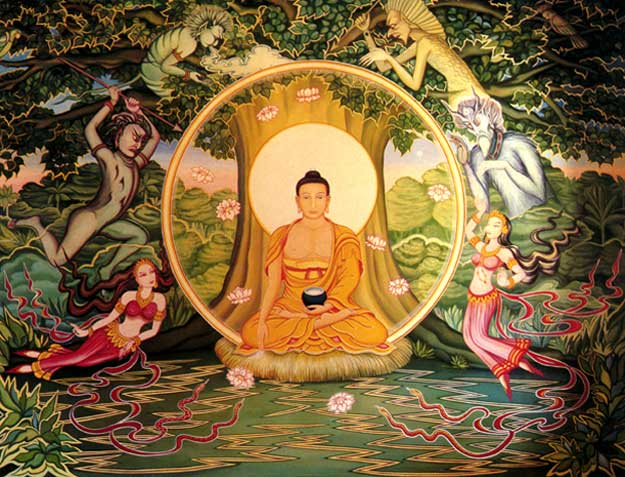
Buddha Purnima


Today is Buddha Purnima, or Vesak, the full-moon associated with the birth, enlightenment and passing away of the Buddha, some 2550 years ago. It is a very auspicious day for Buddhists all over the world.

In an early post, I had written about the Buddha's exclamation on realising enlightenment.

Here are the lines from Sir Edwin Arnold's Light of Asia, which describe Buddha's enlightenment:

... Thus Life's thirst quenches itself
With draughts which double thirst, but who is wise
Tears from his soul this Trishna, feeds his sense
No longer on false shows, files his firm mind
To seek not, strive not, wrong not; bearing meek
All ills which flow from foregone wrongfulness,
And so constraining passions that they die
Famished; till all the sum of ended life -
The Karma - all that total of a soul
Which is the things it did, the thoughts it had,
The 'Self' it wove - with woof of viewless time,
Crossed on the warp invisible of acts -
The outcome of him on the Universe,
Grows pure and sinless; either never more
Needing to find a body and a place,
Or so informing what fresh frame it takes
In new existence that the new toils prove
Lighter and lighter not to be at all,
Thus "finishing the Path;" free from Earth's cheats;
Broken from ties - from Upâdânas - saved
From whirling on the wheel; aroused and sane
As is a man wakened from hateful dreams.
Until - greater than Kings, than Gods more glad! -
The aching craze to live ends, and life glides -
Lifeless - to nameless quiet, nameless joy,
Blessed NIRVANA - sinless, stirless rest -
That change which never changes!

May peace prevail on earth, may all beings be well.

Image: Enlightenment Scene, Temple painting in Bodhgaya, India, by Marianna Rydvald.

Saturday, April 28, 2007

Trans-historical


A painting on bark by Kneepad,
of Groote Eylandt, illustrates creation
story from Australian indigenous people.

In Mahayana Buddhism, there are several very sacred texts, of apocryphal origin, which are very mythic in their content, and phantasmagorical in their description.

The Prince who became a Cuckoo: reading this within the specific psycho-social circumstances I was in, and the state of mind-being generated by that - I only saw it as a "manual of planning".

The Lotus of the True Law: became a "manual of long-term planning” (i.e.trans-historic, e.g. for a final outcome that will emerge after several centuries and then endure over millenia).

The Land of Bliss: a "textbook of civics".

During the period I read these texts - everything took on an aura.

The Sufi teaching has this trans-historicity.

Hermann Hesse’s Journey to the East is an example from contemporary times.

Saturday, September 16, 2006

Asanga and the dog


In response to my Sufi dog tales, Dan has been so kind as to send me the following story of Asanga. This is an awesome and inspiring teaching story.


Asanga was one of the most famous Indian Buddhist saints, and lived in the fourth century. He went to the mountains to do a solitary retreat, concentrating all his meditation practice on the Buddha Maitreya, in the fervent hope that he would be blessed with a vision of this Buddha and receive teachings from him.

For six years Asanga meditated in extreme hardship, but did not even have one auspicious dream. He was disheartened and thought he would never succeed with his aspiration to meet the Buddha Maitreya, and so he abandoned his retreat and left his hermitage. He had not gone far down the road when he saw a man rubbing an enormous iron bar with a strip of silk. Asanga went up to him and asked him what he was doing. "I haven't got a needle," the man replied, "so I'm going to make one out of this iron bar. "Asanga stared at him, astounded; even if the man were able to manage it in a hundred years, he thought, what would be the point? He said to himself: "Look at the trouble people give themselves over things that are totally absurd. You are doing something really valuable, spiritual practice, and you're not nearly so dedicated." He turned around and went back to his retreat.

Another three years went by, still without the slightest sign from the Buddha Maitreya. "Now I know for certain," he thought "I'm never going to succeed." So he left again, and soon came to a bend in the road where there was a huge rock, so tall it seemed to touch the sky. At the foot of the rock was a man busily rubbing it with a feather soaked in water. "What are you doing?" Asanga asked. "This rock is so big it's stopping the sun from shining on my house, so I'm trying to get rid of it." Asanga was amazed at the man's indefatigable energy, and ashamed at his own lack of dedication. He returned to his retreat.

Three more years passed, and still he had not even had a single good dream. He decided, once and for all, that it was hopeless, and he left his retreat for good. The day wore on, and in the afternoon he came across a dog lying by the side of the road. It had only its front legs, and the whole of the lower part of its body was rotting and covered with maggots. Despite its pitiful condition, the dog was snapping at passers-by and pathetically trying to bite them by dragging itself along the ground with its two good legs.

Asanga was overwhelmed with a vivid and unbearable feeling of compassion. He cut a piece of flesh off his own body and gave it to the dog to eat. Then he bent down to take off the maggots that were consuming the dog's body. But he suddenly thought he might hurt them if he tried to pull them out with his fingers, and realized that the only way to remove them would be on his tongue. Asanga knelt on the ground, and looking at the horrible festering, writhing mass, closed his eyes. He leant closer and put out his tongue. The next thing he knew, his tongue was touching the ground. He opened his eyes and looked up. The dog was gone; there in its place was the Buddha Maitreya, ringed by a shimmering aura of light.

"At last," said Asanga, "why did you never appear to me before?"

Maitreya spoke softly: "it is not true that I have never appeared to you before. I was with you all the time, but your negative karma and obscurations prevented you from seeing me. Your twelve years of practice dissolved them slightly so that you were at last able to see the dog. Then, thanks to your genuine and heartfelt compassion, all those obscurations were completely swept away and you can see me before you with your very own eyes. If you don't believe that this is what happened, put me on your shoulder and try and see if anyone else can see me."

Asanga put Maitreya on his right shoulder and went to the marketplace, where he began to ask everyone: "What have I got on my shoulder?" "Nothing," most people said, and hurried on. Only one old woman, whose karma had been slightly purified, answered: "You've got the rotting corpse of an old dog on your shoulder, that's all. "

Asanga at last understood the boundless power of compassion that had purified and transformed his karma, and so made him a vessel fit to receive the vision and instruction of Maitreya. Then the Buddha Maitreya, whose name means "loving kindness," took Asanga to a heavenly realm, and there gave him many sublime teachings that are among the most important in the whole of Buddhism.


From: The Tibetan Book of Living and Dying, by Sogyal Rinpoche.

Wednesday, September 13, 2006

The poisoned arrow


The Buddha was not interested in discussing unnecessary metaphysical questions which are purely speculative and which create imaginary problems. He considered them as a ‘wilderness of opinions’. It seems that there were some among his own disciples who did not appreciate this attitude of his. For, we have the example of one of them, Malunkyaputta by name, who put to the Buddha ten well-known classical questions on metaphysical problems and demanded answers.

One day Malunkyaputta got up from his afternoon meditation, went to the Buddha, saluted him, sat on one side of the road and said:

‘Sir, when I was all alone meditating, this thought occurred to me: There are these problems unexplained, put aside and rejected by the Blessed One. Namely, (1) is the universe enternal or (2) is it not eternal, (3) is the universe finite or (4) it is infinite, (5) is soul the same as body or (6) is soul one thing and body another thing, (7) does the Enlightened One exist after death, or (8) does he not exist after death, or (9) does he both (at the same time) exist and not exist after death, or (10) does he both (at the same time) not exist and not not-exist. These problems the Blessed One does not explain to me. This (attitude) does not please me, I do not appreciate it. I will go to the Blessed One and ask him about this matter. If the Blessed One explains them to me, then I will continue to follow the holy life under him. If he does not explain them, I will leave the Order and go away. If the Blessed One knows that the universe is eternal, let him explain it to me so. If the Blessed One knows that the universe is not eternal, let him say so. If the Blessed One does not know whether the universe is eternal or not, etc, then for a person who does not know, it is straightforward to say “I do not know, I do not see”.’

The Buddha’s reply to Malunkyaputta should do good to many millions in the world today who are wasting valuable time on such metaphysical questions and unnecessarily disturbing their peace of mind:

‘Did I ever tell you, Malunkyaputta, “Come, Malunkyaputta, lead the holy life under me, I will explain these questions to you?” ’

‘No, Sir.’

‘Then, Malunkyaputta, even you, did you tell me: “Sir, I will lead the holy life under the Blessed One, and the Blessed One will explain these questions to me”?’

‘No, Sir.’

‘Even now, Malunkyaputta, I do not tell you: “Come and lead the holy life under me, I will explain these questions to you”. And you do not tell me either: “Sir, I will lead the holy life under the Blessed One, and he will explain these questions to me”. Under the circumstances, you foolish one, who refuses whom? (i.e., both are free and neither is under obligation to the other).

“Malunkyaputta, if anyone says: “I will not lead the holy life under the Blessed One until he explains these questions,” he may die with these questions unanswered by the Enlightened One. Suppose Malunkyaputta, a man is wounded by a poisoned arrow, and his friends and relatives bring him to a surgeon. Suppose the man should then say: “I will not let this arrow be taken out until I know who shot me; whether he is a Ksatriya (of the warrior caste) or a Brahmana (of the priestly caste) or a Vaisya (of the trading and agricultural caste) or a Sudra (of the low caste); what his name and family may be; whether he is tall, short, or of medium stature; whether his complexion is black, brown or golden; from which village, city or town he comes. I will not let this arrow be taken out until I know the kind of bow with which I was shot; the kind of bowstring used; the type of arrow; what sort of feather was used on the arrow and with what kind of material the point of the arrow was made.” Malunkyaputta, that man would die without knowing any of these things. Even so, Malunkyaputta, if anyone says: “I will not follow the holy life under the Blessed One until he answers these questions such as whether the universe is eternal or not, etc,” he would die with these questions unanswered by the Enlightened One.’

Then the Buddha explains to Malunkyaputta that the holy life does not depend on these views. Whatever opinion one may have about these problems, there is birth, old age, decay, death, sorrow, lamentation, pain, grief, distress, “the Cessation of which (i.e. Nirvana) I declare in this very life.”

‘Therefore, Malunkyaputta, bear in mind what I have explained as explained, what I have not explained as unexplained. What are the things that I have not explained? Whether the universe is eternal or not, etc, (those 10 questions) I have not explained. Why, Malunkyaputta, have I not explained them? Because it is not useful, it is not fundamentally connected with the spiritual holy life, is not conducive to aversion, detachment, cessation, tranquility, deep penetration, full realisation, Nirvana. That is why I have not told you about them.

‘Then, what, Malunkyaputta, have I explained? I have explained dukkha (suffering), the arising of dukkha, the cessation of dukkha, and the way leading to the cessation of dukkha. Why, Malunkyaputta, have I explained them? Because it is useful, is fundamentally connected with the spiritual holy life, is conducive to aversion, detachment, cessation, tranquility, deep penetration, full realisation, Nirvana. Therefore I have explained them.

It seems that this advice of the Buddha had the desired effect on Malunkyaputta, because he is reported to have approached the Buddha again for instruction, following which he became an Arahant.


From: What the Buddha Taught, by Walpola Rahula.

See also: Medicine Buddha, Buddha as Healer.
Monday, August 14, 2006

Threads

After my posts yesterday on Religion, I was chatting with my friend Dr Mrinal Bose. He is a practising physician, a man of science and rationality, a secular man, and a humanist. And an aesthete, at least in regard to literature.

As a medical man, he is aware of human psychology, and in his training had spent some time in clinical psychiatry and been quite drawn to this work. He knows his physiology and biochemistry! Yet we can talk about matters like “spirituality” or “Religion”. He knows I am sharing my personal experience when I say something, and accepts and respects this. But he has his views.

He said: “If man had not created religion, the world would have been a better place.”

My response was: If man had not created religion, there would still be natural law, and Religion (with a capital R) is nothing but that. There is also self-knowledge, of body-mind, states, and self-realisation, which man has attained for thousands of years. The marriage of Religion to worldly concerns, of power and wealth, is another matter, and also inevitable. But that need not stop someone from looking at Religion differently, even specific religions and their associated beliefs, practices and rituals, and seeing all of this as something magnificent, which raises humanity to living light. For instance, how can someone know what a pilgrimage is for the inner-world of the devout?

Dr Bose also referred to something a renowned Bangladeshi writer had said in an interview, to the effect that only people who had the time engaged with religion. Peasants and workers did not have time for religion.

I agreed with him. I remembered the Buddhist teaching about a human life with the opportunity to learn - being as rare an occurrence as if a deep sea turtle which surfaces once in millenia came up precisely inside a tube that happened to be floating by at exactly the same time and place! And hence the necessary injunction, to utilise this life to the fullest, to strive to come to awareness, and to help bring other living beings to light.

I also mentioned that it was humble labouring folk, peasants, craftsmen and workers, who exhibited faith and devotion, and the "spiritual" impulse (in the innate sense, rather than any particular sect) was also found among the labouring folk. Hence a person like Kabir, the 15th century weaver, poet and mystic of India. He was heard and revered by the common folk, in whose language and idiom he gave voice to his deep spiritual feelings and insights. Not surprisingly, he attracted people of diverse faiths, and particularly Hindus and Muslims; his own faith was always ambiguous; he quoted Hindu and Islamic precepts, and also forswore external rituals and formal piety and places of worship. His songs and poems still resound in vast parts of India.

When I relate to Dr Bose, I see him as a friend, someone I like and respect and think well off. Because that is what my relation to him has occasioned. Yes, there are some things people could say, which are likely to shock and hurt me, and make me distance myself from them. But equally, there are matters on which I don’t let people’s words or views interfere with my relationship with them, and interfere with the fine commonality shared in other matters. That view is only one small part of them. We can still be one in essence.

I feel a commitment to try to think deeply about what someone I like says, which seems to run counter to my own thoughts and feelings, to see whether that statement can very exactly represent some aspect of my own view on that subject. And very often one finds that there need not really be any disagreement. Besides, merely hearing something one does not like to hear, which offends, or irritates – one need not then let this harden into a feeling of resentment or ill-will against the person.

Dr Bose is very blunt. And disarmingly so! I once sent him a set of synopses of stories (for films) that I had worked on over the years. He said: “Be original dammit, these are formulaic shit” (or something to that effect). I did get a bit of a start! But now, I am supremely grateful for that honest feedback. That helped to open up for me a new dimension of being. And so I always like to get some sharp critical outburst from him!

Dr Bose had also introduced me to the name and work of the Bengali writer Subimal Misra. That led to my taking up translation of his short stories. He also pointed out the parallels between the work of Misra and that of Elfriede Jelinek, the Austrian writer. Through Dr Bose’s feedback about originality, and my exposure to the writings of (and about) Misra and Jelinek – though I’ve been a serious reader for more than half my life, and nursed a wish to write (literary fiction, non-fiction) for years, for the first time in my life I awakened to some fundamental questions, some new considerations and discernments, some new realisations, decisions and choices.

Why write? Write what? Why? For whom? Why? How?

Saturday, August 12, 2006

Great guy


Yesterday morning, just before leaving home for work, I was speaking to my sister, and I referred to my cousin and said “… oh he can handle any situation … he’s a great guy”.

As I walked to the gate, I thought about this cousin, and I was filled with gladness and admiration. I then remembered how envious and jealous I used to be – and what a good cure for that spontaneous joy is.

The bodhisattva in Buddhist tradition is a “being of light”, one whose life is devoted to compassionate service of humanity and all living beings, bringing every being to light through life after life before seeking his own liberation from the endless cycle of life.

The bearing of a bodhisattva: maitri, mudita, karuna, upeksha. Which means: (selfless) love, spontaneous joy (at/for others), compassion and equanimity.

All these are positive states and feelings, in whose light other states and feelings – such as envy and jealousy – are wiped out.

It’s a simple flip – to go from jealousy, anger, hatred and ill-will to spontaneous joy, appreciation, delight, admiration, warmth, love, devotion. And from such small acts of will against negative feelings, and what the new feelings do within us – we are powerfully transformed, with positive capabilities.

When people encounter the positive, joyful feelings of others – they too are touched, moved, humbled, and their finest qualities are awakened.

We carry such a detritus of needless negativism within ourselves, to our own detriment and ill-health. Positive health, and peace on earth – has ultimately to be built individual by individual, feeling by feeling.


Searching for an image to accompany my post, I came upon this amazing website, of Dwayne Edward Rourke, which I invite you to visit. The image is taken from there.

Ten years old


Though born and raised in India, my education was through the English language, and though my family milieu was a simple, spartan, middle-class one, nonetheless this was quite westernised. Thus, for instance, reading meant reading books in English, and literature meant English and American literature, and literature in English translation.

In the late-80s – early-90s, I did a lot of personal study on ecology & environment, cities and planning. I became acquainted with the work of the American thinker and writer Lewis Mumford (1895-1990). I read several of his books and became more and more engrossed with his work and life. I was an atheist, a secular, rational humanist. I had been strongly influenced by Marx. But I think it was through Mumford that my attention was directed to the Hindu and Buddhist religious texts.

Here’s a passage from Lewis Mumford’s My Works and Days that I had noted down:

“The age of ‘the men who are ten years old’ long ago predicted in the Pali Buddhist texts, had arrived … ten-year old minds enclosed in a ten-year old culture with only a ten-year future – if that. … The Buddhists … said of the ‘men who are ten years old’ that ‘their violent hatred against each other will predominate, with violent enmity, violent malevolence, violent lust for wholesale killing.’ A world picture that omitted all values except those fostered by science and technology was left with only a blank nihilism in our proper human realm.

… Strangely, the palpable rationality of the scientific method within its own accredited area gave rise in the great majority of its practitioners to a compulsive irrationality – an uncritical faith in science’s godlike power to control the destinies of the human race. Those who have studied the ancient Mesopotamian and Egyptian religious texts know how cruel, destructive and inhumane man’s godlike faculties actually can be. Only mammalian tenderness and human love have saved mankind from the demented gods that rise up from the unconscious when man lets himself off from the cosmic and earthly sources of his life.”

Image: Run, Children of Qanah, Run! by Marlene Azoulai.

Wednesday, August 02, 2006

The Elephant, from The Dhammapada

Let me share with friends the (23rd) chapter from The Dhammapada (the Buddha's Path of Wisdom), titled "The Elephant".


As an elephant in the battlefield withstands
arrows shot from bows all around, even so shall
I endure abuse. There are many, indeed,
who lack morality.

Tamed elephants can be led into a crowd,
and the king mounts a tamed elephant. So too,
best among people is the subdued one who
endures abuse.

Excellent are well-trained mules,
thoroughbred Sindhu horses and noble tusker
elephants. But better still is the person
who has subdued oneself.

Not by these mounts, however, can
one go to the Untrodden Land (Nirvana), as one
who is self-tamed goes by one's own tamed and
well-controlled mind.

In must during rut, the tusker named
Dhanapalaka is uncontrollable. Held in captivity,
the tusker does not touch a morsel, but only
longingly calls to mind the elephant forest.

When a person is sluggish and gluttonous,
lazy, rolling around in bed like a fat pig--that
sluggard undergoes rebirth again and again.

Formerly this mind wandered about as
it liked, where it wished, according to its pleasure,
but now I shall thoroughly master it with wisdom,
as a mahout controls an elephant in rut.

Delight in heedfulness! Guard well your
thoughts! Draw yourself out of this bog of evil,
even as an elephant draws oneself out of the mud.

If for company you find a wise and
prudent friend, one who leads a good life, you should
overcome all impediments and keep this person's
company, joyously and mindfully.

But if for company you cannot find a wise
and prudent friend, one who leads a good life,
then, like a king who leaves behind a conquered
kingdom or a lone elephant in the elephant forest,
you should go your own way alone.

Better it is to live alone, there is no
fellowship with a fool. Live alone and do no evil;
be carefree like an elephant in the elephant forest.

Good are friends when need arises; good
is contentment with just what one has; good is
merit when life is at an end; and good is the
abandoning of all suffering (through enlightenment).

Good it is to serve one's mother; good
it is to serve one's father; good it is to serve
the Sangha; and good it is to serve the holy people.

Good is virtue until life's end; good is
faith that is steadfast; good is the acquisition
of wisdom; and good is the avoidance of evil.

The Elephant and the Dog


There are several stories in the Jataka Tales (stories of the Buddha’ former lives) about elephants. Here's a happy tale!

Once upon a time a Dog used to go into the stable where the king’s Elephant lived. At first the Dog went there to get the food that was left after the Elephant had finished eating.

Day after day the Dog went to the stable, waiting around for bits to eat. But by and by the Elephant and the Dog came to be great friends. Then the Elephant began to share his food with the Dog, and they ate together. When the Elephant slept, his friend the Dog slept beside him. When the Elephant felt like playing, he would catch the Dog in his trunk and swing him to and fro. Neither the Dog nor the Elephant was quite happy unless the other was nearby.

One day a farmer saw the Dog and said to the Elephant-keeper: “I will buy that Dog. He looks good-tempered, and I see that he is smart. How much do you want for the Dog?”

The Elephant-keeper did not care for the Dog, and he did want some money just then. So he asked a fair price, and the farmer paid it and took the Dog away to the countryside.

The king’s Elephant missed the Dog and did not care to eat when his friend was not there to share the food. When the time came for the Elephant to bathe, he would not bathe. The next day again the Elephant would not eat, and he would not bathe. The third day, when the Elephant would neither eat nor bathe, the king was told about it.

The king sent for his chief servant, saying, “Go to the stable and find out why the Elephant is acting in this way.”

The chief servant went to the stable and looked the Elephant all over. Then he said to the Elephant-keeper: “There seems to be nothing the matter with this Elephant’s body, but why does he look so sad? Has he lost a playmate?”

“Yes,” said the keeper, “there was a Dog who ate and slept and played with the Elephant. The Dog went away three days ago.”

“Do you know where the Dog is now?” asked the chief servant.

“No, I do not,” said the keeper.

Then the chief servant went back to the king and said, “The Elephant is not sick, but he is lonely without his friend, the Dog.”

“Where is the Dog?” asked the king.

“A farmer took him away, so the Elephant-keeper says,” said the chief servant. “No one knows where the farmer lives.”

“Very well,” said the king. “I will send word all over the country, asking the man who bought this Dog to turn him loose. I will give him back as much as he paid for the Dog.”

When the farmer who had bought the Dog heard this, he turned him loose. The Dog ran back as fast as ever he could go to the Elephant’s stable. The Elephant was so glad to see the Dog that he picked him up with his trunk and put him on his head. Then he put him down again.

When the Elephant-keeper brought food, the Elephant watched the Dog as he ate, and then took his own food.

All the rest of their lives the Elephant and the Dog lived together.

Monday, July 31, 2006

Soils


I was born in a Tamil family. And I grew up and have lived all my life in Bengal.

10 years ago, on a holiday in the Nilgiri hills in south India, through a sequence of melodic encounters and experiences, one after another - I felt that the Tamils were essentially a race of bards, and had been so through centuries of history and circumstance, right through to the present day, expressing their unstoppable melodic urge in religion after religion. And I felt that blood running through my own veins. I could understand anew the lyrics of the beautiful song "Putham pudhu bhumi" that I'd been captivated by (from the Tamil film Thiruda Thiruda, set to melody by AR Rehman) :

"Want a fresh new land,
Want one meal every day,
Golden rain must shower,
And the cuckoo must sing Tamil."

Here's a video clip of that song.


A couple of years later, I made a chance visit to Bangladesh, spending two days in Dhaka. I spent some time at a seminar organised by the Department of Sanskrit & Pali at the university. I came upon the Charyagiti, the earliest extant Bangla poems, and the songs of Lalan Fakir. I learnt about the Tantrik, Buddhist and Islamic heritage of the folk of east Bengal. I felt the unique sensibility of that soil, that has endured through millenia, and which has moulded folk devotion. If one wants to see the highest kind of human being, the most refined sensibility, the most lofty, sweetest and child-like face of humanity - it is the golden soil of Bangla that produces this. The national anthem of Bangladesh begins:

My Bangla of gold, I love you!

If my Tamil blood makes me sing - it is of Bengal that I sing, and the humble Bengali Muslim peasant's rare sensibility that I venerate. I am supremely fortunate indeed, and doubly blessed, by these two precious soils.

Here's the Bengali folk songs group Dohar's song offering to the soil of Bengal.

Get this widget Share Track details

Religion


For a long time now, I have been studying and reflecting on Religion (i.e. all religions), sensing the awesome, profound truths and edifying content of the scriptures of Judaism and Buddhism, the Gospel of Christ, Islam. Not as a 'scholar' but as a seeker. My attitude was to implicitly accept what I was reading, without question or critique, and to try to understand what was written.

Also the sacred texts of the faith I was born into, 'Hindu', like The Upanishads. Thus, for instance, I felt the Srimad Bhagavat - was a scientific treatise on the origin, creation and evolution of the universe.

Advanced human life (of the mind, of spirit) is far more ancient than the western world believes, much has happened which is entirely unknown today, but with clues lying around for those who wish to know and observe.

Exchanges - commerce of soul - have taken place between peoples and cultures from ancient times, exhibiting a sweetness of intercourse incomparable to anything in contemporary life. So much of the wealth of 'secular' (i.e. non-religious) life - is the fruit of spiritual fabrication over millenia. Ordinary life is impregnated with the sacred. Everything around us - is sacred.

I don't like to use the terms 'Hindu' or 'Hinduism' - since that is etymologically and otherwise meaningless. Just like harmonising the 'scientific' and 'spiritual', there is the challenge of harmonising the spiritual and social aspects, retaining spiritual inspiration while working to analyse social mores (with their pseudo-religious trappings).

'Reading Temples', for instance, or 'Reading Ritual' - could be themes for projects, to prepare curricula and learning modules for school students.

Karl Marx wrote: "I hate the whole pack of gods in their heavens..." That was perhaps a more fundamentally spiritual articulation, than all the pious hypocrisies of the so-called religious-minded! If only Dr Marx had actually visited India and lived and travelled here - its interesting to imagine the transformations he might have undergone, from the over-conditioning of Europe. Extraordinary scrutiniser that he was - unfortunately he did not get down to scrutinising the very notion of what is human, which he simply received and swallowed lock, stock and barrel, from his culture, overemphasising the 'material', the 'rational' and the 'economic'.

Bringing up, 'educating' and sensitising future generations properly – is the simple solution to all the sufferings plaguing the world. And here, its as much a question of what not to do, as of what to do. What needs to be done – is simply to follow nature, and the human being's fundamental nature. But centuries of obfuscation have taken their toll...

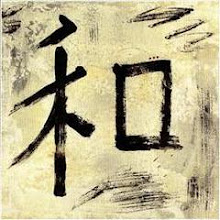
I had written earlier about Sri Aurobindo's view that "all problems of existence are essentially problems of harmony". And the primary means for achieving harmony is the human personality.

Thinking about Darwin - some years ago, it struck me that while he had worked on the Evolution of the Species - what about the evolution of the human personality (in the image of the Maker)? Study of animal BEHAVIOUR and social life would give powerful leads. Lord Buddha's Jataka Tales - may be seen as a study of evolution of the human personality. In human form and guise, the world is actually full of animals of different kinds. But where is MAN?! The purpose of life on earth - is the realisation of the human personality. Love, knowledge and action (in their most profound sense) – are the three means for the perfection of personality.

Saturday, July 15, 2006

Working for peace

In Plum Village in France, we receive many letters from the refugee camps in Singapore, Malaysia, Indonesia, Thailand, and the Philippines, hundreds each week. It is very painful to read them, but we have to do it, we have to be in contact. We try our best to help, but the suffering is enormous, and sometimes we are discouraged. It is said that half the boat people die in the ocean; only half arrive at the shores in Southeast Asia.

There are many young girls, boat people, who are raped by sea pirates. Even though the United Nations and many countries try to help the government of Thailand prevent that kind of piracy, sea pirates continue to inflict much suffering on the refugees. One day we received a letter telling us about a young girl on a small boat who was raped by a Thai pirate.

She was only twelve, and she jumped into the ocean and drowned herself. When you first learn of something like that, you get angry at the pirate. You naturally take the side of the girl. As you look more deeply you will see it differently. If you take the side of the little girl, then it is easy. You only have to take a gun and shoot the pirate. But we cannot do that.

In my meditation I saw that if I had been born in the village of the pirate and raised in the same conditions as he was, I am now the pirate. There is a great likelihood that I would become a pirate. I cannot condemn myself so easily. In my meditation, I saw that many babies are born along the Gulf of Siam, hundreds every day, and if we educators, social workers, politicians, and others do not do something about the situation, in twenty-five years a number of them will become sea pirates. That is certain. If you or I were born today in those fishing villages, we might become sea pirates in twenty-five years. If you take a gun and shoot the pirate, you shoot all of us, because all of us are to some extent responsible for this state of affairs.

After a long meditation, I wrote this poem. In it, there are three people: the twelve-year-old girl, the pirate, and me. Can we look at each other and recognize ourselves in each other? The title of the poem is "Please Call Me By My True Names," because I have so many names. When I hear one of these names, I have to say, "Yes."

From: Being Peace by Thich Nhat Hanh

Please call me by my true names

Do not say that I'll depart tomorrow because even today I still arrive.

Look deeply: I arrive in every second to be a bud on a spring branch, to be a tiny bird, with wings still fragile, learning to sing in my new nest, to be a caterpillar in the heart of flower, to be a jewel hiding itself in a stone.

I still arrive, in order to laugh and to cry, in order to fear and to hope, the rhythm of my heart is the birth and death of all that are alive.

I am the mayfly metamorphosing on the surface of the river, and I am the bird which, when spring comes, arrives in time to eat the mayfly.

I am the frog swimming happily in the clear water of a pond, and I am also the grass-snake who, approaching in silence, feeds itself on the frog.

I am the child in Uganda, all skin and bones, my legs as thin as bamboo sticks, and I am the arms merchant, selling deadly weapons to Uganda.

I am the twelve-year-old girl, refugee on a small boat, who throws herself into the ocean after being raped by a sea pirate, and I am the pirate, my heart not yet capable of seeing and loving.

I am a member of the politburo, with plenty of power in my hands, and I am the man who has to pay his "debt of blood" to my people, dying slowly in a forced labor camp.

My joy is like spring, so warm it makes flowers bloom in all walks of life. My pain is like a river of tears, so full it fills up the four oceans.

Please call me by my true names, so I can hear all my cries and my laughs at once, so I can see that my joy and pain are one.

Please call me by my true names, so I can wake up, and so the door of my heart can be left open, the door of compassion.

From: Being Peace by Thich Nhat Hanh

How to die nonviolently

I wrote a poem for my young brothers and sisters on how to die nonviolently, without hatred. It is called "Recommendation".

Promise me,
promise me this day,
promise me now,
while the sun is overhead
exactly at the zenith,
promise me:

Even as they
strike you down
with a mountain of hatred and violence;
even as they step on you and crush you
like a worm,
even as they dismember and disembowel you,
remember, brother,
remember:
man is not our enemy.

The only thing worthy of you is compassion- invincible, limitless, unconditional. Hatred will never let you face the beast in man.

One day, when you face this beast alone, with your courage intact, your eyes kind, untroubled (even as no one sees them), out of your smile will bloom a flower. And those who love you will behold you across ten thousand worlds of birth and dying.

Alone again, I will go on with bent head, knowing that love has become eternal. On the long, rough road, the sun and the moon will continue to shine.

To practice meditation is to be aware of the existence of suffering. The first Dharma talk that the Buddha gave was about suffering, and the way out of suffering. In South Africa, the black people suffer enormously, but the white people also suffer. If we take one side, we cannot fulfill our task of reconciliation in order to bring about peace.

Are there people who can be in touch with both the black community and the white community in South Africa? If there are not many of them, the situation is bad. There must be people who can get in touch with both sides, understanding the suffering of each, and telling each side about the other.

Are there people doing that kind of understanding and mediation and reconciliation between the two major political blocs on the earth? Can you be more than Americans? Can you be people who understand deeply the suffering of both sides? Can you bring the message of reconciliation?

From: Being Peace by Thich Nhat Hanh

Saturday, July 08, 2006

IK Shukla

Mr Indu K Shukla, in the USA, is a respected poet, writer, literature scholar and activist. He sent me his Hindi sonnet Teerth Purnima, on Buddha Purnima, in response to my earlier post on that subject. On my request he has translated this. Teerth (Sanskrit) means pilgrimage.

Budhha Purnima is the full moon (Taurus full moon) commemorating the birth, attainment of enlightenment, and decease / liberation of the Buddha, in the 5th-6th century BC. Buddhists celebrate this as the festival of Vesak (from the Indian Vaisakh month, which is also celebrated as the onset of spring and the start of the new year in several parts of India).

In the terms of the great scholar-poet AK Ramanujan, this poem is about bhava, feeling, and anubhava, experience: a poetics of personal feeling rather than aesthetics.

“Their pilgrimages, their legends and their hymns map a sacred geography of the land, fashioning a communal self-image that cuts across class and caste. Involving myth and ritual, they create and share a special idiom, a stock of attitudes and themes, and a common heritage alive to this day.” (AK Ramanujan, Hymns for the Drowning: Poems for Visnu by Nammalvar).

The Purnima Triad


The Purnima Triad

a Hindi sonnet

Indu K Shukla

Bharat, crushed by ignorance- evil- crime and injustice, made decrepit by the unholy disease of caste divisions, as if her genius- her intelligence - and her consciousness rendered comatose, was stuck in permanent interment.

The bottomless dark arising from total extinguishing of distinction between good and evil, gobbled up the great heart of Bharat. Man, hacked into caste and class, became helpless, pitiable, puny, helpless, and detestable, his forehead trampled.

By showering light on Bharat and the world with the arrow of transcendental wisdom, you tore through the black night of meanness, regress, and infamy, destroying the fire of sin and removing the distress of the world.

Birth-Enlightenment-Nirvana, all on Purnima, are the triad of teerthas. By them Bharat became sacred and resplendent once more.


Teertha: pilgrimage, Sanskrit.

Written: 5 Apr. 2000. Translated by the poet: 7 July 2006.

Friday, July 07, 2006

The Fire Sutra

"Monks, everything is on fire. What is on fire? The six sense organs – eyes, ears, nose, tongue, body and mind – are all on fire. The six objects of the senses – form, sound, smell, taste, touch, and objects of mind – are all on fire. The six consciousnesses – sight, hearing, smell, taste, feeling, and thought – are all on fire. They are all burning from the flames of desire, hatred and illusion. They are burning from the flames of birth, old age, sickness, and death, and from the flames of pain, anxiety, frustration, worry, fear, and despair.

Monks, every feeling is burning whether it is unpleasant, pleasant, or neutral feeling. Feelings arise and are conditioned by the sense organs, objects of the sense organs, and the sense-consciousnesses. Feelings are burning from the flames of desire, hatred and illusion. Feelings are burning from the flames of birth, old, age, sickness, and death, and from the flames of pain, anxiety, frustration, worry, fear, and despair.

Monks, do not allow yourselves to be consumed by the flames of desire, hatred, and illusion. See the impermanent and inter-dependent nature of everything in existence in order not to be enslaved by the cycle of birth and death created by the sense organs, objects of the senses, and the sense- consciousnesses."

.....

From an introduction to Buddhist texts: “The Fire Sutra is a work that utilizes repetition to explain the inadequacy of the five senses and the mind, and explains their role in the cycle of dependant arising. These six senses are described as “burning”, as are what they sense – the ear is burning, as are sounds and sound impressions, for instance. The text then continues to describe how an enlightened being reacts to the senses and sensory input.”

Monday, July 03, 2006

Zen gem

The following account was written by Jonathan Greenlee, who was in the audience at a lecture on Zen Buddhism which Daisetz Teitaro Suzuki (1870-1966), the renowned Zen monk and teacher, had been invited to deliver:

“While I was at UCLA, DT Suzuki (the famous Zen scholar, writer, master, etc) came to visit. They set up the Regents auditorium for him. So we were all there, the audience all excited, and out came the head of the Oriental department. The audience all quieted down. The Head introduced "Here is DT Suzuki, world class Zen scholar, writer, master, etc. Here he is!"

We all sat in silence. This little guy comes out to the mike. Adjusts a pair of glasses. This is him, we've seen pictures of him before, but he looks smaller. He reaches out and taps the mike. A hollow ping sounds through the hall. He says 'Zen Buddhism, very hard understand, thank you' and walks off the stage.

The audience went crazy! There was a mad struggle backstage, and then the Head lead Suzuki back out, a couple of the department professors with him. They set up some chairs, sat Suzuki down and asked him questions for an hour so everyone would be satisfied.

But I can still hear his voice 'Zen Buddhism, Very hard understand'."

Erich Fromm (1900–1980), the practicing psychoanalyst, social psychologist and committed and insightful social theorist, was a student of Suzuki. His article “Memories of Dr D.T. Suzuki” is available here.