Saturday, September 30, 2006

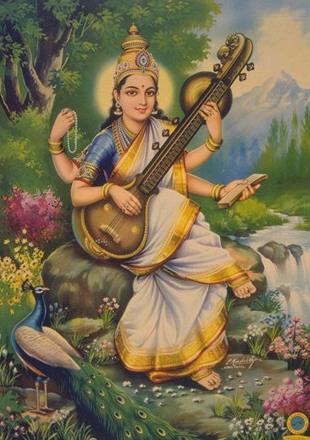
Devi Saraswati


Tomorrow is Saraswati Puja, for (Hindu) south Indians.

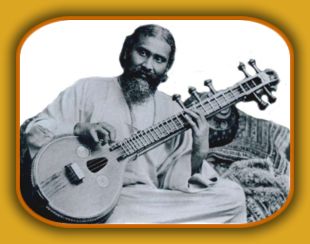
Saraswati literally means “one who gives the essence (sara) of our own Self (swa).” She sits on a swan, and carries a veena (a string instrument).

Puja, as I have explained earlier, means worship, with flower offerings.

Devi Saraswati is the Mother of Learning.

Music is the highest art, the distilled essence of all knowledge, which is self-knowledge. Self-effacing devotion, expressed in heart's melody, in a prayer to Devi Saraswati, is accompanied by Divine vision.

In Carnatic music (i.e. the south Indian classical tradition), one of the first songs learnt is “Varaveena”, a prayer, in Sanskrit, a song of adoration, to Saraswati, composed by Appaya Dikshitar (1554-1626), a scholar, sage and saint.


Varaveena mrudu paani
Vanaruha lochana raani
Suruchira bambhara veni

Suranutha kalyaani
Nirupama shubha guna lola

Nirathi jaya prada sheela
Varadaapriya ranganaayaki

Vaanchita phala daayaki
Saraseejaasana janani
Jaya jaya jaya


You hold the divine veena in your soft hands.
You are the queen of the omniscient. Your eyes are like the lotus petals.
Your curly tresses resemble the bees.
Devas worship your auspicious form.
You have unequalled virtuous qualities.
You give endless victory.
You are the munificent consort of the Beautiful Lord.
You grant boons to the deprived.
O Mother of lotus-seated Creator!
Victory to you!


This song is set in Mohanam raga, which is Bhopali raga in the Hindusthani or north Indian classical system.

Shivkumar Kalyanaraman is a professor of computer science in the USA. His website is also a treasure trove of resources on Carnatic music. He has provided the musical notations for this song, as well as an MP3 recording of a teaching of this song.

Thank you Shivkumar, and may Mother Saraswati’s blessings be always with you.

Another rich site is karnATik.

My mother is away in Bombay, otherwise she would have organised the Puja at home, with an offering of sweet and savoury rice, and the placing of books (of students in the house) before the image of Saraswati.

My younger son Rishiraj (aka Chotu), 11, was the last to religiously place all his school books in front of the image at home. This is a day on which there must be no studying! Great for kids at home during vacations! Chotu's in boarding school now, with his brother Rituraj, 15.

My mother will be doing the Puja at her sister’s, in Bombay.

Hence it will only be an 'inner' observation for me. I observed Saraswati Puja by:

conveying my heartfelt good wishes to -

JP, a college-mate and fellow Tamil-ian & Calcuttan (in which fact I take particular pride right now, as JP has recently become the CIO, Global Services, of British Telecom);

Achinto, photographer, with whom I had been out of touch for a long time; and

Dipali, painter, designer, art teacher and friend, and Saraswati incarnate.

Friday, September 29, 2006

Mulla Nasruddin's letter to his wife

Mulla Nasruddin is an incomparable mythical figure - an idiot? a sage? - in the Sufi teaching stories tradition.

Here is a letter written by Mulla Nasruddin to his wife:


To my dear, ever-loving wife.

During the past year I have tried to make love to you 365 times,
an average of once per day, and the following is a list of the reasons
you gave for rejecting me:

Wrong week, 11 times
It will wake the children, 7 times
It is too hot, 15 times
It is too cold, 3 times
Too tired, 19 times
Too late, 16 times
Too early, 9 times
Pretending to sleep, 33 times
The window is open, neighbours might hear, 3 times
Backache, 16 times
Toothache, 2 times
Headache, 6 times
Not in the mood, 31 times
Baby restless, might cry 18 times
Watched late show, 15 times
Mud-pack, 8 times
Grease on face, 4 times
Too drunk, 7 times
Forgot to visit the chemist's, 10 times
Visitors sleeping in the next room, 7 times
Just had hair done, 28 times
"Is that all you think about?", 62 times

Dearest, do you think we can improve on our record during the forthcoming year?

Your ever-loving husband

Mulla Nasruddin

Thursday, September 28, 2006

28 September


For Medha Patkar


I have written from time to time about various dates which are significant for me.

Among them is today’s date, 28 September.

28 September for me connotes unremitting struggle, for justice, for the oppressed.

The link for me between this date and its meaning - lies in an event on this date, in 1989. This was a massive people’s rally in Harsud, a small town in the state of Madhya Pradesh in India, asserting the will of the people who were going to be ousted and displaced by the Narmada Valley Dams Project:

We shall drown, but we shall not move!

Much water has flown along the dammed Narmada river (the most sacred river in Hindu religious consciousness) since 28 September 1989. And that ancient town of Harsud itself went under-water, in 2004.

But for me that date, and the personal meaning derived from that immense gathering in Harsud of Indian citizen activists and toiling, marginalised people, supported by thousands of others across the country through their local solidarity actions, and the fierce resolve asserted there (and tested repeatedly thereafter) – remains alive, enough to remind me of the struggle for justice whenever I come across the numbers 28 and 9.

Thanks to my association with people like Dr MKA Siddiqui, I have learnt that this is what jihad (in Islam) means: struggle for justice for the oppressed.

An activist, a person with the disposition of working with and for the victims of injustice, struggling for justice – is a jihadi; a struggler for justice is a mujahid, and the term to describe the activism of strugglers for justice would literally translate to Harkat-ul Mujahideen.

Out of his kindly and affectionate disposition, Dr Siddiqui had once told me that I was a true jihadi. No compliment could ever be sweeter and richer!


Post-script: I just learnt, thanks to the website of the International Institute of Social History, that on 28 September 1864, the Saint Martins meeting hall in London was packed to the roof with craftsmen and workers from various countries. The proposal to establish an International Working Men's Association met with great enthusiasm. Karl Marx did not belong to the organizers and was not among the speakers, but he was a member of the presidium and he was chosen (with 54 other persons) in the Preparatory Committee to extend the IWMA. Not before long he would pull the strings of this First International.

'Social work'

From a letter written to a friend some years ago. Still relevant!


'Working in slums' - is not necessarily superior to leading any other kind of life that includes a social conscience, which expresses itself in some form.

Being a good son or parent, a good sibling or friend, colleague, student, teacher, citizen, a hard-working, responsible, thinking, receptive, honest, decent, and caring individual - it is these things that help society to be built and to grow, not just some activity called 'social work', which presumes that there is society-wide irresponsibility, and consequent problems, which some are specially responsible for solving, while everybody else goes about their usual problematic lives.

An old man, a boy and a donkey

An old man and a boy were travelling with a donkey.

The boy rode on the donkey and the old man walked.

As they went along they passed some people who remarked it was a shame the old man was walking and the boy was riding.

The man and boy thought maybe the critics were right, so they changed positions.

Later, they passed some people that remarked, "What a shame, he makes that little boy walk."

They then decided they both would walk!

Soon they passed some more people who thought they were stupid to walk when they had a decent donkey to ride.

So, they both rode the donkey.

Now they passed some people that shamed them by saying how awful to put such a load on a poor donkey.

The boy and man said they were probably right, so they decided to carry the donkey. As they crossed the bridge, they lost their grip on the animal and he fell into the river and drowned.

The moral of the story?

If you try to please everyone, you might as well kiss your ass good-bye.

Enough

"I wish you enough."

What does that mean?

'I wish you enough' means wanting the other person to have a life filled with enough good things to sustain them.

I wish you enough sun to keep your attitude bright.

I wish you enough rain to appreciate the sun more.

I wish you enough happiness to keep your spirit alive.

I wish you enough pain so that the smallest joys in life appear much bigger.

I wish you enough gain to satisfy your wanting.

I wish you enough loss to appreciate all that you possess.

I wish you enough "Hello's" to get you through the final "Good-bye."

Weapons of math instruction

I just received this email from my friend Deva, which I could'nt resist posting.


A public school teacher was arrested today at John F Kennedy International Airport as he attempted to board a flight while in possession of a ruler, a protractor, a set square, a slide rule and a calculator.

At a morning press conference, Attorney General Alberto Gonzales said he believes the man is a member of the notorious Al-gebra movement. He did not identify the man, who has been charged by the FBI with carrying weapons of math instruction.

"Al-gebra is a problem for us," Gonzales said. "They desire solutions by means and extremes, and sometimes go off on tangents in search of absolute values. They use secret code names like 'x' and 'y' and refer to themselves as 'unknowns', but we have determined they belong to a common denominator of the axis of medieval with coordinates in every country. As the Greek philanderer Isosceles used to say, 'There are 3 sides to every triangle'."

When asked to comment on the arrest, President Bush said, "If God had wanted us to have better weapons of math instruction, He would have given us more fingers and toes."

White House aides told reporters they could not recall a more intelligent or profound statement by the President.

Wednesday, September 27, 2006

Jaan's photos

I am happy to share some photographs by my friend and former colleague Jaan. He is a graphic artist and designer, and a photographer. He is from rural Bengal and currently works in Delhi. On my request, he has sent some of his award-winning photographs. He is hoping to exhibit and publish his pictures.

Many more awards to you Jaan!

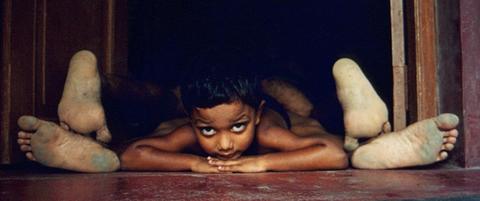
Ascent of Man


Honourable Mention, International Photography Award (IPA), Los Angeles, 2005, in the People / Family category.

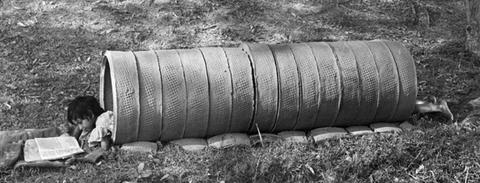
Expansive


Honourable Mention, Canon Asia Pacific Photo Contest, 1994.

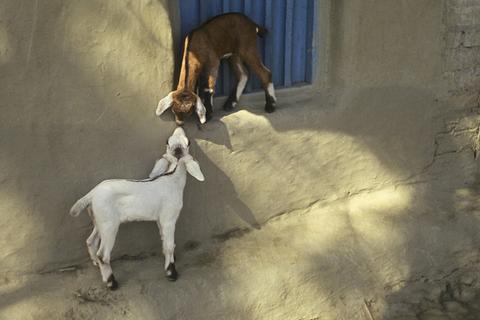
The Kiss


1st prize from Academy of Fine Arts, Amritsar, India, 2006.

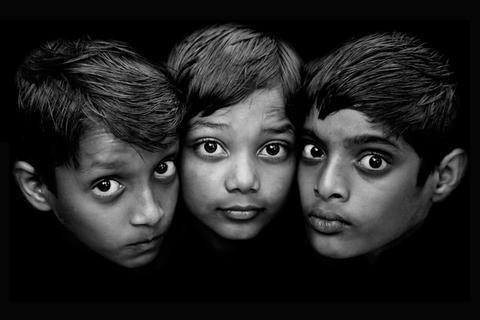
Three Musketeers


Third place, International Photography Award (IPA), Los Angeles, 2006 in the People / Portrait category.

This is one of a series of 3 images.

Waiting List


Honourable Mention, International Photography Award (IPA), Los Angeles, 2005, in the People / Lifestyle category.

Peep Show


Third prize, Nikon International Photo Contest, 1992.

“My first award, and favourite picture!”

Tuesday, September 26, 2006

Ramadan greetings!

Today, Tuesday, is the second day of Ramadan, or Ramzaan as its known here in India.

On Saturday evening, out of the blue, I got a telephone call from a man in Syria. He was travelling to Calcutta, and wanted to know the local fasting time. I was very surprised. I asked him how he had got my number, and he said he had got this through the internet. I was most puzzled! I told him I would get the details and so he could call me later. I called my colleague Amina and asked her, and later conveyed this to the person.

But I’m not a practising Muslim, nor was I born in a Muslim household. Nor am I observing the Ramadan fast, or have I ever done so. But I was glad to be of some assistance to a traveller.

Fasting between sunrise and sunset through this month – not even drinking water, or swallowing one’s spit. This is one of the five cardinal pillars of Islam, together with faith, prayer, charity and pilgrimage. Fasting, or roza as its known here, is at the very heart of a Muslim's faith, and identity. This is an awesome vision and conception, a grand teacher, a ritual par excellence, for the ascent of humanity, to all that is good and high. Bearing discomfort and hardship; self-discipline; humility; virtue; conscience; reflection; appreciation; gratitude; goodwill … these are among the qualities seared into the flesh and fibre of Muslims by the great fasting; as much as they are also filled into the belly by the great feasting, of Ramadan. It is a most auspicious month.

Ramadan is as much about feasting as its about fasting! It is the time when the thoughts of Muslims are entirely on food! It is the time when food is like ambrosia lovingly fed by compassionate Allah’s own hands to the meek, starving follower! The spirit feasts, in gratitude, on the Almighty's kind compassion.

It is a time when Muslims cannot help awakening to “good”, to listening to the voice of conscience, and to practicing piety and virtue.

In India - where the second largest number of Muslims live (after Indonesia), as a large minority among peoples of other faiths, principally Hindu, but also Sikh and Christian - the fasting month of Ramzaan is a time when non-Muslims are naturally aroused to feeling, solidarity, support, compassion, admiration and one-ness towards Muslims; as they are drawn by the feasts. So the evening iftaar, the grand meal, is the means for warmth, friendship, camaraderie, between Muslims and people of other faiths. Several non-Muslim friends of Muslims join their brethren in fasting, to express their one-ness with them.

Ramzaan is a special time for me. It is the time when I call on my Muslim friends and colleagues, when I eat delectable goodies, the time when I love to walk through the crowded, adorned lanes of Muslim neighbourhoods. Everything is a feast; for the eyes, the colourful shops full of wares to tempt families to purchase for the approaching festival of Eid: of fragrances; of smells of food that make the taste buds and the stomach do acrobatics in unbearable anticipation; of innocent, eager, cheerful faces, bright eyes …

Last year, I had posted a piece called "Ramzaan Buffet" on an internet readers’ list. This was about the magnificent culinary spread laid out in the city of Calcutta during Ramzaan, and inviting readers to contact me for a guided gourmand’s tour. I shall make such a post again now. I've acquired a digital camera since then, so I can now garnish my narrative with captivating (and fragrance-exuding) pictures.

My love and good wishes to all my Muslim brothers and sisters! May your valour and prayers in this auspicious month help to bring peace and brotherhood in the world.

Learn by heart this poem of mine

I am moved to reproduce in its entirety a poem heard, remembered and then serendipitously found by my friend JP, and shared in his blog. Thanks JP!


Learn by heart this poem of mine;
books only last a little time
and this one will be borrowed, scarred,
burned by Hungarian border guards,
lost by the library, broken-backed,
its paper dried up, crisped and cracked,
worm-eaten, crumbling into dust,
or slowly brown and self-combust
when climbing Fahrenheit has got
to 451, for that's how hot
your town will be when it burns down.
Learn by heart this poem of mine.

Learn by heart this poem of mine.
Soon books will vanish and you'll find
there won't be any poets or verse
or gas for car or bus - or hearse -
no beer to cheer you till you're crocked,
the liquor stores torn down or locked,
cash only fit to throw away,
as you come closer to that day
when TV steadily transmits
death-rays instead of movie hits
and not a soul to lend a hand
and everything is at an end
but what you hold within your mind,
so find a space there for these lines
and learn by heart this poem of mine.

Learn by heart this poem of mine;
recite it when the putrid tides
that stink of lye break from their beds,
when industry's rank vomit spreads
and covers every patch of ground,
when they've killed every lake and pond,
Destruction humped upon its crutch,
black rotting leaves on every branch;
when gargling plague chokes Springtime's throat
and twilight's breeze is poison, put
your rubber gasmask on and line
by line declaim this poem of mine.

Learn by heart this poem of mine
so, dead, I still will share the time
when you cannot endure a house
deprived of water, light, or gas,
and, stumbling out to find a cave,
roots, berries, nuts to stay alive,
get you a cudgel, find a well,
a bit of land, and, if it's held,
kill the owner, eat the corpse.
I'll trudge beside your faltering steps
between the ruins' broken stones,
whispering "You are dead; you're done!
Where would you go? That soul you own
froze solid when you left your town."
Learn by heart this poem of mine.

Maybe above you, on the earth,
there's nothing left and you, beneath,
deep in your bunker, ask how soon
before the poisoned air leaks down
through layers of lead and concrete. Can
there have been any point to Man
if this is how the thing must end?
What words of comfort can I send?
Shall I admit you've filled my mind
for countless years, through the blind
oppressive dark, the bitter light,
and, though long dead and gone, my hurt
and ancient eyes observe you still?
What else is there for me to tell
to you, who, facing time's design,
will find no use for life or time?
You must forget this poem of mine.

Gyorgy Faludy

Silent teacher


Every once in a while, if one is fortunate, one comes face to face with truth, which is so awesome and majestic, as much as it is terrifying, that one is silenced. In silence, does life work, and through silence are its deepest secrets known.

Any attempt to convey the silent truth in words can only be crushing in its inelegance, and only produce negative reactions in those who hear.

In truth, the only way to be for one who is aware and entirely given over to the silent working of life, is silent, and steadfast in faith.

Such a one, is a true teacher. He wields the sword of clear perception endowed by detachment, great compassion and infinite fortitude. He cuts away for his students, even through silence, all ignorance and delusion, arising from attachment and craving, and leading to eternal suffering.

The existence of such teachers and their teaching is part of the silent working of truth. Just as the true teacher will come to a true seeker, the true seeker will also find his way to a true teacher.

Teaching-learning-teaching-… – that is all that life is. Just as the sun shines on, for billions of years, unfailing, without pause or rest – so do the teachers work in life on earth.

Until the last blade of grass crosses the shore of enlightenment. And then shall the work of the teachers be done.


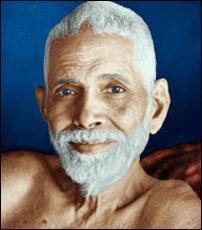
Image: Ramana Maharishi (1879-1950).

Sunday, September 24, 2006

The Tattooed Lion

Once there was a man who wanted to have a lion tattooed on his back.

He went to a tattoo artist and told him what he wanted.

But as soon as he felt the first few pricks, this man began to moan and grown: ‘You are killing me. What part of the lion are you making?’

‘I am just doing the tail now,’ said the artist.

‘Then let us leave out the tail,’ howled the other.

So the artist started again. And again the client could not stand the pricks. ‘What part of the lion is it this time?’ he cried, ‘for I cannot stand the pricks.’

‘This time,’ said the tattooist, ‘it is the lion’s ear.’

‘Let us have a lion without an ear,’ gasped the patient.

So the tattooist tried again. No sooner had the needle entered his skin that the victim squirmed again: ‘Which part of the lion is it this time?’

‘This is the lion’s stomach,’ wearily answered the artist.

‘I don’t want a lion with a stomach,’ said the other man.

Exasperated and distraught, the tattoo artist stood awhile. Then he threw his needle down and cried: ‘A lion without a head, with no tail, without a stomach? Who could draw such a thing? Even God did not!’

Rumi


From: The Way of the Sufi, by Idries Shah.

Why the Dervish Hides Himself

Rumi’s son asked him:

‘How and why is the dervish hidden? Is this done by superficial disguise? Is there something within himself which he conceals?’

The Master said:

‘It might be done in any way. Some write love-poems, and people think that they mean ordinary love. The dervish may hide his true position in the Way by adopting a calling. There are writers; and some, like Baba Farid, are traders. Still others follow various different outer activities.

‘This may be done for the sake of defence against the shallow. Some purposely act in a manner which society might disapprove.

‘The Prophet has therefore said: “God has hidden the Men of Greatest Knowledge.”

‘A device may be adopted by the Followers of the Way to gain peace, when they might otherwise be hindered.’

The master then recited:

Ever-knowing – as they hide and seek.
Appearing other than they are – to the ordinary man;
In inward light they roam – making miracles come to pass.
Yet they are really known – to none.

Munaqib el-Arifin


From: The Way of the Sufi, by Idries Shah.

The Teacher

Seek the appearance of a Teacher who does not seem to be the kind of teacher expected by the thinker or the pious. This is because among the thinkers and the pious there are some who will recognise him in any case. But those who have merit and ability for the way and are not accustomed to the behaviour of the thinking and the pious will reject the Teacher if he wears the appearance of those whom they do not understand.

Najmuddin Kubra


From: The Way of the Sufi, by Idries Shah.

The Design

A Sufi of the Order of the Naqshbandis was asked:

‘Your Order’s name means, literally, “The Designers”. What do you design, and what use is it?’

He said:

‘We do a great deal of designing, and it is most useful. Here is a parable of one such form.

‘Unjustly imprisoned, a tinsmith was allowed to recive a rug woven by his wife. He prostrated himself upon the rug day after day to say his prayers, and after some time he said to his jailers:

‘ “I am poor and without hope, and you are wretchedly paid. But I am a tinsmith. Bring me tin and tools and I shall make small artefacts which you can sell in the market, and we shall both benefit.”

‘The guards agreed to this, and presently the tinsmith and they were both making a profit, from which they bough food and comforts for themselves.

‘Then, one day, when the guards went to the cell, the door was open, and he was gone.

‘Many years later, when this man’s innocence had been established, the man who had imprisoned him asked him how he had escaped, what magic he had used. He said:

‘ “It’s a matter of design, and design within design. My wife is a weaver. She found the man who had made the locks of the cell door, and got the design from him. This she wove into the carpet, at the spot where my head touched in prayer five times a day. I am a metal-worker, and this design looked to me like the inside of a lock. I designed the plan of the artefacts to obtain the materials to make the key – and I escaped.”

‘That,’ said the Naqshbandi Sufi, ‘is one of the ways in which man may make his escape from the tyranny of his captivity.’


From: Thinkers of the East, by Idries Shah.

I’ll Make You Remember


One day Latif the Thief ambushed the commander of the Royal Guard, captured him and took him to a cave.

‘I am going to say something that, no matter how much you try, you will be unable to forget,’ he told the infuriated officer.

Latif made his prisoner take off all his clothes. Then he tied him, facing backwards, on a donkey.

‘You may be able to make a fool of me,’ screamed the soldier, ‘but you’ll never make me think of something if I want to keep it out of my mind.’

‘You have not yet heard the phrase which I want you to remember,’ said Latif. ‘I am turning you loose now, for the donkey to take back to town. And the phrase is:

‘ “I’ll catch and kill Latif the Thief, if it takes me the rest of my life!’ ”


From: Thinkers of the East, by Idries Shah.

Eat No Stones

A hunter, walking through some woods, came upon a notice. He read the words:

STONE-EATING IS FORBIDDEN

His curiosity was stimulated, and he followed a track which led past the sign until he came to a cave at the entrance to which a Sufi was sitting.

The Sufi said to him:

‘The answer to your question is that you have never seen a notice prohibiting the eating of stones because there is no need for one. Not to eat stones may be called a common habit.

‘Only when the human being is able simultaneously to avoid other habits, even more destructive than eating stones, will he be able to get beyond his present pitiful state.’


From: The Way of the Sufi, by Idries Shah.

Saturday, September 23, 2006

The Most Great Name

A fakir in India asked a Sufi whether he would tell him the Most Great Name: the Hundredth Name of Allah. Those who know it can perform miracles, altering the course of life and of history. None may know it until he is worthy.

The Sufi said:

'In accordance with tradition, I must first give you the test which will show your capacity. You must go to the gate of this city and remain there until nightfall, returning to me then to describe something which you will have witnessed.'

The fakir eagerly did as he was told. After nightfall he came back and gave his report to the sage in these terms:

'As instructed, I positioned myself at the city gate in a condition of alertness. The incident which most impressed me during the day concerned an old man. He wanted to enter our city with a huge load of firewood on his back.

'The gatekeeper insisted on his paying a tax on the value of his goods. The old man, being penniless, asked that he be allowed to sell his wood first. Realising that he was friendless and helpless, the gatekeper forced him to hand over his wood, which he stole for himself. The old man was driven away with cruel blows.'

The Sufi said:

'What were your feelings when you saw this?'

The fakir answered:

'I desired even more strongly to know the Most Great Name. Had I known it, the case would have been different for that unfortunate and innocent wood-cutter.'

The Sufi said:

'O man born to attain felicity! I myself learned the Hundredth Name from my own Master, after he had tested my resolution and ascertained whether I was an impulsive emotionalist or a servant of man, and after he had subjected me to experiences which would allow me to see my own thoughts and conduct.

'The Hundredth Name is for the service of all mankind, all the time. My Master was none other than the wood-cutter whom you saw today, by the city gate.


From: Thinkers of the East, by Idries Shah.

The Dervish under a Vow of Solitude

A dervish under a vow of solitude sat in a desert as a king passed with his retinue. Being in a special state of mind he took no notice, not even raising his head as the procession passed.

The king, emotionally overcome by his regal pretensions, was angry and said: 'These wearers of the patchwork robe are as impassive as animals, possessing neither politeness nor due humility.'

His vizier approached the dervish, saying: 'O dervish! The Sultan of the whole of the Earth has just passed by you. Why did you not pay the required homage?'

The dervish answered: 'Let the Sultan look for homage from those who seek to benefit from his goodwill. Tell him, too, that kings are created for the protection of their subjects. Subjects are not created for the service of kings.'


From: The Way of the Sufi, by Idries Shah.

Ajnabi (Stranger)

The Sufi Master Ajnabi said:

'Write to Mulla Firoz and tell him that I have no time to engage him in correspondence, and therefore have nothing to say to his letter.'

The disciple Amini said:

'Is it your intention to annoy him with this letter?'

Ajnabi said:

'He has been annoyed by some of my writings. This annoyance has caused him to write to me. My purpose in writing the passage which angers him was to anger such as he.'

Amini said:

'And this letter will anger him further?'

Ajnabi said:

'Yes. When he was enraged at what I wrote, he did not observe his own anger, which was my intention. He thought that he was observing me, whereas he was only feeling angry. Now I write again, to arouse anger, so that he will see that he is angry. The objective is for the man to realise that my work is a mirror in which he sees himself.'

Amini said:

'The people of the ordinary world always regard those who cause anger as ill-intentioned.'

Ajnabi said:

'The child may regard the adult who tries to remove a thorn from his hand as ill-intentioned. Is that a justification for trying to prevent the child from growing up?'

Amini said:

'And if the child harbours a grudge against the adult who removes the thorn?'

Ajnabi said:

'The child does not really harbour that grudge, because something in him knows the truth.'

Amini asked him:

'But what happens if he never gets to know himself, and yet continues to imagine that others are motivated by personal feelings?'

Ajnabi said:

'If he never gets to know himself, it makes no difference as to what he thinks of other people, because he can never have any appreciation of what other people are really like.'

Amini asked:

'Is it not possible instead of arousing anger a second time to explain that the original writing was composed for this purpose, and to invite the Mulla to review his personal feelings?'

Ajnabi said:

'It is possible to do this, but it will have no effect. Rather it will have an adverse effect. If you tell the man your reason he will imagine that you are excusing yourself, and this will arouse in him sentiments which are harmful only to him. Thus, by explaining you are actually acting to his detriment.'

Amini said:

'Are there no exceptions to this rule, than man must learn through realising his own state, and that his state cannot be explained to him?'

Ajnabi said:

'There are exceptions. But if there were enough exceptions to make any difference to the world, we would not by now have any Mulla Firozes left.'


From: Thinkers of the East, by Idries Shah.

Friday, September 22, 2006

Back home

I returned to Calcutta last night, after a hectic 4 day trip to south India, occasioned by some work there, but principally rushing around, travelling through the soils of my ancestral roots and meeting long-lost friends.

When one is in a ingrained schedule of living, which includes blogging - then, an enforced break from blogging and travel to far-flung places serves to remind that blogging is such a tiny part of life and the world, which must remain largely incommunicable!

I flew from Calcutta to Madras, then took an overnight train to Palakkad. I then took a bus from Palakkad to Cochin, via Trissur, reaching in the evening. I spent the night with my school friend Madhu. The next morning I took a bus back to Palakkad. And immediately took a bus to Coimbatore, from where I took a bus to Kothgiri, in the Nilgiri mountains. I spent the night with my friend Pratim. The next morning, I boarded a bus back to Coimbatore, and then another one to Palakkad. I took an overnight train to Madras, and yesterday I visited my college friend JP's mother in Madras, and another school friend Balaji, before taking the flight back to Calcutta in the evening.

I saw the reflection of the rising sun on the Arabian Sea on India's west coast, and also the reflection of the setting sun on the Bay of Bengal on India's east coast. And I travelled through dry plains, gigantic river basins, lush green countryside, wooded hills and thickly forested mountains.

I could write a fat novel on the resonances and significance of the places I travelled through and the people I met, occasioned by this chance trip!

Returning to a very wet and flooded Calcutta, where there's been incessant rain for 3 days.

On the dog: Orhan Pamuk

I had posted several teaching stories about dogs a few days back.

On the way back from my recent trip to south India, I bought Orhan Pamuk's My Name is Red at the airport bookshop.

This is a murder mystery set in the world of miniaturist artists in 16th century Istanbul.

The book has a chapter titled "I am a Dog", in which a voice (and an ear) is given (by a storyteller) to a dog, whose figure is drawn on paper. The dog-voice asks and investigates why there is such animosity towards dogs among clerics and why the very name has come to be the term for all that is base.

I heartily recommend this book!

Monday, September 18, 2006

Vishwa Karma Puja


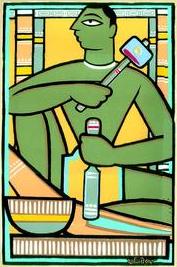
Vishwa Karma, the divine architect of the universe.

Son of Brahma, the Creator, personification of the creative power that welds heaven and earth together.

The divine carpenter carries a club in his right hand and holds tools in his left.

Revealer of
Sthapatya Veda, the science of mechanics and architecture.

Lord of the Arts.

Executor of a thousand handicrafts, most eminent of artisans, fashioner of all the ornaments, on whose craft all men subsist, and whom, a great and immortal God, they continually worship.


From the Rig Veda.


Today, 17 September, is the day of Vishwa Karma Puja in eastern India.

Vishwa Karma means “(the one who guides) the world’s work”. “Puja”, derived from Tamil, means worship or adoration, with flower offerings.

Factory workers, mechanical workshops, artisans, craftsmen etc all worship Lord Vishwa Karma on this day. It is a happy holiday for all industrial establishments. Images of Vishwa Karma, with his vehicle, an elephant, are installed in the premises. A variety of fruit offerings are made to the Lord. And there is a feast for workers, staff and their families. Vishwa Karma Puja used to be a grand affair in large industrial establishments in Calcutta. In the evenings staff associations would put up major stage productions.

In my childhood, on this day the sky in Calcutta used to be dotted with thousands of kites. In fact, non-Hindu boys used to know this as the “kite puja” day. It was the day, towards the end of the rainy (monsoon) season, on which kite flying peaked. That association with kites continues, especially for the humble folk; but in the main, kite flying has simply declined over the years due to various factors.

Boys – and men too – would fly kites from the roof terraces of their homes, or from open fields. As a song by the Bengali singer Anjan Dutt reminds us, the roof tempted and called out to the restless boy! Kite flying – was a serious sport.

Preparing the kite string (manja): using a boiled arrowroot starch base, with a garnishing of glass powdered in a mortar-pestle, and a colour of choice added; applied carefully by hand to the string strung out between lamp-posts, using small pieces of cloth; and then waiting for the string to dry; and finally reeling the crisp sharp string into the latai (the spindle-reel). This was an elaborate and sombre ritual, undertaken on the day before Vishwa Karma Puja. Rather like the elaborate preparations for pujas in my own household, which began with grinding rice flour, for making delectable sweet and savoury offerings. There was muted but feverish excitement and anticipation - of flying the kite on the day; of taunting others to fight; playing the kite and string, and trying to fathom the opponent's weakness; and then the ecstatic cry: Bokatta! I’ve cut you! Lope! Try to catch it! And finally trying to catch the flailing-sinking cut kite's on one's own string.

I never learnt to fly a kite. But I was happy to be slave, assistant and latai-holder to a master, Dhiren, the servant in our house, who was about 6 years older than me. He was outstanding, in kites as well as in marbles games, spinning tops (which also involved a fight between opponents, to break the other's top with one's top), and in dan-guli (known as guli-danda in north India), another folk sport, where a small piece of wood was sought to be hit to great distances with a longer stick.

All this required immense interest, commitment, effort, skill and talent. The expert or champion commanded great respect and awe. Slums were never too far away from the "decent folk's" neighbourhoods, and so play often involved mixed groups. Sadly, the talented champions from poor families were left behind by their better-off playmates, who went to good schools; childhood mates were parted by unequal social opportunities. One remained in a small, closed ambit; for the other it was ever-expanding horizons.

The industrial economy of Calcutta and the state of West Bengal has died over the last 4 decades. Workers of closed factories were driven to suicide. With tertiarisation of the economy, Viswa Karma Puja is today observed more by bus drivers and conductors, taxi drivers and cycle rickshaw pullers.

The last 15 years or so has seen old houses giving way to apartment blocks. Open fields and vacant plots have all gone. People do not have access to kite-flying spaces anymore. Integration between classes has waned, and disparites, alienation, polarisation and hostility has grown.

And there are so many more attractions for middle class children nowadays, from satellite television to video and computer games to amusement parks and arcades … hence children's games and sport like kite flying, marbles, spinning tops, dan-guli etc - all of which obsessed kids and teenagers in Calcutta 35-40 years ago, as well as their earlier generations - have all been forgotten. The better off sections have moved on, to new allures, leaving the traditional things to the socio-economically weak and marginal.

Calcutta used to be the centre of kite-making in India. But the kite trade in Calcutta is in poor shape today.

Though its a Sunday, I will be at our factory. This is a small manufacturing enterprise started by my late father in 1967, which I am now managing on behalf of my family. We manufacture precision instruments for industrial, scientific and medical applications. It started out as an import substitution venture; 4 years ago I began working towards export, and today our instruments are supplied worldwide. But there’s a long way to go – to secure our place in a globalising world – and much work to be done.

A sumptuous feast will be prepared. I will be serving and eating with our staff and workers. And in the evening I leave for a work-related trip, to the place of my family's roots, in south India, to return after 4 days.

May Lord Vishwa Karma’s blessings help to secure the quality of people’s lives everywhere!


Painting: Vishwa Karma, by Jamini Roy.

Saturday, September 16, 2006

The Prophet and the dog

There is an anecdote told of Mohammed, the prophet of Islam.

One day, a panting dog feebly approached one of his followers, who took notice of the poor animal. Seeing a puddle of muddy water, he tore a scrap off the hem of his shirt, soaked it in the water and taking the dog in his lap, he moistened its mouth.

Another person, witnessing this, went and told the Prophet that a member of the group had handled a filthy animal, "and therefore he should not be allowed back here again."

Mohammed asked, "What was he doing to the dog ?"

"I don't know, but I saw him moistening its mouth with a torn piece of cloth dipped in muddy water."

"Then," replied the Prophet, "He is a better Muslim than you, because he is kind to animals."


From: khandro

Asanga and the dog


In response to my Sufi dog tales, Dan has been so kind as to send me the following story of Asanga. This is an awesome and inspiring teaching story.


Asanga was one of the most famous Indian Buddhist saints, and lived in the fourth century. He went to the mountains to do a solitary retreat, concentrating all his meditation practice on the Buddha Maitreya, in the fervent hope that he would be blessed with a vision of this Buddha and receive teachings from him.

For six years Asanga meditated in extreme hardship, but did not even have one auspicious dream. He was disheartened and thought he would never succeed with his aspiration to meet the Buddha Maitreya, and so he abandoned his retreat and left his hermitage. He had not gone far down the road when he saw a man rubbing an enormous iron bar with a strip of silk. Asanga went up to him and asked him what he was doing. "I haven't got a needle," the man replied, "so I'm going to make one out of this iron bar. "Asanga stared at him, astounded; even if the man were able to manage it in a hundred years, he thought, what would be the point? He said to himself: "Look at the trouble people give themselves over things that are totally absurd. You are doing something really valuable, spiritual practice, and you're not nearly so dedicated." He turned around and went back to his retreat.

Another three years went by, still without the slightest sign from the Buddha Maitreya. "Now I know for certain," he thought "I'm never going to succeed." So he left again, and soon came to a bend in the road where there was a huge rock, so tall it seemed to touch the sky. At the foot of the rock was a man busily rubbing it with a feather soaked in water. "What are you doing?" Asanga asked. "This rock is so big it's stopping the sun from shining on my house, so I'm trying to get rid of it." Asanga was amazed at the man's indefatigable energy, and ashamed at his own lack of dedication. He returned to his retreat.

Three more years passed, and still he had not even had a single good dream. He decided, once and for all, that it was hopeless, and he left his retreat for good. The day wore on, and in the afternoon he came across a dog lying by the side of the road. It had only its front legs, and the whole of the lower part of its body was rotting and covered with maggots. Despite its pitiful condition, the dog was snapping at passers-by and pathetically trying to bite them by dragging itself along the ground with its two good legs.

Asanga was overwhelmed with a vivid and unbearable feeling of compassion. He cut a piece of flesh off his own body and gave it to the dog to eat. Then he bent down to take off the maggots that were consuming the dog's body. But he suddenly thought he might hurt them if he tried to pull them out with his fingers, and realized that the only way to remove them would be on his tongue. Asanga knelt on the ground, and looking at the horrible festering, writhing mass, closed his eyes. He leant closer and put out his tongue. The next thing he knew, his tongue was touching the ground. He opened his eyes and looked up. The dog was gone; there in its place was the Buddha Maitreya, ringed by a shimmering aura of light.

"At last," said Asanga, "why did you never appear to me before?"

Maitreya spoke softly: "it is not true that I have never appeared to you before. I was with you all the time, but your negative karma and obscurations prevented you from seeing me. Your twelve years of practice dissolved them slightly so that you were at last able to see the dog. Then, thanks to your genuine and heartfelt compassion, all those obscurations were completely swept away and you can see me before you with your very own eyes. If you don't believe that this is what happened, put me on your shoulder and try and see if anyone else can see me."

Asanga put Maitreya on his right shoulder and went to the marketplace, where he began to ask everyone: "What have I got on my shoulder?" "Nothing," most people said, and hurried on. Only one old woman, whose karma had been slightly purified, answered: "You've got the rotting corpse of an old dog on your shoulder, that's all. "

Asanga at last understood the boundless power of compassion that had purified and transformed his karma, and so made him a vessel fit to receive the vision and instruction of Maitreya. Then the Buddha Maitreya, whose name means "loving kindness," took Asanga to a heavenly realm, and there gave him many sublime teachings that are among the most important in the whole of Buddhism.


From: The Tibetan Book of Living and Dying, by Sogyal Rinpoche.

Come and see Pakistan!


Shirazi is a blogger friend from Lahore, Pakistan. Through his blog, he shares – with love, insight, and tenderness - his land, her history, sights and sounds, people, culture, language, food … He is a great ambassador for Pakistan. Reading his pieces – one has to urge to go there immediately!

Come and see Pakistan!

Especially in the present context of the “war against terrorism” and the unfortunate association of terrorists with this country – it is vital that people across the world see Pakistan and know the country and her people for themselves. They would realise that everything they heard and thought about Pakistan was only a distorted image through a discoloured lens. The real Pakistan is something else. It’s a land of amazing human warmth and cultural and spiritual wealth that would captivate anyone – of sensibility. Every sensitive visitor to Pakistan would return as an ambassador of this country.


Reading Shirazi’s posts, it struck me that someone like him should be organising conducted tours for discerning people from across the world. I remember the advertisements for cultural tours in magazines like New Yorker and Harper’s (or CAM, the Cambridge Alumni Magazine). Shirazi’s posts establish that Pakistan is a prime candidate for similar tours.

Yesterday evening I was talking to Mick Douglas, a friend from Melbourne, who had organised a inter-cultural project in Karachi and Melbourne, highlighting the fabulous “mini-bus art” of Karachi. Mick agreed with me that aesthetics and art is impregnated in the daily lives and activities of the common people.

One comes across Visit Thailand Year, Visit Malaysia year, even Visit India Year. I don’t recall a Visit Pakistan Year. India organised several Festivals of India in different countries in the 1980s. I don’t know whether Festivals of Pakistan have taken place anywhere. Its high time …

I would like to see a Come and See Pakistan! movement, taken up by the people of Pakistan: civil society organisations, business and professional groups, artists, performers, sportspersons etc.

Pakistan is a very special country, a precious treasure in the world community. The world needs to start discovering this now, and thus be uplifted towards building a better world. And thus would the real Pakistan too emerge out of the dark clouds that have overshadowed this beautiful land for a long time.

Where the high mountains are …
Come and see Pakistan,
A beautiful country.

Where the cradle of civilisation is nestled …
Come and see Pakistan,
A beautiful country.

Where treasures of antiquity abound …
Come and see Pakistan,
A beautiful country.

Where mystics and saints hover …
Come and see Pakistan,
A beautiful country.

Where songs of ecstasy resound …
Come and see Pakistan,
A beautiful country.

Where bedazzling textiles sway …
Come and see Pakistan,
A beautiful country.

Where feasts of emperors invite …
Come and see Pakistan,
A beautiful country.

Where the friendliest people are …
Come and see Pakistan,
A beautiful country.


Note to Shirazi: Don’t forget to pass on my commission, okay?

Friday, September 15, 2006

Abu Yazid al-Bestami makes way for a dog

Abu Yazid al-Bestami (also known as Bayazid Bistami), was born in Bestam in north-eastern Persia, where he died in 874 or 877, and where his mausoleum still stands. He is regarded as the founder of the ecstatic (“drunken”) school of Sufism.


One day Abu Yazid was walking with a party of disciples. The road narrowed, and just then a dog approached from the opposite direction. Abu Yazid retired, giving the dog right of way.

The chance thought of disapproval occurred to one of the disciples. “Almighty God honoured man above all creatures. Abu Yazid is the ‘king of the gnostics’ yet with all this dignity, and such a following of disciples, he makes way for a dog. How can that be?”

“Young man,” Abu Yazid replied, “this dog mutely appealed to me, ‘What shortcoming was I guilty of in the dawn of time, and what exceptional merit did you acquire, that I was clad in the skin of a dog whereas you were robed in honour as king of the gnostics?’ This was the thought that came into my head, so I made way for the dog.”


From: Muslim Saints and Mystics: Episodes from the Tadhkirat al-Auliya (‘Memorial of the Saints’) by Farid al-Din Attar, translated by AJ Arberry.

Sofyan-e Thauri

Sofyan-e Thauri was born in 715 at Kufa and attained high proficiency in Traditions and theology. In 775 he collided with the authorities and was compelled to go into hiding in Mecca; he died in 778 at Basra.


One day Sofyan was eating a piece of bread when a dog happened along. He gave the bread to the dog, bit by bit.

“Why did you not eat it with your wife and child?” he was asked.

“If I give bread to the dog,” he replied, “he keeps watch over me all through the night so that I can pray. If I give it to my wife and child, they hold me back from my devotions.”


From: Muslim Saints and Mystics: Episodes from the Tadhkirat al-Auliya (‘Memorial of the Saints’) by Farid al-Din Attar, translated by AJ Arberry.

Maruf-e Karkhi

Maruf-e Karkhi was a prominent mystic of the Baghdad school. He died in 815.


Maruf had an uncle who was the governor of the city. One day he was passing some wasteland when he observed Maruf sitting there eating bread. Before him there was a dog, and Maruf was putting one morsel in his own mouth and then one in the dog’s.

“Are you not ashmed to eat bread with a dog?” cried his uncle.

“It is out of shame that I am giving bread to the poor,” replied Maruf.

Then he raised his head and called to a bird in the air. The bird flew down and perched on his hand, covering his head and eyes with his wings.

“Whosoever is ashamed before God,” said Maruf, “every thing is ashamed before him.”

At once his uncle was filled with confusion.

From: Muslim Saints and Mystics: Episodes from the Tadhkirat al-Auliya (‘Memorial of the Saints’) by Farid al-Din Attar, translated by AJ Arberry.

Abu Othman al-Hiri

Abu Othman al-Hiri lived in Nishapur, where he died in 911.


"For forty years," said Abu Othman, "whatever state God has kept me in I have not resented, and to whatever state He transferred me I have not been angry."

The following story bears out this assertion. A man who disbelieved in Abu Othman sent him an invitation. Abu Othman accepted, and got as far as the door of his house. The man then shouted at him:

"Glutton, there is nothing here for you. Go home!"

Abu Othman went home. He had gone only a little way when the man called out to him:

"Shaikh, come here!"

Abu Othman returned.

"You are very eager to eat," the man taunted him. "There is still less. Be off with you!"

The shaikh departed. The man summoned him again, and he went back.

"Eat stones, or go home!"

Abu Othman went off once more. Thirty times the man summoned him and drove him away. Thirty times the shaikh came and went, without showing the least discomposure. Then the man fell at his feet and with tears repented, becoming his disciple.

"What a man you are!" he exclaimed. "Thirty times I drove you off with contumely, and you showed not the slightest discomposure."

"This is an easy matter," Abu Othman replied. "Dogs do the same. When you drive them away they go, and when you call them they come, without showing any discomposure. A thing in which dogs equal us cannot really be accounted anything. Men's work is something quite other."


From: Muslim Saints and Mystics: Episodes from the Tadhkirat al-Auliya (‘Memorial of the Saints’) by Farid al-Din Attar, translated by AJ Arberry.

al-Termedhi

Abu al-Termedhi was driven out of his native town of Termedh and took refuge in Nishapur, where he was preaching in 898. He is regarded as one of the outstanding creative thinkers of Islamic mysticism.


In Termedhi’s time lived a great ascetic who was always criticising him. Now in all the world Termedhi possessed nothing but a cabin. When he returned from his journey to Hejaz, a dog had whelped in that cabin, which had no door. Termedhi did not wish to drive the dog out, and he went and came eighty times in the hope that the dog would have of its own free will carried its puppies out.

That same night the ascetic saw the Prophet in a dream.

“Sirrah, you have put yourself up against a man who eighty times brought succour to a dog,” the Prophet said. “If you desire eternal happiness, go, bind up your loins and serve him.”

The ascetic, too ashamed to answer Termedhi’s greetings, thereafter spent the rest of his life in his service.


From: Muslim Saints and Mystics: Episodes from the Tadhkirat al-Auliya (‘Memorial of the Saints’) by Farid al-Din Attar, translated by AJ Arberry.

Blackmail in Singur

Singur, an agricultural area in West Bengal, India has been in the news. The Tata company wants to get land there for its low-cost car project. But the local farming households have protested against this, because they fear loss of livelihood, with no alternatives. And the state govt is acting on behalf of the company.

In a bizarre twist, The Statesman reports today that the state’s commerce and industry secretary, Mr Sabyasachi Sen, has said that the development of Singur would come to a halt if the Tatas decide to abandon their project in the face of agitation from the local residents.

He said that the acquired land would not be given back to the farmers. “Even if Tatas go back, the acquired land will remain with the government. Not only will they lose their land, but there will not be any industrial development in Singur as the state government will declare it as an agrarian block and no conversion of agricultural land will be allowed there. Hence, all development avenues will come to a halt,” said Mr Sen.

Ruling out the possibility of shifting the project , Mr Sen said that if the local residents welcome the Tatas, it would be beneficial to them as the industrial house had prepared a blueprint of community development for them.

This is nothing short of blackmail, and a rape of democracy!

If the govt. will declare it an agricultural zone after the Tatas exit – why does it not declare this right now, so that the project comes up in some other non-agricultural zone? And if its to be declared an agricultural zone, why should the state hold on to the land acquired from farmers?

I hope suitable action will be taken against this power-crazed bureaucrat, acting on the behest of his political masters.

Thursday, September 14, 2006

Dogs (& monkeys)


I recently came across, in succession, some posts about dogs by bloggers Flitzy, Kathy, Flitzy again, and Darvish. And a hilarious image in Planck’s Constant. There’s also of course Hayden, who regularly writes about dogs.

This brought to mind the several Sufi dog tales I have among my books. I had paid particular attention to this subject, of dog as metaphor, in terms of reflection, associations etc. I had also once shared these stories with a friend who’s particularly close to dogs.

So, as promised to Kathy, I am now transcribing and posting these.

By posting the following five dog tales, I also pay tribute to the late Idries Shah, the author of many books on Sufi philosophy and teachings. Through his books, he has been a dear and intimate friend and guide.

This is a first offering. More to follow, from the stories of Muslim saints and mystics.

In Hindu religious mythology, there is Hanuman, the monkey son of Wind. He is a principal character in the Ramayana epic, the one who helps Lord Rama defeat the evil King Ravana of Lanka, and rescue his abducted wife Sita. Hanuman is an exemplar of devotion. It is said that wherever and whenever the Ramayana is narrated, Hanuman is present in that assembly.

Like with Sufi dog tales, I have thought long and hard about this monkey business. Why a monkey? Together with Hanuman and the army of monkeys who helped Lord Rama, there were also bears, and even a squirrel! There is a tale of how the squirrel got the marking on the top of its fur, for its wish and efforts to help Lord Rama build the bridge across the sea, to Lanka.

I realised that in the racially and socially stratified Indian setting - all this has profound meanings and resonances in the consciousness of a seeker, of someone engaging compassionately with common people, and working for social justice. These meanings cannot be explained by one to another, like feeding regurgitated pre-masticated pap! It is for each seeker to encounter such tales and symbols, discern their significance, and reflect upon them in the mirror of her own life experience and work.


Cartoon: off the mark

The Teacher and the Dog

A Sufi teacher, walking along a road with a student, was assailed by a ferocious dog.

The disciple was furious and cried out:

‘How dare you approach my master in such a manner?’

‘He is more consistent than you are,’ said the Sage, ‘for he barks at anyone, in accordance with his habit and proclivities; while you regard me as your master and are wholly insensitive to the merits of the many illuminates whom we have already passed on this journey, dismissing them without a second glance.’


From: The Way of the Sufi, by Idries Shah.

The Sufi Who Called Himself a Dog

Maulana Dervish, chief of the Naqshbandi Order and one of its greatest teachers, was sitting one day in his Zavia when a furious cleric forced his way in.

‘You sit there,’ shouted the intruder, ‘dog that you are, surrounded by disciples, obeyed by them in every particular! I, on the other hand, call men to strive towards divine mercy through prayer and austerities as is enjoined upon us.’

At the word ‘dog’, several of the Seekers rose to eject the fanatic.

‘Stay,’, said the Maulana, ‘for “dog” is indeed a good word. I am a dog, who obeys his mater, showing the sheep by signs the interpretation of our Master’s desires. Like a dog I infuriate the interloper and the thief. And I wag my tail in pleasure when my master’s Friends come near.

‘Just as barking and wagging and love are attributes of the dog, we exercise them; for our Master has us, and does not do his own barking and wagging.’


From: The Way of the Sufi, by Idries Shah.

Why the Dog Could Not Drink

Shebli was asked:

‘Who guided you in the Path?’

He said: ‘A dog. One day I saw him, almost dead with thirst, standing by the water’s edge.

‘Every time he looked at his reflection in the water he was frightened, and withdrew, because he thought it was another dog.

‘Finally, such was his necessity, he cast away fear and leapt into the water; at which the “other dog” vanished.

‘The dog found that the obstacle, which was himself, the barrier between him and what he sought, melted away.

‘In this same way my own obstacle vanished, when I knew that it was what I took to be my self. And my Way was first shown to me by the behaviour of – a dog.’


From: The Way of the Sufi, by Idries Shah.

Etiquette

An inquirer asked Sayed Khidr Rumi:

‘Is there anything which can be called the best and also the worst of human institutions?’

He said:

‘Yes, indeed. There is such a thing, and its name is “etiquette”.

‘The advantage of etiquette and conduct is that it enables the Wise to approach the student without being jeered at, and it makes possible the search by the student without people thinking him ridiculous.

‘The disadvantage of etiquette which makes it the worst of human institutions is that it enables the ignorant to erect their own rules of what is permissible in thought and conduct and what is not. If such people decide that there are certain things which should never be thought or done, then they can effectively prevent the transmission of knowledge.’

The inquirer asked:

‘May I have an instance of how this happens in our teaching?’

Sayed Khidr Rumi said:

‘It has been customary for people, when they read prescribed books and accounts of the doings of the Masters, to say, “This is an analogy which does not apply to me." It also enables them to say. “This is an encounter with a stupid man. I could never think like the man in the tale; therefore the Teacher is in this instance dealing with a completely different type of person.” The reality is that such a person is always the one most in need of teaching, while he is unaware of it.

‘There is the story of the dog who was distressed when a man shouted at him, saying, “look at that mangy creature!” The dog, instead of looking for a sage who would cure his mange, jumped into a pool of water and came out dripping wet. He ran up to the man, wagging his tail, as if to say, “Look, my coat is changed, it is all dampness where before it was a dusty mat!” The man started to curse him even more strongly, because he did not want the dog to shake the water off all over him.

‘The dog became convinced that the man was irrational, while it was simply a matter that one did not understand the other. In he instance of the acts related of the Wise, the doggishness in the student must realise that the sage is talking about a real, not an illusory, improvement in his state.’

From: Thinkers of the East, by Idries Shah.

Bayazid Bistami

Bayazid encountered a dog and started to pull his robe away from it, so that it should not defile him.

The dog, in a human voice, said:

‘If I had been dry, there would have been no purpose in avoiding me. If I had been wet, you could have washed your robe. But the hate which you have towards me can never be cleansed.’

Bayazid said:

‘O enlightened dog, come and stay with me for a while.’

The dog answered:

‘That is impossible, because the world uses me as an epithet, and you are regarded by the world as a paragon.’

Bayazid exclaimed:

‘Alas! I am not fit to live with one whom the whole world regards as inferior: how can I therefore approach the Truth which all regard as the Highest of all?’


From: The Way of the Sufi, by Idries Shah.

Wednesday, September 13, 2006

The poisoned arrow


The Buddha was not interested in discussing unnecessary metaphysical questions which are purely speculative and which create imaginary problems. He considered them as a ‘wilderness of opinions’. It seems that there were some among his own disciples who did not appreciate this attitude of his. For, we have the example of one of them, Malunkyaputta by name, who put to the Buddha ten well-known classical questions on metaphysical problems and demanded answers.

One day Malunkyaputta got up from his afternoon meditation, went to the Buddha, saluted him, sat on one side of the road and said:

‘Sir, when I was all alone meditating, this thought occurred to me: There are these problems unexplained, put aside and rejected by the Blessed One. Namely, (1) is the universe enternal or (2) is it not eternal, (3) is the universe finite or (4) it is infinite, (5) is soul the same as body or (6) is soul one thing and body another thing, (7) does the Enlightened One exist after death, or (8) does he not exist after death, or (9) does he both (at the same time) exist and not exist after death, or (10) does he both (at the same time) not exist and not not-exist. These problems the Blessed One does not explain to me. This (attitude) does not please me, I do not appreciate it. I will go to the Blessed One and ask him about this matter. If the Blessed One explains them to me, then I will continue to follow the holy life under him. If he does not explain them, I will leave the Order and go away. If the Blessed One knows that the universe is eternal, let him explain it to me so. If the Blessed One knows that the universe is not eternal, let him say so. If the Blessed One does not know whether the universe is eternal or not, etc, then for a person who does not know, it is straightforward to say “I do not know, I do not see”.’

The Buddha’s reply to Malunkyaputta should do good to many millions in the world today who are wasting valuable time on such metaphysical questions and unnecessarily disturbing their peace of mind:

‘Did I ever tell you, Malunkyaputta, “Come, Malunkyaputta, lead the holy life under me, I will explain these questions to you?” ’

‘No, Sir.’

‘Then, Malunkyaputta, even you, did you tell me: “Sir, I will lead the holy life under the Blessed One, and the Blessed One will explain these questions to me”?’

‘No, Sir.’

‘Even now, Malunkyaputta, I do not tell you: “Come and lead the holy life under me, I will explain these questions to you”. And you do not tell me either: “Sir, I will lead the holy life under the Blessed One, and he will explain these questions to me”. Under the circumstances, you foolish one, who refuses whom? (i.e., both are free and neither is under obligation to the other).

“Malunkyaputta, if anyone says: “I will not lead the holy life under the Blessed One until he explains these questions,” he may die with these questions unanswered by the Enlightened One. Suppose Malunkyaputta, a man is wounded by a poisoned arrow, and his friends and relatives bring him to a surgeon. Suppose the man should then say: “I will not let this arrow be taken out until I know who shot me; whether he is a Ksatriya (of the warrior caste) or a Brahmana (of the priestly caste) or a Vaisya (of the trading and agricultural caste) or a Sudra (of the low caste); what his name and family may be; whether he is tall, short, or of medium stature; whether his complexion is black, brown or golden; from which village, city or town he comes. I will not let this arrow be taken out until I know the kind of bow with which I was shot; the kind of bowstring used; the type of arrow; what sort of feather was used on the arrow and with what kind of material the point of the arrow was made.” Malunkyaputta, that man would die without knowing any of these things. Even so, Malunkyaputta, if anyone says: “I will not follow the holy life under the Blessed One until he answers these questions such as whether the universe is eternal or not, etc,” he would die with these questions unanswered by the Enlightened One.’

Then the Buddha explains to Malunkyaputta that the holy life does not depend on these views. Whatever opinion one may have about these problems, there is birth, old age, decay, death, sorrow, lamentation, pain, grief, distress, “the Cessation of which (i.e. Nirvana) I declare in this very life.”

‘Therefore, Malunkyaputta, bear in mind what I have explained as explained, what I have not explained as unexplained. What are the things that I have not explained? Whether the universe is eternal or not, etc, (those 10 questions) I have not explained. Why, Malunkyaputta, have I not explained them? Because it is not useful, it is not fundamentally connected with the spiritual holy life, is not conducive to aversion, detachment, cessation, tranquility, deep penetration, full realisation, Nirvana. That is why I have not told you about them.

‘Then, what, Malunkyaputta, have I explained? I have explained dukkha (suffering), the arising of dukkha, the cessation of dukkha, and the way leading to the cessation of dukkha. Why, Malunkyaputta, have I explained them? Because it is useful, is fundamentally connected with the spiritual holy life, is conducive to aversion, detachment, cessation, tranquility, deep penetration, full realisation, Nirvana. Therefore I have explained them.

It seems that this advice of the Buddha had the desired effect on Malunkyaputta, because he is reported to have approached the Buddha again for instruction, following which he became an Arahant.


From: What the Buddha Taught, by Walpola Rahula.

See also: Medicine Buddha, Buddha as Healer.

Junk culture 'is poisoning our children'


by Ben Fenton

A sinister cocktail of junk food, marketing, over-competitive schooling and electronic entertainment is poisoning childhood, a powerful lobby of academics and children's experts says.

In a letter to The Daily Telegraph, 110 teachers, psychologists, children's authors and other experts call on the Government to act to prevent the death of childhood.

They write: "We are deeply concerned at the escalating incidence of childhood depression and children's behavioural and developmental conditions."

The group, which includes Philip Pullman, the children's author, Jacqueline Wilson, the children's laureate, her predecessor Michael Morpurgo, Baroness Greenfield, the director of the Royal Institution and Dr Penelope Leach, the child care expert, blames a failure by politicians and public alike to understand how children develop.

"Since children's brains are still developing, they cannot adjust. . . to the effects of ever more rapid technological and cultural change," they write.

"They still need what developing human beings have always needed, including real food (as opposed to processed "junk"), real play (as opposed to sedentary, screen-based entertainment), first-hand experience of the world they live in and regular interaction with the real-life significant adults in their lives.

"They also need time. In a fast-moving, hyper-competitive culture, today's children are expected to cope with an ever-earlier start to formal schoolwork and an overly academic test-driven primary curriculum.

"They are pushed by market forces to act and dress like mini-adults and exposed via the electronic media to material which would have been considered unsuitable for children even in the very recent past."

The letter was circulated by Sue Palmer, a former head teacher and author of Toxic Childhood, and Dr Richard House, senior lecturer at the Research Centre for Therapeutic Education at Roehampton University.

Mrs Palmer said: "I have been thinking about this for a long time and I just decided something had to be done.

"It is like this giant elephant in all our living rooms, the fact that children's development is being drastically affected by the kind of world they are brought up in."

She cited research by Prof Michael Shayer at King's College, London, which showed that 11-year-olds measured in cognitive tests were "on average between two and three years behind where they were 15 years ago".

"I think that is shocking. We must make a public statement – a child's physical and psychological growth cannot be accelerated.

"It changes in biological time, not at electrical speed. Childhood is not a race."

The other signatories include Sir Jonathon Porritt, the environmental campaigner, Prof Tim Brighouse, the Commissioner for London Schools and Sir Richard Bowlby, the President of the Centre for Child Mental Health.

Mr Morpurgo said: "We have so much anxiety about children, their protection, their care, their education, that this has developed into fear. There is a fear around children, both from schools and politicians, which has led to this target-driven education system.

"That has put children into an academic straitjacket from a very early age which restricts creativity and the enrichment of childhood."

He condemned the "virtual play" represented by electronic games and internet surfing. "That is where children are getting their ideas from and I find it quite "toxic" and pretty scary for the future."

Jacqueline Wilson said: "We are not valuing childhood. I speak to children at book signings and they ask me how I go through the process of writing and I say, 'Oh you know, it's just like when you play imaginary games and you simply write it all down'.

"All I get is blank faces. I don't think children use their imaginations any more."

Baroness Greenfield is so concerned about the effect of technology on children she has set up an all-party group in the Lords to look into it.

The other members are three former education secretaries, Baroness Williams, Baroness Shephard and Baroness Morris.


Read what people have to say about this here.

Macho means mean


by Monobina Gupta

This one is for all you males who flaunt your sexuality as your trophy: what, in your opinion, is the mark of a real man?

Is it controlling women sexually to the point of making them weep? Indulging in aggressive and violent behaviour? Beating up your wives when you think they deserve it? Or all of the above?

If you think the options are unfair and an assault on your sensibility, here’s more: a group of males between 18 and 29 years of age think these are what make up an asli mard (real man)!

According to a study done on the group from a northeast Mumbai slum, a “real man” is one who is “physically attractive, dominant, aggressive and sexually powerful”. And possibly like actors Salman Khan and Sanjay Dutt, who most said were their “role models”.

“Controlling women and violent behaviour were important parts of a definition of a real man. They also thought that young women sought this kind of real men,” the study, done by the Population Council, Save the Children and Committee of Research Organisations, said.

Forty-two per cent of the participants said it was the man who should decide what kind of sex to have and “a man needs other women even if things are fine with the wife”.

Thirty-one per cent believed there were times when “a woman deserves to be beaten” up. “A woman should tolerate violence in order to keep her family together,” they said.

Fifty-one per cent believed women “who carried condoms on them were easy”. Besides, it was a woman’s responsibility to avoid getting pregnant. They said they would “never have a gay friend and it disgusts them to see a man acting like a woman”.

The study, however, conceded that most men gave in to “accepted” norms of male behaviour because of pressure from peers, family members and the media.

“It is mostly peer pressure,” Rahul Gaware, a Committee of Research Organisation member who conducted the study, said.

“The overriding factor that defined their masculinity was if they could make their girl/woman partner cry during the sexual act.”

The study was conceived by the Population Council and Save the Children to check HIV/AIDS and violence against women. Research has shown that more young men are, on an average, vulnerable to the infection and more likely to have multiple sexual partners than women.

“Young men in India mature and develop in a male-dominated society with little contact with female peers and virtually no sex education,” the Population Council said.

“In this context, most boys develop a sense of masculinity characterised by male dominance in sexual as well as other areas.”

That a similar kind of machismo is promoted by some of Bollywood’s heroes has not helped. Salman has a history of violent behaviour and Sanjay has played aggressive and macho characters in many early films.

Based on the study’s findings, the three organisations are holding discussions in Delhi to draw up recommendations for future work in India. “We are also working in Pakistan and Bangladesh,” an activist said.

The study model was drawn from Promundo, a Brazilian NGO that has worked with young men and their concepts of masculinity.

“We adopted the same model for our research and intervention,” an activist of the Committee of Research Organisations, Mahendra Rakade, said.

The intervention programme involved group discussions on subjects like changing from violent to intimate relationships, Gaware said.

“At the end of the intervention we found a change in the young men. They were more willing to treat their partners — girl friends or wives — with more respect.”

Tuesday, September 12, 2006

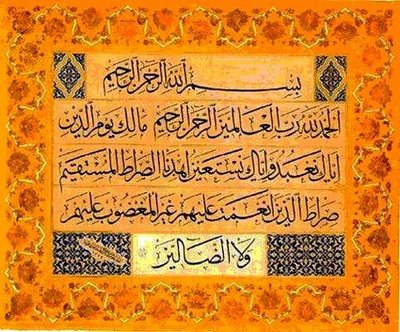
The Fatiha


Bismillah ar Rahman ar Rahim!

Al Hamdu lil Laahe Rabbil Aalameen
Ar Rahmaan ar Rahim
Maaliki yaum id din
Ya quanah budo
Wahiya khanastaiin
Ih dinah as siraat al mustaquiim
Siraat al lazina
An amteh ilaihiim gaiiril madhdubi
Al aiihim waladdu aaleen

Aameen!


Hear / download the Surah Al-Fatiha here (WMA)

Hear / download the Fatiha here (MP3).

The Opening

In the name of God, the Compassionate, the Merciful!

All praise belongs to God alone
Lord of all worlds,
The Compassionate, the Merciful,
Ruler of the Day of Judgement.
It is You that we worship
And to You we appeal for help.
Show us the straight way,
The way of those You have graced,
Not of those on whom is Your wrath,
Nor of those who wander astray.

Amen

Get this widget | Share | Track details

Hazrat Inayat Khan’s elaboration


Hazrat Inayat Khan, founder of the Sufi Order in the west, was born in India in 1882. A master of classical Indian music by the age of twenty, he relinquished a brilliant career to devote himself to the spiritual path. In 1910, he left India to became one of the first teachers of the Sufi tradition in the west. For a decade and a half he travelled throughout Europe and the United States, giving lectures and guiding an ever-growing group of seekers. In 1926, he returned to India, where he died the following year.

I discovered Inayat Khan’s writings in 1998. I came across the following prayer, which seemed to me an elaboration of the Fatiha.


Praise be to Thee, Most Supreme God,
Omnipotent, Omnipresent, All-pervading, the Only Being.
Take us in Thy Parental Arms, raise us from the denseness of the earth,
Thy Beauty do we worship, to Thee do we give willing surrender.
Most Merciful and Compassionate God, the Idealized Lord of the whole humanity,
Thee only do we worship, and towards Thee Alone do we aspire.
Open our hearts towards Thy Beauty, illuminate our souls with Divine Light,
O Thou, the Perfection of Love, Harmony and Beauty,
All-powerful Creator, Sustainer, Judge and Forgiver of our shortcomings,
Lord God of the East and of the West,
of the worlds above and below,
and of the seen and unseen beings.
Pour upon us Thy Love and Thy Light,
give sustenance to our bodies, hearts and souls,
use us for the purpose that Thy Wisdom chooseth,
and guide us on the path of Thine Own Goodness.
Draw us closer to Thee every moment of our life,
until in us be reflected Thy Grace, Thy Glory, Thy Wisdom, Thy Joy and Thy Peace.

Amen

Fields of Merit


One day while standing on a high hill, the Buddha looked out over the fields of rice paddy. He turned to Ananda and said, “Ananda, how beautiful are the golden patches of rice that stretch to the horizon. Wouldn’t it be nice to sew our robes in the same checkered pattern?”

Ananda said “Lord it is a wonderful idea. Sewing the monks' robes in the same pattern as rice fields would be lovely. You have said that a monk who practices the Way is like a fertile field in which seeds of virtue and merit have been sown to benefit both the present and future generations. When one makes offerings to such a monk, or studies and practices with him, it is like sowing seeds of virtue and merit. I will tell the rest of the community to sew future robes in the pattern of rice fields. We can call our robes ‘fields of merit’.

The Buddha smiled his approval.

From: Old Paths White Clouds: Walking in the Footsteps of the Buddha, by Thich Nhat Hanh.

Singing the Fatiha


Among followers of the Islamic faith, any good task, any auspicious occasion, is marked by the recitation of the Fatiha. The Fatiha is considered the distilled essence of the whole Koran. When we inaugrated our office-community centre in PM Basti in early 1998, as we were amidst and working with a Muslim community, we organised a Fatiha recitation ceremony.

After the Talimi Haq School was started in 1998 in Priya Manna Basti, Howrah, the teachers began the classes every afternoon with the students standing and reciting the Surah Fatiha, or the first chapter of the Koran, whose title means “the opening”.

With the daily recitation of the Fatiha, the phonetic sounds were instilled in my mind. When I was in Jerusalem in late 1998, hearing Arabic spoken around me, I remembered the Fatiha and was eager to know what exactly this meant. When I visited my friend Prof Marwan Haddad in Nablus, he gave me a set of children’s Islamic education CDs for our Talimi Haq School.

Back in India, I began listening to one CD in particular, which taught the correct pronunciation and recitation style of several verses from the Koran. I listened to the Fatiha, again and again and again, until I knew it thoroughly and had mastered it. I also referred to the English translation and internalised the meaning of each word, so that it could be expressed in a manner that conveyed the meaning and tone of this verse.

Some years earlier, I had set to melody a traditional Hindu prayer (in Sanskrit) to Ganesa, the Lord of Obstacles. In Hindu custom, any good task, any auspicious occasion, is marked by the recitation of a prayer to Lord Ganesa. So after I had learnt the Fatiha, I sought to fit this to that same melody. I felt there was an underlying oneness in the conception, intent and meaning of the prayer to Ganesa and the Fatiha. I was soon able to render the Fatiha in this melody.

Visiting Jerusalem again in early 2003, I met another friend, Omar Youssef, an architect-planner. Omar is also an accomplished player of the oud, a Middle Eastern string instrument. So Omar and I shared our music and songs. He also took me meet his friends at the Naqleh Esheber centre in Beit Hanina. This is a well-known organization involved in social communication with youth. Naqleh Eshaber is an animated character created by them for their programmes on social and environmental themes; he is thumb-sized, but with a heart as large as the heavens!

As someone born in a Hindu family and now adhering to no particular faith, I was a bit wary about singing the Fatiha in front of practicing Muslims in the Middle East. But their response was very positive! I was overjoyed!

Before I returned home, I visited the Naqleh Esheber centre again with Omar. This time there was also a group of teen boys and girls, and I shared my Fatiha composition with them; once again, with very positive response.

Listening to Omar’s accompaniment on the oud – I got a completely new turn to my melody, and this was resonating in my head.

When I returned to Calcutta – I learnt that a close friend, Dayan, had been killed in a car crash. I was devastated. Before I had left, Dayan had helped me to record some of my songs, including the Fatiha. We were supposed to do a final version. But that was not to be.

Dayan had shared my Fatiha song with his parents (his father is Shia, mother Sunni). So when I went to visit them they asked me to sing this. After the new turn given by Omar’s oud, and now this tragic setting: my melody took a further new turn. The grief-stricken heart plaintively submits to the dictates of the Almighty.

I sang the Fatiha at Dayan’s memorial gathering.

In 2005, I sang the Fatiha for Imam Muhammad Ashafa, from Nigeria. He told me he was an examiner of students in Islamic seminaries, and said he would give me 88 out of 100 for my recitation! And after hearing me sing the Fatiha at the Talimi Haq School in February 2007, blogger Sadiq wrote: "... when you were reciting the Fatiha, I was crying. ... that's the best i have ever heard in my entire life."

Hear / download the Surah Al-Fatiha here (WMA):

Hear / download the Fatiha here (MP3).

Get this widget | Share | Track details