Thursday, November 30, 2006

Singur video


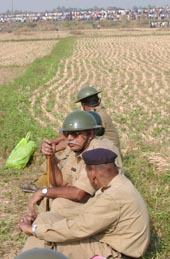
I have been writing about the forced acquisition of land in Singur by the West Bengal govt on behalf of Tata Motors for their small-car project.

Here is Abad Bhumi, a documentary on Singur prepared by a group of research scholars.

Béla Tarr


I heard about the Hungarian film-maker and screenwriter Béla Tarr from writer Subimal Misra.

Misra had heard from his friends that the following films of Béla Tarr were screened at the recently concluded Calcutta Film Festival:

Őszi almanach (Almanac of Fall, 1984), Kárhozat (Damnation, 1987, made in collaboration with Hungarian novelist László Krasznahorkai), and Sátántangó (1994, an adaptation of Krasznahorkai's epic novel, which took over seven years to realize, a 430 minutes masterpiece).

Thus did I learn about Béla Tarr (born 1955), one of the most distinguished film directors of our time.

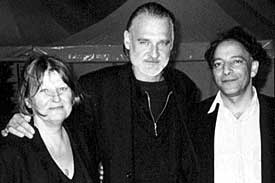
The picture above shows Béla Tarr (centre) with his wife and editor Agnes Hranitzky, and producer Paul Sadoun.

Here are some resources on Béla Tarr:

Wikipedia entry

Article by
Peter Hames

Interview by
Eric Schlosser

Article by
Jonathan Rosenbaum

Reviews of various Tarr films

Here'a clip from Béla Tarr's film Sátántangó.


And here's an interview with Béla Tarr, made during the 12th Sarajevo Film Festival (August 2006).

Wednesday, November 29, 2006

Please vote!


My cousin Anya Sitaram (a BBC World newsreader and documentary producer), and her husband Richard Wilson (environmental journalist and Antarctica reporter) had made a documentary called Being Indian which was shown on BBC World earlier this year.

It is now at second place in the contest for the best BBC documentary of the year 2006.

Today's The Statesman carries an article about Anya and Richard's documentaries.

A vote from you could help this win! Deadline 4 December. Here’s the link.

Click “vote” on Being Indian, and then “Submit”.

Thank you!

Rethinking the nation

Samantak Das writes a column called Jabberwocky in The Statesman. A piece titled ‘Rethinking the nation’ was published yesterday. I reproduce his article below.


As we lurch towards the 60th anniversary of Independence, and the celebration of Asia’s latest unshackled economy takes on an increasingly frenzied and surreal air, I wonder what the man who won Asia’s first-ever Nobel Prize would have made of it all. My thoughts have partly to do with the fact that the 70 to 75 per cent of our people who have reaped little or none of the fruits of our new-found prosperity seem to have fallen off the radar entirely (notwithstanding the occasional clenched-fist-shaking gesture made by bleeding-heart-liberal-pinko-lefties like yours truly or fellow-travelling NGO-wallahs) and partly with the way in which a new surge of jingoistic nationalism seems woven into the very fabric of this celebration of India’s “inevitable” 21st-century superpowerdom.

One clue to Rabindranath Tagore’s response may be found in his Nationalism, a book published nearly 90 years ago, by Macmillan, in the USA, to near-universal cries of opprobrium. Based on lectures on diverse facets of nationalism that Rabindranath had delivered in Japan and the US in 1916, this is a book that can be read with considerable profit by those who are presently indulging in this orgy of unthinking patriotism.

For Rabindranath, nationalism and the nation are soulless mechanical entities that deprive human beings of their humanity, turning them into automata, driven for the benefit of commerce and politics. For him, “government by the Nation is… like a hydraulic press, whose pressure is impersonal and on that account completely effective.” “The idea of the Nation,” he wrote, “is one of the most powerful anaesthetics that man has invented.” And a little later, invoking the ongoing (First) World War, “This European war of Nations is the war of retribution… The time has come when, for the sake of the whole outraged world, Europe should fully know in her own person the terrible absurdity of the thing called the Nation.”

It is this “terrible absurdity” that seems to be dictating terms in our new century (as it seemed to have been in Rabindranath’s), whether as something to be denounced (George W’s “axis of evil”) or celebrated (the media’s “unleashed tiger” economies). For Rabindranath, one of the worst aspects of nationalism was the way it left out the poor, the subaltern, the marginal, the disempowered. In his chapter on India in Nationalism, he would draw repeated attention to this. He warned that “political freedom does not give us freedom when our mind is not free” and saw the pitfalls of trying to “build a political miracle of freedom upon the quicksand of social slavery”.

It is not, of course, only in Nationalism that we find such views expressed by Rabindranath. His 1908 essay “Sadupay” (The Right Means) is a masterful analysis of the way in which “brotherhood” was forced down the throats of the unwilling, resentful subalterns by the elite leaders of the Swadeshi movement in the elites’ desire to enforce the boycott of British-made goods. The “impatience” and “anger” of the elites, which led them to use force and fear to get the poor peasants to do their will, is castigated in no uncertain terms by Rabindranath. “Our misfortune is this,” he wrote, “that we want freedom, but we do not really trust freedom from our hearts. We do not have the patience to respect others’ opinions; we use threats to mould their intellects to our will.”

I’m not suggesting that we should all start speed-reading the Rabindra Rachanavali (Tagore’s complete works) – but, as we celebrate globalised India’s triumphs, there may be a few lessons we could learn from those largely-forgotten prophets from a time when India as we know it, was still a dream.

One Country


The Israeli-Palestinian conflict rages on.

Rashid Khalidi, a New York-born Palestinian-American who holds the Edward Said chair in Arab studies at Columbia University, and is the author of the new book, The Iron Cage: The Story of the Palestinian Struggle for Statehood, describes all that remains of Arab Palestine as a “patchwork of open-air prison camps”.

Will this conflict ever be resolved in a way that will finally bring peace to the region?

Ali Abunimah, in his new book, One Country: A Bold Proposal to End the Israeli-Palestinian Impasse, makes the radical argument that what is needed is one state shared by Palestinians and Israelis.

The son of Palestinians who fled the country in 1948, Ali Abunimah, a Palestinian-American, is the co-founder and editor of the Electronic Intifada website since 2001 and, more recently, of Electronic Iraq and Electronic Lebanon.

Clear-eyed, sharply reasoned, and compassionate, One Country revives an old and neglected idea of sharing the country. Although living together might seem impossible, Abunimah shows how Israelis and Palestinians are by now so intertwined - geographically and economically - that no kind of separation can lead to the security Israelis need or the rights Palestinians must have.

He reveals the bankruptcy of the two-state approach, takes on the objections and taboos that stand in the way of a bi-national solution, demonstrates that sharing the territory will bring benefits for all, and asserts that the country can remain a homeland for both Jews and Palestinians.

The absence of any other workable option can only lead to ever-greater extremism; it is time, Abunimah suggests, for Palestinians and Israelis to imagine a different future and a different relationship.

Reviewing Abunimah’s book, The Economist concedes the author puts forward his proposal skilfully and interestingly but says the proposal is "an escape to Utopia …where lion and lamb nuzzle down together. Impossible, probably.”

But, Abunimah argues, if South Africa could break out of seemingly impossible conflict to find peace and reconciliation, why not Israel? What happened, he says, is that the Africa National Congress was able to put forward a vision that eventually changed the heart of most whites. Will the Palestinians, he wonders, ever find the inner strength to articulate a similar vision?

Abunimah himself chooses to be a visionary.

Tuesday, November 28, 2006

Wrong signals


The great Bengali intellectual and leader Mr Buddhadev Bhattacharjee (Chief Minister, Culture Minister and Police Minister all rolled into one) has blessed us once again with some profound pronouncements.

Opposing the forced land acquisition in Singur (for Tata Motors’ small car plant) will send wrong signals to investors, he has said.

He is quite right. Protesting this flagrant violation of basic norms of governance and democracy will send signals to investors that, for instance:

the people value their source of livelihood and dignity, and will resist moves to marginalise them;

the people value the rule of law and expect transparency, good governance;

the public has a right to know;

the lives and aspirations of the poor, low-income and marginalised are as important as the dreams of fixers, brokers, real-estate sharks and capitalists;

the totalitarian goon brigade that the CPI(M) in West Bengal is today still has to contend with people’s protests and resistance;

the talk about “resurgent Bengal” is all puff, with the flyovers, condominiums, malls and multiplexes in "arrived" Calcutta camouflaging mass poverty and all-round stagnation.


Thank you great leader! We wait with bated breath for your next bestowal of pearls of wisdom.

Sunday, November 26, 2006

I am back!

I returned to Calcutta on Friday morning.

My sons left for Rishi Valley School that evening.

My suitcase, containing my laptop, got left behind at Frankfurt airport. Happily, I got it back a day later.

I had gone to exhibit at the MEDICA trade fair in Duesseldorf. That was quite eventful. Warm relations with our international customers were sustained. And very good openings were made, bringing opportunities for business growth. The challenge now is to upgrade and enhance our manufacturing capabilities. Definitely a new watershed in the life of the small manufacturing enterprise started by my late father in 1967.

On the second evening of the fair, there was the usual grand party at the Canadian pavilion. And one afternoon, the stall promoting the Lille region of France offered five splendid varieties of their beer.

We stayed in an apartment in Essen, very near the historic Wassertrum (water tank). I remembered Uerige, (the famous bierstube in Alstadt, Duesseldorf) from my 2002 visit and found my way there. I made a new friend there, Marcel Khasti, an Iranian architect and painter. We also went to a 103-year old Yugoslav restaurant near the historic old synagogue in Essen.

After the trade fair, I journeyed by train along the beautiful Rhine valley. I spent a night with my friend Johannes in Eppelheim, near Heidelberg. He runs a bookshop, but his main work is in support and solidarity actions with struggles and movements of indigenous peoples in India. His partner Astrid is a teacher of French and nursing. Their son, Christoph, 20, is studying South Asian politics at Heidelberg Univeristy. We went for dinner to the nearby pretty little town of Schwetzingen. In Heidelberg, I also met Fritzi , a young architect, who was in Calcutta last year working on her masters' dissertation on public space in Calcutta.

And from Germany, I went to London. Three days, meeting relatives and friends. As it was cold and wet, I was mainly indoors. My kind hosts in London: Carolyn Stephens, epidemiologist, from the London School of Hygiene and Tropical Medicine, and her Argentinian husband Alfredo, architect, in Highgate; Fiona McCluney, planner and consultant, in Fulham; and my cousin Anya Sitaram, tv newscaster and documentary producer, and her husband Richard Wilson, environmental journalist, in Ealing.

My cousin Feroze took me to visit my aunt Saroja, who is in a nursing home in Battersea. We also spent a while at "The Ship", a pub by the river in Wandsworth. I had Guinness.

The highlight of my visit to London was meeting fellow-blogger and new-found friend Yves. We talked and talked, and had lunch at "The Golden Lion", a pub in Fulham. I had London Pride.

I had hoped to meet my college-friend JP, but he had a sudden engagement. But we spoke over the phone. I was hearing his voice after 26 years!

I had gone carrying small gifts, purposefully selected, for all the people I was to meet, including some of our business customers. And I returned bringing little gifts for people here. Yesterday morning, I visited Dr Siddiqui and gave him the packet of Cuban cigarillos I had brought (after tearing out the glaring "Smoking kills" label). I also met Hasnain and gave him the vial of perfume for his wife Ishrat, a belated wedding gift.

Monday, November 13, 2006

Murray Bookchin


I just learnt via Jan Freijser's long response to my post on Lewis Mumford, about the passing away recently of Murray Bookchin, American political philosopher and activist, and one of the founders of the Institute for Social Ecology. Among his well-known and very influential books were The Ecology of Freedom, and Post-Scarcity Anarchism.

I was saddened, all the more so since he passed away more than 3 months ago and I had not heard about this from the newspapers or TV.

How much I owe to the writings of Murray Bookchin! I am moved to tears recollecting the days I spent reading his books so many years ago, and the impact they had on my consciousness.

His obituary in The Guardian may be read here.

Happy Birthday Rituraj!


Today is my son Rituraj's birthday. He is 15.

I will never forget Rituraj's first birthday. How much we had looked forward to the coming of that day, and what a celebration there was! I smiled so much to greet all the invited guests that my cheeks started aching; but I didn't mind that at all!

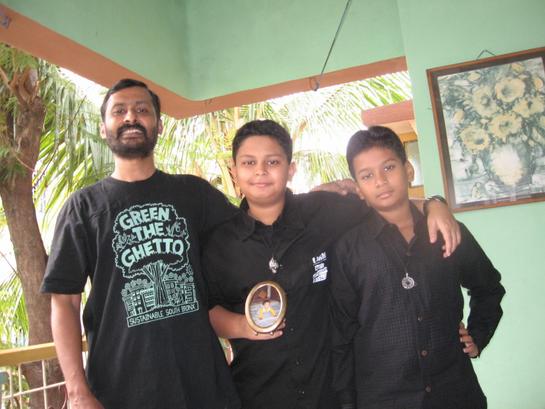
In the picture above, Rituraj holds a picture from his first birthday. Rishiraj (aka Chotu) - don't look so doleful okay!

Singur Update

My friend Sumit Chowdhury has sent me an update on the farmers' agitation in Singur against the forcible acquisition of their land by the West Bengal govt, to hand over to the Tata company for their small car plant.

The update is accessible here.

Sumit has also set up a discussion group called Farmland for development, to exchange information on the countrywide onslaught on fertile farmlands in the name of development, which threatens the life and livelihood of millions.

Aj mukhomukhi dariechhe duto dal
Ar majhamajhi nei to kichhui
Hoy Tatar dalal ar noy to
Ek laruku manush hobi tui


Face to face stand two groups
There’s nothing in between
Either Tata’s tout or
A fighting human you will be.

Measuring our Humanity

Sukanta Chaudhuri, who is is professor of English at Jadavpur University in Calcutta, has written in today's The Telegraph. He expresses his anguish and rage at all that he sees around him in in his city and society, and emphasises that its in the interests of India's privileged classes to preserve such inhumanity.

Thank you Prof Chaudhuri. I am reminded of Emile Zola's "J'Accuse" in the context of the Dreyfus affair ...


The new order does hold out appalling new threats, including moral disownment of a quarter of our population. ... To sustain this lucrative inhumanity, the population must be so tamed as to expect nothing better. No citizen must be allowed the luxury of self-respect, even to think of himself as a citizen. Public services must be unaccountable and incompetent, while corporate services make up in the former attribute their occasional shortfall in the latter. Hospitals — possible sites of humane care — must be so run that they debase the humanity of both patients and staff. Primary schools for the poor must be so derelict that a child who attends one will learn not to demand anything better in life. Basic services like transport and public hygiene must be so dispensed that we accept stress, humiliation, danger and even death as routine facts of life.

The resultant harm we attribute not to the authorities but to god, if we believe in god. Whether our leaders do so has engaged more debate of late than their material offences against the citizenry.

People like ‘us’ enjoy the luxury of such debates: we are creatures of relative affluence, privilege and leisure. Our abjectness appears when we confront the public services, or entities (like corporate firms) supposedly under public control. It appears blatantly in the contempt of the state of West Bengal towards the Right to Information Act — also, by implication, towards the people denied that right. Again our rulers know that they need not fear: our intelligentsia, which preens itself on its political awareness, is oblivious of the matter.

For the truly humble Indian, the deprivation extends beyond information to education. That is the best way to keep him where he belongs. It would be rather a nuisance to treat him as a fully human being. India’s greatest disgrace, its failure over elementary education, is more than a failure: it is virtually a policy pursued by governments of all hues and sanctioned by the educated public to preserve its hegemony.

Non-performance can be a political strategy, a weapon of power. Our rulers have always known this ... We stand perpetually beholden to an order that will not grant anything as of right, but toss us scraps of favour or bounty if we abase ourselves to it. To imbue an administration with this unlovely image is a political masterstroke but a disaster for democracy. It reduces us as citizens and human beings. It also demeans our masters, but why should they mind?

Graham Greene wrote that no policeman can beat a man up unless, somewhere deep down, that man accepts his victimhood. Masochism can protect the weak and the disheartened from many moral challenges. We are unprepared for the human demands of our situation: like natty Neanderthals, we drive down shiny flyovers to the latest shopping mall. Lost to human self-respect, no wonder we are unhappy.

Off to MEDICA 06


I leave this evening for Duesseldorf, Germany, where our company is exhibiting at the MEDICA trade fair.

MEDICA is held around mid-November every year in Duesseldorf. It is the largest and most important trade fair in the medical equipment sector.

I learnt about MEDICA - thanks to the internet. In 2002, shortly after I began working on export promotion, I had come upon the website of Dr Joseph Eldor, an anaesthesiologist in Israel. I communicated with him, and he advised me that we should participate in MEDICA. That was a major watershed in the life of our small manufacturing enterprise.

MEDICA is the Mecca of global medical technology business! Being there - is a scintillating experience, but also very hectic and demanding.

After the fair, I will be visiting my friend Johannes Laping in Heidelberg, and then spending a few days meeting family and friends in London. I hope to meet my college friend JP in London - after more than 26 years. And I hope to meet my new blogger friend Yves.

I will be back in Calcutta on 24th November.

Till then, bye dear friends, and my best wishes to all!

Saturday, November 11, 2006

UNDP’s Human Development Report 2006


“Delivering clean water, removing waste water, and providing sanitation are three of the most basic foundations for human progress.”

But 1.1 billion people do not have access to water, and 2.6 billion do not have access to sanitation. This makes their condition one of “profound deprivation”, caused not by water scarcity, but by poverty, inequality and government failure.

Moreover, nearly two million children die every year for want of clean water and proper sanitation. Throughout the report, in the case of most of the countries hardest hit by such deprivation, two truths about the situation are reiterated. First, although unclean water is an immeasurably greater threat to human security than violent conflict, most countries spend less than one per cent of national income on water.

The report estimates the total additional cost of achieving the Millennium Development Goals (MDG) on access to water and sanitation at about ten billion dollars per year. But this sum has to be put in place. It is less than five days’ worth of global military spending and less than half of what rich countries spend each year on mineral water. In Ethiopia, for instance, the military budget is 10 times the water and sanitation budget; in Pakistan, 47 times.

Second, almost everywhere, the poorer one is, the more one pays for water. People living in urban slums typically pay 5 to 10 times more per litre than people living in high-income areas. The report also argues, in this context, that the public-versus-private debate on water is not helping the poor. Nor is the common belief, in countries arguing for the privatization of water-supply, that the poor are only too willing to pay for their water. They are actually left with little choice in this matter. The privatization debate, according to the report, only distracts attention from the inadequate performance of both public and private water providers in overcoming the global deficit.

India still has to catch up with its target for access to sanitation by the MDG date of 2015

With the voice of falling leaves

Tyranny sets up its own echo-chamber; a void where confused signals buzz about at random; where a murmur or innuendo causes panic: so, in the end, the machinery is more likely to vanish, not with war or revolution, but with a puff, or the voice of falling leaves.

Bruce Chatwin

Literature about literature


I had written to my friend Dr Mrinal Bose:

I have been reading A Quiet Life by Kenzaburo Oe's, a sequel of sorts to his Rouse Up O Young Men of the New Age. I enjoyed the latter more, its about a writer's relationship with his severely handicapped son, in the backdrop of William Blake's poetry. A Quiet Life is simply quieter and more modest in tone, by intention, within a series of works involving the same (semi-autobiographical) characters - an anguished writer, his wife, and their three children. Its in the voice of the writer's daughter, who is also studying the French writer Louis-Ferdinand Céline. So this is a remarkable discovery too.

Literature in which literature is a subject - can be brilliant, and can also seem far away from life and reality, narcissistic. In Oe it is simply brilliant.

His reply:

Literature within literature is something I would love to read, but something I would perhaps never attempt to write. I think it's for those writers who are short of life experiences, and have no other resources except their books to get their material from. Why write fiction if you don't know and experience - in your own unique way - the life floating around us? That's how I think.

So I wrote:

In general I agree with what you have said. But I have also had other experiences and hence my own attitude and perception has altered.

Long ago, in an interview with Salman Rushdie I read in some magazine, he had referred to Milan Kundera's line:

"the struggle of man against power is the struggle of memory against forgetting".

I was really struck by that, and frantically hunted for Kundera, presumed it was from The Book of Laughter and Forgetting, (it was) and bought and read it. Thus began a new phase in my life.

Great literature - is always based on life and the imagination. This also then becomes part of the world around us. When we experience life ourselves, great literature's insights ring true and help us in our own self-realisation. So, rather than literature about literature taking one away from real life, it is presumed that one is looking at life, and literature is something that heightens this engagement. Or so I feel!

In another exchange on literature, I wrote to Dr Bose:

You said: "only interesting people can write big things." That is if they write! Otherwise the big thing they write will be through their work and life. Ultimately, life is the stuff of literature, and literature best expresses life. But life and literature must remain two, except for those readers who see and read a larger book, where they are one. In mysticism, life and literature become one!

On hope


Lorena is a research scholar in anthropology from New Zealand. For her doctoral thesis, she is looking at "hope" in the context of women in Calcutta's slums who are working for improvements.

In an exchange with her, I had written:

Basically, my exposure to the lives of the poor and my own experience - leaves me utterly devoid of hope. I know I shall not see any major improvement in my lifetime. In the very ugly, obscene reality I see around me, I have no desire to stay alive. However, that does not translate into wanting to take my life! There is however a constant urge to either detach completely from everything, like a reclusive hermit; or descend into vengeful violent actions ...

There's an (Urdu) poem by the great Urdu poet of Southasia, Faiz Ahmed Faiz called "See the city from here". The poet talks about the ugly underbelly of the city, of exploitation, suffering, injustice. He says that once you've seen that, all the charms and beauties of the city do not appear so charming and beautiful any more, instead they take on an ugly hue.

Something like that happened with me. Though I could perhaps be comfortable and gleeful with my own life circumstances, that simply isn't possible any more, its as if I'm infected by the reality, cursed ...

Concern for the poor, awareness regarding the poor etc - is one thing. That still presumes a distance and a difference, between oneself, and the other. But its another thing altogether to be afflicted, to suffer like the other! Then one is reduced to silence. Thankfully, the poor do not suffer as much as one might imagine. They are hardy, they are habituated to their circumstances.

I had written a poem some years ago, which included these lines:

"Oh, how insubstantial the despair
Of those who rise to great depths!"


and

"Sad indeed is the care-freedom
Of the life that is entirely deprived!"


Samuel Beckett had written:

"Where I am, I don't know, I'll never know, in the silence you don't know, you must go on, I can't go on, I'll go on."

(L'Innommable, or The Unnamable)

Whether one likes it or not, one is bound, to go on. And in this going on, small things give small satisfactions. One also occasionally reflects and sees that some things are in fact accomplished, howsoever invisible and subtle, an advance is made in a certain direction. Sometimes, though increasingly infrequently, one has an overwhelming, euphoric sense of the meaning of it all, and a contentment.

That makes one go on, regardless of the bleak harsh reality.

Friday, November 10, 2006

Magnificent collection


Last evening, I stumbled upon the British Library's collection of images Svadesh videsh: home from home. What a delight!

Begun by the East India Company in 1801, this fascinating survey of the landscape and architectural heritage of South Asia spans the late-18th to mid-20th centuries. The collection is curated by John Falconer (Curator, Photographs, India Office Collection), who has also written an introduction.

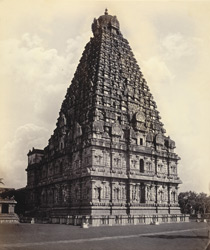
This is a photograph of the monumental Brihadishvara Temple at Thanjavur (Tamil Nadu), the most impressive architectural achievement of the Chola era. The great king Rajaraja I founded construction of the temple around 1010.

The photographer was Edmund David Lyon, who was Governor of Dublin District Prison (Military), 1854-56, and later worked as a professional photographer in India, with a studio in Ootacamund. From 1867-1868 he was commissioned by the Madras and Bombay Governments to photograph archaeological and architectural antiquities and produced an extensive documentary record of South Indian architecture.

Read the curator's introduction here.

View the entire collection here.

Muslim children most deprived of education


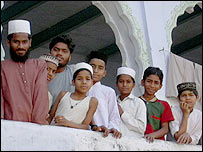
About 13.5 million children in India in the age group of 6-13 years are out of school, with Muslims being the most affected section of the society, a study by UNESCO has found. The just-released Education for All Global Monitoring Report 2007 found that the 13.5 million out-of-school students account for 6.9 per cent of the 6-13 age group children in the country. Significantly, the rate of out-of-school children among Muslims was higher, at 10 per cent.

West Bengal has the highest number of out-of-school children after the states of Bihar, Jharkhand and Assam. It also has the highest number of Scheduled Tribe children out of school. Eleven per cent of Muslim children in the Left Front-ruled state do not go to school.

The state has been sluggish in its commitment to widen the access to education.

High dropout rates and gender disparities continue despite a 93 per cent enrolment rate claimed by the government of India.

“Nigeria, Pakistan, India and Ethiopia (in descending order) are home to the largest number of school dropouts. Twenty-three million for the four countries,” says the Unesco report. “A recent survey of primary schools and pupils across India, for example, showed the average absentee rate to be 30 per cent on the days schools were visited.”

The southern states in India present a different picture. “In the south, some states appear to have virtually achieved universal schooling for 6 to 13 year olds,” says the report. The dropout rate varies not only across states but also within them.

The focus of Unesco’s report is on early childhood care and education for those below 6 years — they do not come under the fundamental right to education guaranteed for children in the 6-14 age group.

The report says India is not using its creative talent in the Education for All (EFA) programme. “One of the main conclusions was that India’s approach to EFA was lacking in vision and policy for non-formal education,”

It raises questions about the way the Sarva Siksha Abhiyan, a key EFA programme, is being implemented. On paper, the enrolment is high but the quality of education is under a cloud. A study conducted by a group of NGOs has shown that a large percentage of students across the country is not equipped with minimum levels of learning.

Thursday, November 09, 2006

To uproot ...


Mukul Kesavan has written in today’s The Telegraph about the appointment of a racist Israeli politician, Avigdor Lieberman, as deputy prime minister of that country. I am moved to reproduce much of that below. This is very much in line with something a close friend had told me:

Zionism in its present form - is an enemy of civilisation. The so-called sense of insecurity about homeland of Israeli Jews - is a bizarre pathology that is allowed to inflict damage and destruction to others.

I am reminded of Simone Weil's words (in her book The Need for Roots):

"Uprootedness is by far the most dangerous malady to which human societies are exposed, for it is a self-propagating one. For people who are really uprooted there remain only two possible sorts of behaviour: either to fall into a spiritual lethargy resembling death ... or to hurl themselves into some form of activity necessarily designed to uproot, often by the most violent methods, those who are not yet uprooted, or only partly so ... Whoever is uprooted himself uproots others."


Cartoon: Sharon trying to uproot the Palestinian resistance to the Israeli occupation, by Amjad Rasmi, Arab News.

Homogenous People x Self-Determination = Nation


by Mukul Kesavan

The justificatory back story … One, the near-extermination of European Jews during the Holocaust justifies a secure Jewish state in Palestine. Two, the Jewish state has a right to defend itself against the hostility of those of its Arab neighbours who refuse to recognize its existence: how can Israel be expected to respond proportionately to those who would undo its existence? And three, rocket-firing Arab refuseniks are responsible for Israeli reprisals because they futilely challenge the historical reality of Israel. Israel, in this account of west Asian conflict, exists as a sovereign democratic state in a sea of Arab authoritarianism, seeking co-existence with a Palestinian state that Israelis are willing to negotiate into existence, were there a negotiating partner.

This legitimizing narrative is misleading. The violence in Palestine is not generated by the struggle of a secular democracy defending itself against Muslim terrorism: it is the consequence of a majoritarian nationalism, Zionism, trying to force the people it dispossessed, the Palestinians, into accepting their dispossession, into accepting their ethnic cleansing as a necessary cost that humanity had to pay to right the wrong done by Hitler to European Jewry.

Avigdor Lieberman is a Russian Jew who advocates population transfers to consolidate Israel’s Jewish nature. He wants the Arabs of north-eastern Israel to be stripped of Israeli citizenship and their areas merged with a Palestinian statelet. In return, he wants Israel to annex large parts of the West Bank as territorial compensation. He is part of a far-right fascist party and his political instincts are the same as those of Le Pen or Jorge Haider. Israel’s ruling coalition has tried to distance itself from his ethnic cleansing prescriptions by describing them as his personal views, not those of the Israeli state.

The truth, though, is that from its inception, the expansion and consolidation of Israel as a Jewish state have been predicated on a policy of ethnic cleansing.

Modern nationalism as invented in Europe invokes a homogenous People as its justification. Homogenous People multiplied by Self-Determination = Nation. These self-determining Peoples are nearly always defined by a mix of language, religion and race, a mix that contemporary usage calls ethnicity. Like the European nationalisms on which it was based, Zionism is an ethnic nationalism that established an ethnic state whose organic citizens were Jews. If the natural citizens of Israel are Jews, by definition a Zionist state will see non-Jews as a problem, as foreigners who dilute the People.

When Lieberman argues that Israel should have no Arab citizens because a Palestinian state in the West Bank will have no Jews, he is saying openly what many Israelis privately believe. He is taking to its logical conclusion a policy of discrimination and dispossession that every Israeli government, Labour, Likud or other, follows. The creation of dense Jewish settler enclaves on the West Bank, the systematically engineered changes in the demography of East Jerusalem, the restrictions placed on the entry of the relatives of Israeli Arabs, the self-evidently second-class status of Arab citizens, taken together make Lieberman’s prescriptions a logical consequence of ethnic nationalism, not an aberration.

The brutal, incoherent history of Pakistan shows us clearly that a nation founded in the name of a faith-based People is essentially sectarian and illiberal. Even democratic states like Sri Lanka or Israel create a class of helots once they nominate an ethnic majority as the proprietors of the nation.

In the West the very idea of a properly secular, pluralist state in what was once Palestine is outrageous, a symptom of insidious anti-semitism. But as citizens of a pluralist republic surrounded by failed majoritarian states, Indians must argue that our experience teaches us that ethnic nationalism is a prescription for civil war and ethnic cleansing. Western nationalisms achieved the homogeneity they desired by suppressing difference in faith and language in Europe, by killing off the natives in their settler colonies and by ignoring the humanity of slaves. These aren’t examples that younger nations should imitate. When Western policy establishments extend uncritical support to Israel because they see that country as a beacon of Western values, they should know that their embrace includes Avigdor Lieberman and the Zionist tradition of ethnic cleansing.

For Indians, Avigdor Lieberman is a reminder that the violence, purging and subordination that he plans to subject Israel’s Arabs to, has already been visited on Gujarat’s Muslims by a political tendency that is a close cousin of Zionism, Hindutva.

In recent weeks the Hindustan Times and Himal have separately described the systematic and continuing subordination of Gujarat’s Muslims in the aftermath of the pogroms. We have, on our western border, an educated, wealthy province which once gave us Gandhi and is now incubating an Indian fascism.

Commitment revealed


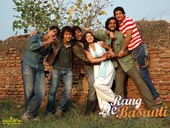
The Hindi film Rang De Basanti released early this year became a kind of anthem of new-found social concern and public activism for India’s educated urban youth, who have so far distinguished themselves largely by their immersion in self-enrichment to the exclusion of all else, in globalising India.

The film was about spirited youth protest against MiG fighter aircraft crashes.

The film was much referred to during the students’ agitation against affirmative action in favour of historically disprivileged sections in medical and engineering colleges.

Kavita Gadgil, the woman whose campaign against flying coffins inspired Rang De, has hit out at the film’s makers for not honouring their promise to raise funds for a memorial she is building for air force pilots killed on duty.

Director Rakeysh Mehra and his team had promised to organise a charity show to raise funds for the Pune memorial but had not fulfilled it.

In 2003, Gadgil had fought a lone battle against the defence establishment for the rising number of MiG crashes, two years after her 26-year-old son Abhijeet died in a crash during a routine MiG 21 sortie.

Although the air force had initially blamed the crash on “pilot error”, Gadgil’s campaign had forced them to acknowledge there were technical reasons at play also. Gadgil had then set out to build a memorial for fighter pilots and soldiers at her farmhouse near Sinhagad in Pune. Work on the memorial has started. The Gadgils have put in Rupees 6 million and are trying to tap corporate funds.

“The film gave a message to the youth and tried to inspire them to be socially committed to a cause. The film has been a huge hit… and is now going to the Oscars. But Mehra does not want to help a cause that inspired the film in the first place. I feel completely cheated.”

She is angry that Mehra is now trying to get the service chiefs to endorse Rang De in the run-up to the Oscars.

“He wants to use the service chiefs’ endorsement to propel his commercial product onto the international stage, but what is he prepared to give in return to the services? Or to the pilots whose supreme sacrifice… he has so effectively used?”

So much for the new-found sprit of social concern and public activism!

Absolute power corrupts absolutely


Like Rip Van Winkle, Biman Bose, the CPI(M)’s West Bengal secretary seems to have woken up! (According to Wikipedia, "Rip Van Winkle" means either a person who sleeps for a long period of time, or one who is inexplicably, perhaps even blissfully, unaware of current events.)

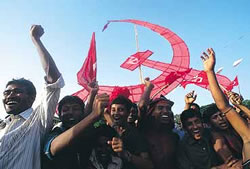
All the vices that power can induce in 30 years has crept into the CPI(M), the party leader admitted day before yesterday.

Biman Bose went on to list some of them — corruption, nepotism, personal gratification, factionalism and craving for power — while addressing Calcutta district committee cadre who had assembled to commemorate the November revolution in Russia.

“Some people have joined the party hoping that it would be a passport to jobs and other opportunities for personal benefits. Many flaunt the party membership to demand preference in school and college jobs,” Bose said.

The party appears to be suffering from the influx of such self-seekers as obtaining membership has become easier now. “At least 10 per cent of the new entrants are ideologically and politically unfit to be our members. How many of the 31,500 members in the city have gone through the party constitution? Let us swear, how many of us can rise above personal interests?” he asked.

Asking party committees to check personal backgrounds of membership aspirants, Bose said: “Don’t choose them from the types who want to be whole-timers just because of unemployment.”

He did not mention the Bally incident in which CPI(M) workers were arrested for harassing a housewife and beating up her husband; nor the Barasat incident, where a party leader was arrested for the murder of his own father in the context of a factional conflict. Bose decried the increasing involvement of party cadre in real estate and supply of building materials.

“I heard people are asked to buy cement from one, brick and iron rods from another. Later, it is found that party leaders are behind these businesses,” said Bose, also a party politburo member.

The party used to go to the people earlier, now it is the other way round. Feuds within have assumed “cancerous” proportions as some leaders are “ruining party democracy for personal gain”.

A split Opposition is seeing the CPI(M) through in the state, the leader suggested, saying “a divided party will be in more trouble” as the Opposition parties close ranks.

“Be respectful and sympathetic towards toiling people.” As the CPI(M) became appealing to “those who had never voted for the party earlier” — the middle class — it lost touch with its original supporters.

This is not the first time that a CPI(M) leader has expressed concern. Several years ago, the late Benoy Choudhury had described the West Bengal government itself as one run by “contractors”.

The CPI(M)’s plan to expand its base in the north Indian Hindi heartland is being hobbled by a lack of dedicated organisers as leaders are not keen to leave secure sanctuaries like Bengal.

The party also has to ward off competition from NGOs in recruiting cadre. Prospective party workers, “idealist and socially committed youth”, are allegedly being lured away by NGOs offering better salaries and perks.

“Not many leaders are ready to leave Bengal to work at the party centre in Delhi from where organisers are assigned specific state responsibilities. Relaxed life after 30 years of Left rule has made insecure and harrowing jobs elsewhere unattractive to many,’’ , says MP and central committee member from Bengal Hannan Molla.

“Today, student and youth organisations in Bengal do not produce dedicated organisers like the whole-timers of yesteryears who would risk life and career for a base outside Bengal,’’ says another central committee member from Bengal.

Even the “leaders of earlier generations are reluctant to venture out”, he adds, attributing it to a “mindset that develops because of the trappings of power”.

Wednesday, November 08, 2006

The truth is out


The truth is out. In a few days, the report of the Sachar Committee (on the socio-economic condition of Muslims in India) will be presented to the nation.

The findings are grave. Muslims in India lag behind the Scheduled Castes and Schedules Tribes, who have so far been viewed as the weaker sections.

The lie of “Muslim appeasement” will also be nailed.

The stage has already been set for the presentation of the report and its grave findings. The Prime Minister of India has called for minorities to receive a fair share of education and jobs in the public and private sectors. The BJP has already condemned such a call, as anti-national. And the CPI(M) has for the first time formed a cell on minorities.

Dr Syeda Hameed, a member of the Planning Commission, had recently written an article “Trapped in a blind alley”, on this subject.

Commenting on this, blogger Ashish, while wishing for a society where there is no discrimination against anyone because of his religion, nevertheless seems to be quite removed from the everyday reality of the Indian Muslim. I wouldn’t be surprised if many others think along the same lines. I reproduce an extract from his piece to illustrate this view.

Most surveys show the Muslim community in India to be under-represented in terms of jobs, education, and so on. These 2 areas are the primary areas that allow people to advance and progress in life, and being under-represented in these areas is a depictment of how far behind the community is. But a good solution to this is not so easy to find. If you ask a politician, he will suggest the vote-bank catching method of providing reservations. However, reservation on the basis of religion is a bad idea. In our society, there is a great deal of turmoil already on the reservation area, and adding to this would be a bad move. The founding fathers of the Constitution had advocated reservations to the long depressed communities that were down-trodden. What they felt was that these reservations over a period of time will bring the community ahead in spite of the biases against them.

However, there is no inherent and inbuilt bias against the Muslim community. It is a question of numbers - if there are more Muslims in the education basket (school and college), then there will be more fairly represented in the job area. The major challenge behind the muslim community is to ensure that their children attend schools that provide them the necessary education to advance in the world. They have to be able to see the advantage of proper education for their male and female children.The controversial idea in this is that this education will lead to them challenging some of the ideas advocated by their clergy (a trend that you already see in Christianity and Hinduism), and this is something that can be fairly unsettling. An educated mind typically asks questions until it is satisfied, and the clergy typically believe in ensuring that their word is seen a direct interpretation of the religion and hence a direction from the god. This will typically clash.


Ashish describes himself as an engineer with an MBA, and a concerned citizen. So I hope that he will now reflect on what he thinks and examine the basis for his views. I hope what he has written will be a beginning of a process of rigorous enquiry for him, to find out for himself what the real truth is, beyond any question. I have no doubt that when he sees and knows for himself this truth – of what it means to be a poor Muslim, and how the “system” operates for him / her – he will be filled with sadness and rage at the real prejudice, discrimination, apathy, denial, marginalisation, pauperisation and strategic deprivation his Muslim fellow citizens suffer.

Siddharth Varadarajan, Krish and Bhupinder have also written about this.

Nothing but frustrations


Just yesterday afternoon I had a discussion with Dr MKA Siddiqui on this view, which Ashish has articulated.

I reproduce below extracts from an article Dr Siddiqui had written last year on the “Educational Scenario of Calcutta’s Urdu Speaking Community”.


Muslims constitute about nine hundred thousand individuals, or 20 per cent of the total population of the Calcutta Municipal Corporation area, 80 per cent of whom are Urdu speaking. The total number of boys and girls of school going age in this population is estimated to be 140,000.

The total enrolment figure of boys and girls of this linguistic group in all the 27 recognised school which cater to their educational needs did not exceed 14,663. If all the other kinds of institutions are taken into account we find 5,090 children enrolled in madrasas and approximately 15,000 in maktabs. The total number of enrolment does not exceed 35,000. This means that only 11 per cent of the Urdu speaking boys and girls go to school and if enrolment figures in institutions of all kinds are taken into account, not more than 25 per cent of Urdu speaking boys and girls attend some sort of educational institution. In terms of absolute numbers, 105,000 students belonging to the linguistic group do not attend any school, largely due to extreme dearth of educational institutions.

Out of an approximately total number of 600 to 700 schools in Kolkata Municipal Corporation area there are 43 Urdu medium schools (Junior 16, High 21 & Higher Secondary 6). Only 27 of these schools are recognized and the remaining are unrecognized, while one H.S. and two junior schools are run by the state government. These two junior government schools are over a century old but have not been upgraded till now, nor do we know of any such plan for future.

Incidentally intensive survey of a slum in 1997 showed that percentage of illiteracy was higher than what it had been on the eve of independence in 1947. This is an index of the downward mobility of the community in the field of literacy and much more in the field of education.

In spite of their socio-economic condition there is a burning passion among the decisive bulk of Urdu speaking population to acquire education and educate their children. This, they have been told, is the only way to change their lot. But when they come forward to provide their children the benefit of education, they confront nothing but frustrations.

Thus with merely a glance at the city’s Urdu speaking population one will notice quite a number of difficult problems they are confronted with. These relate to spheres of housing and space, health, economy and education, which deserve attention. It may appear that the very survival of the community, as a self-respecting segment of the society, is at stake. Awareness of the situation is a prerequisite for any action programme.

If this linguistic minority in this great metropolis is to be saved from total disaster it will demand formulation of an action programme in the field of education, and address itself to tasks which require selfless endeavour and considerable amount of sacrifice by relevant sections of the community and the society. It is, however, sad that the dominant socio-political environment is either completely unaware of the socio-enconomic and educational problems of this unfortunate linguistic minority or is determined to treat the problems it faces as unworthy of attention under a policy of ‘strategic deprivation’. It is all the more unfortunate that this significant minority is often deemed as a potential threat to the society, ever ready to provide shelter to imaginary infiltrators and is seen as demanding for educational institutions which breed fundamentalism.

The dominant socio-political leadership may have its own logic in its power game, but raking up issues which are absolutely unreal, perhaps only aiming at maligning the oppressed people, cannot be excused, because instated of encouraging the people in the their struggle for survival, it keeps them in a state of perpetual anxiety and despair, deprived and awe-struck, to keep them under the thumb of the regime in power.

The need of the hour

I also quote in this context from the document titled “2006 West Bengal Assembly Elections & Minorities”, brought out by the Association of Indian Minorities.


The Muslim community considers education to be very important for girls and boys. However, given the experience of poor Muslims of a bias in the labour market there has been a tendency for boys to become disinterested in further education after primary education. Hence initiation of appropriate vocational training which enable self-employment would significantly counter-act the disincentive to seeking education. This is an important issue for immediate action.

The current minimum age of marriage of Muslim girls is 14 years. In most cases, Muslim girls are married off by the age of 16. This often results in withdrawal of the girls from schooling. Besides concern for the sound health of mothers and their children, the incidence of desertion of such young married girls is not insignificant. Left alone to fend for themselves and their infants, and lacking in adequate education or marketable skills, these girls must face a harsh existence. Increasing the age of marriage of girls through legislation based on dialogue with community elders and leaders is essential.

Similarly, creating opportunities for Muslim women’s employment and self-employment would have an immense transformative effect on the current situation.

The need of the hour is the opening of primary schools in the localities where there are large numbers of Muslims living and working. The
Sarva Shiksha Abhiyaan (Education for All Campaign), whose implementation continues to be a travesty in this state, must be thoroughly overhauled and used as a powerful means to reach out basic education to all.

Racist poem

According to a report by Ben Russell in The Independent, Britain’s Opposition Conservative Party chief, Mr David Cameron, faced an embarrassing race row last night when he was forced to suspend a former parliamentary candidate from the party because of a racist email.

The Liberal Democrats reported Mrs Ellenor Bland, who stood as a Tory candidate for Swansea East in the last election, to the Commission for Racial Equality, over the message sent from her email address to council colleagues. They said it showed “deeply unpleasant elements” in the Conservative Party.

Party managers immediately suspended Mrs Bland over the email, which included a poem about immigrants coming to Britain to claim benefits and a cartoon of the white cliffs of Dover emblazoned with the words: “piss off - we’re full”.

Mrs Bland denied sending the email, which was signed “Oh Yes! Ellie”. Her husband, also a Tory councillor, said he forwarded the message as a “light-hearted” joke and said he regretted any offence.

The Poem

I cross ocean poor and broke.
Take bus, see employment folk.
Nice man treat me good in there.
Say I need to see welfare.
Welfare say, “You come no more,
we send cash right to your door.”
Welfare cheques - they make you wealthy!
NHS - it keep you healthy!
By and by, I got plenty money.
Thanks to you, British dummy!
Write to friends in motherland.
Tell them “come fast as you can”.
They come in turbans and Ford trucks.
I buy big house with welfare bucks!
They come here, we live together.
More welfare cheques, it gets better!
Fourteen families, they moving in,
but neighbour’s patience wearing thin.
Finally, white guy moves away.
Now I buy his house, then I say,
“Find more aliens for house to rent.”
And in the yard I put a tent.
Everything is very good,
and soon we own the neighbourhood.
We have hobby, it’s called breeding.
Welfare pay for baby feeding.
Kids need dentist? Wife need pills?
We get free! We got no bills!
Britain crazy! They pay all year,
to keep welfare running here.
We think UK darn good place.
Too darn good for the white man race!
If they no like us, they can scram.
Got lots of room in Pakistan!


But the idea of lots of Britishers visiting Pakistan is not a bad one, from the point of view of promoting improved international understanding, and people-to-people friendship.

Good neighbours

Not to be left behind in good neighbourliness, Harpreet Singh has written in today’s The Statesman about Gen Musharraf’s proposal for an “out-of-the-box” solution to the Kashmir conflict.

He writes:

Pakistan should thank its stars for not being situated next to Israel. Faced with the kind of misbehaviour India has been living with, the latter would have gifted Pakistan a time machine much before the idea appeared in any book or movie and sent it straight to the Stone Age.

You don’t speak for me Mr Harpreet Singh! I do not believe in harbouring or expressing such views. They are simply not conducive to good relations with one’s neighbours. This kind of talk, injurious to the dignity of the citizens of Pakistan, is ugly and uncivilised. We can do without super-patriots like you Mr Singh!

Example of harmony

What with all the prejudice everywhere, I was delighted to read yesterday about a Muslim couple in Udaipur, India, who married off their adopted Hindu daughter in accordance with Hindu customs.

The girl was abandoned rather cruelly at the age of four by her own family, for bringing “bad luck” on it: the untimely death of one of her parents was, stereotypically for an Indian family, blamed on her. The succour-offering Muslim couple, Syed Shahzad Alam and Mrs Mehtab, then became her adoptive parents. Mr Alam is a head clerk in the Indian Railways.

Mr Alam and Mrs Mehtab went patiently through all the Hindu nuptial rituals at the Arya Samaj temple in Udaipur on 5th November as Miss Tina married Mr Ram Kishan Chaudhary, of Jhunjhunu District.

Asked what life without her was going to be like for them, the Muslim parents said that the “little girl” they had taken home so many years ago “completed” their family, which was previously blessed with two sons. The parents shed tears of sadness during the kanyadan (daughter-giving).

An office-bearer of the Arya Samaj temple, Dr Sri Ram Arya, interpreted the marriage as a triumph of secularism in the country.

Tuesday, November 07, 2006

Truth ... and power


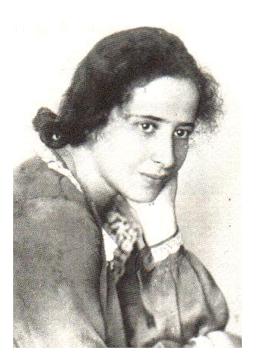
"Is it of the very essence of truth to be impotent and of the very essence of power to be deceitful? And what kind of reality does truth possess if it is powerless in the public realm?

Hannah Arendt, in Truth and Politics.

When, when?


"Shouldn't these ancient sufferings of ours finally start to bear fruit?"

Rainer Maria Rilke

Monday, November 06, 2006

Is the earth flat or round?

Anirban Pal, a research scholar at the University of Colorado, Denver, has written a paper in the journal Environment & Urbanization, titled “Scope for bottom-up planning in Calcutta: rhetoric vs reality”.

He examines how elected officials at different government levels, professional planners and ordinary citizens interact. Which players are dominant in the process of metropolitan planning?

Here’s an interesting passage from Anirban’s article:


There is a story of a would-be school teacher who was asked during an interview by the principal of a conservative religious school: “Is the earth flat of round?” The hapless teacher looked around at the faces of the interviewers for hints, and, not finding any, settled for: “I can teach it flat or round.” This story might help us to understand the relationship between the planners of Calcutta and their political bosses at the state and local levels.

I am reminded of the Indian film maestro Satyajit Ray's satirical fable Hirak Rajar Deshe ("In the land of the Diamond King"). Here an evil king's ministers piously nod their head in acquiescence, reciting "right, right" whenever the king declares any of his inhuman, irrational fiats.

Untruth, idiocy, ugliness and inhumanity thrives, and in that is the power of our rulers!

Village Earth

Taking a hot-water shower to relieve my arthritic aches and stiffnesses, I was struck by how luxurious it is to have running hot water.

The late grassroots technologist Dr CV Seshadri had once told a television interviewer in the context of a discussion on water availability that a bath a day was every citizen's fundamental human right – which many were denied.

But besides the water, there is also the question of bathing space. So many people in Calcutta, and especially women, have to bathe in the streets, exposed to passers-by. They bathe with their clothes on.

Hundreds of thousands of the poor and low-income in Calcutta live in something like a 100 sq ft space, which could be home to three generations of family members. Some people have a tiny space at home where they can bathe – after others have vacated the room for privacy.

A poor woman in Calcutta – may never have the opportunity to be alone with her body. If she had a lump on her breast – she may never know about this until it is too late.

But you wouldn’t think about such things when you see the designer bathrooms which are the rage in our cities, over which the new rich of globalising India spend a fortune.

This reminds me of the analysis of the late Dartmouth professor, Donella Meadows' "State of the Village Report".

There’s also the update, If the World were a village of 1,000 in 2000, by Lloyd C. Russow of Philadelphia University.

These put into perspective the actual quality of human life on planet earth.

Saturday, November 04, 2006

I shout ...


Naeem Mohaiemen is a filmmaker and media artist based in Dhaka and New York.

In his blog, and in an article in The Daily Star, he has written about being a “minority” in Bangladesh.

I salute Naeem’s sensitive heart, his conscience, and his rage at the apathy and inhumanity of his fellow countrymen.

Naeem writes:

My uncle used to tell the story of the maulana who stood in front of a temple in 1940s Noakhali, using his body to defy those who wanted to burn alive the Hindus who had been their former neighbors. This is in Noakhali of all places, a blight in 1940s partition narratives for so many examples of brutality, including the apocryphal story of Muslims who slaughtered Gandhi's goat (is it true? I have never been able to find any evidence). If that village elder found an interpretation of religion that taught compassion, how are we in this backwards trap fifty years on?

He concludes his article with the cry:

I shout at all of you with rage, because I refuse to accept a haven for me that is a nightmare for others. There is still time to stop this with our words, our actions and our bodies.

Did we want this Bangladesh?

Sadly, I find myself in a similar position here in India, in West Bengal, where the Muslim minority languishes, is reviled, manipulated and used, and their dreams and dignity crushed under the prejudice and apathy of my countrymen.

So it was gratifying to read Annu’s comment on Naeem’s blog, which I reproduce here.

"Unfortunately, this is true of West Bengal too. Even if people refuse to acknowledge it, the childhood taunts against minorities transform themselves into open discrimination in adulthood. Recently, when my father and sister went flat-hunting in Kolkata, one of the owners said ‘this is a good decent building, we don’t rent out to Muslims or Christians’ maybe assuming from my sister’s Hindu name ‘Savitri’ that we were Hindus. Increasingly, Muslims in West Bengal are using non-Islamic names such as ‘Gulabi’, ‘Sonali’ to ‘pass off’ and not be discriminated against by the Hindu majority.

Of course what also adds to discrimination in West Bengal is caste and one’s rural origin. When I stayed in the Sundarbans, I was surprised to find that the few successful relatives of people living there had changed their rural and low-caste surnames - such as ‘Pod’, ‘Aulia’, ‘Majhi’, ‘Pramanik’ - to ‘appropriate’ Brahman-Kayastha ones. I also found that school teachers there had forcefully changed the names of Hindu children with ‘Muslim’ names such as Ghazi and Jorina. When I asked why, I was told that their parents didn’t know the difference between Hindu and Muslim names and had ‘mistakenly’ named their children and it was their duty to rectify the ‘faults’ of these rustics.

More recently, when I went back to Bangladesh (after 10 years), I was surprised to note how this time people obsessively asked me my religion. When I refused to answer I was asked my name. This was as much in Dhaka as in little villages. And to think that barely a hundred years ago, many of the villagers of southern Bengal did not know whether they were Hindu or Muslim (if you look at the early censuses it is fascinating to note how in some years people categorised themselves as ‘Muslims’ and in some others as ‘Hindus’ – even O’Malley remarks on this!!)."

Thank you Annu for pointing this out. I think I know this Annu! She wrote last year about how the West Bengal govt betrayed the East Bengal refugees and the poor and marginalised.

Read Sandip Bandopadhyay's article on caste in West Bengal here.

Celebrate West Bengal

Citizens of West Bengal have two causes to celebrate!

Members of the National Employment Guarantee Council (a council of Left party members and non-governmental organisations) who attended a public hearing in West Bengal last week have returned with a flurry of complaints about politicisation of the scheme, indifference and a lack of awareness about implementation procedures.

They said the Buddhadeb Bhattacharjee government is following in the footsteps of most others, killing a scheme that could improve the lives of the poor if implemented properly.

Political bias is manifesting itself at every stage — from accepting application forms to issuing job cards and then allocating jobs. Instead of strengthening the scheme, political parties are pushing their own people, hurting other applicants. The districts where the scheme is faring the worst are Malda, Purulia and South 24-Parganas.

In many places, wages are not paid in time. “They have worked for seven days and have not been paid wages even after three months,” said a member. In some places the workers are not even getting the minimum wage of Rs 68.

One of the worst flaws is the lack of awareness among the people. The government has not taken steps to inform the people about their rights. Nor have the political parties.

Meanwhile, the Central Information Commission has said the West Bengal government is among the most reluctant in the country to disclose information under the Right to Information Act.

The Commission has also questioned the Buddhadeb Bhattacharjee government’s seriousness about the act. The govt doesn’t even feel the need to tell its citizens where the information commission is located. The telephone no. doesn’t exist!

The government is yet to ensure all ministries and departments have public information officers — the first person a citizen approaches for information. Neither is there an appellate authority, who the citizen goes to if denied information at the first stage.

Both were supposed to be appointed within 100 days of the information act coming into effect.

“The Calcutta Municipal Corporation has repeatedly refused to listen to the State Information Commission. It still has not appointed an appellate authority, which is a major problem as most cases are to do with the CMC,” a state commission official said.

According to the Central Information Commission, it had to intervene several times after the state commission’s orders were violated.“In one case, where an appellant had sought information about the sale of land at Singur, the Commission had to come into the picture after a district magistrate brazenly refused to comply with the State Commission's order,” a Central Commission official said.

Friday, November 03, 2006

Literature post

My friend Mrinal Bose, a physician and writer, chided me last evening for not writing about literature on my blog. Actually I had been holding back on that. For that would unplug a torrent within me, and nowadays I’m seeking tranquillity rather than turbulence.

My only defence was that I’m no scholar of critic of literature. I simply love to read, and have the habit of being moved immensely by some books.

Serendipitous literature highpoints for me in the last couple of years:

Kenzaburo Oe's Rouse Up O Young Men of the New Age, and A Quiet Life. What a wondrous, magical experience Rouse Up ... was for me! And Quiet Life - is so quiet, restrained and modest in comparison, so to read the two in succession is a good introduction to the awesome calibre of Oe.

Jose Saramago's Blindness and All the names. Again awesome … I read these two books and Oe's Rouse Up ... during visits to my sons at the Rishi Valley School. So they have a special aura in my memory.

Re-reading all of JD Salinger's published works (Catcher …, Nine Stories, Franny and Zooey, Raise high … and Seymour); discovering his uncollected stories on the internet and reading these. You either love Salinger or detest him. If you are in the former category …

Lagahoo Poems by James Aboud (Trinidad). Magical, mystical, terrifying, thrilling …

A collection of some of the best works of the “graphic literature” genre.

Writings of DT Suzuki, including the 3-vol Essays on Zen Buddhism.

And meeting Gunter Grass during his visit to Calcutta last year, spending a whole day with him (on a river cruise along the Hooghly!) and giving him some of my poems (written out by hand).

Gunter Grass and his wife lived in Calcutta in 1986-87, and he wrote a book, Show your tongue, very critical of the apathy of privileged sections of Calcutta to the poverty around them. He came to visit Unnayan, the social action group I was working in then, to learn about rickshaw-pullers; that organisation had done a lot of work on this concern.

I met Gunter Grass then, and took his autograph on my copy of Tin Drum, the first serious work of literature I read, when I was 20. When I met him again last year, he warmly remembered his visit to our office in 1986 and said he had been impressed by the youthful energy and social radicalism. He also told me that he had written a novel about the rickshaw (Toad Song).

He was in Calcutta again, for a new experience.

I told him that in India, when people meet elders or teachers they touch their feet - to express their respect and reverence, taking the dust of their feet to bless them on their journey. But in a modern, 'secular' society, these traditions are going out of currency and are also frowned upon by some. Grass said he understood and appreciated this, and spoke about young artists thinking they were the cat's whiskers, descended straight from heaven!

I spoke to him about his being a graphic artist (he also drew extensively, on his 1986 visit), and that he might be interested in the emergence of the 'graphic novel'. (One of the leaders of that movement, Will Eisner, who wrote A Contract with God, had passed away recently.) With reading falling, perhaps we are going to see the growth of this form. And it provides a far richer experience than the written novel. I grew up consuming comics, including comics-type illustrated versions of the classics. Three years ago, on behalf of my son I was searching on comics on the net and came upon a magnificent treasure of graphic novels, to update my knowledge of this medium after having read Art Speigelman’s Maus books in the early 90s.

On the river cruise with Gunter Grass, we got down at Serampur to visit the famed seminary and college there. A cycle-rickshaw puller, an old man, recognised Grass from reports about him in the newspapers. Grass was most impressed!

I told him I did not consider his book on Calcutta offensive, or part of the long tradition of westerners writing sanctimoniously about this city. I said it was a work of deep compassion and love for the common man. Grass was really happy to hear that!

Thursday, November 02, 2006

City renewal blog

In 2000 I got a domain name and put up a website of Howrah Pilot Project, a slum community empowerment organisation I had started in 1997. But for various reasons that website was a non-starter. I kept renewing the domain name. When renewal time came again recently, I decided to close that chapter, and start a blog-site instead in the same name – cityrenewal.

So yesterday I put up (yet) another blog, City Renewal: rebuilding the city, from the grassroots.

This blog, Cuckoo’s Call – is me (though I have been deliberately silent on various matters). I had put up my poems on Inheritance, which is a static blog. The City Renewal blog would be about my work in Calcutta. And the Talimi Haq School blog would be about one means of that work.

So my blog-communication activity will now be spread over 3 blogs.

Wednesday, November 01, 2006

The Singur story


I have been writing about Singur, where the West Bengal govt is forcibly acquiring land from farmers to hand over to Tata Motors for their small car project.

My friend Sumit Chowdhury, who is a film-maker, writer and activist, has written a detailed article on the Singur land acquisition. That is available here.

Image: poster from Bangladesh, “Let the paddy no longer be sown with our blood, our life: fifty years of Tebhaga peasants uprising”, National Committee for the 50th Anniversary Celebration of the Tebhaga Uprising, 1998; designer: Qayum Chowdhury.

Special Economic Zones scandal

Singur is a shame and a scandal. And its similar to the shameful scandal of “Special Economic Zones”, under which a bounty of huge tracts of land and all kinds of financial exemptions is given to industrialists and real-estate sharks.

Sunita Narain has written in Down to Earth about this. She writes:

At a media-studded book release function, a leading editor was recounting a recent incident. He was traveling with a top Uttar Pradesh politician in his brand new plane. The politician told him that the plane was a gift from a leading industrialist. The editor was then told that the return gift by the politician was not meagre: it was 1,000 hectares of prime agricultural land for a new special economic zone (SEZ).

Read Sunita Narain’s article here.

Talimi Haq School blog


After hearing from Clarence Fisher, I started a blog yesterday for Talimi Haq School.

During 2003-04, the children at Talimi Haq School had participated in an internet communication project, with students from schools in the UK, around the theme of "nature". This had been initiated by UK artists Anne Eggebert and Polly Gould. Going through my computer files last evening, I found that there's a lot of text and images from that project which I could put up on the school blog.

And of course, the teachers and students could also be motivated to make regular posts. We have a computer and a broad-band connection at the school, as well as a scanner and a digital camera.

I would like to think this opens up an exciting new chapter in the life of the the teachers and children at Talimi Haq School.

Calcutta photoblog: colourful Calcutta

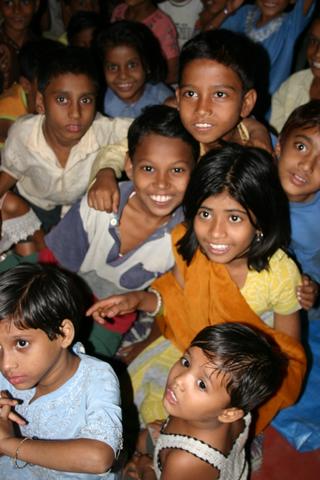
One of my favourite pictures from among those I've posted is this one.

Colourful!

The theme for the next set of images for my Calcutta photoblog is: colourful Calcutta.

Calcutta 147


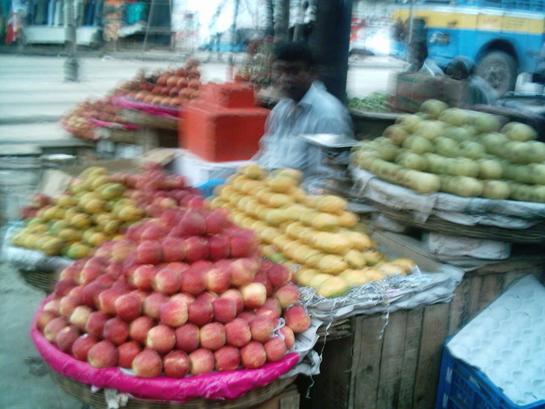
Pavement fruit-seller.

Calcutta 148


Flower-garlands seller.

Calcutta 149


Beauty-care products, from the pavement.

Calcutta 150


Hand-painted hoarding, with state govt message commending small industries.

Calcutta 151


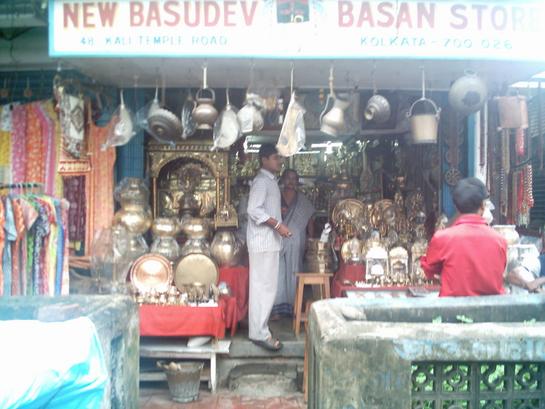
Shop selling ritual utensils.

Calcutta 152


Objects for adornment of images of gods and goddesses.

Calcutta 153


More ritual items, but now mass-produced using synthetic materials.